How to Write SaaS SEO Content with AI (That Actually Ranks)
 Kamaraj Mathiarasan (Kim)
Last updated on
Kamaraj Mathiarasan (Kim)
Last updated on

If you’re scared to write content with AI, it’s usually because someone told you Google is hunting for a “written by a robot” tag. There isn’t one. Google penalises content that doesn’t help the reader, and it does not care whether you or a model typed it.
The trap isn’t using AI. It’s using it the lazy way: feeding a model a topic title, lightly editing the summary it hands back, and publishing a page that says nothing the top of page one didn’t already say. Here’s the process I actually use to write SaaS SEO content with AI that ranks, and it starts well before you open a chat window.
TL;DR
- The penalty myth is wrong: Google rewards content that serves the reader. A well-built AI-assisted page beats a human-written page of fluff every time.
- Garbage in, garbage out: the model is only as good as your input. Feed it a generic brief and you get generic content.
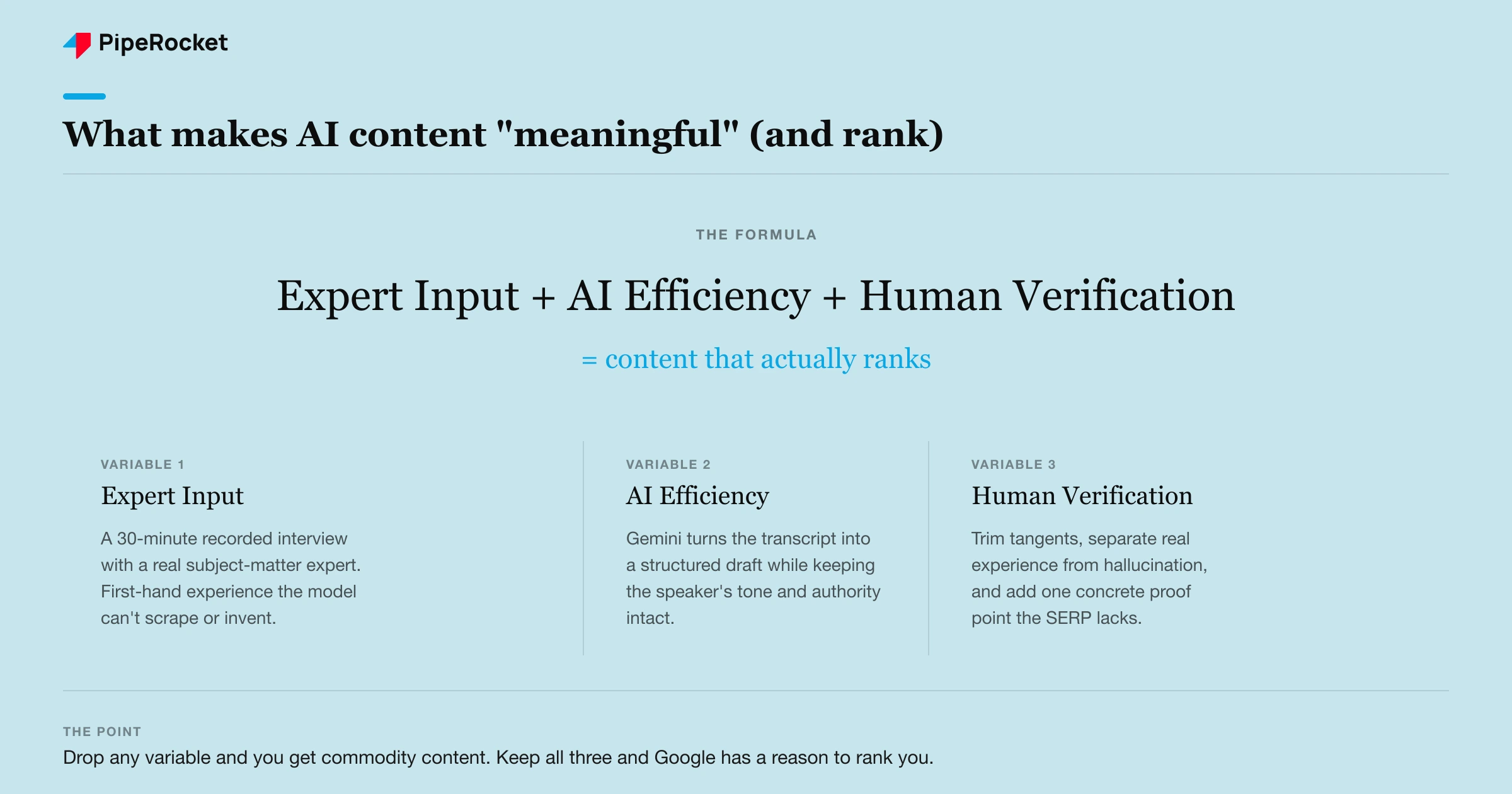
- Interview an expert first: a 30-minute recorded conversation gives the model first-hand experience it can’t scrape or invent.
- The tool matters for one job: for turning a transcript into a blog without flattening the voice, Gemini beats the others I’ve tested.
- Verify, then prove: trim hallucinations, keep the real-world example, and the page earns trust no summary can.
- It works: I’ve written about 10 blogs this way and all of them sit in the top two pages.
Why Most AI Content Fails (And It Isn’t the AI’s Fault)
Most AI content fails because of what people feed the model, not the model itself. If you type a keyword into ChatGPT or Gemini and hit enter, you get a blog in two minutes that reads like every other blog on the topic. It scraped page one, summarised it, and handed it back. Publish that and you’ve added nothing.
I call this the editorial trap. The output is technically correct and completely hollow. A real HR manager reads your “Conduct Fun Fridays” section, thinks “I already knew that,” and leaves.
Google’s 2026 guidance
actually backs this up. The company has been clear that AEO and GEO are still just SEO, and that special AI tactics like a dedicated llms.txt file or AI-specific rewriting aren’t required to show up in its generative answers. The thing that decides whether you rank or get cited is the same thing it has always been: did you genuinely help the person searching?
So the question stops being “will AI get me penalised” and becomes “how do I get something into the draft that the rest of page one doesn’t have.” The answer is expertise the model can’t fake.
Treat the Blog as a One-on-One, Not a Broadcast
Write for one person, not a crowd. Most marketers picture thousands of readers and write something vague enough to fit all of them. The result pleases no one.
When I use AI to help me write, I picture exactly one reader. Right now that’s you: someone in SaaS trying to use AI without getting burned, who doesn’t want another “Top 10 AI Tools” list, who wants a workflow they can run on Monday.
That shift changes the output. A broadcast reads like a lecture. A one-on-one reads like a colleague walking you through what they actually do. The second one is what people finish, share, and link to.
Step 1: Get Real Input With the Interview Method
The fix for generic AI content is to change the input source from Google results to a real expert. Most people build their brief by copying the H2s off the top three results and pasting them into a model. You end up with the same content as everyone else, because the model doesn’t know why any of those points are true.
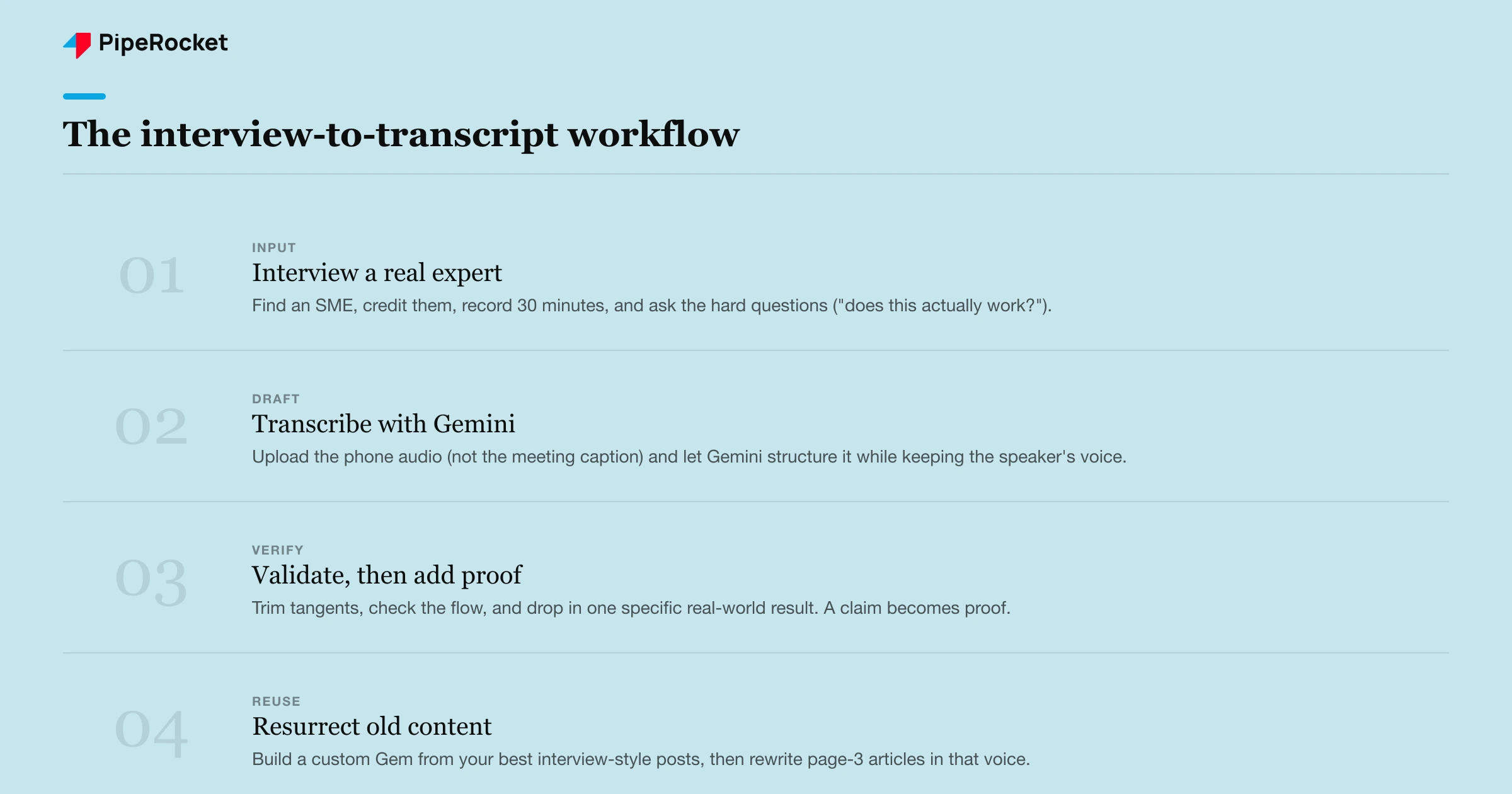
So I interview a subject-matter expert instead. Here’s the workflow:
- Find the expert. Your own product manager, a colleague, a founder, or someone on LinkedIn who lives the topic.
- Give them a reason. Most people happily share what they know if you credit them in the piece or link their profile.
- Record 30 minutes. That’s the whole commitment. One short conversation.
- Ask the hard questions. “Does this actually work?” “Give me an example of when it failed.” The uncomfortable questions are where the gold is.
- Stay out of the way. Your job is to keep the conversation moving and let them talk.
Now you’re not handing the model a generic brief. You’re handing it a transcript full of first-hand experience. AI can’t hallucinate experience, but it can organise yours perfectly.
Step 2: Record and Transcribe (And the Tool That Actually Keeps the Voice)
Record the audio yourself and transcribe it with Gemini, not the meeting tool. I don’t trust auto-captions from meeting software because they drop chunks of context and mangle technical terms. I run a dual setup: the meeting transcript as a backup, and the real recording on my phone’s voice recorder.
I upload that audio file straight to Gemini. It captures close to 100% of what was said, even with an accent, a non-native speaker, or audio that’s nowhere near studio quality.
The bigger reason I land on Gemini is voice. I’ve tested most of the options for turning a transcript into a draft, and they are not equal for this one job:
| Tool | Turning a transcript into a blog |
|---|---|
| Gemini | Keeps the interview energy. The expert’s “I” and “we” and their stories survive. Output sounds like a person. |
| ChatGPT | Over-corrects. It “fixes” the writing until the personality is sanded off and it reads robotic. |
| Claude | Strong writer, but still smooths the spoken voice more than I want for this. |
| Jasper | Built for marketing copy, not for preserving a raw expert transcript’s tone. |
Weighing the two directly? See our neutral Jasper vs Copy.ai breakdown.
When an expert speaks, they talk with authority and tell stories. Gemini holds onto that. Ask it to turn the transcript into a structured blog and it reads like an expert talking to you, not a third party writing a report about the topic.
Step 3: Validate the Output, Then Add Proof
You’re 90% done when Gemini hands back the draft, but you can’t hit publish yet, because meaningful content needs verification. Since you’re working from a transcript and not the open internet, the risk of the model inventing things is already low. Your job is to check the flow makes sense and cut the tangents that don’t serve the reader.
Then add the proof. During every interview I ask for one specific scenario where the expert applied the advice and what happened. That single detail does more for trust than anything else on the page.
“Fun Fridays boost morale” is a claim. “We ran Fun Fridays and saw a 20% lift in our eNPS score” is proof. The internet is drowning in claims and starving for proof, and your transcript is where the proof comes from.
Step 4: Use the Same Method to Resurrect Dead Content
This workflow fixes old posts, not just new ones. Everyone has pages written three years ago that sit on page three: technically fine, completely lifeless. You can revive them with the same approach.
- Build a custom Gem in Gemini. Set up a persona and upload two or three of your best interview-style articles as references.
- Feed it the tone. Prompt it with “optimise this existing article, keep the structure, but rewrite it in this tone.”
- Overhaul the voice in one pass. The post goes from generic wiki-article to something that sounds like it came from someone who knows the work.
Is This Actually Working? Here’s the Result
This isn’t theory. I’m running this exact playbook right now and I’ve written about 10 blogs using the interview-to-transcript-to-blog format. I sit with a founder or a colleague, we talk for 30 minutes, I transcribe and structure it with Gemini, then I edit and publish.
All 10 sit in the top two pages of the SERP . Not because of a trick, but because high-quality content built on real experience is what Google is trying to surface in the first place. Satisfy the human first and the rankings follow.
Common Mistakes That Sink AI Content
The fastest way to fail is to skip the human entirely. Raw AI output is commodity content, because the model works by summarising what already ranks. Without your expertise layered in, you’re republishing page one in a new font.
The second mistake is keeping every word the model gives you. A transcript has tangents and repetition. If you don’t cut, the reader feels the padding. Dense and useful beats long and complete.
The last one is treating AI as the expert instead of the ghostwriter. It’s brilliant at structure, grammar, and flow. It does not know your product or your buyer’s real problems. That part is still yours.
Editorial review at this standard is the expensive part of AI-assisted content, and the SaaS SEO agency comparison shows which teams staff for it.
Why PipeRocket Digital Builds Content This Way
We started PipeRocket because we were tired of watching SaaS companies burn budget on content that pulls traffic and never converts. We act as an extension of your team, interviewing your product and sales leaders to pull out the experience that AI tools miss, then we build the pages that actually drive pipeline. If you want a partner who cares about outcomes over output, take a look at how we run SaaS SEO and then talk to us .
Frequently Asked Questions
Will Google penalise my SaaS content if I write it with AI?
No. Google penalises content that fails the reader or reads as low-value spam, regardless of who or what wrote it. Its own 2026 guidance treats AI-search optimisation as ordinary SEO and says no special AI tactics are required. Use AI to scale genuinely helpful content and you’re safe, because the judgement is about quality, not the tool.
What are the best AI tools for writing SaaS content?
For turning an expert transcript into a publishable draft, I get the best results from Gemini, because it keeps the speaker’s tone and authority intact instead of flattening it. ChatGPT and Claude are strong writers but tend to over-smooth a spoken voice, and Jasper is built more for short marketing copy. The honest answer is that the tool matters far less than the input you feed it, though Claude’s growing set of SEO-specific skills and plugins are worth a look if you want more than a drafting assistant.
Why interview an expert instead of just researching on Google?
Google results give you editorial summaries, which are rehashes of content that already ranks. An expert gives you first-hand experience, real examples, and the reasons behind the advice, which is exactly what the page one results are missing. That input is what makes your content un-fakeable and worth citing, both for human readers and for AI answers.