llms.txt for SaaS: What It Is and Whether You Actually Need One
 Vignesh Sampath
Last updated on
Vignesh Sampath
Last updated on

A markdown file at the root of your domain is having a moment. llms.txt promises to hand AI crawlers a clean, curated map of your best content so ChatGPT, Perplexity, and Claude quote you correctly. The reality in 2026 is more careful than the hype, and if you run a SaaS site, the honest question is whether anything will actually read it, before you worry about how fast you can ship one.
TL;DR
- What llms.txt is: A proposed markdown file at your root that gives AI models a curated list of your most important pages in clean, link-first format.
- What it’s not: It sits apart from robots.txt, it offers no ranking hack, and no major AI crawler has confirmed it reads the file yet.
- Whether SaaS needs one: Low-effort insurance if your docs and product pages are JavaScript-heavy or hard to parse. Skip it if your content is already clean HTML and you have bigger gaps.
- How to build one: A short H1, a summary blockquote, then sectioned markdown links to docs, product, and key resources. Optionally a fuller
llms-full.txt. - How to measure it: You mostly can’t, cleanly. Watch server logs for AI-bot hits and track whether your brand shows up in answers. The file itself gives you nothing to measure.
What Is llms.txt and Why Does SaaS Keep Asking About It?
llms.txt is a proposed standard for a single markdown file at your domain root (yoursite.com/llms.txt) that lists your most important content for large language models to read. The idea is simple: AI systems have small context windows and struggle with cluttered HTML, so you hand them a clean, curated index instead of making them crawl your whole site and guess what matters.
It was proposed in 2024 by Jeremy Howard of Answer.AI. The format is deliberately boring: an H1 with your product name, a short summary, then markdown sections of annotated links. That’s it. No schema, no JSON, no config.
Here’s the part that trips people up. llms.txt is aimed at inference time and retrieval, meaning the moment an AI is answering a question and needs a source. It has nothing to do with training the model months earlier. The pitch is that a model pulling live context can grab your llms.txt, follow the links you chose, and represent your product accurately.
SaaS teams ask about it more than anyone else for one reason: docs. A SaaS company’s most valuable content, its API reference, setup guides, and integration pages, is exactly the stuff AI assistants get asked about and exactly the stuff that’s often buried in JavaScript-rendered doc portals. llms.txt is pitched as the fix.
The one thing to be clear-eyed about
No major AI crawler has publicly confirmed it reads llms.txt in 2026. Google’s own AI-optimization guidance is blunt about it: llms.txt, content chunking, and AI-specific schema are not needed for its generative features, and AI-focused site files may be crawled but get no special treatment. Google’s wider message that same guidance is that AEO and GEO are still just SEO . OpenAI, Anthropic, and Perplexity haven’t announced support either. So this is a bet on where things go, and no documented pipeline into any model exists today, with the biggest player saying plainly it changes nothing on its end. Treat it that way and you’ll make a sane decision.
How Is llms.txt Different From robots.txt and sitemap.xml?
llms.txt is a curation file, while robots.txt is a permission file and sitemap.xml is a completeness file. They solve three different problems and one does not replace another. The most common mistake we see is teams treating llms.txt like “robots.txt but for AI,” which misses the point entirely.
robots.txt tells any crawler what it’s allowed to touch. sitemap.xml hands a crawler the full list of every URL you want indexed, so nothing gets missed. llms.txt does the opposite of a sitemap. Instead of “here’s everything,” it says “here are the few things that actually matter, in the order they matter.”
| File | Job | Audience | Format |
|---|---|---|---|
| robots.txt | Grant or block crawl access | All bots | Directives |
| sitemap.xml | List every indexable URL | Search crawlers | XML |
| llms.txt | Curate the pages that matter most | AI models (proposed) | Markdown |
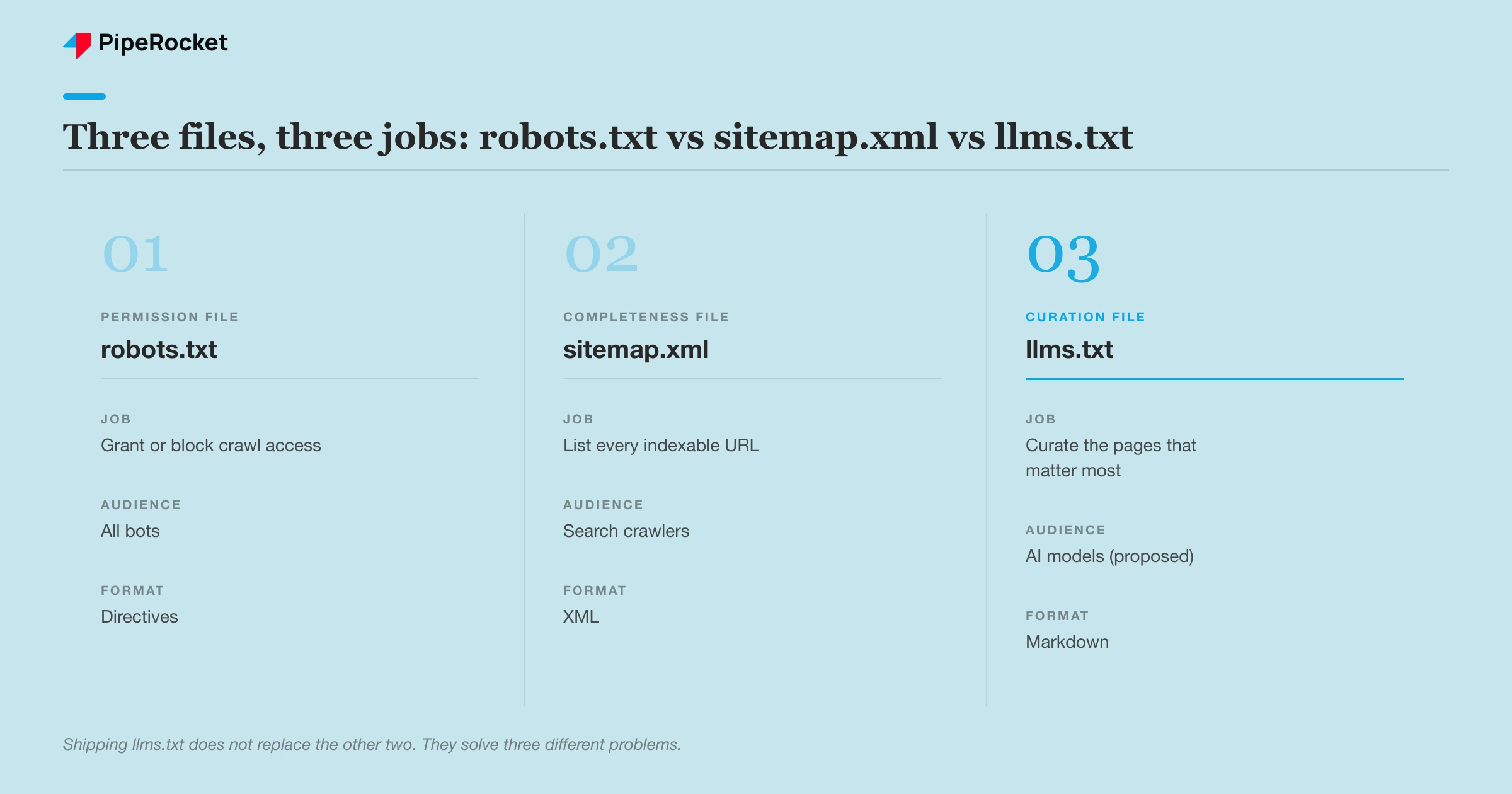
The practical takeaway: shipping llms.txt doesn’t let you skip the other two. If you want to actually control whether AI bots crawl you, that still lives in robots.txt with user-agents like GPTBot and PerplexityBot. llms.txt has zero authority over access. It’s a suggestion the crawler can freely ignore.
Does Your SaaS Actually Need an llms.txt File?
Most SaaS sites don’t need llms.txt urgently, but a specific type of site gets real value from it, and it’s cheap enough that the calculation usually favors shipping one. The decision comes down to how clean your content already is and how much of your value lives in documentation.
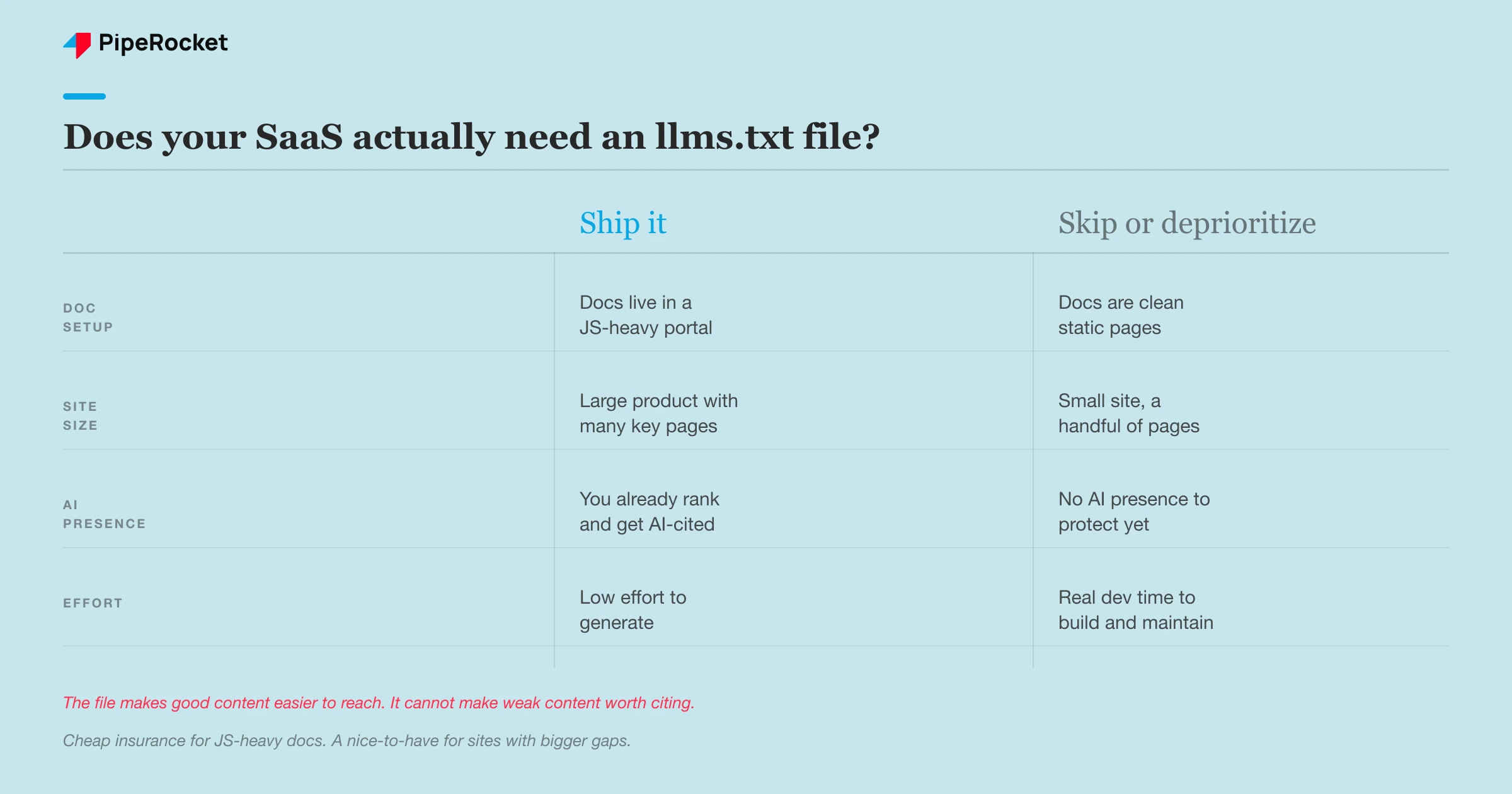
Build one sooner if your docs and product pages are heavy on JavaScript rendering, live behind a doc-portal framework, or bury key content in tabs and accordions that a crawler reads as noise. An llms.txt that points straight at the clean markdown or plain URLs of those pages is genuinely useful insurance.
Deprioritize it if your content is already server-rendered clean HTML, your docs are simple pages, and you have more pressing gaps, like weak product pages or thin comparison content. In that case llms.txt is a nice-to-have that won’t move anything on its own.
When it earns its place vs when it’s busywork
| Ship llms.txt | Skip or deprioritize |
|---|---|
| Docs live in a JS-heavy portal | Docs are clean static pages |
| Large product with many key pages | Small site, a handful of pages |
| You already rank and get AI-cited | You have no AI presence to protect yet |
| Low engineering effort to generate | It’d take real dev time to maintain |
One honest note from doing AI-search work across B2B SaaS: the file has little to do with getting you into AI answers. The same things that win regular search, clear structure, answer-first content, and real credibility signals, are what get your pages pulled into AI responses. llms.txt makes your good content easier to reach. It doesn’t make weak content worth citing.
How to Build an llms.txt File for a SaaS Site
Build llms.txt as a plain markdown file with an H1, a one-line summary blockquote, then sectioned lists of your most important links. The spec is loose on purpose, so the discipline lives in what you choose to include rather than in the syntax. Keep it to the pages an AI would genuinely need to answer a question about your product.
Here’s the structure the spec describes:
# Acme CRM

> Acme is a CRM for B2B sales teams that automates pipeline
> tracking and forecasting.

## Docs
- [Getting Started](https://acme.com/docs/start): Setup and first-run guide
- [API Reference](https://acme.com/docs/api): Full REST API endpoints

## Product
- [Pricing](https://acme.com/pricing): Plans and per-seat costs
- [Integrations](https://acme.com/integrations): Supported tools

## Optional
- [Changelog](https://acme.com/changelog): Recent releases
A few rules that make the difference between a useful file and a dead one:
- Lead with a real summary. The blockquote under the H1 is prime context. Say what the product does in plain language and keep marketing copy out of it.
- Annotate every link. The text after the colon tells the model why the page matters. Skip it and you’ve just made a worse sitemap.
- Prioritize ruthlessly. Docs, pricing, integrations, and core product pages first. An
## Optionalsection can hold the rest. - Point at clean pages. If your docs render badly, link to markdown versions or the cleanest URL you have.
The llms-full.txt option
llms-full.txt is a second, larger file that inlines the actual content of your key pages instead of only linking to them, so a model gets everything in one fetch. For a SaaS docs site this can be worth it because it removes the follow-the-link step entirely.
The catch is maintenance. A full file goes stale the moment you ship a feature, so only build it if you can automate generation from your docs source. A hand-maintained llms-full.txt that lags three releases behind does more harm than a missing one, because it feeds models wrong information about your own product.
How Do You Measure Whether llms.txt Is Doing Anything?
You largely can’t measure llms.txt cleanly in 2026, and anyone promising a dashboard for it is selling you something. The file has no reporting layer, no analytics hook, and the crawlers that might read it don’t confirm they do. So you measure around it and never directly on it.
The one direct signal available is your server logs. Filter for requests to /llms.txt and for AI user-agents (GPTBot, ChatGPT-User, PerplexityBot, ClaudeBot, Google-Extended). If those bots are hitting the file, at least you know it’s being fetched. That’s the floor, and it stops well short of proving impact.
For actual impact, track the outcome the file is supposed to drive:
- AI answer presence: Are you showing up in ChatGPT, Perplexity, and Google’s AI answers for the prompts that matter, alternatives, comparisons, and best-tool-for-use-case queries?
- Repeat citations: One mention is noise. Showing up across many prompt variations is a pattern worth trusting.
- Bottom-funnel behavior: More branded search, more direct visits, better inbound quality is more believable than any “AI sessions up 400%” chart.
We’ve been blunt about this internally: most LLM -tracking tools right now are close to guesswork, so treat any AI-visibility number as directional and never precise. That goes double for a file no crawler admits to reading. Ship llms.txt as cheap insurance, keep your logs open, and judge it by whether your brand shows up in answers. The file has no metrics of its own to trust.
Why PipeRocket Digital Helps SaaS Teams Get This Right
We treat llms.txt as one small piece of a larger AI-search play, with no magic attached to the file itself. Before we ship one, we make sure your docs and product pages are actually worth citing, because a clean index over weak content changes nothing. Our AI SEO services cover the whole picture: content AI wants to quote, the structure that gets it pulled into answers, and honest measurement of whether it’s working. If you want this built properly instead of guessed at, reach out to us here .
Frequently Asked Questions
Do AI crawlers like ChatGPT and Perplexity read llms.txt?
There’s no public confirmation that they do as of 2026. Google has explicitly said it isn’t using llms.txt, and OpenAI, Anthropic, and Perplexity haven’t announced support either. Some AI-first tools and smaller crawlers have adopted it, so the file isn’t ignored everywhere, but you should treat it as a forward bet rather than a documented pipeline into any major model today. Check your server logs for AI user-agents to see who’s actually fetching yours.
Is llms.txt the same as robots.txt?
No. robots.txt controls what a crawler is allowed to access, using directives and user-agents to grant or block crawling . llms.txt does nothing about access. It’s a curated markdown list of your most important content, meant to help an AI understand and use your pages. It says nothing about permitting or forbidding crawling. If you want to actually control AI-bot access, that still lives in robots.txt. The two files solve completely different problems and you may want both.
Will an llms.txt file help my SaaS rank higher in AI search?
Not on its own. llms.txt makes your best content easier for an AI to find and parse, but it doesn’t make weak content worth citing. The things that get your pages pulled into AI answers are the same ones that win regular search: clear structure, answer-first writing, first-party data, and credibility signals across third-party sites. Think of llms.txt as removing friction for content that already deserves to be surfaced. It won’t hand you visibility you haven’t earned.