GEO vs SEO: What's Actually Different in 2026
 Kamaraj Mathiarasan (Kim)
Last updated on
Kamaraj Mathiarasan (Kim)
Last updated on
SEO (Search Engine Optimization) helps a page earn a ranking in Google or Bing so a buyer clicks through to your site, while GEO (Generative Engine Optimization) helps get your brand named or recommended inside conversational AI tools like ChatGPT, Perplexity, and Google’s AI Overviews. One drives visits. The other drives citations.
TL;DR
- SEO optimizes a page to rank in traditional search results and earn a click.
- GEO optimizes your brand to get cited or recommended inside AI-generated answers.
- SEO measures success by rank position and traffic; GEO measures it by whether an AI engine names you at all, click or no click.
- Across 53 B2B SaaS brands we tracked over eight months, organic search sent 91.3% of traffic versus 8.7% from AI engines combined, so SEO still carries the program (see our full AI SEO statistics ).
The Core Differences
GEO and SEO chase different outcomes, so they need different inputs, different success criteria, and different content shapes. Laying them side by side makes the split concrete instead of abstract.
| Feature | SEO | GEO |
|---|---|---|
| Primary Target | Google and Bing’s ranking algorithms | Generative engines like ChatGPT, Perplexity, and Gemini |
| Goal | Rank a page on page one for a target keyword | Get named or recommended inside a synthesized answer |
| Content Strategy | Keyword-mapped pages, internal links, backlinks, technical crawlability | Answer-first structure, off-site authority, entity consistency, first-party data |
| User Outcome | The buyer clicks through to your site to find the answer | The buyer gets the answer (and your name) without ever visiting |
| Success Metrics | Keyword rankings, organic traffic, click-through rate | Citation frequency, share of answer, branded search lift |
The table makes the mechanism clear. SEO’s whole model depends on a click happening, so every metric traces back to a URL in a results page. GEO’s model doesn’t need a click at all. The engine can name your product, describe what it does, and recommend it, and the entire interaction happens inside the chat window.
That’s a real shift in what “winning” looks like. A page can lose the click and still win the mention, which is a result SEO reporting was never built to capture. A buyer can ask an AI engine which tool solves their problem, hear your name in the answer, and never open a browser tab pointed at your site.
The inputs differ just as much as the outcomes. SEO rewards a page that ranks well on its own merits: solid keyword targeting, internal links, and a healthy backlink profile pointed at that specific URL.
GEO rewards a brand the wider web already trusts, since generative engines pull their reasoning from third-party sources like Reddit threads, G2 reviews, and Wikipedia entries rather than from your homepage alone. A page can rank on Google with zero outside validation. A brand rarely gets cited by an AI engine without it.
Do You Need Both?
Yes. The data makes this a settled question rather than an opinion: organic search sent 91.3% of all traffic across the 53 B2B SaaS brands we analyzed over eight months, and AI engines combined sent 8.7%. SEO is still doing most of the work.
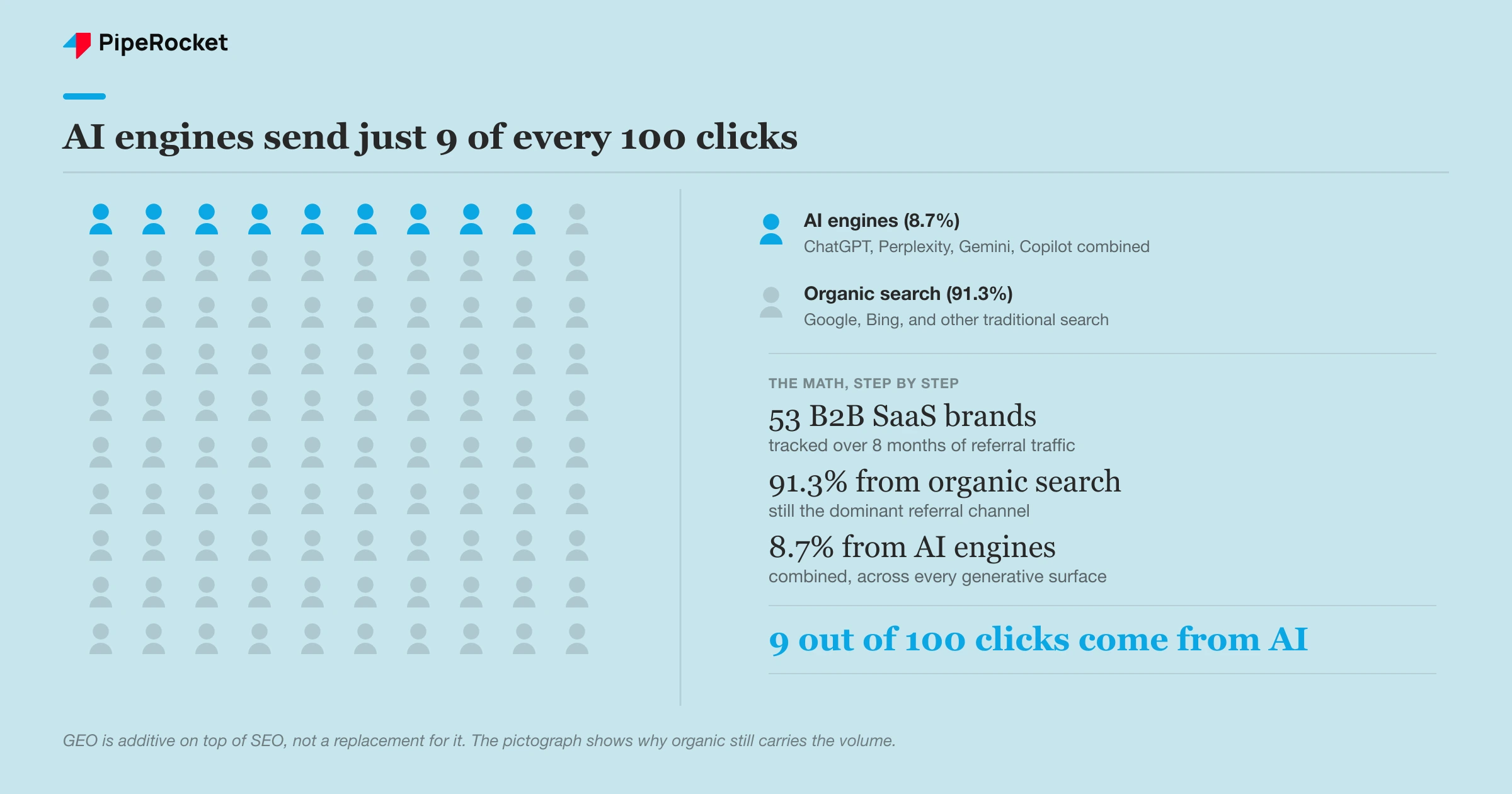
That doesn’t make GEO optional. It makes GEO additive on top of an SEO foundation, not a replacement for one. AI engines that browse the live web retrieve and rank pages using much of the same logic organic search does, so a page that can’t earn an organic ranking rarely earns an AI citation either.
Treat the relationship as sequential rather than competing:
- SEO builds the crawlable, well-structured, authoritative foundation.
- GEO layers citation-specific work (off-site authority, entity clarity, answer-first formatting) on top of that foundation.
- Cutting SEO to fund GEO usually shrinks both, because GEO’s inputs come from the SEO program.
A team that runs GEO tactics on a site with weak technical health and no off-site authority is optimizing the smaller channel while starving the one that still sends the majority of the traffic. The 91.3%/8.7% split is an argument for sizing the AI search investment honestly, not for skipping it.
There’s a second reason the two stay linked even as AI search grows. Most AI-driven discovery doesn’t convert directly. A buyer meets your category inside an AI answer, doesn’t click, and later searches your brand name on Google to verify you before booking a demo.
Standard attribution credits that second search to organic, not to the AI engine that actually started the journey. Cut GEO because attribution can’t see it, and you lose a real discovery channel that’s quietly feeding your branded search.
Cut SEO to fund GEO, and you lose the foundation that made the citation possible in the first place. Fund both, sized to what the data actually shows: SEO carries the program, GEO extends its reach into a surface that’s still small but growing.
How to Optimize for SEO
A real SaaS SEO program runs on four parts working together. Maxing one and ignoring the rest doesn’t produce the same result as scoring all four at once.
Content
Build bottom-of-funnel pages first. Comparisons, alternatives, and integration pages convert at a far higher rate than top-of-funnel blog posts, and organizing that content into pillar-and-spoke clusters signals topical depth to Google.
Technical Health
Fixing crawlability, indexation , broken redirects, canonical errors, and JavaScript rendering clears most of the backlog for a SaaS site with a thousand or two pages, not the millions an e-commerce catalog handles. Chasing a perfect Core Web Vitals score past that point rarely moves rankings much further.
Authority
This comes from a portfolio of sources rather than one tactic. Digital PR, original research, integration directories, and community presence on Reddit and Quora all contribute referring-domain quality, which matters more than raw link count.
Measurement
This is what keeps the other three honest. A program judged on organic-attributed pipeline and SQLs gets funded again next year. A program judged on raw sessions or keyword rankings looks busy right up until someone asks what it actually produced in revenue.
Two more levers compound on top of those four once the foundation is live.
Internal Linking
Tight internal linking between cluster pages passes authority to the pages that carry pipeline, and it helps Google understand topical depth faster than backlinks alone can. A pillar page that never links down to its supporting content wastes most of the authority it earns.
Schema and Structured Data
FAQ, Article, and Product schema make a page’s structure explicit to crawlers instead of implicit in the prose. That speeds up indexation, and it’s increasingly what determines whether Google can lift a section cleanly into a snippet or an AI Overview.
For the full breakdown of each of these parts, with the tactics and sequencing that make them compound, see our complete SaaS SEO guide.
How to Optimize for GEO
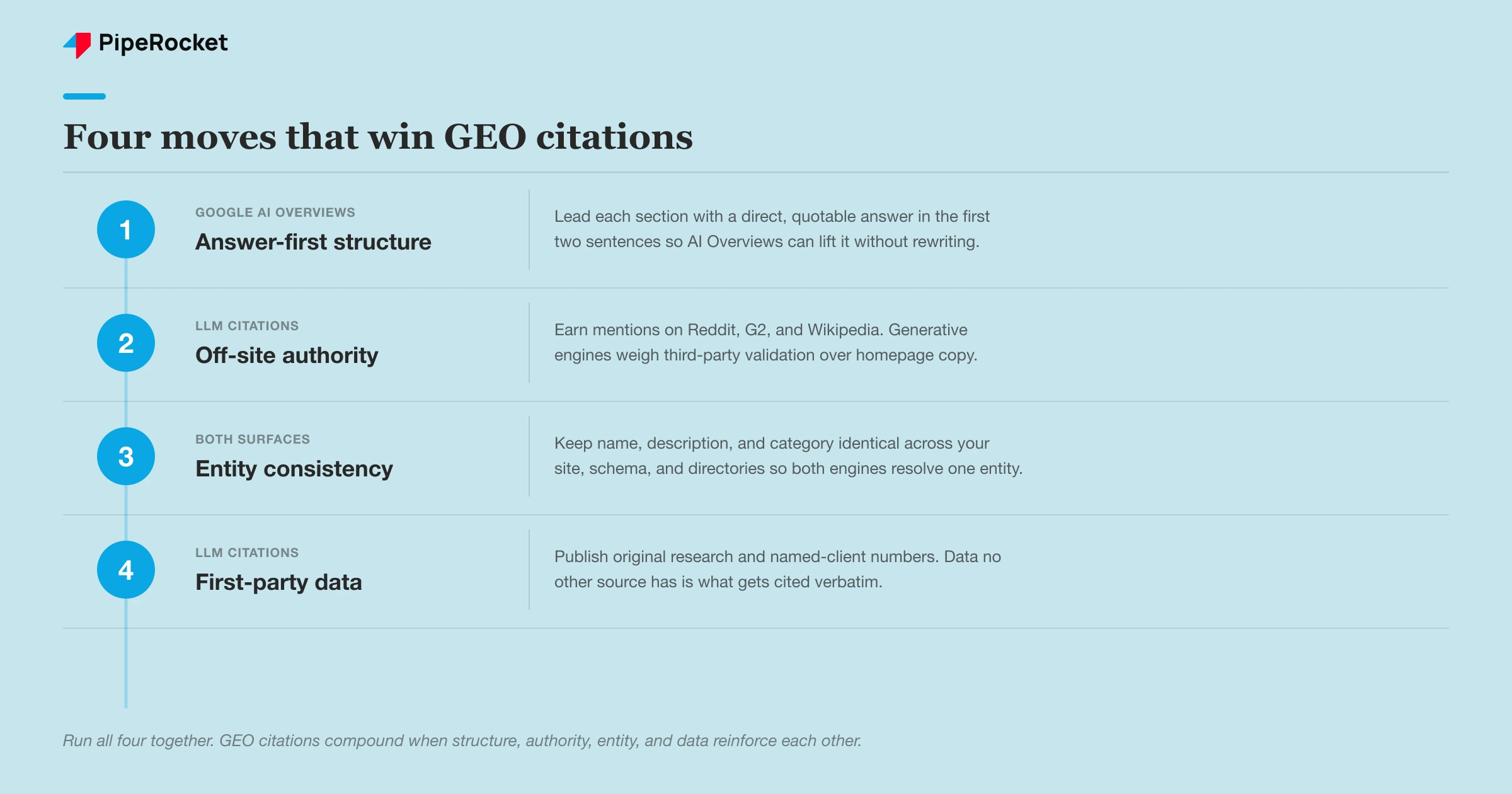
Winning GEO comes down to four moves, and every one of them also strengthens your organic SEO at the same time. This is the same foundation as SEO, pointed at a second surface, not a separate checklist running alongside it.
Answer-First Structure
Answer the question in the first two sentences of a section, use question-shaped headings, and add FAQ or Article schema so both search engines and LLMs can parse the structure, not just the words.
Off-Site Authority
This is where most citations actually get decided. Generative engines pull their reasons from places they trust, like Reddit, G2, Clutch, and Wikipedia, far more than they pull from your own homepage. A brand with zero presence on those platforms is effectively invisible to the surface it’s trying to win.
Entity Consistency
Keep your brand name, category, and core facts identical across every platform where you appear. AI engines build a picture of who you are from across the web, and inconsistent facts make you a riskier thing to cite.
First-Party Data
AI engines reward content with something new to say, so a benchmark drawn from your own customer base earns citations that a generic explainer never will.
These four moves don’t split cleanly by surface, but two levers do skew one way. Heavy schema markup and featured-snippet formatting raise your odds inside Google’s AI Overviews , since clean structure makes a page easier to lift into the answer box even though Google doesn’t require it. Off-site brand mentions on Reddit, Quora, and review sites matter more for LLM citations, since generative engines lean on third-party sources far more heavily than Google does for a snippet.
Knowing that split matters when you’re short on time and have to choose where to start. A category where buyers already research inside ChatGPT rewards the off-site push first. A category where they still Google a how-to question rewards the schema and snippet work first.
Monitor AI Referral Traffic
Track referral traffic from chatgpt.com, perplexity.ai, and other AI engines in GA4 to see which pages are already earning citation-driven visits. The pages already working are the fastest signal for where to double down next.
Update Content on a Faster Cycle
LLMs favor freshness signals for fast-moving topics, so a GEO-focused refresh cadence, quarterly rather than annually, keeps cited facts from going stale and losing citation share to a more recently updated competitor.
For the complete playbook behind these four moves, including how they split between LLM citations and Google’s AI Overviews, see our GEO for SaaS guide.
Common Mistakes to Avoid
Treating GEO as a Replacement for SEO
GEO still runs on the SEO foundation underneath it. Cutting SEO investment to fund a GEO program usually shrinks both, since GEO’s inputs, structure, authority, and crawlability, come from the SEO work.
Chasing AI Citations With No Off-Site Authority
Generative engines pull their reasoning from Reddit, G2, and Wikipedia far more than from a brand’s own homepage. A team that ships answer-first content but skips off-site presence is optimizing half the equation.
Judging GEO Success With SEO Metrics
Rank position and organic traffic don’t capture a citation that never produced a click. A GEO program measured only on session counts looks like it’s failing even when it’s working.
Letting the Technical Backlog Slide
A site with unresolved crawlability or indexation issues rarely earns an AI citation either, since AI engines that browse the live web retrieve pages using much of the same logic organic search does. Fixing that backlog is prerequisite work, not an optional cleanup.
Frequently Asked Questions
Is GEO replacing SEO?
No. Organic search sent 91.3% of all traffic across the 53 B2B SaaS brands we tracked over eight months, with AI engines combined sending only 8.7%, and organic still produced far more leads in absolute terms. GEO is a growing discovery layer that sits on top of an SEO foundation, not a channel that’s overtaking it. The signals that earn AI citations, like clear structure and real authority, are largely the same signals that earn organic rankings in the first place.
What are the 4 types of SEO?
The four core types are:
- Technical SEO covers crawlability, indexation, and site speed.
- On-page SEO covers content and keyword targeting on the page itself.
- Off-page SEO covers backlinks and brand mentions earned elsewhere on the web.
- Local SEO covers visibility in geographically targeted searches.
For how these four fit into a full B2B SaaS program, see our SaaS SEO pillar guide.
Is SEO being phased out?
Not based on the numbers. Across our dataset of 53 B2B SaaS brands, organic search still accounted for 91.3% of total traffic against 8.7% from AI engines combined, a gap wide enough to rule out any near-term phase-out. AI search is reshaping how buyers discover a category, but the underlying mechanics that earn a ranking, crawlability, structure, and authority, are the same mechanics AI engines lean on to decide who gets cited.
What is GEO in digital marketing?
GEO, or generative engine optimization , is the practice of getting a brand cited, named, or recommended inside AI-generated answers from tools like ChatGPT, Perplexity, and Gemini. For the full playbook on how to do it for a B2B SaaS company, see our GEO for SaaS guide.
How PipeRocket Digital Builds Both Into One Program
We run GEO inside the SEO program, not as a separate line item, because most of the work is shared. That means fixing the technical and content foundation first, then layering off-site authority and entity work that earns citations on both surfaces.
If you want to know where your SaaS brand stands on organic rankings and AI citations, talk to our team , or explore our AI SEO services to see how we structure the work.