AI SEO Strategy and Framework 2026: The Operating Model for SaaS Teams
 Kamaraj Mathiarasan (Kim)
Last updated on
Kamaraj Mathiarasan (Kim)
Last updated on
This guide gives SaaS marketing teams the operating model for AI SEO: a five-step strategy for structuring, sequencing, prioritizing, resourcing, and measuring the program so it produces pipeline instead of a share-of-model score nobody can bank. It’s for the SEO lead, content lead, or head of marketing who owns organic and now has to make AI search a deliberate part of it, and it doubles as a practical SaaS GEO strategy for anyone whose main goal is getting cited inside generative engines specifically.
TL;DR
The AI SEO strategy is an operating model with five steps, run in this order:
- Set the objective. Optimize for pipeline, not AI sessions. Split effort to match the channels: organic drove 91.3% of traffic and AI 8.7% across the 53 SaaS brands we analyzed.
- Sequence the roadmap. Fix the organic foundation first, then layer citation-specific work. Don’t run them in parallel.
- Prioritize with a score. Rank each play on pipeline proximity, effort, and durability so the roadmap reflects revenue, not urgency.
- Resource and own it. Assign one owner and carve out a slice of the existing SEO budget. No new headcount needed at first.
- Measure prompts and pipeline. Track prompt presence, branded lift, and pipeline quality, not AI-visibility scores.
Why AI SEO Needs an Operating Model, Not Just Tactics
The reason most AI SEO programs stall is that they get run as a pile of tactics with no model underneath deciding what gets done first, who owns it, and how you’ll know it worked. Teams read a listicle of eleven tactics, try to do all eleven, and do none of them well.
An operating model answers five questions before you touch a tactic:
- What are you actually optimizing for?
- In what order does the work happen?
- How do you decide what gets built first?
- Who owns it and what does it cost?
- How do you measure whether it’s working?
The common belief we want to challenge sits in the first question. Most teams assume AI SEO is a fundamentally new game with new rules, so they go hunting for AI-specific hacks. In our experience the rules barely changed. What changed is what gets rewarded and how you weight your effort against it.
AI Didn’t Replace the Fundamentals, It Reweighted Them
The fundamentals that rank you on Google are the fundamentals that get you cited by AI engines. Clear structure, answer-first content, genuine third-party authority, and consistent brand signals are the inputs both systems read. Our team’s read is that AI isn’t changing SEO slowly. It’s changing what gets rewarded, and rankings are no longer the finish line.
That matters because it kills the case for a separate AI SEO team running a parallel roadmap. When the same page-level and off-site work feeds both surfaces, splitting it into two programs just doubles the coordination cost and halves the focus.
The reweighting is real, though. Credibility signals, entity consistency, and first-hand experience carry more weight now than raw keyword coverage did three years ago. So the operating model isn’t “do new things.” It’s “do the same things, weighted toward what AI systems reward, in the right order.”
The 91.3% Number That Sets Your Budget Split
Organic search still does the majority of the work, and that single fact should anchor how much of your effort goes where. Across the 53 B2B SaaS brands we analyzed over eight months, 91.3% of all traffic came from organic search and only 8.7% from AI engines combined.
That’s not an argument to ignore AI. AI is a real, growing discovery layer with a different intent profile, and only 11.8% of AI-referred sessions carried brand-name intent versus 28.1% for organic, so AI is where buyers meet your category before they know your name. It’s an argument to size the investment honestly.
If you’re pouring half your SEO effort into an 8.7% channel because it’s the shiny one, the model is broken. The operating model treats AI SEO as a deliberate slice of a program whose foundation is still organic.
The Five-Part AI SEO Operating Model
An AI SEO program has five moving parts, and they only work when they’re sequenced and owned rather than run as loose tactics. Each part answers one of the five questions above, and each one feeds the next.
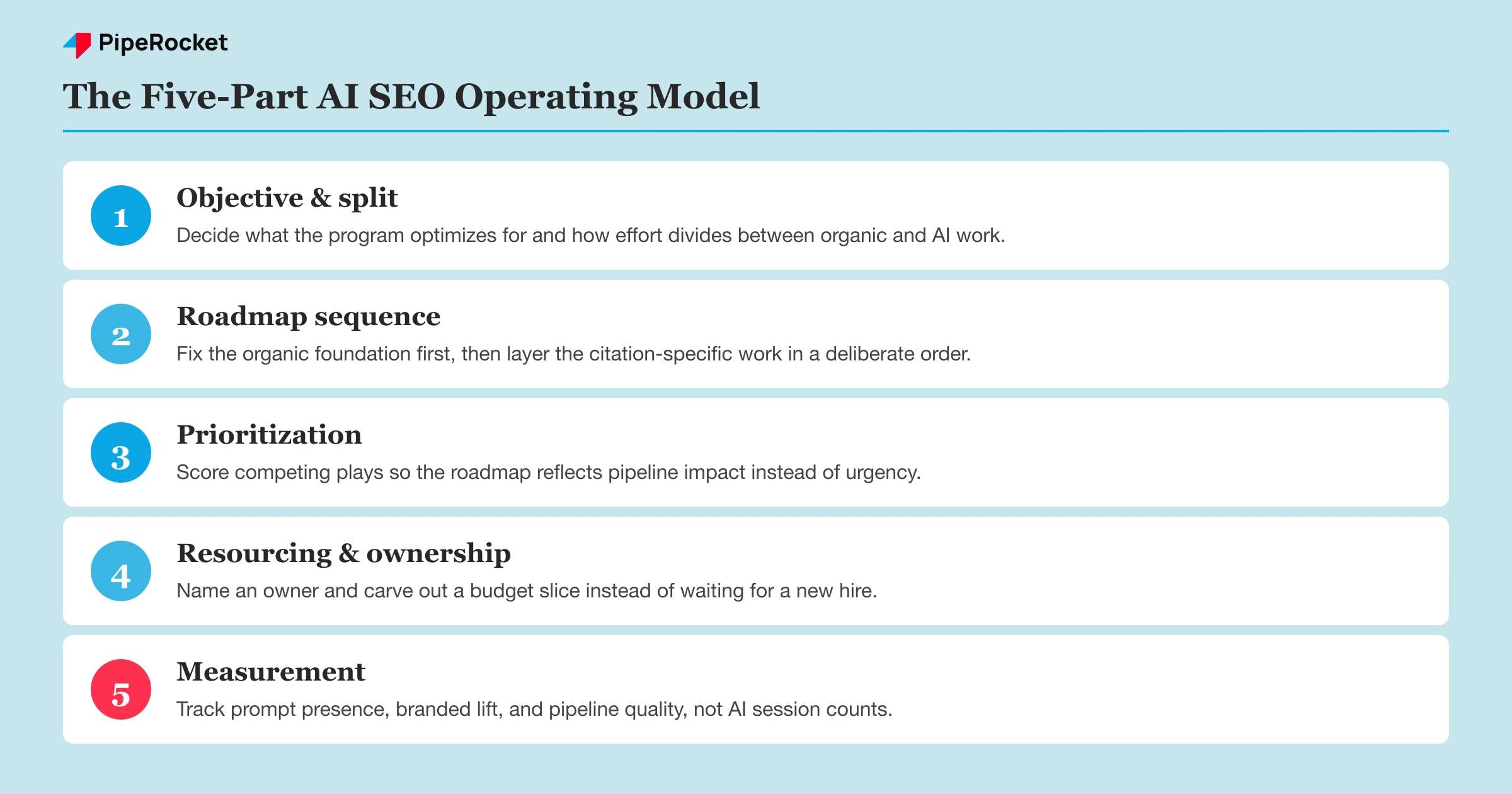
The five parts are:
- Objective and split. Decide what the program optimizes for and how effort divides between the organic foundation and AI-specific work.
- Roadmap sequence. Fix the foundation first, then layer citation-specific work in a deliberate order.
- Prioritization. Score competing plays so the roadmap reflects pipeline impact rather than urgency.
- Resourcing and ownership. Name an owner and carve out a budget slice instead of waiting for a new hire.
- Measurement. Track prompt presence, branded lift, and pipeline quality rather than AI session counts.
The rest of this guide walks each part in order, because the order is the point. Skip the objective and you’ll prioritize the wrong plays. Skip the sequence and you’ll build citation tactics on a foundation that can’t support them.
Part 1: Decide What You’re Actually Optimizing For
Before any keyword, any schema, any Reddit thread, decide what the program is supposed to produce and how effort splits between organic and AI. This is the step teams skip, and skipping it is why AI SEO roadmaps drift toward whatever tactic trended last week.
The objective for a B2B SaaS AI SEO program is rarely “more AI traffic.” It’s usually one of two things: getting cited when buyers ask AI engines which tools solve a problem you solve, or catching the branded organic search that AI-driven discovery kicks off downstream. Both are pipeline objectives. Neither is a session count.
Name the Objective in Pipeline Terms
State the objective as a pipeline outcome your CRM can see, not as a visibility metric. “Appear in AI answers for the ten prompts our buyers actually use, and grow branded organic search alongside it” is an objective you can act on. “Improve our AI visibility score” is not.
A compliance SaaS for fintech teams might set the objective as showing up when a buyer asks an AI engine “which SOC 2 automation tool works for a Series B fintech.” That objective tells you which pages to build, which review profiles to strengthen, and which prompts to watch.
The objective also decides your channel split. If the goal is category-level discovery for a brand-new product, more effort tilts toward the non-branded, well-structured content AI engines pull into answers. If the goal is defending an established category position, the split tilts back toward the branded organic pages buyers verify through.
Match the Objective to How AI Discovery Actually Feeds Pipeline
AI discovery mostly feeds pipeline indirectly, through branded search, so your objective has to account for the handoff. A buyer meets your category in an AI answer, doesn’t click, and later Googles your brand name to verify you. Standard attribution never credits AI for that, but it’s a real path.
We’ve seen homepage conversions climb month over month for stretches that line up with exactly this pattern, where AI-driven discovery feeds branded organic searches attribution can’t trace. If your objective ignores that handoff, you’ll undervalue AI, cut the program, and lose the branded lift it was quietly creating.
So the objective isn’t “win AI or win organic.” It’s to build the two as one system where AI does category discovery and organic closes the verified buyer. Get that framing right and the next four parts of the model fall into place.
Part 2: Sequence the Roadmap, Foundation Before Levers
Fix the organic foundation before you touch a single AI-specific lever, because most AI citation eligibility is built through the fundamentals you already own. Teams that chase citation hacks on a weak foundation consistently underperform teams that get the fundamentals right first.
The sequence isn’t arbitrary. AI engines that browse in real time rank and retrieve pages much like search does, so a page that can’t rank organically has little chance of being retrieved and cited. The foundation is the mechanism itself, which is why you can’t skip it.
Here’s the order we run it in:
| Phase | Work | Why it comes here |
|---|---|---|
| 1. Foundation | Technical health, crawlability, site structure, topical clusters | AI retrieval and organic ranking both depend on it |
| 2. Extraction | Answer-first formatting, clear H2/H3 hierarchy, FAQ sections | Makes existing content citeable without new pages |
| 3. Authority | Third-party review presence, entity consistency, named-author schema | Feeds the training-data and trust signals AI leans on |
| 4. Freshness | dateModified accuracy on time-sensitive pages |
Keeps browsing engines pulling your current pages |
Foundation and Extraction Come First Because They’re Nearly Free
Phases one and two are mostly rework of assets you already have, which is why they lead. Restructuring an existing page to answer the question in its first sentence costs a fraction of building third-party authority, and it makes that page eligible for citation immediately.
The extraction work is the highest-leverage early move. A section that opens with a direct, quotable answer wins the citation over a section that builds to its answer across four paragraphs. Most SaaS content already covers the right topics. It just buries the answer, and un-burying it is an editing job rather than a content project.
Run these two phases across your existing library before you commission anything new. In practice this is a content audit with an AI-extraction lens laid over your normal intent and format checks.
Authority and Freshness Are Slower, So They Run Continuously
Phases three and four don’t have an end date, so they run as ongoing programs rather than one-time projects. Building genuine G2, Clutch, and Reddit presence takes months of real activity, and it can’t be crash-built the week before a launch.
The same-signals-win-both-surfaces point holds here. Our team’s read is that the credibility signals earning AI citations are the credibility signals earning organic authority, so this phase isn’t AI-specific overhead. It’s the authority work you’d do anyway, pointed at the platforms AI engines trust.
Freshness is the cheapest ongoing discipline: keep dateModified honest on pages where facts change, and refresh the facts when they change rather than touching the URL to fake recency.
Part 3: Prioritize Plays With a Scoring Model
Score every candidate play against pipeline proximity, effort, and durability so the roadmap reflects revenue impact instead of urgency. Without a scoring model, AI SEO roadmaps get built from whatever the loudest stakeholder read this week, and the highest-impact work sits in a backlog.
We adapt the same six-dimension execution model we use for the broader program, scoring each area from weak to great: AI and future readiness, brand signals, topical authority , user-intent mapping, technical health, and off-site authority. Modern search brands win by hitting “great” across all six, not by maxing one and ignoring the rest.
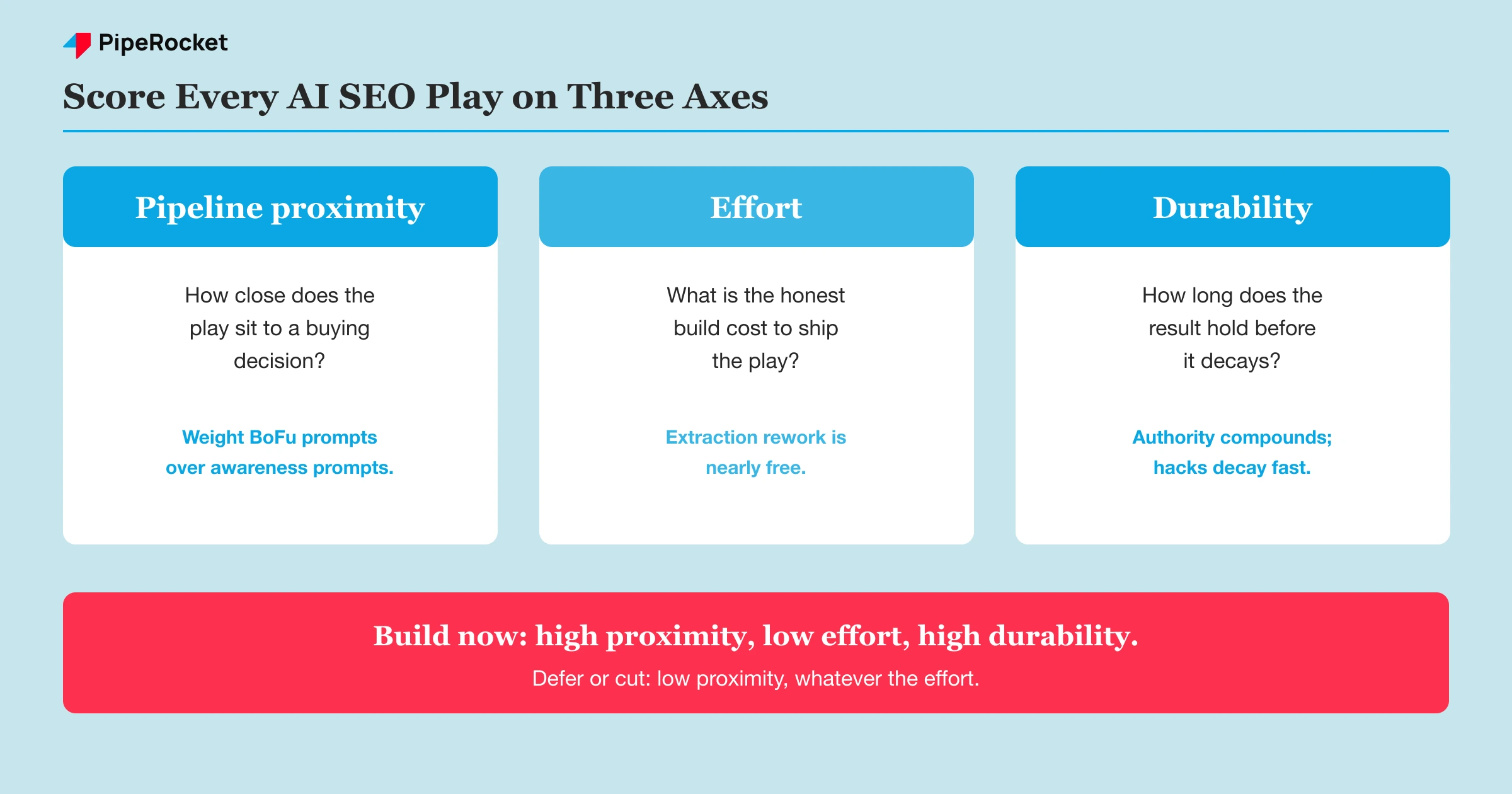
Score Each Play on Three Axes
Rate every candidate play on pipeline proximity, effort, and durability, then sequence by the combination. Pipeline proximity asks how close the play sits to a buying decision. Effort is the honest build cost. Durability is how long the result holds before it decays.
- High proximity, low effort, high durability: build now. Restructuring BoFu comparison pages for extraction is the classic example.
- High proximity, high effort: schedule and resource properly. Building real Wikipedia entity presence sits here.
- Low proximity, any effort: defer or cut. Chasing citations for top-of-funnel prompts your buyers never ask belongs at the bottom.
The point is to force a decision, not to build a spreadsheet for its own sake. Score five candidate plays this way and the sequence usually names itself, because one or two will clearly out-rank the rest on proximity and durability.
Weight BoFu Prompts Over Awareness Prompts
Prioritize the prompts a buyer uses when they already have the problem, because those are the ones near a purchase. Awareness prompts pull in researchers and students; BoFu prompts pull in decision-makers, and AI sessions already skew slightly harder toward BoFu than organic does.
The prompts worth scoring highest are the alternatives, comparisons, and best-tool-for-a-specific-use-case queries. A buyer asking an AI engine for the best incident-management tool for a mid-market DevOps team is close to a decision. A buyer asking what incident management is generally isn’t.
This is the same intent-over-volume discipline that governs the organic program, applied to prompts. Chasing high-frequency awareness prompts feels productive and moves no pipeline, so weight the scoring model toward proximity every time.
Part 4: Resource It and Give It an Owner
AI SEO rarely needs a new hire on day one. It needs a named owner and a defined slice of the existing SEO budget, because most of the work is a reweighting of tasks your team already does. Teams that wait to hire an “AI SEO specialist” before starting usually just delay work their current SEO owner could run.
The failure mode here is orphaned ownership. When AI SEO belongs to everyone, it belongs to no one, and the citation-specific work never gets done because it’s always someone else’s job. Assign it to the person who already owns organic content and technical SEO , since the work overlaps so heavily.
Fund It as a Carve-Out, Not a New Line Item
Treat AI SEO as a percentage of the SEO budget you already run rather than a fresh budget fight. We treat 10 to 15% of the marketing budget as a working benchmark for SEO overall, weighted by stage, and AI SEO is a slice inside that rather than an addition on top.
Early-stage teams establishing presence sit toward the higher end because they’re building the foundation from scratch. Scaling teams often push the share higher still as SEO becomes their primary pipeline channel, so treat 10 to 15% as the floor of the range, not the ceiling. In both cases, the AI-specific carve-out is small at first: extraction rework, review-profile building, and schema hygiene are cheap relative to net-new content.
Treat that number as a stage-dependent range rather than a fixed rule. The point is that AI SEO gets funded from a defined slice with a clear owner, so the work actually happens instead of living in a wish list.
Decide What Stays In-House and What Doesn’t
Split the work by whether it needs deep product context or specialist repetition. First-hand, POV-heavy content needs your internal knowledge of the ICP and can’t be fully outsourced. Schema implementation, technical audits, and review-profile operations are specialist, repeatable work an AI SEO agency can own.
A lean team keeps the objective-setting and the first-hand content in-house and hands the repeatable execution to a partner. That keeps the un-fakeable part, your real experience and your ICP’s actual language, where only you can produce it.
The one thing not to outsource is conviction. First-hand experience is becoming a ranking and citation signal because AI systems are hunting for it, so founder- and practitioner-led explanations beat anonymous, outsourced copy. Keep that in the building.
Part 5: Measure Prompts and Pipeline, Not AI Sessions
Measure the program on prompt presence, branded lift, and pipeline quality rather than an AI-visibility session count, because the session count is mostly guesswork. Most AI SEO programs get killed by bad measurement, either an inflated dashboard number that collapses or a vanity metric nobody can tie to revenue.
The tools are the problem. As Kim puts it:
“Most LLM SEO tracking tools right now? Pure guesswork.” (Kim)
They run synthetic prompts through the model instead of tracking real user searches, and LLM outputs are personalized by location, history, and context, so there’s no universal rank to report. Treat any AI-visibility dashboard as a directional estimate, never as a measurement.
Track These Five Signals Instead
When you don’t trust the AI session number, measure the five things that actually indicate the program is working:
- Right-prompt presence. Are you appearing for the alternatives, comparison, and best-tool prompts your buyers actually use?
- Repeat presence. One citation is noise. Showing up across 20 to 30 prompt variations is a pattern.
- BoFu page behavior. More direct visits, more branded search, and better alternatives-page performance are more believable than “AI sessions up 400%.”
- What sales hears. “I saw you in ChatGPT” or “I found you comparing tools” is a real signal from a real buyer.
- Pipeline quality. Better inbound quality, faster trust, and buyers who already know your brand are the outcome that matters.
Treat AI visibility as an early signal rather than a mature reporting channel. We’ve watched AI traffic numbers spike across 20-plus pages overnight and vanish just as fast during tool testing, and real demand doesn’t behave like that. The believable signals build slowly.
Separate AI Platforms in GA4
Break AI referral traffic out by platform in GA4 because the platforms don’t convert alike, and a blended number hides which one produces pipeline. Volume and quality don’t correlate across engines.
In our dataset, Microsoft Copilot sent only 3.1% of AI traffic but delivered the highest Lead-to-SQL rate of any platform, because its users arrive from inside enterprise productivity tools already in work mode. ChatGPT dominates on volume; Copilot wins on quality. Reporting “AI traffic” as one bucket hides a spread that wide.
Set up platform-level tracking early so the measurement matches the model. If Copilot is your quality channel, you want to know before you decide where the program’s effort goes next quarter.
Common Mistakes to Avoid
The predictable ways AI SEO programs go wrong are structural rather than tactical, and each one traces back to skipping a part of the operating model. These are the failures we see most often when a team asks us to fix a program that isn’t producing.
Running AI SEO as a Parallel Program
Standing up a separate AI SEO team with its own roadmap doubles coordination and halves focus. The work overlaps so heavily with organic that splitting it means two people redoing the same content audits and authority work. Fold AI SEO into the existing program as a weighting decision with one owner.
Building Citation Tactics on a Weak Foundation
Chasing schema and Reddit citations while the site can’t rank organically wastes the effort, because browsing AI engines retrieve and rank pages much like search does. A page that doesn’t rank rarely gets cited. Fix crawlability, structure, and topical authority first, then layer the citation-specific work.
Optimizing for a Visibility Score
Treating an AI-visibility dashboard number as the target optimizes toward a metric built on synthetic prompts. The score can rise while pipeline does nothing, and it can collapse without any real change to your demand. Measure prompt presence and pipeline quality, and use visibility tools only as one weak indicator among stronger ones.
Cutting AI SEO Because Attribution Can’t See It
Killing the program because last-click attribution never credits AI ignores the branded-search handoff that AI discovery creates. Buyers meet your category in an AI answer and convert later through branded organic search that attribution logs as direct. Watch branded lift and homepage conversions alongside AI’s claimed credit.
How to Know the Model Is Working
You know the operating model is working when the believable, slow-building signals move together, not when a dashboard spikes. Prompt presence widens, branded search rises, BoFu pages get more direct traffic, and sales starts hearing that buyers found you through AI. Those move as a group when the program is real.
Set a review cadence that matches the timeline. AI authority and organic foundation both compound over months, so a monthly check on prompt presence and branded lift is more honest than a weekly stare at a visibility score. The compounding usually shows around the six-month mark, the same curve organic authority follows.
The clearest tell is pipeline quality. When inbound arrives already knowing your brand, already having compared you, and trusting you faster, the discovery layer is doing its job. That’s the outcome worth reporting to the board.
How PipeRocket Builds AI SEO Programs for SaaS Teams
We build AI SEO as one program with organic search, not a bolt-on beside it. We set the objective in pipeline terms, sequence the foundation first, prioritize the plays closest to a buying decision, and measure prompt presence and branded lift over a vanity score. Because most of the work is a reweighting of a strong SEO program, we run it inside our SaaS SEO service . To see where your brand stands across AI engines and what would move pipeline, reach out to us here , or compare the best SaaS SEO agencies first.
Frequently Asked Questions
What is an AI SEO strategy?
An AI SEO strategy is the plan a team uses to earn visibility in AI-generated answers while keeping its organic search foundation intact. It’s less a new discipline than a weighting decision layered on the SEO program you already run, because the signals that earn AI citations are largely the signals that rank you on Google. A workable strategy names a pipeline objective, sequences the work so the foundation comes first, and measures prompt presence and pipeline rather than an AI-visibility score. The goal is to appear when buyers ask AI engines which tools solve a problem you solve.
Is GEO replacing SEO for SaaS companies?
No. Across the 53 B2B SaaS brands we analyzed over eight months, organic search sent 91.3% of all traffic versus 8.7% from AI engines combined, and organic produced far more leads in absolute terms. Generative engine optimization is an additive discovery layer with a different intent profile. The signals that drive organic rankings, content quality, authority, and structured data, are largely the same signals that drive AI citation eligibility. Building the SEO foundation first is the mechanism through which most AI visibility gets built, so treating GEO as a replacement usually backfires. See our full breakdown of GEO vs SEO for the side-by-side comparison.
How do you measure the ROI of an AI SEO program?
Measure it on prompt presence, branded lift, and pipeline quality rather than an AI-visibility dashboard, because most of those tools run synthetic prompts and can’t see real user searches. Track whether you appear for the specific alternatives and comparison prompts your buyers use, whether you show up repeatedly across many prompt variations, and whether branded search and homepage conversions rise alongside the AI activity. Separate AI referral traffic by platform in GA4, since platforms like Copilot can send low volume but high-quality, converting traffic. The most defensible ROI signal is inbound that arrives already knowing and trusting your brand.
Who should own AI SEO on a SaaS marketing team?
The person who already owns organic content and technical SEO should own AI SEO, because the work overlaps so heavily that splitting it wastes effort. Most teams don’t need a dedicated AI SEO hire on day one; they need a named owner and a defined slice of the existing SEO budget. Keep the objective-setting and first-hand, POV-driven content in-house, since that requires deep knowledge of your ICP and can’t be outsourced. Repeatable execution like schema implementation, technical audits, and review-profile operations can be handled by a partner, agency, or a dedicated AI SEO consultant .