AEO vs GEO: Which Should You Prioritize?
 Kamaraj Mathiarasan (Kim)
Last updated on
Kamaraj Mathiarasan (Kim)
Last updated on
AEO (Answer Engine Optimization) chases direct answers on Google, the kind that win a featured snippet or an AI Overview, while GEO (Generative Engine Optimization) chases citations inside conversational tools like ChatGPT and Perplexity. Different surfaces, same underlying muscle, which is why the prioritization question is mostly a false start.
TL;DR
- AEO gets you extracted into Google’s answer box: featured snippets, AI Overviews, and voice results all pull from how your page is structured.
- GEO gets you named inside a generative answer: ChatGPT, Perplexity, Gemini, and Claude cite you based on what the web already says about you elsewhere.
- One is Google pulling from your page, the other is an LLM pulling from the wider web, and the credibility work underneath is nearly identical either way.
- Most of the underlying work is shared, so this isn’t a real prioritization choice: GEO and AEO are the same job in different clothes, and treating them as separate priorities just wastes effort.
The Core Differences
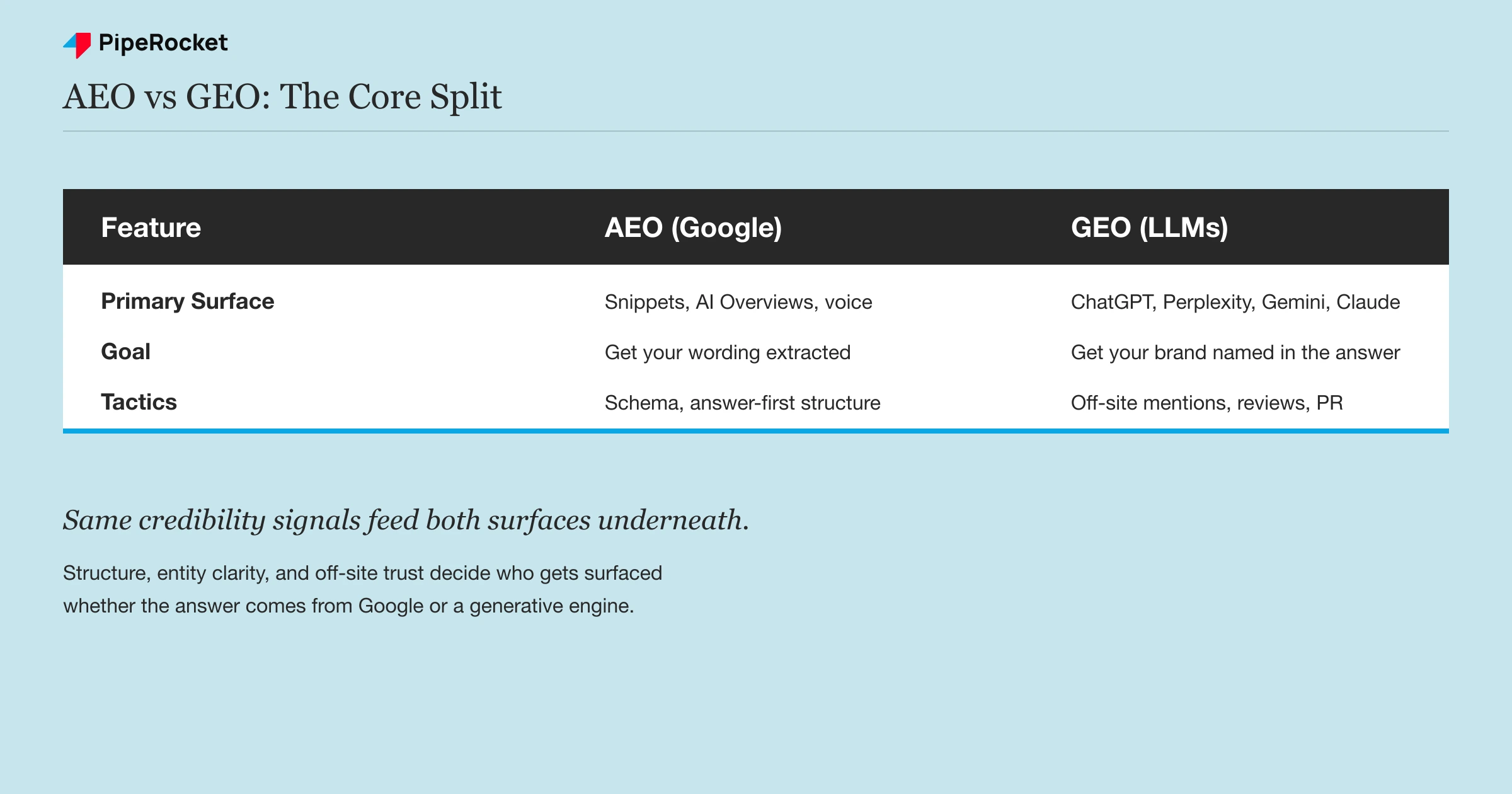
The two surfaces reward the same foundation, but they pull from different places and reward slightly different finishing touches. The table below is the fast version.
| Feature | AEO | GEO |
|---|---|---|
| Primary Surface | Google’s own results: featured snippets, AI Overviews, voice answers | Conversational AI tools: ChatGPT, Perplexity, Gemini, Claude |
| Goal | Get your page’s exact wording extracted into the answer box | Get your brand named inside a synthesized, multi-source answer |
| Tactics | Answer-first structure, FAQ and Article schema, snippet-friendly formatting | Off-site mentions, reviews, and citations the model already trusts |
Google extracts an answer from a single page it’s already crawled and ranks. An LLM composes an answer from a blend of sources it trusts, which is why a page can rank on Google and still never get quoted inside ChatGPT if the brand has no footprint anywhere else.
That gap trips up a lot of teams who assume “we rank well” automatically means “we get cited well.” It doesn’t.
A page can sit at position one for a competitive term and still be invisible to a generative engine that’s pulling its reasoning from Reddit threads and G2 reviews instead of the ranked page itself. The two surfaces are judging different evidence, even when the underlying subject is the same brand.
Do You Need Both?
You don’t have to pick one, because AEO and GEO share almost every input that actually earns visibility. Clear structure, a consistent entity, and real third-party credibility feed both surfaces at once, so treating this as a prioritization call means solving the same problem twice.
It also helps to size the opportunity honestly before you split effort. Across the 53 B2B SaaS brands in our AI SEO statistics , organic search sent 91.3% of all traffic against 8.7% from AI engines combined. AEO and GEO are both worth building, but neither replaces the SEO foundation that’s still doing most of the work.
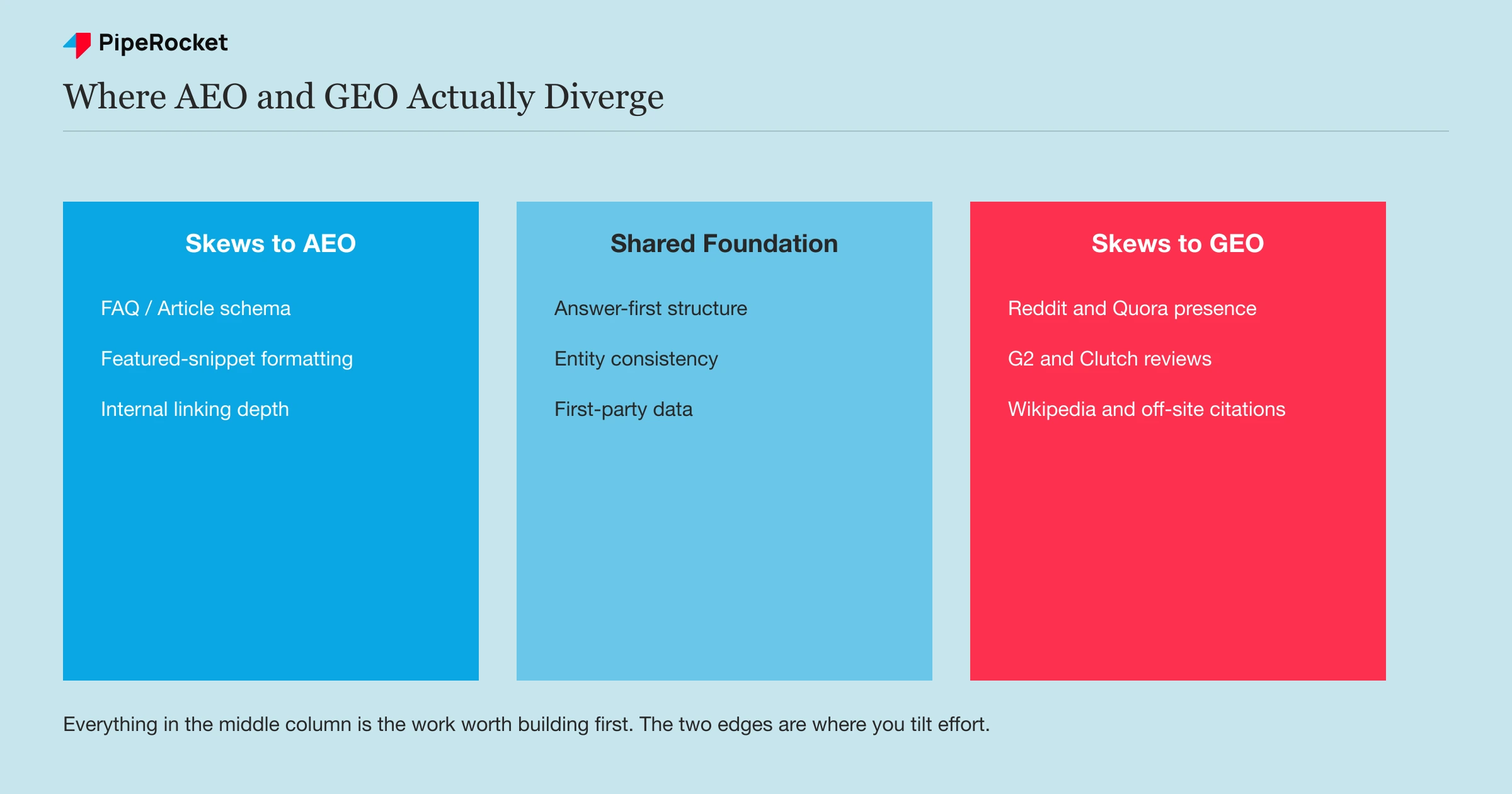
Where they genuinely split is narrow. Heavy schema markup and snippet-specific formatting skew toward AEO, since Google’s extraction leans hard on structured data in a way LLMs mostly don’t.
Off-site brand mentions and digital PR skew toward GEO, since generative engines pull their reasons from Reddit threads, G2 reviews, and Wikipedia far more than Google does for a snippet.
That gives you a real sequencing decision instead of a fake either/or. Build the shared foundation first:
- Answer-first content on the pages that matter most
- A clean, consistent entity across the web
- A couple of first-party data pieces worth quoting
Layer schema and snippet formatting on top once that foundation is live. Then push off-site presence (Reddit, G2, review platforms, digital PR) as the ongoing second track, since that work compounds slower and needs a longer runway .
Schema and snippet formatting are on-page changes a team can ship in a sprint once the content itself is answer-first.
Off-site authority takes real participation on the platforms these engines already trust, built over months rather than shipped in a sprint. Start that slower track early and layer the faster on-page track once the content is ready. That keeps both moving instead of stalling one while you wait on the other.
If your buyers still mostly search Google for informational queries, weight the early sprints toward the AEO -leaning tactics. If your category already shows up more inside ChatGPT and Perplexity threads, weight the early sprints toward off-site presence instead. Either way, the shared foundation underneath doesn’t change.
How to Optimize for AEO
AEO rewards a page Google can lift cleanly, so the fixes are mostly structural.
Structure Content for Extraction
Start with the FAQ, Article, and Product schema that tells Google exactly what each section answers, since machines read structure as well as words. Then tighten the formatting itself: answer the core question in the first one or two sentences of every section, use question-shaped headings that match how buyers actually phrase the search, turn any comparison into a table instead of a paragraph, and keep internal linking depth tight around the pages you want extracted.
None of this is exotic. It’s the same answer-first habit that wins a featured snippet, applied consistently across every page you want Google to lift into an AI Overview. The part teams skip most often is the schema, since it feels like a technical afterthought rather than a content decision. It’s what tells Google’s extraction system where the clean answer actually sits on the page.
Test and Monitor Snippet Wins
Check Google Search Console for which pages already own a featured snippet or an AI Overview mention, and treat those as the template. A page that already gets lifted tells you more about what Google’s extraction rewards than any general best-practices list, so iterate the rest of the site toward what’s already working.
For the fuller build, including how this plugs into the rest of an AI search program, see our complete GEO and AEO playbook .
How to Optimize for GEO
GEO rewards a brand the model already trusts before it ever reaches your page, so most of the work happens off-site. Structure your pages the same answer-first way you would for AEO, since LLMs quote text they can isolate cleanly, but the decisive lever here is authority the engine can find elsewhere.
That means showing up where the model actually looks:
- Answer real buyer questions on Reddit and Quora with substance, not a pitch
- Earn genuine reviews on G2 and Clutch with named outcomes
- Lock your entity so your name, category, and core facts stay consistent everywhere
- Publish first-party data worth quoting, since original numbers get cited far more than another restatement of the consensus
Keep Your Entity Consistent Everywhere
A consistent entity matters more here than most teams expect. If different sites describe your brand with conflicting facts, the model reads that as a reason to hedge or skip you entirely.
Win the Category Before You Win the Brand Mention
Generative engines tend to surface a category before they surface a specific brand. Well-structured, non-branded content that answers a buying question honestly is more likely to get pulled into the synthesized answer than a page that only talks about itself.
Build a Review and Citation Program
Treat G2, Clutch, and Reddit presence as an ongoing program, not a one-time push (our Reddit marketing services run it that way). Ask happy customers for reviews with specific, named outcomes, and answer real questions in relevant subreddits and Quora threads on a schedule, since generative engines weight recent, substantive third-party mentions over a stale profile from two years ago.
Track Which AI Engines Actually Cite You
Run your brand and category terms through ChatGPT, Perplexity, and Gemini on a regular cadence and note whether you show up, and what the engine says about you when you do. This kind of manual spot-check is still the most reliable way to catch a factual error or an outdated claim before it compounds across every engine that reads the same source.
Our full walkthrough of the four moves that win both surfaces lives in the GEO and AEO playbook for SaaS .
Tip: before you split the roadmap, check your existing content plan. Missing schema, a buried answer, or zero off-site presence are unfinished basics, not a missing GEO or AEO plan, and fixing them moves both surfaces at once.
Common Mistakes to Avoid
Running AEO and GEO as Two Separate Roadmaps
Splitting AEO and GEO into separate initiatives means funding and reporting the same shared foundation twice. Most of the work, structure, entity consistency, and content quality, feeds both surfaces at once.
Assuming a Google Ranking Means an LLM Citation
A page can sit at position one for a competitive term and still be invisible to a generative engine pulling its reasoning from Reddit and G2 instead of the ranked page itself. Ranking well and getting cited well are judged on different evidence.
Jumping to Surface-Specific Tactics Too Early
Schema and off-site mentions only compound once the shared foundation, answer-first content, a consistent entity, and real first-party data, is already in place. Layering surface-specific tactics on top of a weak foundation wastes the effort on both.
Reporting AEO and GEO Separately to Leadership
Treating these as two line items on a report makes the program look more fragmented than it is, and it invites the exact “which one should we prioritize” question that the shared inputs make moot in the first place.
Frequently Asked Questions
Is AI Overview AEO or GEO?
AI Overviews is specifically an AEO surface. It’s Google extracting an answer from a page it has already crawled and ranked, the same mechanism behind a featured snippet, just formatted for a longer synthesized response.
GEO covers a separate set of surfaces entirely: the chat tools like ChatGPT, Perplexity, Claude, and Gemini. There, the engine composes an answer from sources across the web rather than lifting text from one ranked page.
What is the difference between AEO vs GEO vs SEO in 2026?
- SEO is the foundation: ranking your pages in Google’s traditional results through relevance, authority, and technical health.
- AEO sits on top of that foundation and focuses specifically on getting your content extracted into Google’s answer formats, snippets, AI Overviews, and voice results.
- GEO runs alongside both, focused on getting your brand named inside conversational AI tools that pull from the wider web rather than a single ranked page.
For the SEO-vs-GEO half of this comparison in more depth, see our breakdown of GEO vs SEO .
Is AI SEO the same as GEO?
No, AI SEO is the umbrella term that covers both GEO and AEO. It’s the operating model a team uses to earn visibility across every AI-driven surface, Google’s answer formats and the conversational engines alike, while keeping the organic SEO foundation intact.
GEO and AEO are the two surface-specific expressions of that same program, not competing disciplines.
What is the meaning of AEO and GEO?
AEO (answer engine optimization) means optimizing content to get extracted into direct-answer formats like Google’s featured snippets and AI Overviews. GEO (generative engine optimization ) means optimizing your brand’s off-site presence and content structure to get cited or named inside generative AI tools like ChatGPT and Perplexity.
How PipeRocket Digital Handles AEO and GEO Together
We build AEO and GEO into the same SEO retainer rather than selling them as separate line items, because the underlying work barely changes between them.
If your SaaS isn’t showing up in AI Overviews or getting named in ChatGPT, our AI SEO services cover both surfaces from one program. Or talk to our team and we’ll show you exactly where the gaps are.