SaaS Marketing: The Complete Guide
 Kamaraj Mathiarasan (Kim)
Last updated on
Kamaraj Mathiarasan (Kim)
Last updated on
SaaS marketing is the practice of promoting subscription software using content, SEO, and paid channels to turn trials and demos into recurring revenue instead of a one-time sale, prioritizing lifetime value and renewal over a single purchase.
TL;DR
- SaaS marketing promotes subscription software through content, SEO, and paid channels, built around renewal and lifetime value rather than a one-time sale.
- The plan has to name whether the product is self-serve, sales-assisted, or hybrid before picking a single channel, since the product itself does part of the selling through trials and freemium.
- Expansion revenue from existing accounts often carries more of the growth number than new logos do, a loop most B2B guides skip entirely.
- AI search is already reshaping how buyers shortlist SaaS vendors, since a growing share of B2B software research now starts inside a chatbot instead of Google.
- CAC, LTV, trial-to-paid, net revenue retention, and MRR/ARR growth tell a truer story about whether the program is working than traffic or MQL count ever will.
- Integration and partner marketing, sharing audiences with complementary SaaS tools, is a core acquisition channel most teams underuse.
What Is SaaS Marketing?
SaaS marketing is how software-as-a-service companies get prospects to try, buy, and keep paying for a product that renews every month or year instead of getting bought once. That renewal cycle changes the job description. A marketing team isn’t just filling a pipeline; it’s protecting a subscription base that can shrink as fast as it grows.
Three structural facts separate SaaS marketing from a typical B2B services or hardware playbook.
The product often does part of the selling
In a product-led growth (PLG) motion, a prospect can sign up, use the tool, and hit a paywall or usage limit before marketing or sales ever talks to them. Marketing’s job shifts from “convince them to buy” to “get the right person into the trial and out the other side converted.”
Trial-to-paid rates vary widely by trial design, with credit-card-required trials converting several times higher than open opt-in trials. The pattern that matters most is qualification: accounts that show real product usage (PQLs) convert at roughly 25-30%, compared to 5-10% for leads qualified only by marketing activity like a form fill (Optif.ai / ProductLed benchmark data, cited in SHnO Research, 2026 ).
Keeping accounts matters as much as winning them
A new logo is one data point. What a SaaS company actually needs is net revenue retention, meaning existing customers upgrade, add seats, and stick around faster than anyone churns out. A marketing plan that only counts new trials and ignores expansion is measuring half the business.
The buying committee researches before anyone raises a hand
SaaS deals above a few hundred dollars a month rarely get bought by one person clicking “subscribe.” A champion tests it, a manager checks the budget, IT checks security, and increasingly, all of them run part of that research through an AI assistant instead of a search bar.
How SaaS Marketing Actually Works: The Self-Serve vs. Sales-Assisted Split
SaaS marketing runs on one of three motions, self-serve, sales-assisted, or hybrid, and the motion decides the channel mix rather than the reverse. Pick the motion first, then build channels underneath it, since the motion sets the kind of digital marketing SaaS teams should be running.
The single biggest strategic decision in SaaS marketing is picking the motion, and most teams skip it and just copy whatever channel mix a case study used. That’s backwards. The motion should decide the channel mix, not the other way around.
| Motion | Who it fits | What marketing optimizes for | Where the risk sits |
|---|---|---|---|
| Self-serve (PLG) | Low price point, individual or small-team buyer, fast time-to-value | Trial signups, activation, in-product conversion moments | Weak activation quietly caps growth even when signups look healthy |
| Sales-assisted | Higher price point, multi-stakeholder buying committee , longer evaluation | Qualified pipeline, sales-ready content, deal velocity | Marketing generates volume sales can’t work fast enough to close |
| Hybrid | Mid-market and enterprise expansion off a self-serve base | Product usage signals that trigger a sales touch at the right moment | Marketing and sales disagree on when a trial becomes “sales-ready” |
Most SaaS companies past their first few hundred customers run some version of hybrid, whether they’ve named it that or not. A free tier brings in volume, and a sales team works the accounts that show real usage or come in above a certain seat count. The mistake is running a pure PLG content and paid strategy while sales quietly needs enterprise-grade case studies and security documentation nobody built.
Picture two fictional companies to see why this matters. An invoicing tool for freelancers at $15 a month lives and dies on how many people finish setup in their first session, so every marketing asset should be built to get someone from signup to their first invoice sent.
A compliance platform for fintech teams at $2,000 a month sells to a security lead, a finance lead, and an engineering lead in the same deal. The same “get to your first invoice” messaging would read as thin to that buying committee, which needs documentation and proof over a fast onboarding flow.
Why “just add sales” doesn’t fix a broken self-serve motion
Bolting a sales team onto a product with weak activation doesn’t rescue the numbers. If most trial users never reach the moment where the product proves its value, sales ends up chasing accounts that were never going to convert.
When that happens, the SaaS growth strategy underneath the whole plan needs a rebuild before any channel work matters. That deeper operating-model question, how acquisition, activation, and expansion fit together as one system, is the subject of our full SaaS growth strategy guide .
The SaaS Marketing Funnel Has an Extra Loop
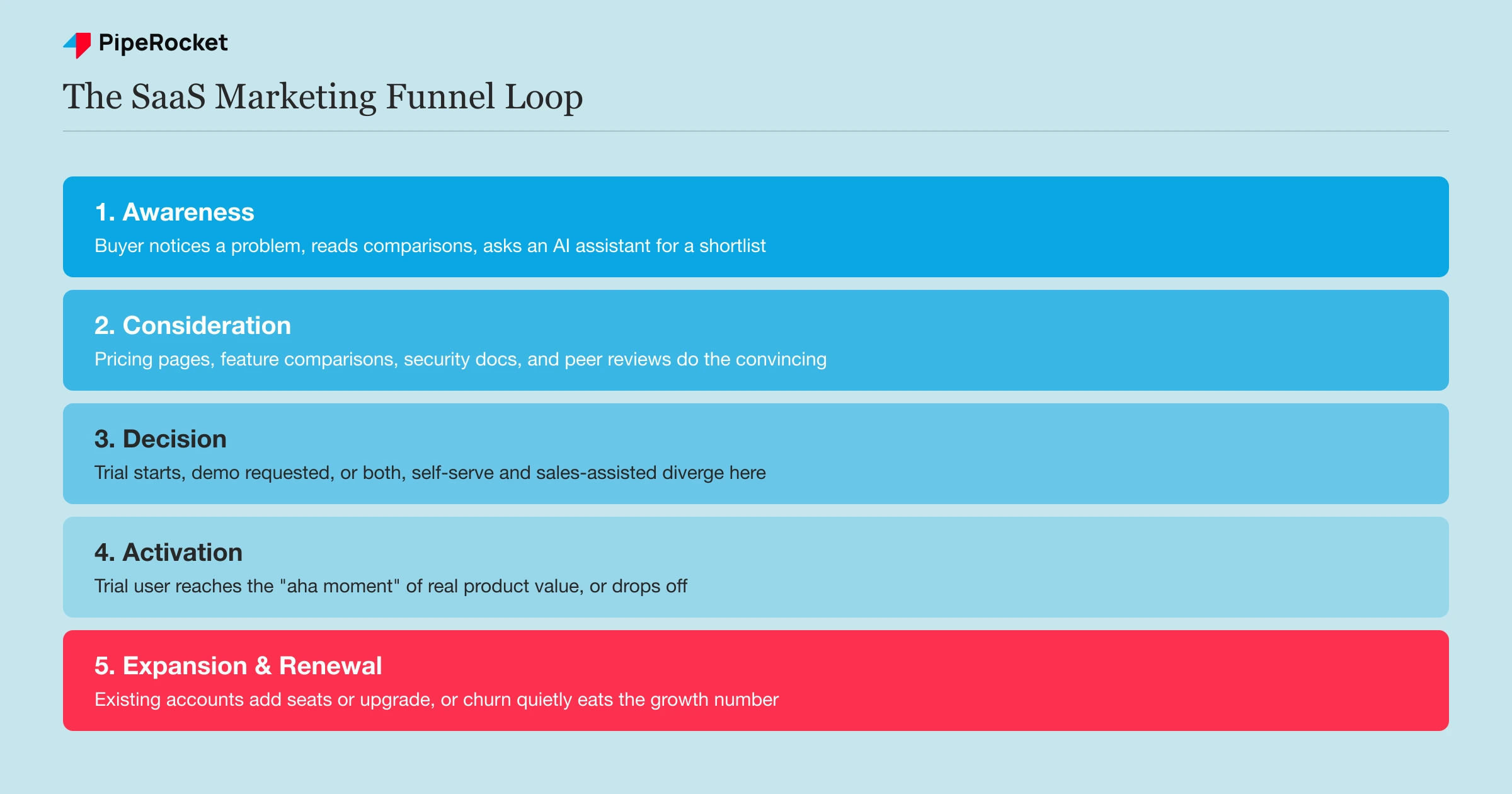
A standard B2B funnel runs awareness to consideration to decision. SaaS adds a loop after the sale: activation, expansion, and renewal. Skip that loop in your planning and you’ll keep funding acquisition to backfill churn you never diagnosed.
Awareness. The buyer notices a problem: manual work, a broken workflow, a tool they’ve outgrown. They’re reading comparison content, watching demo videos, and increasingly asking an AI assistant to shortlist options before they visit a single vendor site.
Consideration. They’re evaluating two or three real options. Pricing pages, feature comparisons, security documentation, and peer reviews on G2 or Capterra do most of the convincing here, not a sales deck.
Decision. They start a trial, request a demo, or both. This is where self-serve and sales-assisted motions diverge hardest: one measures in-product moments, the other measures deal stage.
Activation. The trial user either reaches the moment the product proves its worth, sometimes called the “aha moment,” or they don’t. Marketing rarely owns this stage directly, but the messaging that got them into the trial sets their expectations for what “value” even looks like.
Expansion and renewal. Existing customers add seats, upgrade tiers, or churn. This stage often gets ignored by marketing teams who see their job as ending at “closed-won,” which is exactly the gap that shows up later as a revenue number nobody can explain.
A project-management SaaS is a useful example of why this loop matters more than the front half. A team of five signs up, gets value fast, and stays on the entry plan for a year. Marketing spent nothing to keep them, and expansion happened only when someone in the account, not a rep, decided to add a department.
If nobody’s tracking that moment as a marketing-relevant event, the team has no idea what triggered it or how to repeat it on purpose.
Why the AI Search Era Changes Who Gets Found
Recent research from G2 found that 51% of B2B software buyers now start their research with an AI chatbot more often than with Google (G2 Research, 2026 ). For SaaS marketing, that shift means being cited inside an answer now matters as much as ranking on a results page.
Search used to mean a buyer typed a query into Google and clicked through a list of blue links. That’s no longer the whole picture. A large and growing share of B2B software buyers now run part of their vendor research inside an AI chatbot instead of a search engine, and the shift happened faster than most marketing teams have adjusted to.
Buyer-journey research from multiple analyst firms puts the share of the B2B buying process that now happens before a prospect contacts a vendor directly at somewhere between 60% and 80%. Most of the persuading, in other words, happens somewhere marketing can’t watch in real time.
Being ranked and being recommended are two different jobs
Ranking earns a link a buyer clicks; being recommended earns a mention inside the answer a buyer reads first. The two jobs draw on different signals, as the table shows.
| Old search behavior | AI-assisted behavior | |
|---|---|---|
| What the buyer does | Types a query, scans a list of blue links | Asks a chatbot to compare vendors and shortlist |
| What wins visibility | Rankings, click-through, on-page relevance | Structured content, clear comparison pages, third-party citations an AI can point to |
Ranking on page one still matters, because a lot of research still happens the old way, and because AI systems draw heavily on indexed, well-structured web content to form their answers in the first place.
But getting cited by name inside a chatbot’s answer to “what’s the best tool for X” is a distinct skill. It’s built on structured content, clear comparison pages , and third-party proof that an AI system can point to with confidence.
A buyer can arrive already having picked a different vendor than they planned
Some research suggests a majority of buyers who lean on AI chatbots for vendor research end up choosing a different company than the one they originally had in mind. A meaningful share even purchase from a vendor they’d never heard of before the chatbot surfaced it.
That’s a real opportunity for a SaaS company that isn’t the incumbent. It’s also a real risk for one that assumes brand recognition alone will carry it through an AI-mediated shortlist.
The Ten Channels a Complete SaaS Marketing Program Runs
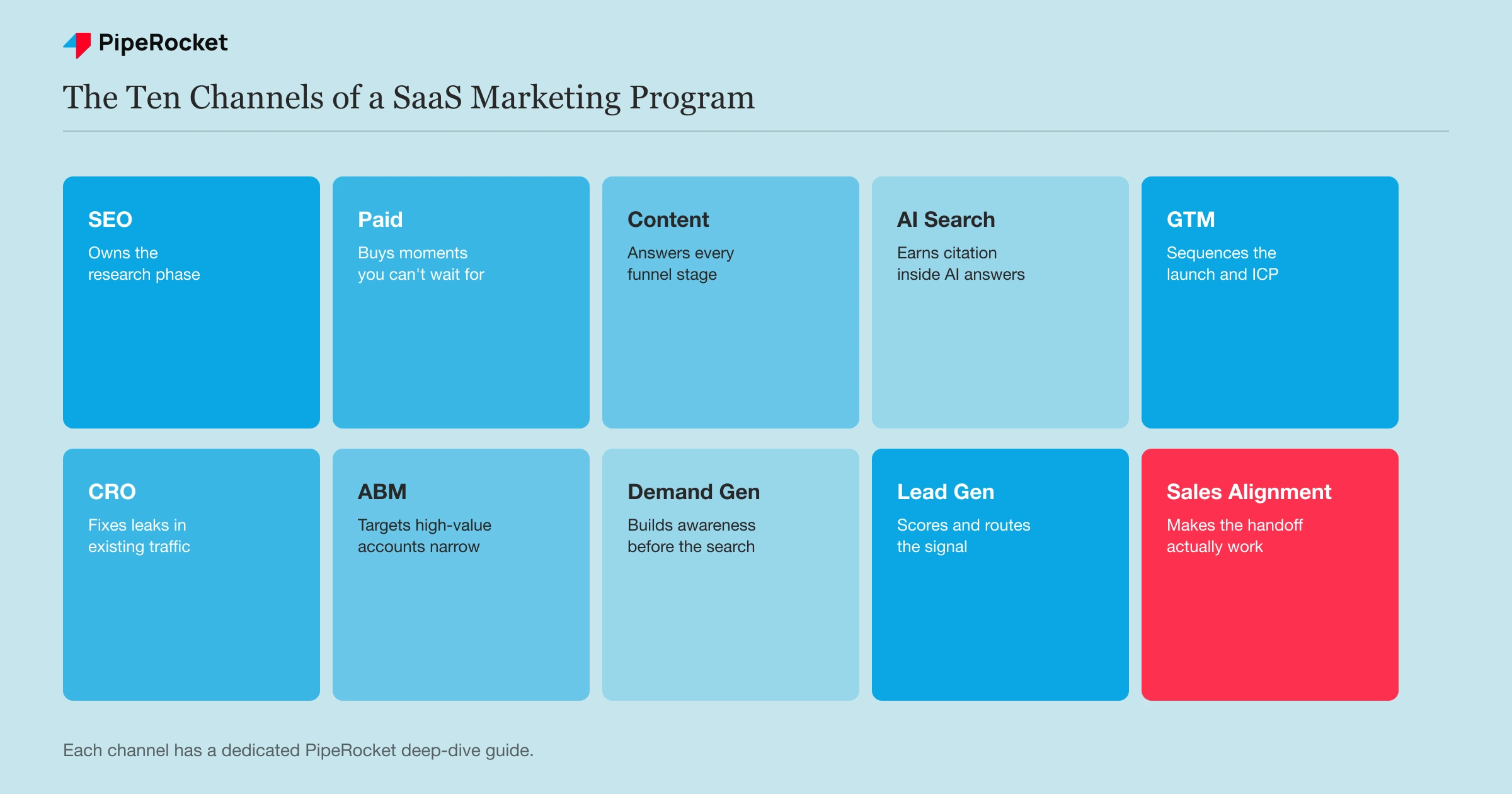
A complete SaaS marketing program runs ten distinct channels: SEO, paid marketing, content, AI search visibility, go-to-market strategy, CRO, ABM, demand generation, lead generation , and sales alignment, each with its own metrics and skill set.
Treating SaaS marketing as one job is how teams end up hiring a single generalist to do the work of ten disciplines, or a single agency to claim expertise in all of them at once. Neither works past a certain scale. The channels below divide the SaaS digital marketing workload the way a mature program actually should, each with its own skill set, its own metrics, and its own deep-dive guide.
No single team runs all ten of these at full depth on day one, and no single article, including this one, should try to teach all ten from scratch. Below is what each channel does inside the overall program and where to go for the real playbook.
1. SEO: Owning the Research Phase
Search is where a large share of SaaS evaluation happens quietly, before a prospect fills out any form. Ranking for the comparison and evaluation-stage searches your buyers actually run, not just top-of-funnel definitions, is what separates SaaS SEO from generic content marketing . The full framework for keyword targeting, technical SEO for JS-heavy product marketing sites, and content architecture lives in our SaaS SEO guide .
2. Paid Marketing: Buying the Moments You Can’t Wait to Earn
Paid search and paid social exist to show up the moment someone’s actively comparing, and to retarget the accounts your sales team is already working. It’s the fastest lever to pull and the easiest one to waste money on if it’s not sequenced against the funnel stage. The channel mix, budget-splitting logic, and platform-by-platform tactics are in our SaaS paid marketing guide .
3. Content Marketing: Building the Library That Answers Every Stage
Content is the connective tissue between SEO, paid, and sales enablement. It’s also the most commonly misallocated budget in the whole program, with teams pouring effort into awareness posts while the bottom-of-funnel comparison and pricing content that actually closes deals sits thin or missing. The full pillar-and-cluster planning method is in our SaaS content marketing guide .
4. AI Search Visibility: Showing Up Inside the Answer, Not Just the Page
Traditional SEO gets you a ranking. AI search visibility gets your brand mentioned inside the answer a chatbot gives when a buyer asks it to compare vendors, and those two things are no longer the same skill. A growing share of B2B software buyers, over half by some 2026 research, now start vendor research inside an AI chatbot rather than a search engine (G2 Research, 2026 ).
The framework for earning that visibility, from structured content to third-party citation building, is in our AI SEO strategy and framework . Autonomous AI agents for SEO are a related but separate discipline worth knowing about too, since they now handle SEO research and execution work rather than just answering a buyer’s question in chat.
5. Go-to-Market Strategy: Sequencing the Launch
GTM strategy governs what happens before a channel gets a single dollar: who the ICP is, what the positioning says, which channel goes first, and how the first 90 days get measured. Running paid and content without a GTM plan behind them is how teams end up with activity that never adds up to a coherent story. The full ICP-to-day-90 playbook is in our SaaS go-to-market strategy guide .
6. Conversion Rate Optimization: Fixing the Leaks Before Adding More Traffic
CRO is the discipline of getting more value out of the traffic and trials you already have, instead of buying more of both. Most SaaS teams treat this as a landing-page tweak function; it’s actually a pipeline problem, because a 1-point lift in trial-to-paid conversion can outperform a 20% increase in top-of-funnel spend. The full framework is in our SaaS CRO strategy guide .
7. Account-Based Marketing: Going Narrow on High-Value Accounts
ABM flips the funnel for enterprise and mid-market deals: instead of broad reach, you pick a target list of accounts and run coordinated content, ads, and outreach at the whole buying committee inside each one. It only makes sense above a certain deal size, where the cost of custom-tailoring outreach still pencils out. The cross-channel framework is in our SaaS ABM strategy guide .
8. Demand Generation: Building Awareness Before the Search Starts
Demand gen creates the problem-awareness that makes someone search for a solution in the first place, as distinct from demand capture, which just catches people who are already looking. Skip this and every other channel is fishing in a pond that stops refilling. Email marketing sits inside this layer as the nurture engine, keeping trial signups and content subscribers warm until they hit a buying trigger. The full framework is in our SaaS demand generation strategy guide .
9. Lead Generation: Turning Interest Into a Routable Signal
Lead gen is the operational layer that turns a trial signup, a content download, or a demo request into something sales can actually act on, scored and routed by the right motion instead of one universal form. The scoring and routing framework is in our SaaS lead generation strategy guide .
10. Sales and Marketing Alignment: Making the Handoff Actually Work
None of the above matters if marketing and sales define “qualified” differently. Alignment means agreeing on what counts as a sales-ready trial or lead before the campaign launches, not debating it after a bad quarter. This connective layer runs through nearly every guide linked above rather than owning a page of its own, because it’s less a channel than a discipline every channel has to respect.
One acquisition lever mature programs layer on top of these ten is integration and partner marketing. Integration and partner marketing means sharing audiences with complementary SaaS tools, co-marketing to each other’s customers, and earning placement in a partner’s app marketplace or directory. A single well-placed integration can put a product in front of thousands of already-qualified accounts that trust the partner, at a fraction of the cost of buying that reach through paid channels. It works best once a product has an API or marketplace presence worth partnering around.
Common Mistakes That Break a SaaS Marketing Program
Copying a PLG playbook onto a sales-assisted product
Free-trial growth tactics built for a $20-a-month tool don’t transfer cleanly to a $2,000-a-month platform with a multi-person buying committee. The messaging, content depth, and even the trial length that work for one motion actively hurt the other. Our guide to B2B growth marketing breaks down which plays actually fit a longer, committee-driven sales cycle.
A 7-day trial that pressures a solo user into a fast decision reads as aggressive to a buying committee that needs three weeks just to get security sign-off. A 14-day self-serve onboarding flow, meanwhile, feels thin to a finance lead who wants a real proposal.
Measuring new logos and ignoring expansion
A marketing team that reports trial signups and closed-won deals but never touches net revenue retention is reporting on half the business. If churn is quietly eating growth, no amount of top-of-funnel volume fixes it.
A team celebrating a strong new-logo quarter while retention slides is often about to face a much harder conversation, once the board asks why the net number didn’t move the way the top-line number did.
Treating AI search visibility as a future problem
Waiting for AI-driven vendor research to “mature” before investing in it is a bet that buyers will wait too. The research already shows a real and growing share starting their evaluation inside a chatbot, not a search bar, and that share isn’t shrinking back. Companies that keep pushing this to next year’s roadmap are handing early-mover advantage to whichever competitor gets its content structured for AI citation first.
Running channels in isolation instead of as one system
SEO content that never gets a paid boost, an ABM list that content marketing doesn’t know exists, a GTM plan sales never saw. Each channel guide above assumes it’s operating inside a coordinated plan, not as an island. The tell is usually organizational: three specialists each optimizing their own dashboard, none of them able to explain how their work changes what the other two do next.
Skipping the metrics that reveal whether any of this is working
Traffic and MQL counts feel like progress even when they mean nothing for revenue. CAC, LTV, trial-to-paid conversion, and net revenue retention are the numbers that tell the truth, and they’re covered in full in our SaaS marketing metrics guide . A program that can’t produce these four numbers on request is flying without instruments, regardless of how current its reporting looks.
How to Know the Program Is Actually Working
Five numbers separate a healthy SaaS marketing program from a merely busy one: CAC, LTV, trial-to-paid conversion, net revenue retention, and MRR/ARR growth. Traffic and MQL counts are not on that list.
Vanity metrics are the easiest trap in SaaS marketing because they’re the easiest to move. Doubling blog output moves traffic. Doubling ad spend moves impressions. Neither one proves the business is healthier.
The numbers that hold up under scrutiny track cost against durable revenue instead of activity:
- CAC (customer acquisition cost): what it actually costs, fully loaded, to land one paying customer
- LTV (lifetime value ): what that customer is worth across their full subscription life, counting renewals and upgrades on top of the first invoice
- Trial-to-paid or free-to-paid conversion rate : the single clearest signal of whether product and messaging match
- Net revenue retention: whether the existing customer base is growing or quietly shrinking underneath the new-logo number
- MRR/ARR (monthly and annual recurring revenue): the durable revenue base the whole program exists to grow, and the number every metric above ultimately rolls up into
A program can hit every acquisition target on the dashboard and still be losing money if CAC keeps climbing while LTV stalls. That’s the exact failure mode our SaaS marketing metrics guide is built to catch, with the formulas, benchmarks, and reporting cadence that make these numbers usable instead of decorative.
The LTV-to-CAC ratio is the single number that ties the cost-and-value metrics together, and it’s worth understanding before diving into the full metrics guide. A ratio near 1:1 means the business is spending almost as much to acquire a customer as that customer will ever pay back, which is unsustainable no matter how good the growth rate looks on a slide.
A ratio closer to 3:1 or higher is usually the mark of a program that’s actually compounding rather than just running fast.
What to Do When the Program Stalls
Every SaaS marketing team hits the same handful of walls: traffic that won’t convert, a sales team that says leads are junk, a CAC that keeps creeping up, or a board asking why growth slowed with no clear answer. These aren’t separate crises. They’re symptoms of the same handful of root causes repeating across different channels.
Rather than re-litigate each symptom here, we’ve mapped the most common ones, and the fixes that actually work, in our Top SaaS Marketing Challenges guide . Read this page to understand the shape of the whole program; read that one when a specific piece of it breaks.
If you’re building the program from scratch rather than diagnosing an existing one, our SaaS marketing plan template gives you the eight sections a real operating document needs.
How PipeRocket Digital Builds SaaS Marketing Programs
We build SaaS marketing programs around the motion first, self-serve, sales-assisted, or hybrid, then sequence SEO, paid, and content underneath it instead of running channels as separate bets. If you want a second opinion on where your program’s gaps actually are, get in touch . For teams evaluating agencies for the first time, our roundups of the best SaaS marketing agencies and best SaaS SEO agencies are a useful starting comparison.
Want the condensed, working version of everything above? Run your own program against our interactive SaaS marketing checklist .
Frequently Asked Questions
What’s the difference between SaaS marketing and regular B2B marketing?
SaaS marketing has to account for a subscription revenue model, which means expansion and retention matter as much as new customer acquisition. It also usually involves a free trial or freemium tier that does part of the selling before a salesperson ever gets involved, something most B2B service or hardware marketing doesn’t have to plan around.
Which SaaS marketing channel should I invest in first?
It depends on the motion. A low-price, self-serve product usually gets the most out of SEO and content aimed at comparison and evaluation searches, since that’s where trial signups originate. A higher-priced, sales-assisted product usually needs ABM and demand generation first, because the buying committee needs to be reached deliberately rather than caught passively searching.
How long does it take to see results from SaaS marketing?
SEO and content typically take three to six months to show meaningful traffic and pipeline impact, since they depend on search authority building over time. Paid channels can show results within weeks but stop the moment budget stops. The realistic answer for a full program is that early signals show up in a quarter, but durable, repeatable growth usually takes two to three quarters to compound.
Do small SaaS companies need all ten marketing channels?
No. A small team with a handful of people should pick two or three channels that match its motion and go deep, rather than spreading thin across ten. A self-serve product with a small marketing team typically gets the most out of SEO, content, and basic paid search first.
From there, it can add ABM, demand generation, or a dedicated AI search play once there’s a repeatable base to expand from. Running all ten channels shallow at once usually produces worse results than running three of them well.