SaaS Growth Strategy: The Complete Operating Model
 Praveen Ravi
Last updated on
Praveen Ravi
Last updated on
Most SaaS teams I meet describe growth as one thing: get more customers. So they pour budget into acquisition, watch the top of the funnel fill up, and then stare at a revenue chart that’s flat anyway. The problem is rarely the acquisition engine itself. Acquisition is only one of four growth motions, and the other three are running on fumes.
Growth works like an operating model. This guide lays out the four motions, how they connect, and how to decide which one deserves your attention right now.
TL;DR
- Growth is a system of four motions: Acquisition, activation, retention, and expansion each pull a different lever, and revenue only compounds when they work together.
- Acquisition brings people in: It’s the most expensive motion and the one every team over-invests in first, so we treat it as a single input into a larger model.
- Product-led growth is one acquisition engine: It fits self-serve products with fast time-to-value and still needs the other three motions behind it.
- Retention is the motion that funds everything else: Keeping customers cheap to serve and slow to leave is what makes acquisition math work in the first place.
- Expansion is the most capital-efficient revenue you’ll ever book: Growing the accounts you already have beats winning new ones on cost, speed, and predictability.
- Choose one motion per stage and sequence the rest: Your ARR stage tells you which motion compounds fastest right now, so you fund that one and layer the others deliberately.
- You’ll know it’s working from the base: Net revenue retention, CAC payback, and expansion share tell you whether the model compounds or leaks.
- The Rule of 40 tells you if growth is efficient: Balancing growth rate against profit margin catches a model that’s growing fast but burning too much to sustain it.
Why SaaS Growth Needs an Operating Model, Not a Tactic List
A SaaS growth operating model is a system that coordinates four motions (acquisition, activation, retention, and expansion) so they compound, instead of a loose list of tactics that each pull a different lever. It tells you which motion matters at your stage and what the others quietly cost you.
Growth stalls when a team runs tactics without a model underneath them. You can ship a paid campaign, a referral loop, and an onboarding email sequence in the same quarter and still lose ground, because none of them are pulling the same lever. A model tells you which lever matters at your stage and what the others are quietly costing you.
Here’s the belief I keep running into: more customers equals more growth. It sounds obvious, and it’s wrong often enough to sink companies. Customer acquisition cost has climbed sharply across B2B SaaS; one Paddle analysis put the rise at roughly 60% over a five-year span. If your only motion is buying new logos, rising CAC eats your margin while you’re distracted by a growing user count.
Recurring revenue changes the whole calculation
SaaS growth behaves differently from one-time-sale businesses because the money arrives over time. A customer isn’t worth what they paid this month. They’re worth what they’ll pay across their whole life with you, minus what it cost to win and keep them.
That single fact reorders your priorities. A customer who churns in month four can lose you money even if the sale looked profitable on day one. Median SaaS CAC payback sits around 16 months, per Benchmarkit , so a customer who leaves before then never paid you back. Retention and expansion stop being “nice to have” and become the difference between a model that compounds and one that leaks.
The four levers, and why teams only pull one
Most teams pull acquisition hard and leave the other three levers untouched. It’s the most visible motion, the easiest to buy, and the one leadership asks about first. So the org optimizes for new logos and treats everything after the sale as someone else’s job.
The cost is invisible until it isn’t. You can hit your new-logo target every quarter and still watch net revenue shrink, because the base is churning faster than the top fills. An operating model forces you to look at all four motions at once and fund the one that’s actually holding you back.
The Four Growth Motions
SaaS growth runs on four motions: acquisition, activation, retention, and expansion. Each one owns a different moment in the customer’s life with you, and each one is measured differently. Treating them as one blurry “growth” number is how teams end up funding the wrong thing.
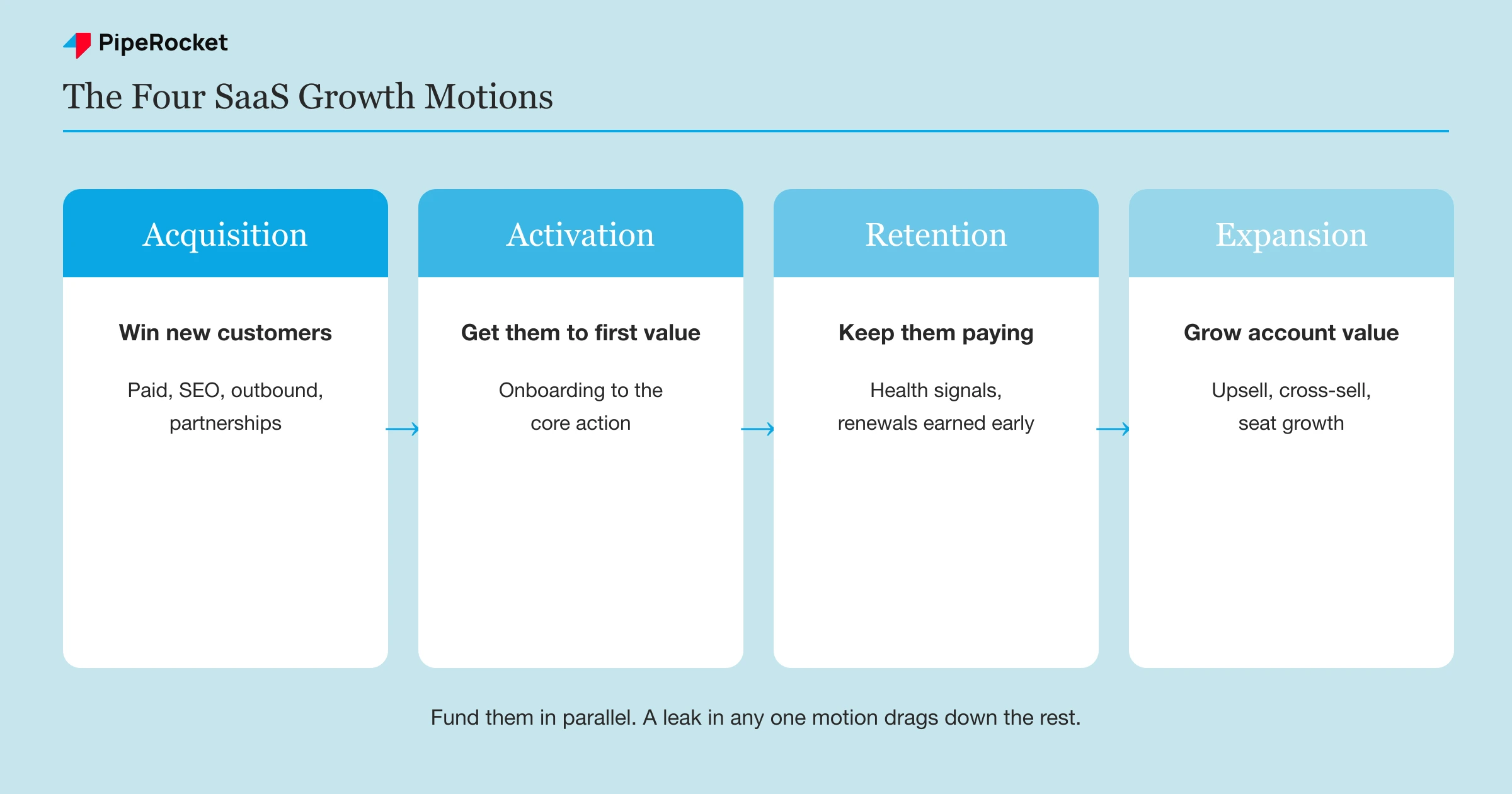
Acquisition wins new customers. Activation gets those new customers to their first real moment of value, the point where the product actually does the thing they signed up for. Retention keeps them paying and using the product month after month. Expansion grows the revenue from accounts you already have through upsell, cross-sell, and seat growth.
The motions run in sequence for any single customer, but you invest in them in parallel as a company. A leaky activation step makes every acquisition dollar worth less. Weak retention caps how much expansion you can ever earn. When people ask why their growth feels stuck despite hard work, it’s almost always because two or three motions are starving while one is overfed.
The rest of this guide covers each motion, then shows you how to decide which one to fund first. Acquisition and product-led growth each get a summary here because they deserve their own deep treatment. Retention and expansion get the full walkthrough, since they’re the motions most teams under-build.
Customer Acquisition: The Motion Everyone Starts With
Acquisition is how you win customers who’ve never paid you before, and it’s the motion every SaaS team builds first. It spans paid search, paid social, SEO , outbound sales, partnerships, and events. The core job is the same across all of them: turn a stranger into a qualified opportunity, then into a paying customer.
Two things make B2B SaaS acquisition harder than it looks. The buying group is rarely one person. Gartner puts the typical B2B buying group at six to ten decision-makers, so a single “lead” is often one voice in a committee you can’t fully see. And the cost keeps rising, which means efficiency matters as much as volume.
Signal-based go-to-market strategy has become a common input here: teams prioritize accounts using intent data, hiring signals, and tech-stack signals so acquisition spend chases buyers already showing they’re in-market. Which motions you fund still assumes you’ve picked a go-to-market strategy in the first place, since that choice decides whether acquisition runs sales-led, self-serve, or a blend.
Acquisition is the most expensive of the four motions and the one with the worst standalone economics, so it can’t carry a growth model by itself. It feeds the top of the system, and everything downstream decides whether that feed pays off. For the full build, including channel selection, targeting, and the economics of each source, work through our dedicated guide on customer acquisition strategy rather than treating this summary as the whole picture.
Product-Led Growth: One Acquisition Engine Among Several
Product-led growth uses the product itself as the primary way to acquire and convert customers. Free trials, freemium tiers, and self-serve onboarding let a user experience value before they ever talk to sales. Done well, it lowers acquisition cost and shortens the buying cycle because the product does the selling. Referral and viral loops sit inside this engine too: when the product gets more useful as a user invites teammates or shares output, each activated account becomes its own acquisition channel.
PLG isn’t a universal strategy, though. It works when a product delivers value fast, a single user can adopt it without a committee, and the price point supports self-serve checkout. It struggles when the product needs heavy configuration, the buyer and the user are different people, or the deal size demands a human conversation. Plenty of strong SaaS companies are deliberately sales-led for exactly these reasons.
Treat PLG as one possible acquisition engine that plugs into the wider model. It still needs activation to turn signups into active users, retention to keep them, and expansion to grow them. If PLG fits your product, our product-led growth strategy guide covers the motion in depth, from trial design to the self-serve-to-sales handoff. This section is only the framing.
Retention: The Motion That Funds Everything Else
Retention is keeping the customers you already won, and it’s the motion that decides whether the other three ever pay off. Every point of churn you prevent is revenue you don’t have to re-earn through expensive acquisition. When people ask whether to focus on getting users or keeping them, the honest answer is that keeping them is what makes getting them affordable.
The trap is treating retention as a support function that kicks in when someone threatens to leave. By then it’s usually too late. Retention is decided in the first few weeks, long before a renewal date, and it lives in three places.
Activation is where retention actually starts
Most churn is baked in during the first month, not the last. A customer who never reaches their first real moment of value, what teams call time-to-value (TTV), has no reason to stay, and no amount of renewal-season outreach fixes a product they never got working. Software buyers expect returns fast, with 57% expecting positive ROI within three months, per G2 . Miss that window and you’re renewing on hope.
So the first retention lever is activation. Map the specific action that correlates with customers sticking around, whether that’s inviting a teammate, connecting a data source, or completing a first workflow. Then redesign onboarding so more customers hit that action faster. This is the cheapest retention work you’ll ever do, because it stops churn before it forms.
Healthy customers tell you before they leave
Retention improves when you can see risk coming. A handful of signals show up weeks before a cancellation, which gives you room to act while there’s still something to save:
- Usage drops: account activity falls off from its normal baseline.
- Support tickets pile up: rising friction or unresolved problems.
- A champion leaves the account: your internal advocate moves on.
- Logins go quiet: the people who signed up stop showing up.
Build a simple health view from the signals you already have. You don’t need a data science team for the first version. Track logins, feature adoption, and support volume per account, flag the ones trending down, and give someone the job of reaching out before the renewal conversation. The point is to intervene early, when a phone call can still change the outcome.
Renewals are earned across the whole contract
The renewal is the sum of everything the customer experienced since they signed, not a single moment. If the product delivered value and someone paid attention, the renewal is a formality. If it didn’t, no discount saves it.
That’s why I push teams to treat the period between signing and renewing as the actual retention work, rather than scrambling in the final 30 days. Regular check-ins tied to the customer’s own goals, proof of the value delivered, and a fast response when something breaks all compound into a renewal that closes itself. Retention is quieter than acquisition, but it’s where the margin lives.
Expansion: The Most Capital-Efficient Revenue You’ll Book
Expansion is growing revenue from customers you already have, and it’s the most efficient money in SaaS. You’ve already paid to acquire and activate the account, so growing it costs a fraction of winning a new one. This is why mature SaaS companies get a growing share of new revenue from their existing base rather than from new logos.
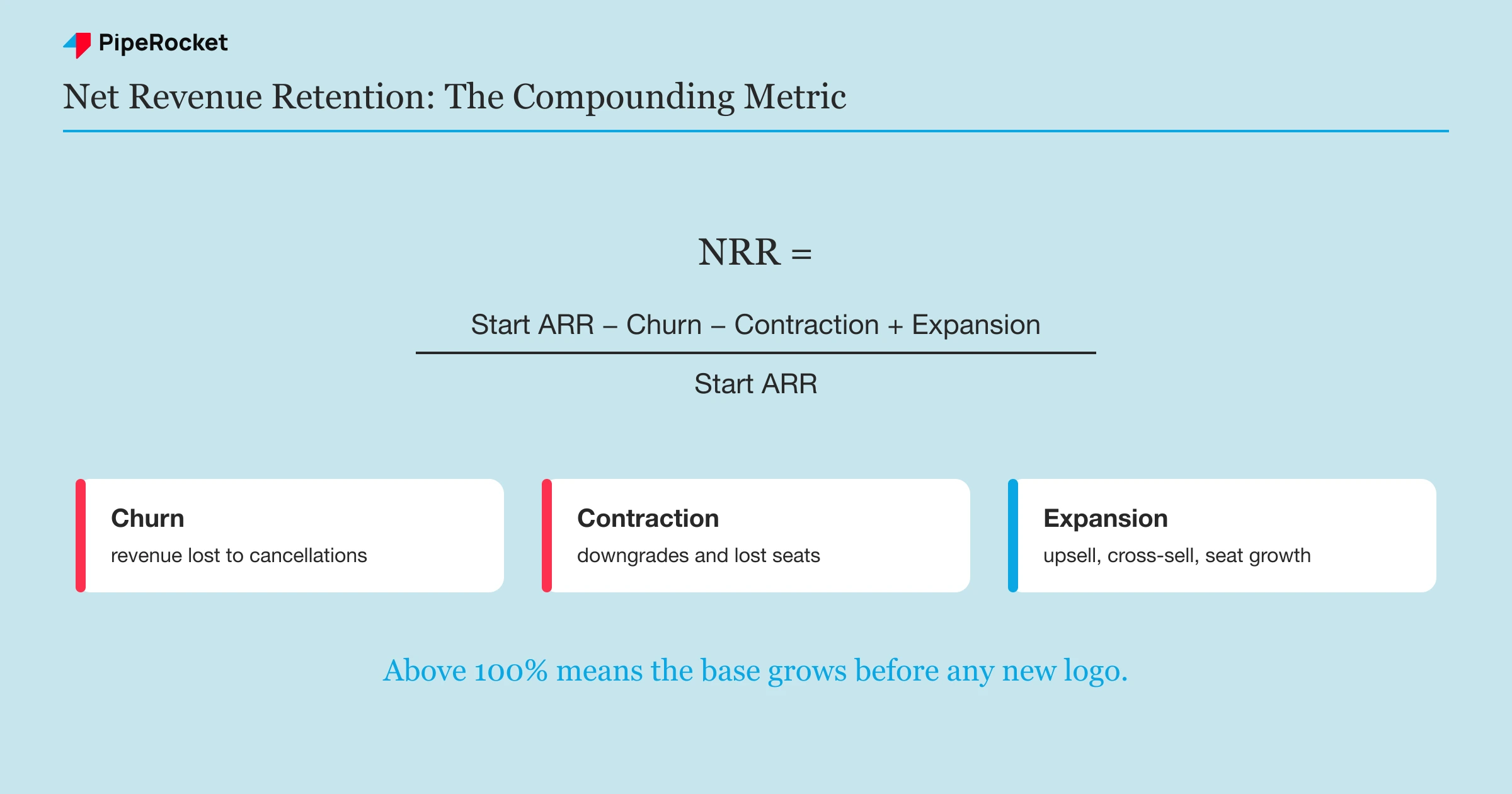
The metric that captures this is net revenue retention . It measures how much revenue your existing customers generate this year versus last year, after churn and downgrades but including upgrades. When NRR sits above 100%, your customer base grows revenue on its own, before you add a single new logo. That’s the closest thing SaaS has to compounding interest.
Upsell moves customers up the value ladder
Upsell is selling the same customer a bigger version of what they already buy: a higher tier, more capacity, premium features. It works because a customer who’s getting value naturally hits the ceiling of their current plan, and the upgrade solves a problem they can already feel.
The mistake is pushing upgrades on a schedule instead of on a signal. An upsell lands when the customer is bumping against a real limit, like seat caps, usage ceilings, or a feature they keep asking for. Watch for those signals in your usage data and time the conversation to them. A well-timed upsell feels like help. A calendar-driven one feels like a shakedown.
Cross-sell widens how the account uses you
Cross-sell is selling a related product or module the customer doesn’t have yet. It deepens how embedded you are in their operation, and every additional product you sell into an account makes that account harder to leave.
The prerequisite is that the customer is already succeeding with the first product. Cross-selling a second module to an account that’s barely using the first one just accelerates churn across both. So cross-sell sits downstream of retention. Get the core product delivering value, prove it, then widen. Accounts that use you in more than one place are the ones that renew for years.
Pricing and packaging decide your expansion ceiling
Your ability to expand is capped by how you package and price. If everything is bundled into one flat plan, there’s nothing to upgrade into and no natural expansion path. If your pricing scales with the value the customer gets, expansion happens almost on its own as they grow.
This is why usage-based and tiered models have taken over so much of SaaS. They tie your revenue to the customer’s own growth, so as they succeed, your account value rises without a hard sell. Review your packaging with one question in mind: when a customer gets more value from us, does our revenue automatically follow? If the answer is no, your expansion ceiling is lower than it needs to be. Treat pricing as something you test and iterate on over time rather than a structural decision you make once. The best SaaS teams revisit tiers, limits, and metrics regularly as they learn what customers actually pay for.
How to Choose and Sequence Your Growth Motions
The motion to fund depends on your ARR stage: acquisition plus activation pre-$1M, compounding acquisition from $1M to $10M, retention from $10M to $25M, and expansion past $25M. Fund that one first, then layer the rest.
You can’t run all four motions at full intensity at once, so the real skill is choosing which one to fund first and sequencing the rest. The answer depends on your stage. What compounds fastest at $1M ARR is different from what compounds at $25M, and pouring money into the wrong motion for your stage is how teams burn a year.
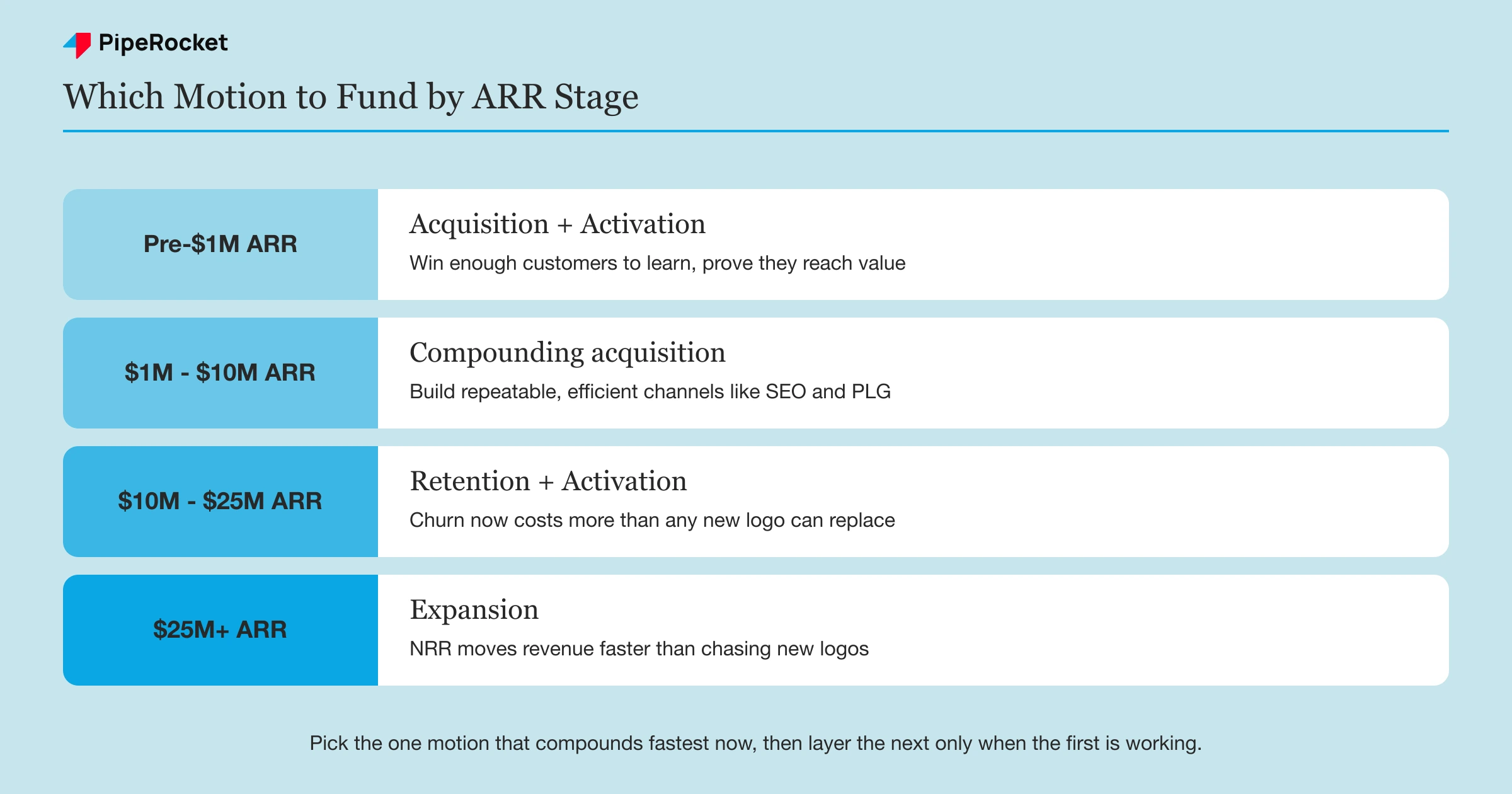
Here’s the rough map I use when deciding where a company should spend its next dollar of growth effort:
| Stage | Primary motion to fund | Why it compounds here | What to hold back |
|---|---|---|---|
| Pre-$1M ARR | Acquisition + activation | You need enough customers to learn, and proof they reach value | Heavy expansion machinery; you have nothing to expand yet |
| $1M to $10M ARR | Acquisition that compounds (SEO, content, PLG) | You need repeatable, efficient channels beyond paid volume | Complex upsell motions before retention is solid |
| $10M to $25M ARR | Retention + activation | Churn now costs more than any new logo can replace | Chasing new channels while the base leaks |
| $25M+ ARR | Expansion | Your base is large enough that NRR moves revenue more than acquisition | Over-indexing on new logos when expansion is cheaper |
The sequencing lesson is one I learned watching which SaaS companies grew steadily and which stalled. The teams that scaled cleanly tuned the whole system first, meaning their message, offer, onboarding, and follow-up, before they turned up spend on any single motion. The ones that struggled tried to buy growth in a channel that wasn’t ready and paid for the lesson.
I treat paid acquisition like research and development early on, not a vending machine. Every dollar tests an angle, a message, or a segment before it scales. Capital lets you move faster, but clarity about which motion fits your stage is what keeps you from running in circles. Pick the one motion that compounds fastest right now, give it real time, and layer the next one only when the first is working.
Common Mistakes to Avoid
The failure modes in SaaS growth are predictable, and most of them come from over-investing in one motion while the others starve. These are the ones I see most.
Treating acquisition as the whole strategy
The most common mistake is funding acquisition as if it’s the entire model. Teams celebrate rising signups and growing traffic while net revenue quietly flattens, because the base is churning as fast as the top fills. New logos feel like progress, but if you’re replacing churned revenue instead of adding to it, you’re running to stand still.
Reading dashboards instead of pipeline
Growth dashboards lie by omission. I worked with a CRM SaaS client whose Google Ads dashboards looked healthy, with strong traffic and clicks, while almost none of it moved down the funnel into real opportunities. We rebuilt the account around the intent that actually converted, cut the underperforming spend, and got roughly the same qualified-lead volume for far less money. The metrics looked fine the whole time. The pipeline told the real story.
Chasing expansion before retention is solid
Expansion built on weak retention backfires. Cross-selling a second product to an account that’s barely using the first one just gives them two reasons to leave instead of one. Expansion only compounds on top of accounts that are already succeeding, so retention has to come first in the sequence.
Ignoring activation entirely
Teams obsess over the sale and the renewal while ignoring the first month in between, which is where most churn is actually decided. A customer who never reaches first value was lost during onboarding, well before the renewal date arrives. Skipping activation work means paying full acquisition cost for customers who were never going to stay.
How to Know It’s Working
You know the model is working when the base grows on its own, and you diagnose it from a small set of numbers rather than a vanity dashboard. Signups and traffic tell you almost nothing about whether the system compounds. These are the numbers that do.
- Net revenue retention: Above 100% means your existing customers grow revenue without new logos. This is the single clearest signal that retention and expansion are healthy.
- CAC payback period : How many months until a customer pays back what it cost to acquire them. Shorter payback means acquisition and activation are efficient enough to fund the rest.
- Expansion share of new revenue: The portion of new revenue coming from existing accounts versus new logos. A rising share means expansion is starting to carry growth.
- Gross retention: How much revenue you keep before any expansion. This isolates whether you have a leak, separate from whether expansion is masking it.
The Rule of 40
The Rule of 40 says a healthy SaaS company’s revenue growth rate plus its profit margin should add up to at least 40%. Fast growth can offset a thin or negative margin, and strong profitability can offset slower growth, but a model that clears neither is usually burning more than it can sustain.
It’s the efficiency check that sits on top of the other numbers. A company growing 60% while burning enough to run a -25% margin still clears 40, and so does one growing 20% at a 20% margin. If you’re growing fast but far below the line, the model is spending faster than it compounds. Track it alongside NRR and CAC payback so growth and efficiency stay in view together.
Read these together, not in isolation. High acquisition with poor NRR means you’re filling a leaky bucket. Strong NRR with slow CAC payback means the base is healthy but the top of the funnel is inefficient. The pattern across the four numbers tells you which motion needs your next dollar, which is the whole point of running growth as a model.
How PipeRocket Digital Helps SaaS Teams Grow
At PipeRocket, we build growth around the motion that’s actually holding a company back, not the one that’s easiest to buy. We study the customer, the sales data, and the full path from click to opportunity before we spend anything, then we fund the motion your stage demands. Most of our work sits in the acquisition and expansion layers, where we run SaaS SEO and SaaS PPC programs that feed qualified pipeline instead of vanity traffic. If you want this built as a system rather than a set of disconnected campaigns, reach out to us here .
Frequently Asked Questions
What is a SaaS growth strategy?
A SaaS growth strategy is a plan for growing recurring revenue across four motions: acquisition, activation, retention, and expansion. Rather than focusing only on winning new customers, it coordinates how you bring people in, get them to value, keep them, and grow their account over time. The goal is a system where each motion supports the others, so revenue compounds instead of relying on constant new-logo volume. A good strategy also tells you which motion to prioritize based on your current stage. For the broader B2B version of this question, including how it applies outside a pure SaaS operating model, see our B2B growth marketing piece.
Should a SaaS company focus on acquisition or retention?
It depends on your stage, but retention is what makes acquisition affordable, so most maturing companies under-invest in it. Early on, you need enough customers to learn and reach product-market fit , so acquisition leads. Once you’re past roughly $10M ARR, churn usually costs more than any new logo can replace, and retention plus expansion become the faster path to growth. The honest answer is that keeping customers cheap to serve and slow to leave is what lets your acquisition math work in the first place.
What is the Rule of 40 in SaaS?
The Rule of 40 says a healthy SaaS company’s revenue growth rate plus its profit margin should add up to 40% or more. Fast growth can offset a lower margin, and strong margin can offset slower growth. It’s a quick check on whether growth is efficient or just expensive.
What is a good SaaS growth rate?
There’s no single number. Many benchmarks put healthy year-over-year growth at 100% or more pre-$10M ARR, tapering toward 20-30% past $25M ARR, with the Rule of 40 as the efficiency check on whichever rate you’re running.
What is a good net revenue retention rate for SaaS?
Net revenue retention above 100% is the threshold every SaaS company wants to clear, because it means your existing customers grow revenue on their own, before you add any new logos. The strongest mature SaaS businesses run well above that mark, driven by upsell, cross-sell, and seat expansion outpacing churn and downgrades. Below 100% means your base is shrinking and acquisition has to work harder just to keep you flat. NRR is the clearest single measure of whether your retention and expansion motions are healthy.