SaaS Customer Acquisition Strategy: The 2026 Guide
 Praveen Ravi
Last updated on
Praveen Ravi
Last updated on
Most SaaS teams treat customer acquisition as a list of tactics to try: run some ads, publish some content, hire an SDR, see what sticks. That’s how you end up spending on six channels and trusting none of them. Acquisition is really two decisions. Which channel portfolio fits how you sell, and whether the CAC and payback math actually holds. Get those right and the tactics almost pick themselves.
TL;DR
- Acquisition maps to how you sell: Product-led (self-serve trial or freemium), sales-led (outbound plus demos), or hybrid, and the motion decides which channels are worth funding.
- Acquisition is a portfolio decision: Your deal size decides how many channels you need to run, and low-ACV products can win on one while high-ACV committee buys need several.
- CAC and payback are the only scoreboard: A channel earns more budget when its payback period is short enough to fund the next customer, and it gets cut or fixed when it isn’t.
- Pick channels by sales motion: Match each channel to how you actually sell, fund the ones that capture existing demand first, and only create demand once capture is saturated.
- The funnel leaks between the click and the close: More spend on a leaky funnel just buys more waste, so fix the drop-offs before you scale.
- Diversify when a channel maxes out: When search demand runs dry, reallocate to influence channels instead of paying more for the same clicks.
- Fix the strategic mistakes first: The costly errors are strategic ones about when to spend, how to measure influence, and what traffic you actually buy.
- Measure blended CAC and payback by channel: Vanity traffic hides which channels actually fund growth, so tie every channel back to pipeline and revenue.
Why Customer Acquisition Breaks When You Treat It as a Tactics List
A channel that built one company can quietly bankrupt another, because acquisition economics depend on your price, your sales motion, and how many people sign off on the deal. Most teams pick channels by what’s working for someone else on LinkedIn, and that’s backwards. Copy the tactic without the context and you copy someone else’s math onto your own P&L.
Here’s what I’ve seen across dozens of SaaS accounts. The teams that struggle run channels in isolation and judge each one on its own vanity metric. The teams that grow run a portfolio and judge the whole thing on one number: how efficiently it turns spend into paying customers who stay.
Treat Acquisition Like a Portfolio You Manage
Think of acquisition the way you’d think about where to put money, not where to place a single bet. Every channel has a different cost curve, a different payback speed, and a different job in the funnel. Some capture people already looking for you. Some plant a seed months before the buyer is ready.
Running one channel means one point of failure. When Google search demand for your category maxes out, a single-channel account hits a wall it can’t spend past. A portfolio spreads the risk and lets each channel do the job it’s actually good at, which is why the mix matters more than any one line item.
The catch is that more channels cost more to run and measure. You don’t want six half-managed channels. You want the smallest portfolio that covers how your buyers actually decide.
Your Deal Size Decides How Many Channels You Need
The higher the deal size, the more the channel mix matters. A low-ACV product, something a single user can swipe a card for, can genuinely win on one strong channel. A high-ACV deal is a committee decision, and no single channel reaches a whole committee. Our team has seen this hold across account after account.
Picture a $40/month tool sold to individual marketers. Google search plus a solid onboarding flow can carry most of that pipeline, because one person searches, tries, and buys.
Now picture a $60k/year platform sold to a security team, a finance approver, and the VP who owns the budget. Each asks a different question and pays attention in a different place. One channel physically can’t be in all those rooms.
So before you argue about which channel is best, answer a simpler question: how many people have to say yes, and where do each of them spend their attention?
Core Acquisition Motions: PLG, SLG, and Hybrid
Every SaaS acquisition model runs on one of three motions: product-led, sales-led, or hybrid. The motion is how a stranger becomes a customer, and it decides which channels are worth funding before you spend a dollar. Deal size and how many people sign off point you to the right one.
- Product-led growth (PLG): The product does the selling through a free trial or freemium tier, and the user signs up, tries it, and buys without ever talking to sales. This fits low-ACV, single-user products where one person can swipe a card. Trial-to-paid conversion and onboarding are the levers here.
- Sales-led growth (SLG): A sales team drives the deal through outbound and demos, which fits high-ACV committee buys where a security lead, a finance approver, and a budget owner all have to say yes. Pipeline lives across several channels because no single one reaches a whole committee.
- Hybrid: Users self-serve in early, then sales steps in at usage limits or when the account shows expansion signals. Most SaaS ends up here as it moves upmarket, running a self-serve front door with a sales motion for the larger deals.
Pick the motion that matches your price and buying committee first, then fund the channels that serve it. A product-led growth motion wastes money on an outbound SDR team, and a sales-led enterprise deal rarely closes off a self-serve trial alone.
The Only Math That Decides If Acquisition Works: CAC and Payback
A channel works when it pays for the next customer before you run out of cash. That’s it. Everything else, the creative, the copy, the targeting, is in service of that one outcome. If your customer acquisition cost sits below what a customer is worth and the money comes back fast enough to reinvest, the channel scales. If it doesn’t, no amount of optimization saves it.
This is where most acquisition plans fall apart. Teams track cost per lead and cost per click because those numbers are easy to pull, then wonder why a “cheap” channel never turns into revenue. A cheap click that never closes ends up costing you more than an expensive one that does.
How to Calculate What a Customer Actually Costs You
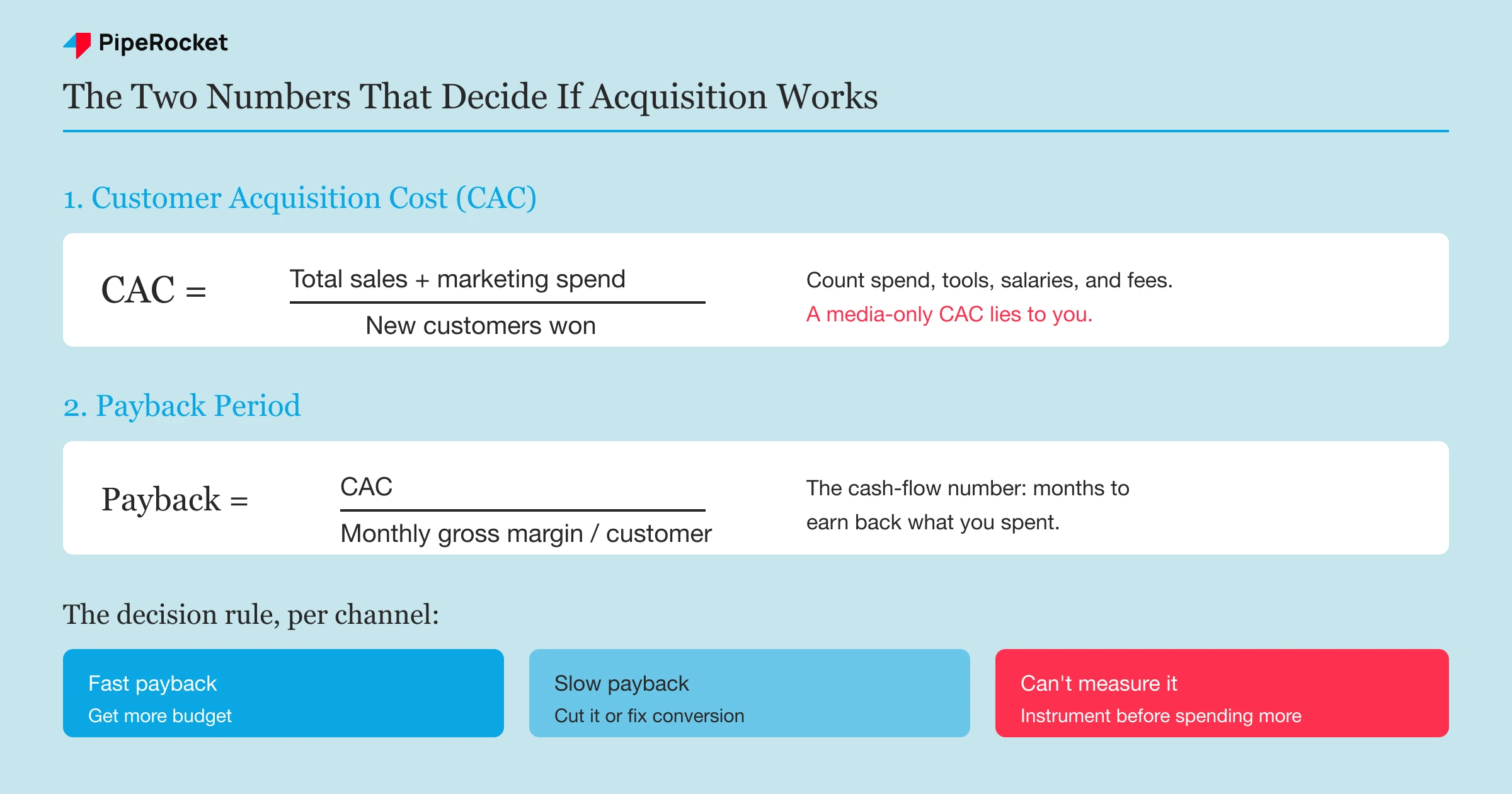
Customer acquisition cost is your total sales and marketing spend over a period divided by the number of new customers won in that period. Include the ad budget, the tools, the salaries, and the agency fees. A CAC that only counts media spend is a number that lies to you.
Then compare it to lifetime value . The LTV to CAC ratio tells you whether a customer is worth more than you paid to get them, and a common working target for B2B SaaS is roughly 3 to 1. Below that and you’re overpaying. Well above it and you’re probably underinvesting and leaving growth on the table.
The mistake I see most is a blended CAC that hides everything. When one channel pays back in months and another bleeds for two years, averaging them together tells you nothing. Calculate CAC per channel, or you can’t manage the portfolio at all.
Payback Period Is the Number That Kills or Funds a Channel
Payback period is how many months of a customer’s gross margin it takes to earn back what you spent acquiring them. It’s the cash-flow number, and it decides whether you can afford to keep spending. A channel with a great LTV to CAC ratio can still starve you if it takes two years to see the money.
Industry benchmarks put the median SaaS CAC payback at roughly 16 months, and bottom-quartile teams wait two years or more (Benchmarkit ). Treat that as directional, not a target. What matters is your own number against your own runway .
The decision rule is blunt once you have payback by channel:
- Channels that pay back fast get more budget.
- Channels that pay back slowly either get cut or get one specific fix to the conversion rate .
- Channels you can’t measure at all get instrumented before they get another dollar.
Forecast the Economics Before You Spend a Dollar
I run a rough forecast on every paid channel before launch, so I know whether the math can work at all. Start from the total search volume, model it down to impressions at a realistic impression share , then to clicks at a sane click-through rate , then to conversions at a believable landing-page rate. Multiply clicks by average cost per click for spend, divide by conversions for CPA.
On one account the numbers landed at a roughly $2,600 cost per acquisition . That sounds insane until you weigh it against the deal. When the lifetime value of that customer is around $90k, a $2,600 CPA is a no-brainer. The number is only high or low relative to what a customer is worth.
Do this before launch and you stop chasing channels the math was never going to support. You’re not buying pipeline on a hunch. You’re buying it against a forecast you can hold the channel to.
How to Pick Channels by Deal Size and Go-to-Market Motion
Match the channel to how you actually sell, not to what’s trending. A self-serve motion rewards a different portfolio than a committee-driven enterprise motion does. The highest-impact move is to sort every channel into one of two jobs first: capturing demand that already exists, or creating demand that doesn’t yet.
- Capture channels catch people already looking for a solution like yours: search ads, high-intent organic content, and referrals. These convert fast because the intent is already there.
- Influence channels plant the idea earlier, so weeks later the buyer comes looking for you by name: LinkedIn and Reddit sit here. They pay back slowly and only make sense on bigger deals.
As our team frames it internally, Google is for capture and LinkedIn is for influence. Judge an influence channel on last-click and you’ll pause the campaigns that were quietly working.
Top Acquisition Channels for SaaS
The channels that matter for SaaS group into four categories: SEO and content, paid search and social, outbound, and referrals and affiliates. Each carries a different cost, payback speed, and funnel job, so map them to your motion and deal size before you fund one.
- SEO and content: Capture channel that compounds; low cost over time and fits any ACV, self-serve or sales-led.
- Paid search and social: Google and Bing search ads capture mid-to-high-ACV intent; LinkedIn ads and ABM influence high-ACV committee buys.
- Outbound and SDR: High-cost, slow-payback capture and influence for high-ACV sales-led deals.
- Referrals and partnerships: Low-cost, fast-payback capture that works best with sticky products.
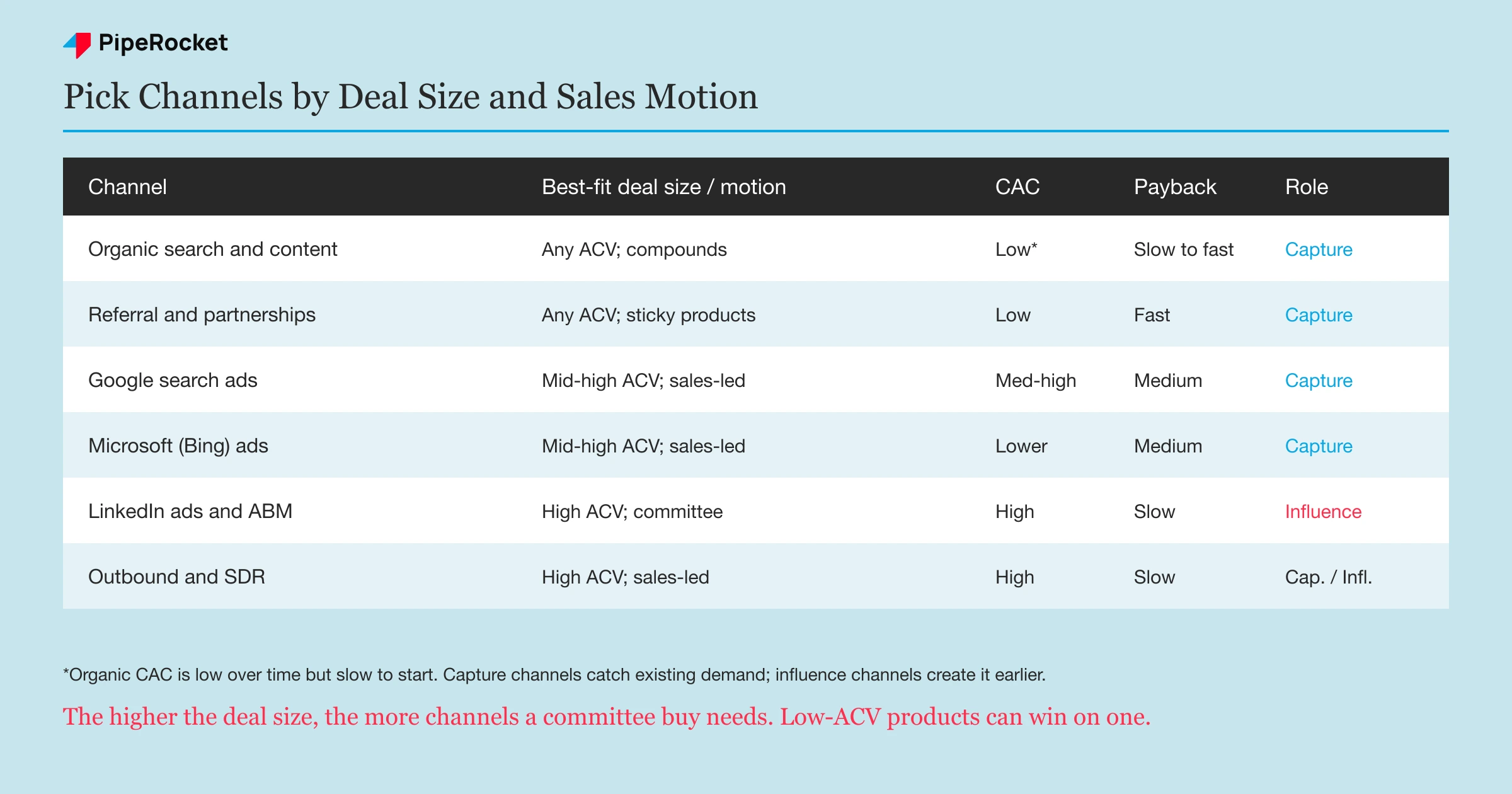
Here’s how the common SaaS channels line up:
| Channel | Best-fit deal size and motion | Relative CAC | Payback speed | Funnel role |
|---|---|---|---|---|
| Organic search and content | Any ACV; compounds for self-serve and sales-led | Low over time | Slow to start, then fast | Capture |
| Referral and partnerships | Any ACV; strongest with sticky products | Low | Fast | Capture |
| Google search ads | Mid to high ACV; sales-led | Medium to high | Medium | Capture |
| Microsoft (Bing) ads | Mid to high ACV; sales-led | Often lower than Google | Medium | Capture |
| LinkedIn ads and ABM | High ACV; committee buys | High | Slow | Influence |
| Outbound and SDR | High ACV; sales-led | High | Slow | Capture and influence |
Capture Demand Before You Try to Create It
Fund the channels that capture existing demand before the ones that create it. Someone searching “best SOC 2 compliance software” has a problem right now, and that click is worth far more than an impression served to someone who’s just scrolling. When budget is tight, high-intent capture is where the money should go first.
This is why I don’t start paid on top-of-funnel terms. Broad awareness queries pull students, researchers, and people months from buying, and they burn budget fast. Start on bottom and middle-funnel intent, the “best X software” and “X vs Y” searches, and only open awareness spend once you’ve genuinely saturated the high-intent terms and can’t spend more profitably there.
Creating demand isn’t wrong. It’s just a later move, and it’s a high-ACV move, because influence channels only pay off when the deal is big enough to justify the wait.
The Acquisition Funnel: From First Touch to Closed
Every acquisition funnel leaks somewhere between the click and the closed deal. The ad is rarely the culprit. The usual suspects are the landing page that doesn’t match the query, the demo form with no open slot, the pricing or checkout page that adds friction right before signup, and the follow-up that arrives two days late. You can have the sharpest targeting in your category and still lose most of it after the click.
For a self-serve product, the pricing and checkout page is an acquisition lever in its own right. A confusing plan grid or a signup that demands a card before value lands raises your effective CAC just as surely as a bad ad, so treat that page as part of the funnel you fix before you scale.
A CMO once told us on a call, “we spent $120K and made just $90K back.” The instinct is to blame the ads. The reality was messier.
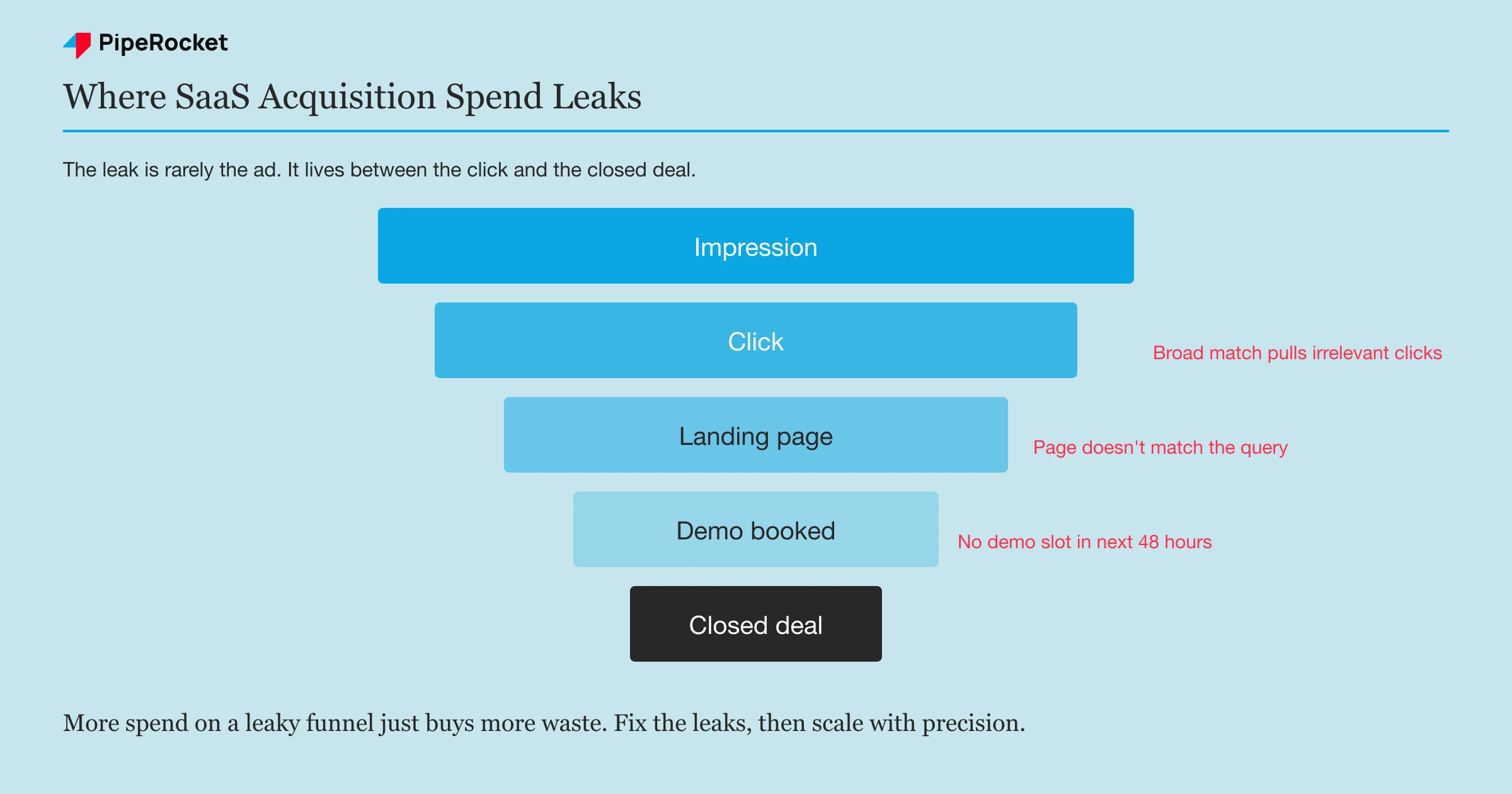
When we dug in, the money was leaking in four places at once:
- A quarter of qualified leads never scheduled, because there were no demo slots open in the next 48 hours.
- New campaigns ran on broad match and search partners, pulling far more irrelevant traffic.
- Cost per click on the best campaigns had jumped while clicks dropped, all to chase top-of-page share.
- Nearly half the search queries were informational, not buying intent.
Scaling Spend Without Fixing the Funnel Just Buys More Waste
Doubling spend on a leaky funnel doesn’t double pipeline. It multiplies the leak. On that same account, once we balanced the demo slots, paused broad match and search partners, stabilized bidding, and refocused on real buyer intent, the picture changed.
ARR grew from around $70K to $150K on a spend increase of only $100K to $130K. Roughly $30k more spend returned about $80k more ARR, because the fundamentals were fixed first.
Scaling spend and growing pipeline are two different things. At a cost-per-click ceiling, the next dollar buys a worse click than the last one, so more budget on a broken funnel just finds you more expensive ways to lose. Fix the leaks, then scale with precision.
When One Channel Maxes Out: Diversifying the Portfolio
Search demand runs out. Every category has a finite number of people typing your keywords each month, and once you own most of that auction, the next dollar buys clicks that cost more and convert worse. This is the moment single-channel accounts stall, and the wrong reaction is to keep squeezing Google.
We had a client whose leadership was frustrated on a January call. We’d scaled Google spend 25%, but pipeline was flat and revenue hadn’t moved. The category keywords were maxed, so every extra search dollar was burning. We made a bold call and restructured the whole spend:
- Keep search on a lean budget to capture the in-market demand that still existed.
- Reallocate the rest to building awareness with the right ICP on LinkedIn, the one platform with real firmographic and technographic targeting.
- Measure only real ICP accounts reached, with no vanity MQLs and no gated PDFs.
One rule held the reallocation together: this was awareness, not lead gen. Two months later, revenue grew from around $105K to $238K in ARR, and the average deal size climbed from $2.5k to $7.3k in MRR. The pipeline got sharper because we invested where the audience actually paid attention.
That’s the pattern across the founders I talk to. Google can’t carry the whole weight, and the teams that grow steadily build brand demand so their cost per opportunity drops over time as the market starts to trust them.
Common Acquisition Mistakes to Avoid
The expensive mistakes in acquisition aren’t tactical. They’re strategic errors about when to spend, how to measure, and what to buy. Here are the ones that cost the most.
Running paid before the product is ready to convert
A SaaS isn’t ready for paid until two things are true: a clear value proposition that separates it from the alternatives, and enough budget and patience to run a genuine three-month test. Without those, you’re not buying pipeline. You’re buying an expensive education. Paid amplifies whatever your funnel already does, so pointing spend at a page that doesn’t convert just makes you lose money faster.
Judging influence channels on last-click attribution
Nobody on LinkedIn is in buying mode. The ad plants a seed, and weeks later the buyer Googles your brand and converts, which last-click credits to search. Score your influence channels on last-click and you’ll pause the exact campaigns feeding your branded search.
Reddit works the same way. It’s an awareness channel, so judge it on reach and assisted pipeline, not on demos it gets last-touch credit for.
Buying cheap clicks that never convert
When traffic grows but pipeline stays flat, you have an audience problem dressed up as a traffic win. I’ve watched accounts pour budget into cheaper clicks and wider match types, only to fill the funnel with people who were never going to buy. One high-intent visitor who matches your ICP is worth more than a thousand curious clicks. Tighten the targeting before you widen the top.
Treating acquisition budget as a fixed percentage
Budget shouldn’t be a flat number you set once and defend. It should move with payback. When SEO becomes the primary pipeline channel, it can justify a larger share of marketing spend than an early experiment does. Set the split by which channels are paying back, and revisit it every quarter as those numbers change, not once a year in a planning deck.
How to Know Your Acquisition Model Is Working
You know it’s working when spend, payback, and pipeline all move together, not when a dashboard shows more clicks. The whole point of treating acquisition as a portfolio is that you can see which parts fund growth and which parts drain it. That only happens if you measure the right things.
Track these, per channel and blended:
- Blended and per-channel CAC, so you can see which channels actually fund the next customer.
- Payback period by channel, the cash-flow number that decides funding.
- LTV to CAC ratio, to catch channels you’re overpaying for or underinvesting in.
- Trial-to-paid conversion rate, the metric that tells a product-led motion whether the signups you acquire actually turn into revenue.
- Churn, because a customer who leaves early quietly wrecks your LTV and turns a payback that looked healthy into a loss.
- Organic-attributed and paid-attributed pipeline, measured in real opportunities rather than sessions or impressions.
Weigh organic carefully here, because it usually converts better than the numbers first suggest. Across the 53 B2B SaaS brands we analysed over eight months, organic generated 37x more leads in absolute terms than all AI referral sources combined, and converted visitors to leads at 0.92%, nearly 3.5x the AI rate. Channels that compound quietly can carry more of your acquisition than a last-click view ever credits them for.
The tell that you’ve got it right is boring but real. Your cost per opportunity trends down over a few quarters, your payback shortens, and you can say with a straight face which channel earned each customer.
Why PipeRocket Digital Builds SaaS Acquisition Engines
We build acquisition as a system, not a pile of campaigns. That means forecasting the CAC and payback math before we spend, funding the channels that capture real intent first, and treating awareness channels as influence rather than last-click lead gen. On the paid side, our SaaS PPC team fixes the funnel leaks before scaling spend. On organic, our SaaS SEO work builds the compounding channel that carries pipeline for years. If you want this built properly, reach out to us .
Frequently Asked Questions
What is a good CAC payback period for B2B SaaS?
A payback period under 12 months is generally considered healthy for B2B SaaS, and venture-backed teams chasing rapid growth often aim for six to nine months. Industry benchmarks put the median closer to 16 months, so many companies sit above the ideal. The right target depends on your runway and margin, not on a single benchmark. If a channel pays back fast enough to fund the next customer without straining cash flow, it’s working.
Which customer acquisition channels work best for SaaS?
There’s no universal best channel, because the right mix depends on your deal size and sales motion. Low-ACV, self-serve products often win on organic search, content, and referrals, which carry low acquisition costs and compound over time. Higher-ACV committee buys usually need a portfolio that adds paid search, LinkedIn ABM, and outbound, since no single channel reaches a whole buying committee . Start with the channels that capture existing demand, then add demand-creation channels once your high-intent spend is saturated.
What is the rule of 7 in B2B?
The rule of 7 says a prospect typically needs about seven touches across channels before they convert. That’s why influence channels like LinkedIn should be judged on assisted pipeline and branded search, not on last-click demos, since most of their work happens before the final click.
What is the difference between customer acquisition and lead generation?
Lead generation sits inside acquisition as one piece of it. Lead gen focuses on capturing contacts, the forms and offers that turn interest into a named prospect. Customer acquisition is the broader model: the full economics and channel portfolio that turn a stranger into a paying customer, including CAC, payback, and the funnel all the way to a closed deal. You can generate plenty of leads and still have a broken acquisition model if those leads never convert profitably.