Most SaaS teams adopt product-led growth for the wrong reason. They hear it lowers CAC and read it as “we can grow without a sales team.” Then the free signups pour in, activation stays flat, and revenue doesn’t move.
Product-led growth works when the product runs the first sales conversation for you. That only happens if a new user reaches real value before they lose interest. This guide walks the whole PLG motion: trial versus freemium, activation, product-qualified leads, self-serve funnels, expansion, and the numbers that tell you it’s working.
TL;DR
- PLG is a full growth motion: the product carries the top of the sales conversation, so most PLG failures trace back to activation rather than acquisition.
- Trial or freemium is a product decision: trials suit fast, single-value products; freemium suits high-volume tools with network effects and a real free-tier ceiling.
- Activation is the whole game: if new users don’t hit their first real value fast, nothing downstream (retention, expansion, revenue) has a chance.
- PQLs beat MQLs on conversion: a lead defined by in-product behaviour plus fit converts far better than one defined by a form fill.
- PLG and sales-led aren’t rivals: most B2B SaaS above a certain deal size ends up running both, with the product feeding sales the warm accounts.
- Expansion is where PLG pays off: self-serve acquisition is cheap, but the compounding revenue comes from existing accounts using more over time.
- Measure the whole funnel: activation rate, PQL conversion, time-to-value, and net revenue retention tell you the truth; a raw signup count hides every problem underneath it.
- PLG carries real execution risk: without tight product-market fit, a poor free experience burns signups faster than a bad ad, so a weak product makes PLG more expensive than sales-led.
Why Product-Led Growth Needs Its Own Playbook
Product-led growth means the product itself drives acquisition, conversion, and retention, so a user can experience value before they ever talk to a human. That single shift breaks most of the standard SaaS growth playbook, which assumes a lead fills a form and a rep takes it from there.
Here’s the belief that gets teams into trouble. They treat PLG as “sales-led growth minus the salespeople.” So they bolt a free trial onto the same funnel, keep the same metrics, and wait for cheaper pipeline. It doesn’t come, because the product now owns the job the rep used to do, and nobody built it for that.
Adoption is real and still climbing. Roughly 91% of B2B SaaS companies above $50M ARR now run a PLG motion, and 91% of firms with a PLG motion plan to invest more in it . Popularity isn’t the same as competence, though.
The product does the first sales conversation now
In a sales-led motion, a rep qualifies the buyer, handles objections, and shows value in a demo. In PLG, the product does all three before anyone reaches out. The onboarding is the discovery call. The empty-state screen is the pitch. The first workflow a user completes is the proof.
So the work moves upstream, into product and onboarding, where most marketing teams have little control. That’s why PLG needs its own playbook. You’re not optimising a form or a landing page anymore, you’re optimising whether a stranger can teach themselves your product in one sitting.
Cheaper acquisition, harder conversion
PLG lowers the cost of getting someone in the door, and it raises the bar on what happens next. A free signup costs you almost nothing. Turning that signup into an activated user who pays is far harder than closing a lead a rep already warmed up.
The trade-off is blunt. Sales-led motions spend money to create qualified conversations. Product-led motions spend product and onboarding effort to earn them for free. If your product can’t carry that weight, PLG just fills your database with people who never come back.
Free Trial or Freemium: Which One Fits Your Product
The trial-versus-freemium choice is a product decision, and picking the wrong model quietly caps your growth for years. A free trial gives full access for a limited window. Freemium gives limited access forever. They attract different users and convert on different mechanics.
Free trials tend to convert a higher share of signups. Recent benchmarks put free-trial signup-to-paid conversion near 17%, versus roughly 5% for freemium . Freemium usually pulls more signups in the first place, so the models trade volume for conversion rate . Neither number means much until you match it to your product.
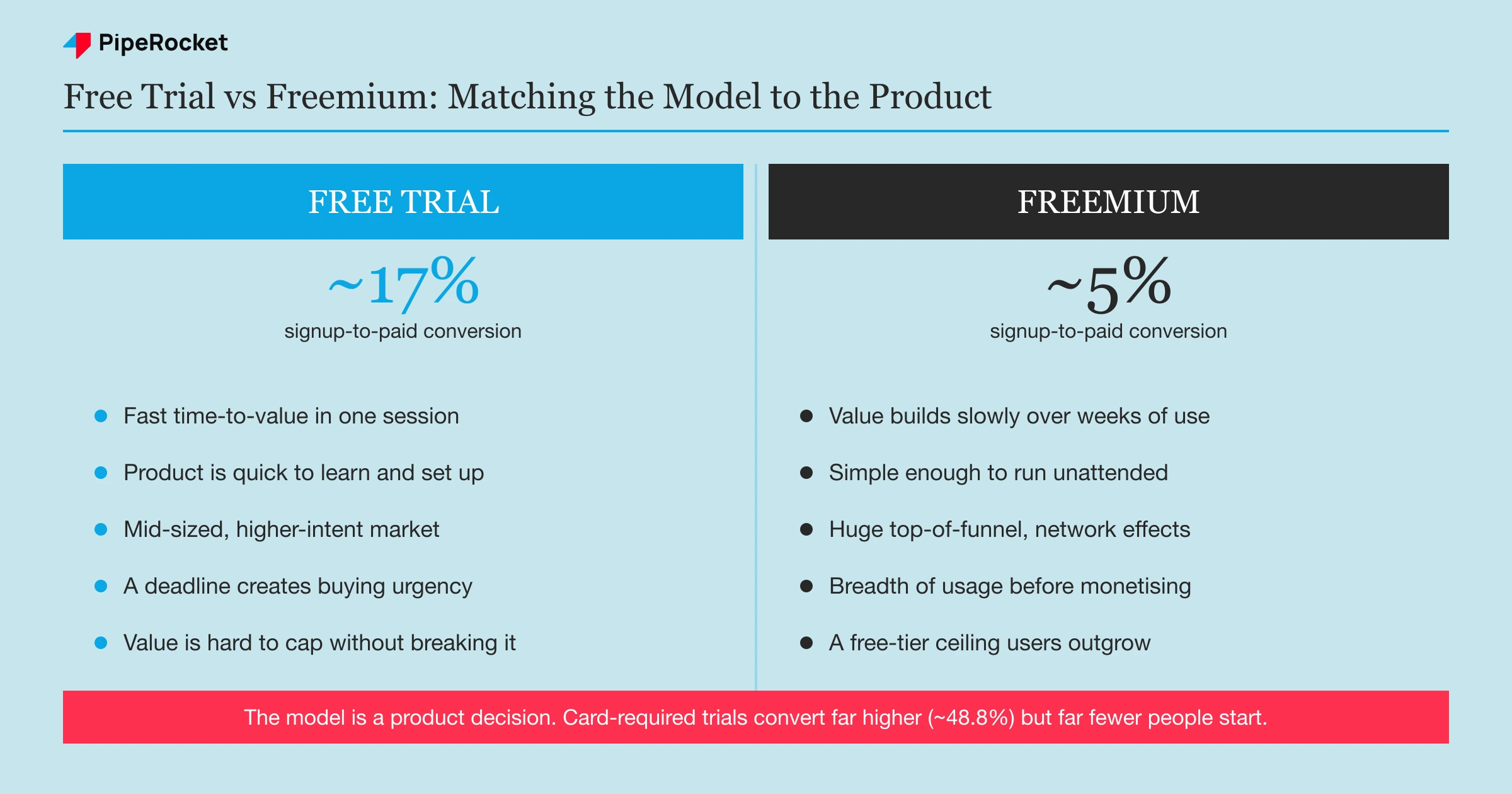
Here’s the split I use when advising SaaS teams on which model fits.
| Factor | Free trial fits when | Freemium fits when |
|---|---|---|
| Time-to-value | A user can hit real value in one session | Value builds slowly over weeks of use |
| Product complexity | Product is fast to learn and set up | Product is simple enough to run unattended forever |
| Volume potential | Market is mid-sized, higher-intent | Huge top-of-funnel with viral or network effects |
| Free-tier ceiling | Hard to cap value without breaking the product | Easy to draw a line users will outgrow |
| Sales overlay | You want a deadline to create urgency | You want breadth of usage before monetising |
Credit-card-required trials change the math
Asking for a card upfront changes who signs up and how they convert. Opt-out trials that require a card convert dramatically higher, with one benchmark showing roughly 48.8% for card-required trials versus about 18.2% for opt-in . The catch is obvious: far fewer people start.
So the card gate is a filter, not a free win. It suits products with clear, immediate value where the buyer already knows they want in. For a top-of-funnel land-and-expand play, the card wall throttles the exact volume freemium is supposed to generate.
Don’t run both models by accident
Plenty of teams end up with a trial and a free tier because different quarters shipped different experiments. That’s the worst outcome. Each model needs its own activation goal, its own conversion trigger, and its own messaging.
A compliance SaaS for fintech teams, for instance, rarely wins on freemium because the value shows up only after a real audit workflow runs. A trial with a firm deadline and guided setup fits that buyer far better than a permanently free sandbox they poke at once and abandon.
Getting Users to Value: Activation and Time-to-Value
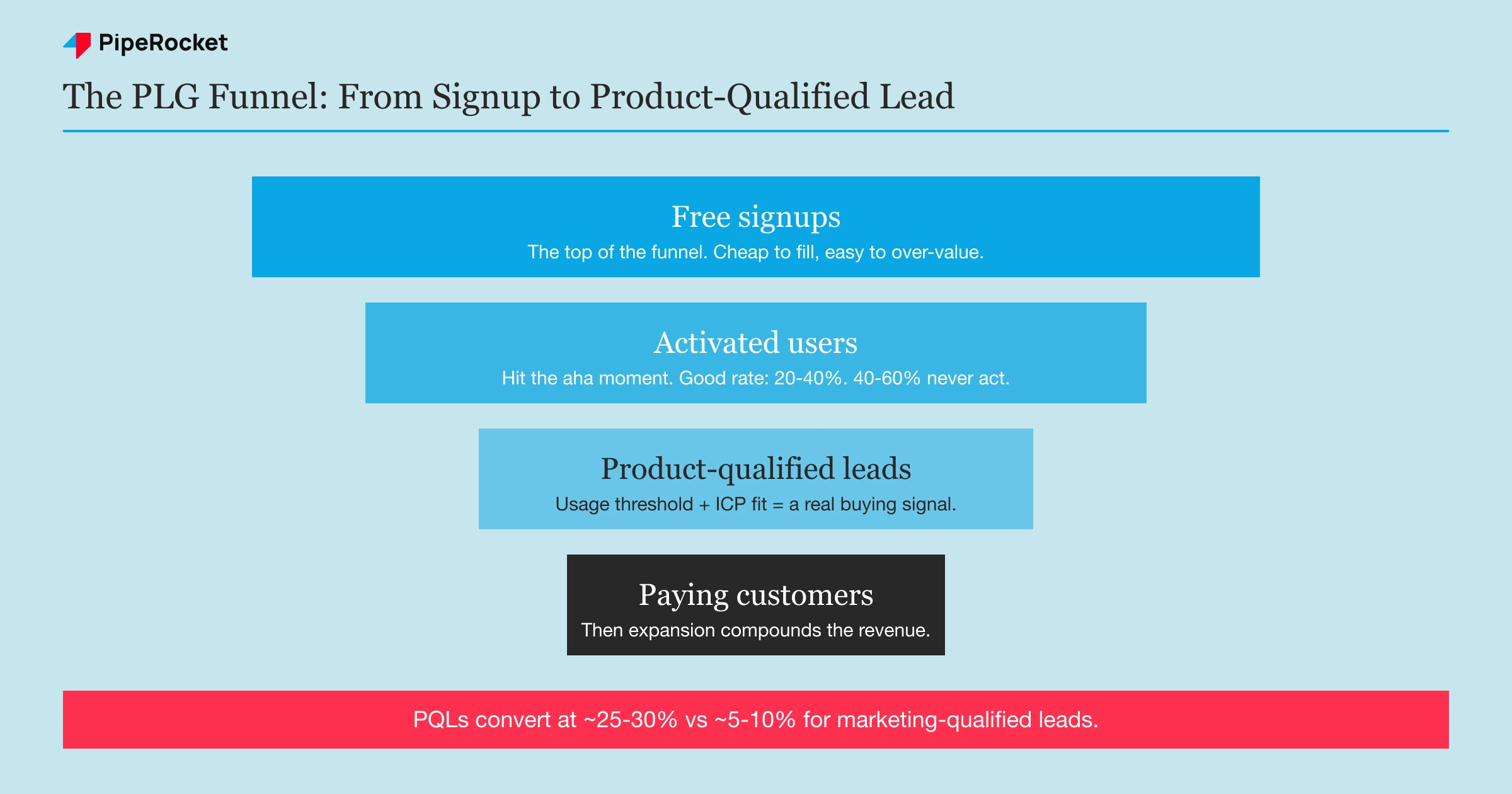
Activation is where PLG is won or lost, and it’s the metric most teams underinvest in. Activation is the share of new users who reach a defined first-value milestone. Everything downstream depends on it, yet only about 34% of PLG teams actually track it .
The numbers show how brutal the drop-off is. A good activation rate averages around 30% to 40%, with best-in-class above 50% , while 40% to 60% of free users never take a single meaningful action . Most of your signups are ghosting you before they ever see what you built.
Define the aha moment before you optimise anything
You can’t improve activation until you name the single action that predicts a user sticks. That’s the aha moment: the specific thing an activated user does that a churned one doesn’t. It’s rarely “signed up” or “logged in twice.”
The classic example is Slack treating a team that hits 2,000 messages as genuinely activated, because usage at that level correlates with retention. Your milestone will be different. Find the in-product action that separates users who renew from users who vanish, then make reaching it the whole job of onboarding.
Time-to-value is measured in minutes
Time-to-value is how long it takes a new user to reach that first milestone, and shorter is almost always better. Best-in-class PLG products aim to deliver a first “aha” inside the opening session, often within the first few minutes of use.
Every step between signup and value is a place to lose people. Long setup forms, empty dashboards, and “invite your team first” walls all push value further away. The fix is usually subtraction: cut steps, pre-fill data, show a populated example instead of a blank screen.
Note: activation and time-to-value are product problems dressed as marketing problems. Marketing can drive signups all day, but if onboarding can’t get a stranger to value, more traffic just means more waste.
Product-Qualified Leads: Reading Usage as a Buying Signal
A product-qualified lead is a user whose in-product behaviour, combined with fit, signals they’re ready to buy or expand. This is the single biggest advantage PLG hands you: instead of guessing intent from a form, you read it from what people actually do inside the product.
The conversion gap is large. Leads qualified by product usage convert at roughly 25% to 30%, against 5% to 10% for marketing-qualified leads . A user who has already built something real in your product is a fundamentally warmer buyer than one who downloaded an ebook.
A PQL is usage plus fit
Heavy usage from a solo user at a company you can’t sell to isn’t a PQL, it’s a hobbyist. A real PQL combines two things:
- Behaviour: the user has hit meaningful usage, like reaching a limit, inviting teammates, or completing a core workflow repeatedly.
- Fit: the account matches your ICP on role, company size, and industry.
Score both. A user who trips a usage threshold and works at a target-account company is who your sales team should call. Someone who does one but not the other stays in the self-serve flow until the picture changes.
Define the threshold from your own retention data
Your PQL definition has to come from your data, not a blog post. Look at accounts that converted and expanded, then find the in-product actions they shared in their first weeks. That pattern is your threshold.
Set it too low and you flood sales with noise, which trains reps to ignore the signal. Set it too high and you starve them of pipeline while good accounts convert themselves at a lower price than a sales conversation would have earned. Revisit the threshold as the product and ICP change.
PLG or Sales-Led: How to Choose (and When to Run Both)
PLG and sales-led growth aren’t opposing camps you must pick between. For most B2B SaaS above a certain deal size, the real answer is both, sequenced so the product feeds sales the accounts worth a human conversation. The question is which motion leads.
Deal size and product complexity decide the lead motion. A cheap, simple tool a single user adopts can run almost entirely self-serve. A six-figure platform bought by a committee needs sales, with the product acting as proof rather than the closer.
PLG also differs from sales-led and community-led growth in who does the convincing. Sales-led growth puts a rep at the centre, community-led growth puts peers and a user community at the centre, and product-led growth puts the product itself at the centre. Most mature SaaS blends all three, but the lead motion decides where you invest first.
| Dimension | PLG leads | Sales-led leads |
|---|---|---|
| Deal size | Low to mid ACV | High ACV, committee buys |
| Buyer | Individual or small team adopts first | Multiple stakeholders evaluate together |
| Product complexity | Self-serve setup possible | Needs configuration, security review, onboarding |
| Time-to-value | Minutes to days | Weeks, often with implementation |
| Primary cost | Product and onboarding investment | Sales headcount and marketing spend |
The product-qualified account is where the two motions meet
In a hybrid motion, PLG handles acquisition and early value, then hands sales the accounts showing real traction. Sales doesn’t chase cold lists, they call accounts already using the product and hitting expansion signals. That’s the strongest version of both motions running together.
This is why PLG valuations tend to run higher. Product-led companies have historically traded at a premium to the broader SaaS index per OpenView’s PLG Index , largely because the self-serve base lowers CAC while the sales overlay captures the big expansions.
When PLG breaks
PLG works when a user can reach value alone and the product’s value grows with usage. It breaks when the buyer and the user are different people, when security or procurement gates every deal, or when value only appears after heavy configuration. Force PLG onto that product and you’ll generate signups that never convert because the person who signs up can’t actually say yes.
The Expansion Loop: Where PLG Revenue Compounds
Expansion is where product-led growth actually pays for itself. Self-serve acquisition is cheap, but the compounding revenue comes from existing accounts using more over time, which is why net revenue retention is the metric investors care about most in PLG businesses.
The mechanic is simple. A user lands on a free or entry tier, gets value, pulls in teammates, hits a usage ceiling, and upgrades. Then the account expands seats, adds workflows, and grows again. That loop turns one activated user into an account that pays more every year without new acquisition cost. Products with an active user community tend to see this loop compound faster, since peers answering each other’s questions and sharing workflows does some of the activation work a support team would otherwise carry, which is the core mechanic behind community-led growth .
Build the upgrade trigger into the product
Expansion shouldn’t depend on a rep noticing an account is growing. The product should surface the upgrade at the moment a user hits a natural ceiling: a seat limit, a usage cap, a locked feature they now clearly need. The best upgrade prompts arrive exactly when the pain is real.
That’s the quiet strength of a well-drawn free tier. The line between free and paid should sit right where a happy user starts to outgrow it, so upgrading feels like a reward rather than a toll. Draw it too generously and users never bump the ceiling. Draw it too tight and they leave before they see value.
Viral loops turn users into an acquisition channel
Viral loops are sharing and collaboration features that pull new users into the product as a byproduct of normal use, so each active user quietly recruits the next. This is the fourth core PLG lever alongside fast time-to-value, self-serve onboarding, and product-qualified leads.
The mechanic is built into the workflow, not bolted on as a referral gimmick. Inviting a teammate to collaborate, sharing a document, or sending a scheduling link all expose a non-user to the product at the moment it’s useful. A strong loop means acquisition compounds from usage instead of from ad spend.
PLG in practice: how well-known products run the motion
The clearest PLG examples are products a stranger can adopt alone and then spread to a team. A few widely-known motions show the pattern:
- Slack: individuals and small teams start using it, then invite coworkers, so adoption spreads across an org from the bottom up.
- Dropbox: its referral program rewarded users with extra storage for inviting friends, turning the product’s own users into its acquisition channel.
- Calendly: every scheduling link sent to a non-user exposes them to the product at a useful moment, which is a viral loop built into the core action.
- Zoom: joining a meeting introduces non-users to the product before they ever sign up, seeding self-serve adoption.
Each one lets a user reach value alone, then builds sharing or collaboration into the workflow so usage drives new signups.
Retention has to come first
Expansion only compounds on top of retention, so churn quietly undoes all of it. An account that expands then churns six months later is worse than one that never expanded, because you invested in growing something that walked away. Fix the leak before you pour in more water.
The Metrics That Tell You PLG Is Working
The right PLG metrics track the whole funnel from signup to expansion. A raw signup count is the vanity number that hides every problem underneath it. A dashboard full of signups with flat activation is a slow-motion failure.
Track this short stack instead of a wall of numbers:
- Activation rate: the share of signups reaching your first-value milestone. This is the leading indicator for everything else.
- Time-to-value: how long that milestone takes. Rising TTV predicts falling activation.
- Free-to-paid conversion: the share of free or trial users who become paying customers.
- PQL conversion rate: how well product-qualified leads turn into revenue, which validates your threshold.
- Net revenue retention: expansion minus churn from existing accounts, the real health check on a PLG business.
For an early-stage PLG motion, start with just three: activation rate, time-to-value, and net revenue retention. An NRR above 120% is widely treated as best-in-class, because expansion outpacing churn is what makes revenue compound without buying every new dollar.
Read these as a connected funnel. A strong activation rate with weak free-to-paid conversion points at pricing or the upgrade trigger. Strong conversion with weak NRR points at retention. The metric that’s lagging tells you which part of the motion to fix next.
Common Mistakes to Avoid
Treating PLG as an acquisition tactic instead of a full motion
The most common failure is bolting a free trial onto a sales-led funnel and calling it PLG. The trial pulls in signups, but nothing in product or onboarding changed, so activation stays flat and the “cheaper pipeline” never shows up. PLG is a motion that spans product and onboarding, right through to how you monetise. A free trial on the pricing page is just one visible surface of it.
Optimising signups while ignoring activation
Marketing gets rewarded for signups, so that’s what teams chase, even though 40% to 60% of free users never take a meaningful action . Doubling signups while activation stays flat just doubles the number of people who ghost you. The signup is the start of the work, not the win.
Drawing the freemium line in the wrong place
A free tier that’s too generous means users get everything they need and never upgrade. Too stingy and they leave before reaching value. The line should sit exactly where a happy user starts to outgrow it, so hitting the ceiling feels like earning the upgrade, not paying a toll.
Setting a PQL threshold you never revisit
A PQL definition pulled from a blog post, or set once and forgotten, sends sales the wrong accounts. Too loose and reps drown in noise and start ignoring the signal. Too tight and good accounts convert themselves at a discount to what sales could have earned. Rebuild the threshold from your own retention data, and revisit it as the product changes.
Forcing PLG onto a product that can’t carry it
When the buyer isn’t the user, or every deal needs a security review, self-serve conversion stalls no matter how good onboarding is. The person who signs up can’t actually approve the purchase. For those products, PLG belongs as a proof layer feeding sales, not as the primary motion.
How PipeRocket Digital Helps SaaS Teams Build a PLG Engine
As a SaaS marketing agency , we build the acquisition and activation layer that a product-led motion lives or dies on. That means self-serve funnels tied to a real activation milestone, product-led content that pulls in users who convert, and reporting that tracks activation and PQL conversion instead of raw signups. Most agencies chase traffic. We tie the motion to pipeline and expansion. If you want this built properly, you can compare the best SaaS marketing agencies , see how our SaaS SEO agency service drives product-led content, or reach out to us here .
Frequently Asked Questions
What is product-led growth?
Product-led growth is a motion where the product itself drives acquisition, conversion, and retention, so a user reaches real value before ever talking to a salesperson. Free trials, freemium, and self-serve onboarding let the product run the first sales conversation on its own.
What is a product-led growth SaaS company?
A product-led growth SaaS company is one where the product does the qualifying, demo, and proof work a sales rep would otherwise do. Users sign up, onboard themselves, and hit value before contact, and the product feeds warm accounts to sales rather than the other way around.
What are product-led growth examples?
Slack, Dropbox, Calendly, and Zoom are common PLG examples. Users adopt each alone, then sharing or collaboration spreads it: Slack invites coworkers, Dropbox rewarded referrals with storage, Calendly links reach non-users, and joining a Zoom call exposes new people to the product.
What’s the difference between product-led growth and sales-led growth?
In sales-led growth, a rep qualifies the buyer, runs the demo, and closes the deal, so the human drives the conversion. In product-led growth, the product does that job first: users sign up, onboard themselves, and reach value before anyone reaches out. PLG usually suits lower-ACV products a single user can adopt, while sales-led suits high-ACV, committee-driven deals. Most B2B SaaS above a certain deal size ends up running both, with the product feeding sales the accounts already showing traction.
Is a free trial or freemium better for SaaS?
It depends on your product, not on which converts better in the abstract. Free trials convert a higher share of signups, roughly 17% versus about 5% for freemium, but freemium usually generates more signups to begin with. Trials fit products with fast time-to-value where a deadline creates urgency. Freemium fits high-volume products with network effects and a free-tier ceiling users naturally outgrow. Pick the model that matches how your product delivers value, then commit to it rather than running both by accident.
What metrics matter most in product-led growth?
Activation rate, time-to-value, and net revenue retention are the three to start with. Activation, the share of signups who reach your first-value milestone, is the leading indicator, because retention, conversion, and expansion all depend on it. Time-to-value tells you how fast users get there, and rising TTV predicts falling activation. Net revenue retention, expansion minus churn from existing accounts, shows whether revenue compounds. Once those are stable, layer in free-to-paid conversion and PQL conversion rate. Total signups is the metric to ignore.