SaaS Marketing Metrics That Actually Matter
 Omar Sheriff
Last updated on
Omar Sheriff
Last updated on

A SaaS team tracking thirty metrics on a dashboard usually can’t tell you which three moved revenue last quarter. Tracking everything is how you end up reporting nothing useful. A handful of marketing metrics actually tie back to pipeline and revenue, and the rest are vanity that fill slides and impress no one who reads a P&L. Here’s the set worth tracking, grouped so you can build a dashboard that means something, plus the metrics you should stop reporting.
TL;DR
- Three groups cover what matters: Lead and funnel metrics, cost and value metrics, and revenue and retention metrics are the only groupings a SaaS marketing team needs.
- Lead and funnel metrics find the leak: MQL-to-SQL, website conversion rate, and trial-to-paid show stage by stage exactly where pipeline is lost.
- Cost and value metrics answer the economics: CAC, CAC payback, and a 3:1 LTV:CAC ratio tell you what a customer costs and whether acquisition is sustainable.
- Revenue and retention metrics matter most: MRR/ARR, churn, and net revenue retention above 100% are the numbers a board and a CFO actually read.
- Stop reporting vanity: Raw traffic, impressions, followers, and email opens measure activity rather than outcomes, and they crowd out the metrics that count.
What Are SaaS Marketing Metrics?
SaaS marketing metrics are the numbers that measure how marketing drives customer acquisition, revenue, and retention. They cover what it costs to win a customer, how well the funnel converts, and how much revenue marketing influences over time.
They overlap with product and sales metrics but aren’t the same. Product metrics track usage and activation inside the app, and sales metrics track the deal cycle. Marketing metrics connect spend to pipeline. The trap most teams fall into is treating every measurable number as a metric worth reporting, when the job is to connect dollars in to revenue out, not to count activity.
Lead and Funnel Metrics
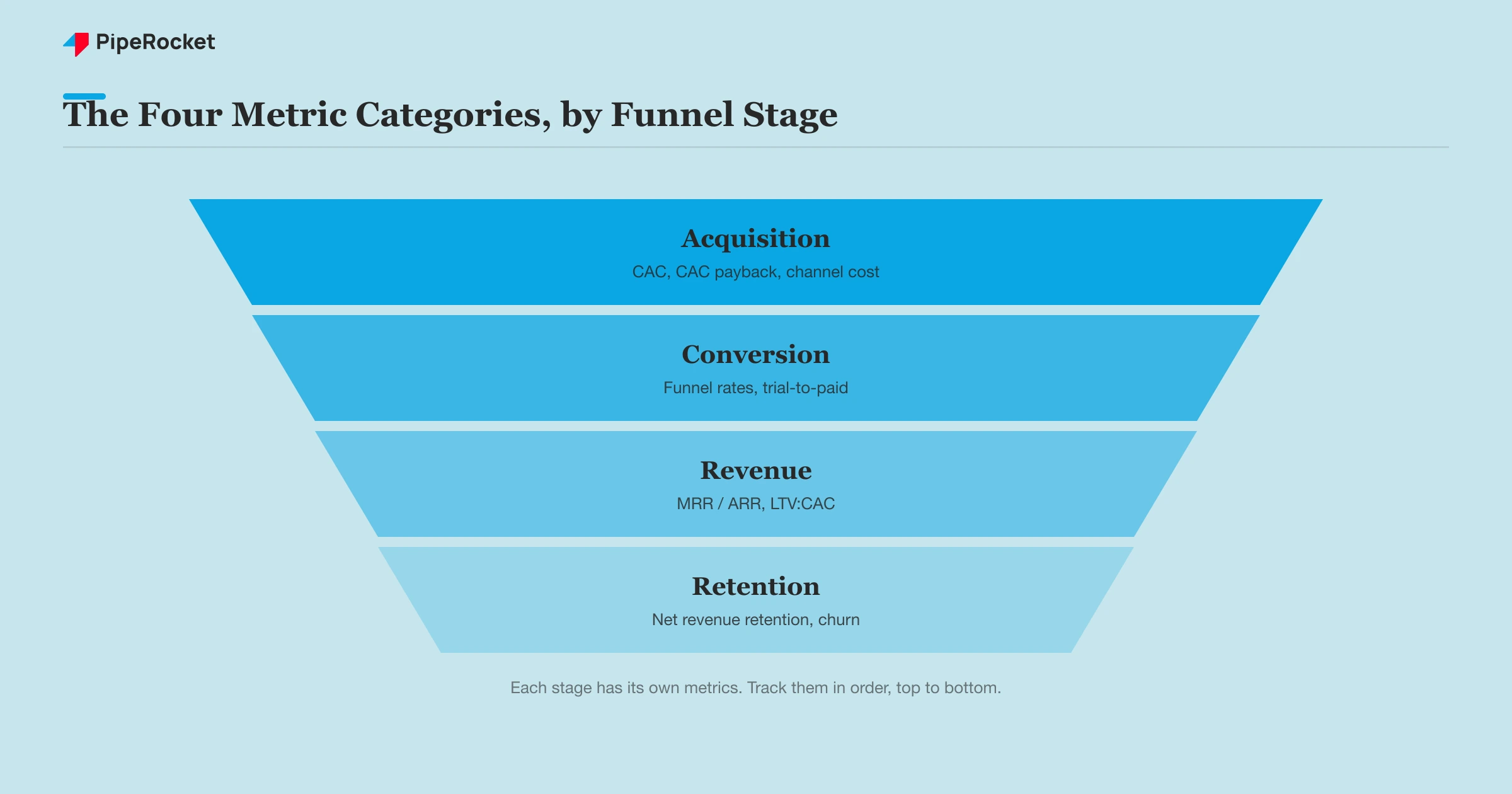
Lead and funnel metrics track how prospects move from visitor to paying customer, and a single stage usually explains a stalled pipeline. The core set is MQL, SQL, website conversion rate, funnel conversion rate by stage, and trial-to-paid. When traffic is up but revenue is flat, one of these steps is doing the damage.
| Metric | What it measures | Formula |
|---|---|---|
| MQL (marketing qualified lead) | A lead that meets a fit and behavior threshold marketing agrees is worth passing to sales | Leads meeting the agreed MQL scoring bar |
| SQL (sales qualified lead) | An MQL that sales accepts as worth actively pursuing | MQLs accepted by sales as sales-ready |
| Website conversion rate | Share of site visitors that take the target action (signup, demo, trial) | Conversions ÷ total visitors |
| Funnel conversion rate (by stage) | Share of prospects that move from one funnel stage to the next | Leads reaching next stage ÷ leads entering the stage |
| Trial-to-paid rate | Share of free trials that become paying customers | Paid conversions ÷ trials started |
| Signup-to-activation rate | Share of new users that reach the product’s first-value moment | Activated users ÷ signups |
MQL and SQL
An MQL is a lead that clears a fit-and-behavior threshold marketing agrees is worth passing on; an SQL is an MQL that sales accepts as worth pursuing. The gap between the two is where marketing and sales alignment shows up. A flood of MQLs that sales rejects means your scoring bar is measuring interest, not intent.
Website and funnel conversion rate by stage
Funnel conversion rate is the share of prospects that move from one stage to the next, measured at every step rather than just top to bottom. Track visitor to lead, lead to MQL, MQL to SQL, and SQL to closed-won. Measuring each stage separately is what lets you find the leak, because a healthy top of funnel feeding a broken middle looks fine on a traffic chart and terrible on a revenue chart.
Trial-to-paid and signup-to-activation
Trial-to-paid rate is paid conversions divided by trials started, and for product-led SaaS these two conversions decide your revenue. Signup-to-activation measures whether new users reach the moment the product clicks, and trial-to-paid measures whether that turns into money. A product-led company with a weak activation rate has a leak no amount of top-of-funnel traffic will fix, so these belong on the core dashboard, not in a product silo.
Cost and Value Metrics
Cost and value metrics answer what a customer costs to acquire and whether that cost pays back. The core set is CAC, CAC payback period, customer lifetime value (CLV/LTV), and the LTV:CAC ratio. Get them right and you know which channels to fund. Get them wrong, usually by measuring leads instead of customers, and you scale the channels that look cheap but never close.
| Metric | What it measures | Formula |
|---|---|---|
| CAC | Fully loaded cost to acquire one customer | (Ad spend + tools + agency fees + salaries) ÷ new customers |
| CAC payback period | Months to recover acquisition cost from a customer | CAC ÷ monthly gross-margin revenue per customer |
| CLV / LTV | Gross-margin revenue expected from a customer over their lifetime | Average gross-margin revenue × average customer lifetime |
| LTV:CAC ratio | Whether acquisition is economically sustainable | LTV ÷ CAC |
Customer acquisition cost (CAC)
CAC is your fully loaded cost to acquire one customer: ad spend, tools, agency fees, and the salaries of the people doing the work, divided by the number of new customers in the period. The number most teams report is cost per lead, then they call it CAC. That miscalculation hides a broken funnel, because cheap leads that never convert make acquisition look efficient when it isn’t. Run your own numbers through our free CAC calculator to see where you actually land. Blended CAC across all channels hides which ones work, so segment CAC by channel or you defund the channel that converts best.
CAC payback period
CAC payback is the number of months it takes to recover acquisition cost from a customer’s gross-margin revenue. It matters more than CAC alone because it’s a cash-flow metric, not a vanity ratio. A common benchmark is recovering CAC inside 12 months for a healthy SaaS, though it varies by deal size and motion. The longer the payback, the more cash you tie up to grow.
Customer lifetime value and LTV:CAC
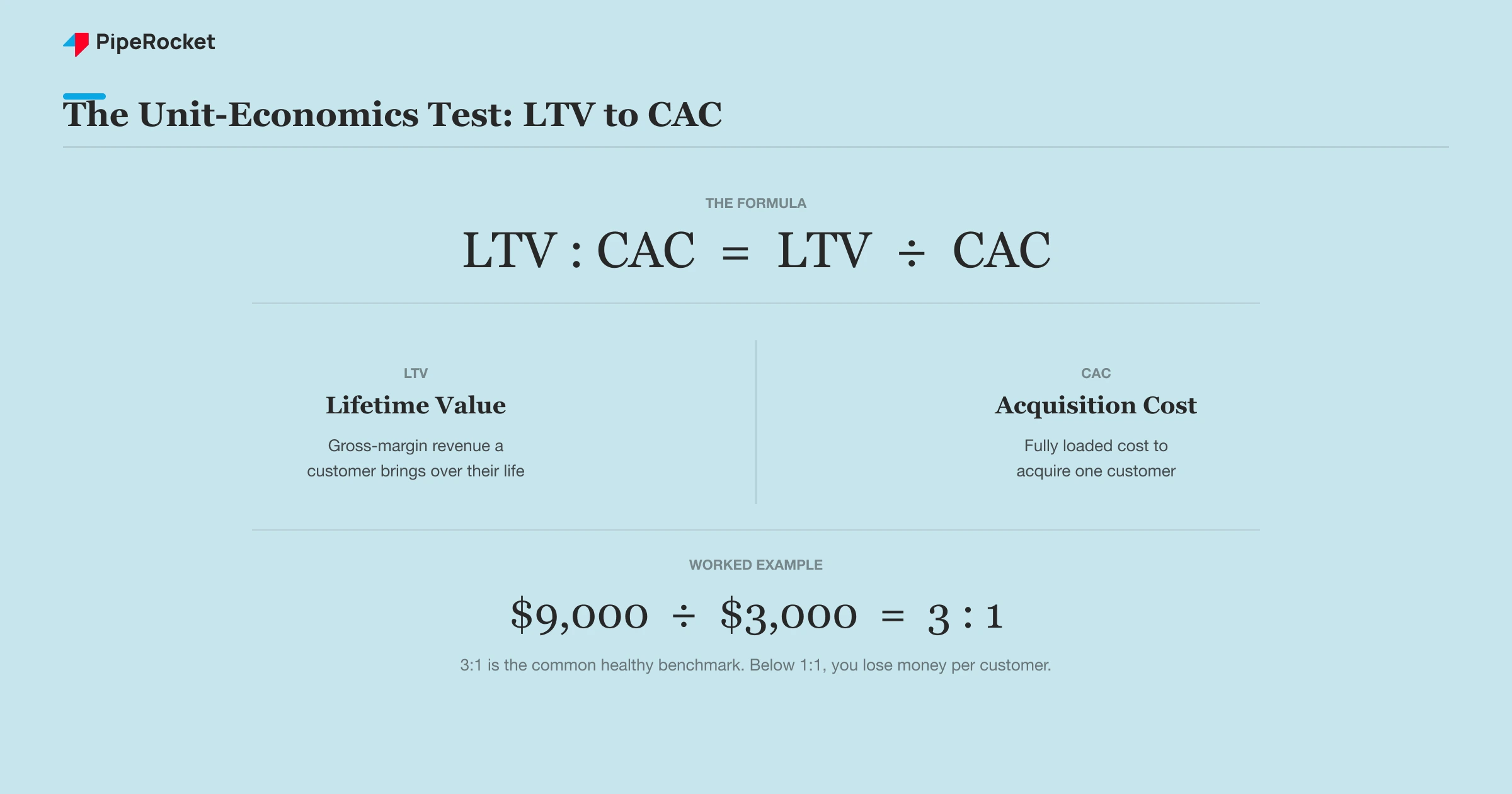
LTV is the gross-margin revenue you expect from a customer over their lifetime, and the LTV:CAC ratio is the unit-economics test of whether acquisition is sustainable. The widely cited rule of thumb is 3:1, meaning a customer is worth roughly three times what you paid to acquire them. Below 1:1 you lose money on every customer, and far above 3:1 often means you’re underinvesting in growth. Treat LTV as an informed estimate, since it rests on assumptions about lifetime and churn that change, and our free LTV calculator will run the math for you.
Revenue and Retention Metrics
Revenue and retention metrics are the numbers a CFO and a board actually read, and marketing should speak them fluently. The core set is MRR, ARR, churn, and net revenue retention (NRR). If your reporting stops at leads and never reaches recurring revenue, you hand the revenue conversation to finance and sales by default.
| Metric | What it measures | Formula |
|---|---|---|
| MRR | Predictable subscription revenue booked each month | Sum of monthly recurring subscription revenue |
| ARR | Annualized recurring revenue | MRR × 12 |
| Churn rate | Revenue or customers lost to cancellations and downgrades | Revenue lost ÷ starting revenue base |
| NRR | Base revenue growth including expansion, net of churn | (Starting MRR + expansion − churn − contraction) ÷ starting MRR |
MRR and ARR
MRR and ARR are the base everything else ladders up to: MRR is the predictable subscription revenue you book each month, and ARR is its annualized form. Marketing’s job is to show its contribution to new and expansion MRR, not just to count the leads that fed it. Our free MRR & ARR calculator does the conversion for you.
Net revenue retention and churn
Churn is the revenue you lose from cancellations and downgrades, and net revenue retention (NRR ) folds in expansion from existing customers. NRR above 100% means your installed base grows even if you add no new customers, which is why retention often beats acquisition as a SaaS growth lever. A leaky bucket doesn’t get fixed by pouring in more leads, and these two metrics are what expose the leak.
The Vanity Metrics to Stop Reporting
Some metrics fill dashboards and impress no one who reads a P&L. They feel like progress because they go up and to the right, but they don’t connect to revenue, and reporting them crowds out the numbers that do.
The framing we keep coming back to is simple: stop chasing traffic, start chasing signals. A metric earns its place on the board deck only if you can trace a line from it to pipeline.
Raw traffic, impressions, and followers
These measure activity, not outcomes. Traffic that doesn’t convert is a cost, not a win, and a follower count has never closed a deal. They’re worth watching as diagnostic inputs, but they don’t belong in a revenue conversation, and presenting them as results is how marketing loses credibility with finance.
Email opens and generic engagement
Open rates are easy to game and weakly tied to revenue, and privacy changes like Apple Mail’s pre-loading have inflated them to the point of near-meaninglessness. Generic “engagement” scores have the same problem: they bundle low-intent activity into a number that feels meaningful and tells you almost nothing about pipeline. Track replies, clicks to high-intent pages, and conversions instead.
Which Metrics Belong in Front of the Board
A board wants four or five numbers that connect marketing to revenue, not a thirty-row dashboard. Pick the metrics that show pipeline contribution and unit economics, and leave the diagnostic detail for your team’s working dashboard.
| Board-grade metric | What it answers |
|---|---|
| Marketing-influenced pipeline | How much revenue marketing is sourcing or touching |
| CAC and CAC payback | What a customer costs and how fast you recover it |
| LTV:CAC ratio | Whether acquisition is economically sustainable |
| Net revenue retention | Whether the base is growing on its own |
| New and expansion MRR | Marketing’s direct contribution to recurring revenue |
Two acronyms belong in this conversation. Marketing Sourced Revenue (MSR) is the revenue tied to opportunities marketing originated, and Marketing Efficiency Ratio (MER) is total revenue divided by total marketing spend. Both put “marketing-influenced pipeline” into terms a finance team already tracks. For the efficiency picture at the company level, the Rule of 40 is the growth-plus-margin benchmark a board pairs with these numbers.
Five numbers a board can act on beat thirty it has to wade through. If a metric can’t answer a revenue question someone in that room is asking, it stays on the working dashboard, not the board slide.
How PipeRocket Digital Reports SaaS Marketing
As a SaaS marketing agency , we report against pipeline and revenue, not vanity dashboards. That means tying organic and paid work to influenced pipeline, CAC, and the recurring-revenue metrics a board actually reads. Marketing earns its seat in the revenue conversation that way. If your reporting stops at traffic and leads, see how we run SaaS SEO , or talk to our team and we’ll help you build reporting that connects to revenue.
Frequently Asked Questions
What are the most important SaaS marketing metrics?
The ones that connect spend to revenue: customer acquisition cost (CAC) and CAC payback period , funnel conversion rates, LTV:CAC, and net revenue retention. For most SaaS teams, marketing-influenced pipeline is the single most important number, because it shows how much revenue marketing is actually sourcing rather than how much activity it’s generating. Everything else is either a diagnostic input or, in the case of raw traffic and followers, vanity.
What are the top 10 SaaS metrics?
The 10 that matter most for marketing: CAC, CAC payback period, MQL-to-SQL conversion, website conversion rate, trial-to-paid rate, MRR, ARR, LTV, LTV:CAC ratio, and net revenue retention. Together they cover cost, funnel, and recurring revenue.
What are the 5 marketing metrics?
The five board-grade marketing metrics are marketing-influenced pipeline, CAC and CAC payback, LTV:CAC ratio, net revenue retention, and new plus expansion MRR. Each ties marketing spend directly to a revenue question.
What is a good LTV:CAC ratio for SaaS?
The widely cited rule of thumb is 3:1, meaning a customer is worth about three times what you spent to acquire them. Below 1:1 you’re losing money on every customer, and a ratio far above 3:1 often signals you’re underinvesting in growth and could afford to acquire more aggressively. Treat it as directional guidance rather than a hard target, since LTV depends on assumptions about customer lifetime and churn that shift over time.
What’s the difference between a vanity metric and a decision-driving metric?
A vanity metric goes up and to the right and feels like progress while staying disconnected from any decision or revenue, like raw traffic, impressions, or follower count. A decision-driving metric tells you what to do next and ties to an outcome, like a trial-to-paid rate that points to a conversion problem or a channel CAC that shows where to shift budget. The test is simple: if the number changes, does anything in your strategy change?