B2B Growth Marketing: What It Actually Means and How It Works
 Praveen Ravi
Last updated on
Praveen Ravi
Last updated on
B2B growth marketing is a testing-driven approach that treats every channel as a hypothesis to prove with a small bet before scaling it, measures results across the full funnel instead of top-of-funnel clicks, and compounds what already works instead of resetting the plan every quarter.
TL;DR
- B2B growth marketing is a testing-and-measurement discipline, not a synonym for B2B marketing or a bigger name for the same campaign work.
- Traditional B2B marketing plans a calendar and executes it; growth marketing runs an experiment loop and only funds what the data confirms.
- It runs on three motions: proving channels with small bets before scaling them, measuring the whole funnel instead of top-of-funnel clicks, and compounding what already works instead of resetting every quarter.
- The channels themselves, content, paid, ABM, lifecycle email, run through the same test-measure-scale loop; that loop is what makes something growth marketing, not the channel list.
- It sits below a B2B growth strategy and above individual tactics, translating strategic decisions into a testing system that finds which channels and messages actually convert.
- Growth marketing fails most often when teams call random tactic-stacking “growth marketing” without ever measuring results against pipeline.
- Buyer enablement is part of the job: modern B2B buyers research independently before talking to sales, so the program has to remove friction across touchpoints, not just test channels.
- The metrics that matter have names: customer acquisition cost (CAC), customer lifetime value (CLV), and pipeline velocity, not just a loose “cost per opportunity.”
- You can tell it’s working from a small set of numbers: qualified pipeline per channel, cost per opportunity trending down, and a rising share of revenue from channels proven through testing rather than habit.
- First reads on a single test show up in weeks, but a compounding pipeline effect takes two to three full test-and-scale cycles because of B2B’s longer sales cycle.
What Is B2B Growth Marketing?
B2B growth marketing is the practice of using structured experiments and full-funnel data to find, then scale, the channels and messages that actually produce revenue for a business selling to other businesses. It borrows the test-and-measure mindset from consumer growth hacking and applies it to longer B2B sales cycles and multi-stakeholder buying groups.
The label gets used loosely, which causes most of the confusion around it. Some teams call any marketing activity “growth marketing” the moment it involves a dashboard. Others treat it as a synonym for demand generation. Neither is accurate.
What separates growth marketing from regular marketing execution is the loop underneath it: form a hypothesis about a channel or message, run it at small scale, measure the result against pipeline instead of clicks, then either kill it or fund it harder. That loop is what makes it growth marketing rather than ordinary execution with a new label.
It’s not the same as a growth strategy
A B2B growth strategy decides which customer segment to prioritize, which buying motion fits that segment, and whether the business can retain what acquisition brings in. Growth marketing sits underneath those decisions.
It’s the testing system that finds which specific channels, messages, and offers execute best against a segment and motion someone already picked. If those upstream decisions haven’t been made yet, our guide on building a growth strategy covers that layer first.
Why Does B2B Growth Marketing Matter?
B2B growth marketing matters because it ties every marketing dollar to measured pipeline instead of activity, so budget flows to what actually converts. That produces a lower cost per opportunity over time and a marketing engine that gets more predictable each quarter rather than resetting.
The business case comes down to a few concrete benefits:
- Lower waste. Capped tests catch a losing channel in weeks, well before the quarterly review that would otherwise arrive after the budget is spent.
- Compounding efficiency. Reinvesting in proven channels means cost per opportunity falls while pipeline grows, instead of both climbing together.
- Revenue accountability. Full-funnel measurement lets marketing report qualified pipeline and closed revenue that a sales team acts on, rather than impressions and MQLs it ignores.
- Faster reaction. Measurement built into each launch means the team acts on a clear signal in the first few weeks instead of the retro.
For a business selling into slow, multi-stakeholder B2B buying groups, that discipline is often the difference between a marketing spend that compounds and one that quietly leaks budget into channels no one ever proved.
How B2B Growth Marketing Differs From Traditional B2B Marketing
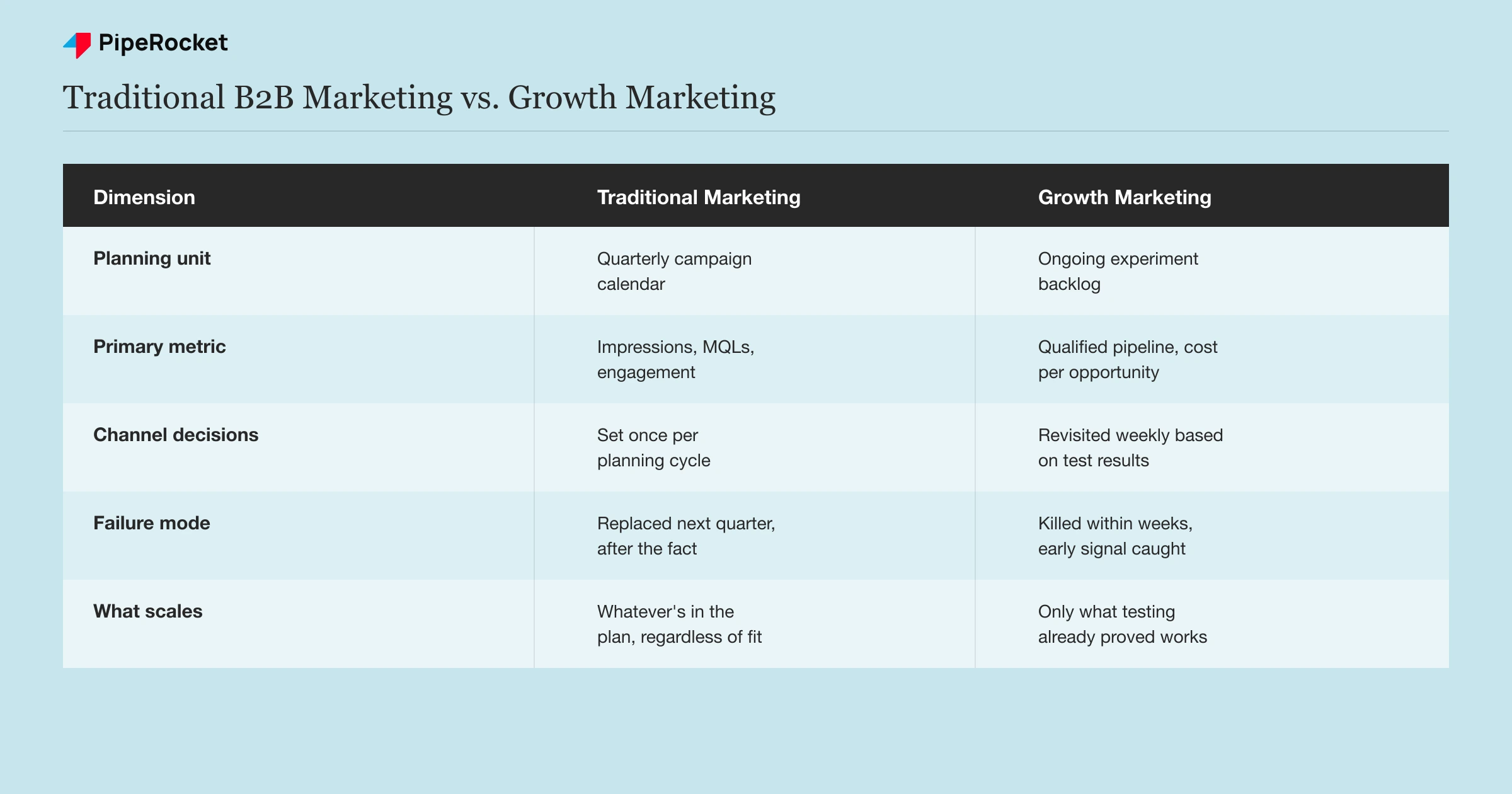
The difference is the operating model, not the channel list: traditional marketing plans a calendar and executes it, while growth marketing tests each channel and compounds only what proves out. Both B2B marketing approaches use the same content, ads, and email.
| Dimension | Traditional B2B marketing | B2B growth marketing |
|---|---|---|
| Planning unit | Quarterly campaign calendar | Ongoing experiment backlog |
| Primary metric | Impressions, MQLs, engagement | Qualified pipeline, cost per opportunity |
| Channel decisions | Set once per planning cycle | Revisited weekly based on test results |
| Failure mode | A campaign underperforms and gets replaced next quarter | A test underperforms and gets killed within weeks |
| What scales | Whatever’s in the plan, regardless of performance | Only what testing already proved works |
The practical effect shows up in how fast a team reacts. A traditional marketing org discovers a channel is underperforming at the quarterly review, three months after budget went out the door. A growth marketing org catches the same signal in the first few weeks, because it built measurement into the launch instead of the retro.
Growth marketing doesn’t replace brand and content work
None of this makes brand-building or long-form content marketing obsolete. Growth marketing needs something to test: an offer, a message, a landing page, a channel. Content and brand work often produce the raw material growth marketing then experiments with and scales.
The teams that get this wrong usually pick one extreme. They either run growth marketing with nothing built to test, cycling through shallow paid experiments with no real offer behind them, or they build content and brand assets for years without ever running the measurement loop that tells them what’s actually converting.
What Are the Core Motions of B2B Growth Marketing?
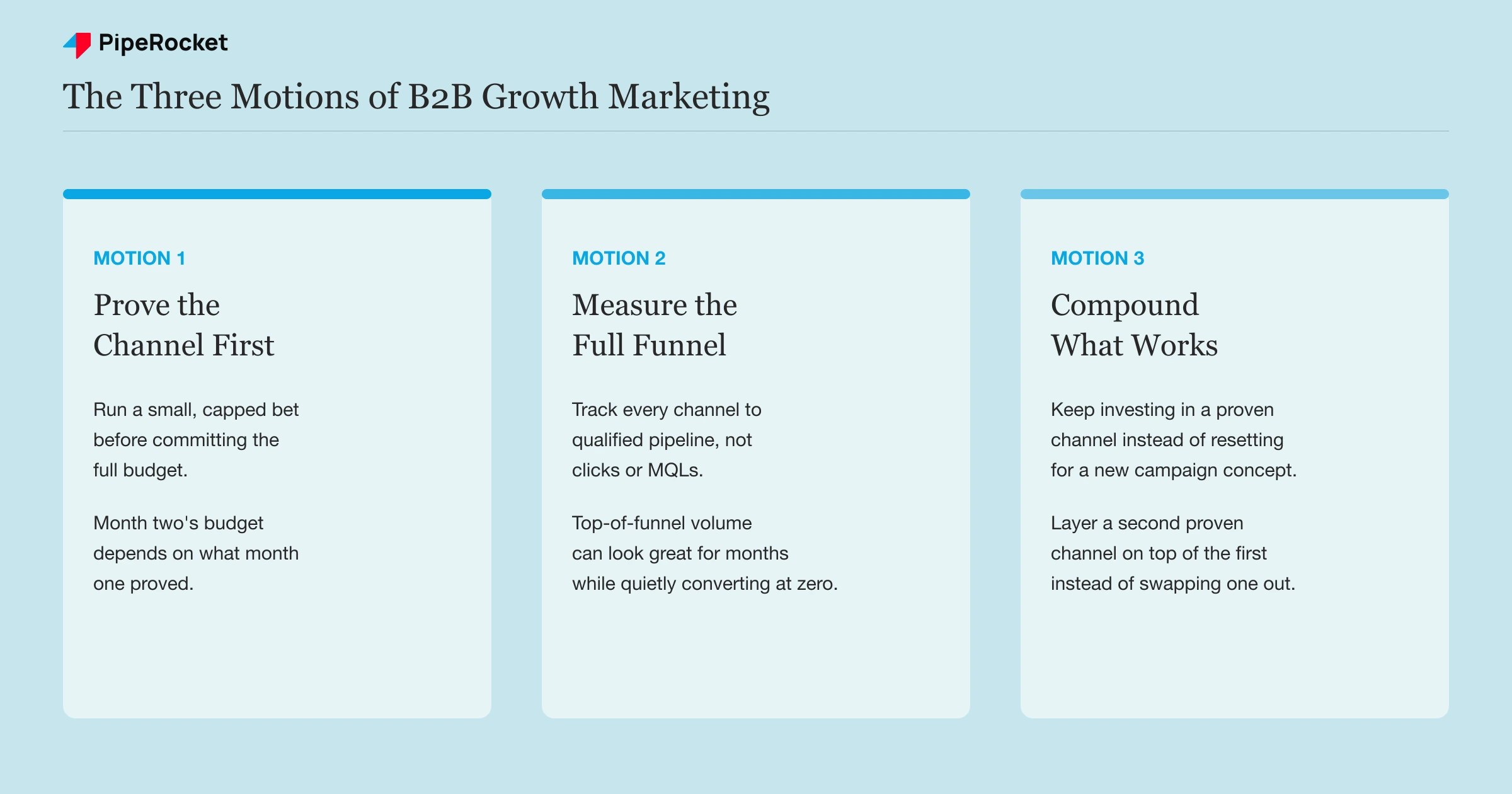
B2B growth marketing runs on three core motions: (1) prove a channel with a small bet before scaling the budget, (2) measure the full funnel down to pipeline instead of top-of-funnel clicks, and (3) compound what already works instead of resetting every quarter. Skip any one and what’s left is a marketing plan with a growth-marketing label stapled on.
- Prove the channel before you scale the budget: cap the first bet and let the data decide the next one.
- Measure the whole funnel down to pipeline: track a channel all the way to qualified pipeline instead of a click or MQL .
- Compound what works instead of resetting every quarter: keep funding proven channels and layer new ones on top.
Prove the channel before you scale the budget
Every new channel or message starts as a small, capped bet, not a full-budget launch. The point of the small bet is to buy a real answer about whether the channel works for this specific offer and audience, before the spend gets big enough to hurt if it’s wrong.
This runs against how most B2B budgets actually get allocated. Leadership approves a channel for the year, and the team spends the full amount regardless of what the first six weeks of data say. Growth marketing inverts that: the budget for month two depends on what month one proved, not on what got approved in January.
Measure the whole funnel down to pipeline
A growth marketing program tracks a channel all the way to qualified pipeline instead of stopping at a click, form fill, or MQL. Clicks and form fills are cheap to generate and easy to celebrate, but they tell you almost nothing about whether the channel produces revenue a sales team can actually close.
B2B’s long sales cycle and multi-stakeholder buying groups make this harder than it looks. A channel can post great top-of-funnel numbers for months while quietly feeding leads that never survive a real qualification call. Full-funnel measurement is what catches that gap before a quarter of spend gets wasted on volume that never converts.
“Full-funnel” also extends past the first close. A channel that produces cheap logos who churn in a year isn’t actually cheap, so a growing number of B2B growth marketing programs now track what a channel’s customers do after they sign:
- Expansion revenue and renewal rate per channel.
- Time to second purchase.
That’s still the same measurement discipline, just carried one stage further than most teams bother to look.
Compound what works instead of resetting every quarter
Once a channel or message is proven, growth marketing keeps investing in it rather than rotating to something new because the calendar says it’s time for a refresh. Compounding is what separates a program that gets steadily more efficient from one that restarts its learning curve every ninety days.
This is where a lot of B2B teams leave the most value on the table. A proven LinkedIn ad angle or a landing page that converts well gets shelved for a new campaign concept, and the team quietly re-learns lessons it already had six months earlier.
Layering a second proven channel on top of the first, instead of swapping one for another, is what builds a system that gets cheaper and more predictable over time.
Which Channels B2B Growth Marketing Actually Runs Through
B2B growth marketing doesn’t use a different channel list than the rest of B2B marketing. It uses the same channels and puts each one through the prove-measure-compound loop instead of running it on a fixed plan.
- Content and SEO . Content and organic search feed the top of the loop with material to test: which pages, topics, and formats actually turn into pipeline rather than traffic. Growth marketing treats a content calendar as a set of hypotheses about what a buyer will act on.
- Paid social and search. Paid channels are where the small-bet discipline shows up most visibly, a capped test budget on a new audience, angle, or platform before it earns a bigger allocation. LinkedIn and paid search are common starting points because they’re fast to read and fast to kill.
- Account-based marketing. ABM narrows the test to a named list of accounts instead of a broad audience, which changes what “proof” looks like: specific target accounts engaging and moving into a sales conversation.
- Lifecycle and retention email. Email inside a growth marketing program gets tested against how it changes activation, expansion, and renewal behavior, the same full-funnel measurement applied past the first close, rather than running as an autopilot nurture drip.
- Referral and customer-led growth. Existing customers are a channel too. Growth marketing tests referral asks, case-study-driven outreach, and customer advocacy programs with the same rigor as a paid channel, because a proven customer-led motion often has a lower cost per opportunity than anything paid can match.
What Is Buyer Enablement in B2B Growth Marketing?
Buyer enablement is the practice of removing friction across every touchpoint so a self-directed buyer can research, evaluate, and build internal consensus without waiting on a sales rep. It matters because most B2B buyers now do the bulk of their research independently before they ever talk to sales.
A growth marketing program that only tests channels but ignores what happens after the click leaves pipeline on the table. The same test-measure-scale loop applies here: treat the buyer’s self-serve path as a set of hypotheses.
- Pricing and comparison clarity. Test whether transparent pricing, comparison pages , and ROI content move buyers forward faster than gated “talk to sales” walls.
- Self-serve proof. Case studies, product tours, and documentation a buying committee can circulate without a call.
- Consensus content. Material aimed at the other stakeholders a champion has to convince internally, since B2B deals close through whole buying groups rather than one person.
Enablement is measured the same way as any channel: does removing that friction produce more qualified pipeline and shorter cycles, or not?
How Does AI Change B2B Growth Marketing Operations?
AI changes B2B growth marketing operations by compressing the test-measure-scale loop: real-time analytics surface which channels are converting faster, and generative AI produces the message and content variants that feed the next round of experiments. It speeds the loop up; it does not replace the discipline underneath it.
Two shifts matter most for growth teams:
- Data and analytics integration. Real-time dashboards and attribution let a team read a channel’s pipeline signal in days instead of waiting for a monthly report, which is the whole point of the small-bet motion.
- AI-assisted content and personalization. Generative tools produce ad angles, landing-page variants, and segmented outreach faster, so a team can test more hypotheses per cycle and personalize to a named account at scale.
The caution is the same as with any channel: AI makes it cheap to generate volume, so the full-funnel measurement discipline matters more, not less. A faster content engine pointed at an unproven offer just wastes budget quicker.
Who Runs B2B Growth Marketing?
B2B growth marketing is usually run by a small cross-functional growth team, not a single channel manager: a growth lead who owns the experiment backlog, working alongside paid, content, lifecycle, and analytics specialists, with tight sales and RevOps alignment so tests are measured against real pipeline.
The defining trait is ownership of the loop rather than a channel. In smaller companies one growth marketer wears several of these hats; in larger orgs the roles split out, but the team still shares a single experiment backlog and a single pipeline-based scorecard. Without that shared measurement line back to sales, the “team” is just channel specialists running parallel plans, which is the traditional model with a new title.
Where Growth Marketing Fits Inside a Bigger B2B Growth Strategy
Growth marketing is the execution and testing layer inside a broader growth strategy , not a replacement for it. The strategy decides the segment, the buying motion, and the channels worth trying. Growth marketing then runs the experiments that find which specific version of each channel, message, and offer actually converts that segment.
Skipping the strategy layer is the most common reason growth marketing programs underperform even when the testing discipline is solid. A team can run a rigorous experiment loop on the wrong segment or the wrong buying motion and still end up with clean data pointing nowhere useful.
Get the upstream decisions right first, and growth marketing has something worth testing against. Our growth strategy guide covers how to make those calls: which segment compounds fastest, which motion fits how that segment buys, and whether the base can hold what acquisition brings in.
Common Mistakes That Undermine B2B Growth Marketing
Most growth marketing programs that stall trace back to one of a short list of mistakes, and almost all of them involve skipping the loop rather than running it badly.
Calling tactic-stacking growth marketing
Cold email, a paid social campaign, and a webinar series all launched in the same month don’t add up to growth marketing just because the mix is aggressive and multi-channel.
- Fix: check whether each tactic has a hypothesis and a measurement plan attached before it launches. Volume of tactics isn’t the discipline; the loop underneath each one is, and without it this is just traditional marketing running faster.
Measuring MQLs instead of pipeline
A channel looks like a huge win because MQL volume tripled, while the sales team quietly reports that almost none of those leads are worth a callback. MQL count is the easiest number to move and the least connected to revenue, which makes it a dangerous primary metric.
- Fix: tie every test to a pipeline or opportunity metric from day one instead of a lead-volume metric that’s easy to inflate.
Killing tests too early or too late
Two weeks of soft numbers gets one channel killed, while a dead channel elsewhere keeps drawing budget for two quarters out of sunk-cost attachment. Neither team set a real threshold up front.
- Fix: set the sample size or timeframe needed for a real read before the test launches, then hold to it in both directions. B2B’s longer sales cycle means a channel often needs more time to show a true signal than a consumer growth team would ever tolerate, but that’s not a license to run a losing bet indefinitely either.
Running growth marketing with nothing to test
An aggressive experimentation calendar against a single generic offer and a landing page that hasn’t changed in a year produces activity, not signal. The fix: build or refresh the underlying content, offer, and pages growth marketing needs before scaling the experiment volume around them.
How Do You Know B2B Growth Marketing Is Working?
You can tell whether a growth marketing program is actually working from a handful of named metrics, not from how many tests ran this quarter: qualified pipeline per channel, customer acquisition cost (CAC), customer lifetime value (CLV), and pipeline velocity, read together over time.
- Qualified pipeline per channel: which channels are producing pipeline a sales team would actually work, separate from leads or clicks logged in a dashboard.
- Customer acquisition cost (CAC), trending down: the fully loaded cost to win a customer through a channel. It’s a stricter number than cost per opportunity, and as testing narrows in on what converts it should fall instead of staying flat while spend grows.
- Customer lifetime value (CLV): the total revenue a channel’s customers produce after they sign, expansion and renewals included. A channel with a low CAC but low CLV (cheap logos that churn) isn’t actually a win.
- Pipeline velocity: how fast qualified deals move through the stages to close. Rising velocity means a channel is bringing in buyers who are ready to move, while stalling leads drag it down.
- Share of revenue from tested-and-proven channels: a rising share means the compounding motion is working. A flat or falling share means the program is still guessing.
- Time to kill or scale a test: how quickly the team acts on a clear signal. A program that takes a full quarter to react to obvious data isn’t running an experiment loop, whatever it’s called internally.
Read these together. Rising pipeline with flat or rising cost per opportunity means testing isn’t actually narrowing anything down yet. Rising pipeline with falling cost per opportunity and a growing share from proven channels means the compounding is real.
How PipeRocket Digital Runs B2B Growth Marketing
We build growth marketing around the loop, not the label: small proven bets, full-funnel measurement into pipeline, and heavier investment in whatever the data confirms.
Our SaaS PPC programs run on capped tests before any budget scales, and our SaaS SEO work is measured against pipeline, not rankings alone.
If your marketing runs a lot of activity without a clear read on what’s actually compounding, reach out to us here .
Frequently Asked Questions
What is B2B growth marketing?
B2B growth marketing is a data-driven discipline that grows revenue for businesses selling to other businesses through continuous testing, full-funnel measurement, and scaling only the channels and messages that prove out with real pipeline data.
It differs from traditional B2B marketing by running an ongoing experiment loop instead of a fixed campaign calendar, and it differs from a growth strategy by operating one layer below it, executing and testing against decisions the strategy already made.
Is B2B growth marketing the same as demand generation?
Not exactly. Demand generation is the function that fills the pipeline with campaigns, content, and paid programs across defined channels. Growth marketing can sit on top of demand generation as its testing discipline, deciding which of those campaigns and channels actually deserve more budget based on measured pipeline results.
A team can run demand generation without growth marketing’s experiment loop, and plenty do.
What does B2B marketing mean compared to B2B growth marketing?
B2B marketing is the broader umbrella covering every activity that promotes one business’s product or service to another business, from brand awareness through post-purchase retention content. B2B growth marketing is a specific operating approach inside that umbrella, defined by its testing loop and full-funnel measurement rather than by which channels it uses.
Any of the channels in a standard B2B marketing plan, content, paid ads, email, ABM , can be run either the traditional way or the growth marketing way. The difference is the discipline behind them, not the channel list itself.
How long does it take to see results from B2B growth marketing?
First reads on a single test show up in weeks. A compounding pipeline effect usually takes two to three full test-and-scale cycles, and B2B’s longer, multi-stakeholder sales cycle stretches that timeline further than a consumer growth team would expect.
What metrics should I track in B2B growth marketing?
Track qualified pipeline per channel, customer acquisition cost (CAC), customer lifetime value (CLV), and pipeline velocity. Read them together: falling CAC with rising CLV and velocity means the testing is narrowing in on what actually converts, not just moving cheap leads.