What Is Revenue Operations (RevOps)? A Practical Guide for SaaS Teams
 Ranjeeth Kumar
Last updated on
Ranjeeth Kumar
Last updated on

Revenue operations (RevOps) means running sales, marketing, and customer success on one shared process, one data set, and one set of metrics instead of three separate ones. It exists to close the gaps between those teams that cost SaaS companies pipeline and renewals every quarter.
What You Need to Know About Revenue Operations
- RevOps unifies the processes, data, and tools that sales, marketing, and customer success each used to run separately.
- It rests on four working parts: process alignment, technology management, data and analytics, and enablement.
- Most SaaS companies build RevOps reactively, after a bad quarter exposes how disconnected their revenue teams already were.
- RevOps is broader than sales ops, which only owns the sales team’s tools and process.
- Implementation follows a four-phase sequence: audit existing handoffs, integrate the tech stack, automate lead routing and renewal alerts, then optimize with shared dashboards.
- The core RevOps metrics to track are net revenue retention, CAC, pipeline velocity, and churn rate, plus lead response time and forecast accuracy.
- Getting this right shows up as fewer handoff losses between marketing and sales, and fewer surprises in the renewal pipeline.
What Is Revenue Operations?
Revenue operations is the function that owns the shared systems, data, and process that sales, marketing, and customer success all rely on to generate and retain revenue. Instead of three teams each running their own tools and definitions, RevOps builds one operating layer underneath all of them.
That layer covers a few concrete things:
- Which CRM fields exist and what they mean
- How a lead gets scored and routed
- Which dashboard is the source of truth for pipeline
- How a renewal risk gets flagged before it becomes a churn conversation
RevOps doesn’t do the selling, the campaigns, or the customer support. It builds and maintains the infrastructure those functions run on.
The Four Parts That Make Up RevOps
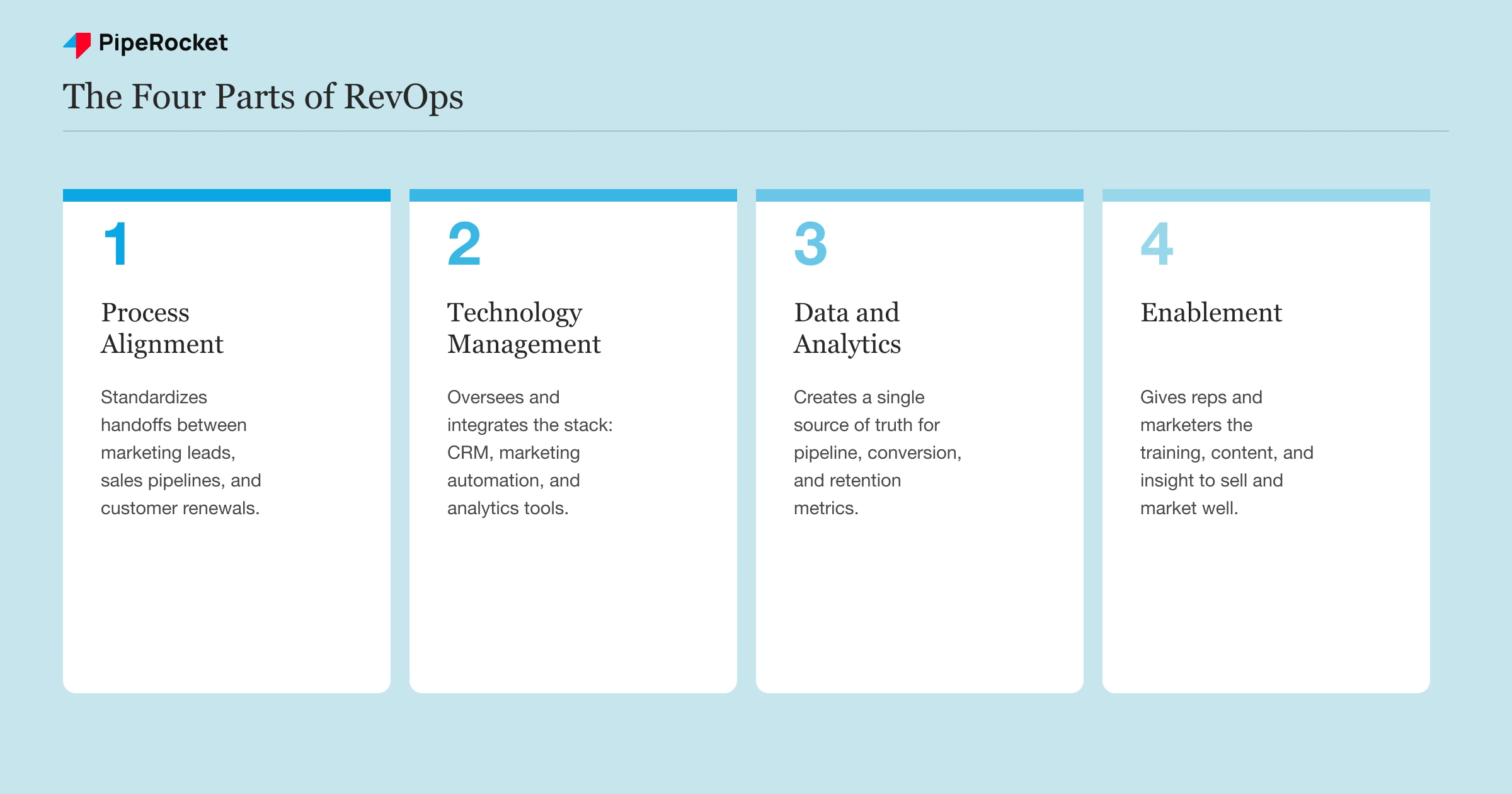
RevOps runs as four connected functions rather than a single job description. A team missing any one of them usually feels it as a specific, recognizable symptom, not just a vague sense that “things are disorganized.”
Process Alignment Standardizes the Handoffs Between Teams
Process alignment sets one standard for how a lead, an opportunity, or a renewal moves between marketing, sales, and customer success. It defines what “qualified” means before a lead ever reaches a rep, what stages an opportunity passes through, and what triggers a customer success check-in.
Without this, every handoff becomes a negotiation. A lead marketing calls “sales-ready” gets bounced back because sales’ definition of ready is different, and that argument repeats every week until someone writes the definition down and holds both teams to it.
Technology Management Keeps the Stack From Working Against Itself
Technology management oversees the CRM, marketing automation platform, and analytics tools so they share data instead of quietly duplicating or contradicting it. This is the unglamorous part of RevOps, and it’s the part that breaks first when nobody owns it. In practice, that means RevOps decides:
- Which system is authoritative for which piece of data
- What integrations keep the rest in sync automatically
- Who owns a field’s definition when marketing and sales disagree on what it means
- Which tool category owns which job across the stack: CRM for pipeline, marketing automation for demand, CPQ or billing for deal terms, and analytics for reporting
Without that ownership, a CRM field disagreement becomes a recurring argument instead of a five-minute fix, because nobody’s job is to resolve it once and make it stick.
Data and Analytics Gives Everyone the Same Number
Data and analytics creates a single source of truth for pipeline, conversion, and retention metrics, so marketing, sales, and leadership are all looking at the same number instead of three versions that don’t reconcile. This sounds basic, but it’s the single most common thing missing once a SaaS company scales past its early, everyone-in-one-room stage.
When marketing reports one MQL -to-close rate and sales reports a different one for the same period, both are probably right by their own definition. Both are also useless to a CFO trying to plan next quarter’s budget. RevOps builds the reporting layer that makes the number the same regardless of who’s looking at it.
Enablement Gives Reps and Marketers What They Need to Actually Perform
Enablement provides sales and marketing with the training, content, and competitive insight they need to sell and market effectively, rather than leaving each team to build its own playbook from scratch. RevOps is the one making sure a rep’s battle card reflects this quarter’s actual objections, not a stale version from a year ago.
Enablement sits close to process alignment, but it’s distinct: process alignment defines the workflow, enablement makes sure the people running that workflow have the material to execute it well.
Why SaaS Teams Keep Rebuilding the Same Broken Handoffs
Most SaaS companies don’t lack these four parts individually. They lack one owner for how those parts talk to each other. Marketing runs its funnel in one system, sales runs its pipeline in another, and customer success tracks health scores in a third, each with its own definition of what a “qualified” account even looks like.
That’s the actual failure mode behind most “leads aren’t converting” complaints. It plays out in three steps:
- Marketing hands off a lead that fits its own scoring model.
- Sales doesn’t trust the score because it wasn’t built with sales input, so reps re-qualify from scratch.
- The lead sits for a week doing nothing while both teams assume the other is handling it.
Nobody planned this. Each team optimized its own corner and assumed the seams would hold. They don’t, and the revenue lost in that gap rarely shows up on either team’s dashboard. That invisibility is why it goes unfixed for years. RevOps is the function built specifically to own those seams instead of leaving them to chance.
RevOps vs. Sales Ops: What’s Actually Different
Sales ops owns the sales team’s tools, territory design, and quota process. RevOps owns the shared infrastructure across sales, marketing, and customer success, and sales ops usually reports into it. Because RevOps owns that cross-team layer, it’s routinely confused with sales ops, as if it were just a rebrand with a bigger budget. That’s a common misread.
| Sales Ops | RevOps | |
|---|---|---|
| Scope | Sales team only | Sales, marketing, and customer success |
| Owns | CRM sales workflow, territory and quota design, sales forecasting | Cross-functional process, data definitions, tool integration, reporting |
| Metrics | Win rate, quota attainment, sales cycle length | Pipeline conversion across the full funnel, CAC, net revenue retention |
| Typical reporting line | VP Sales | CRO, CFO, or CEO |
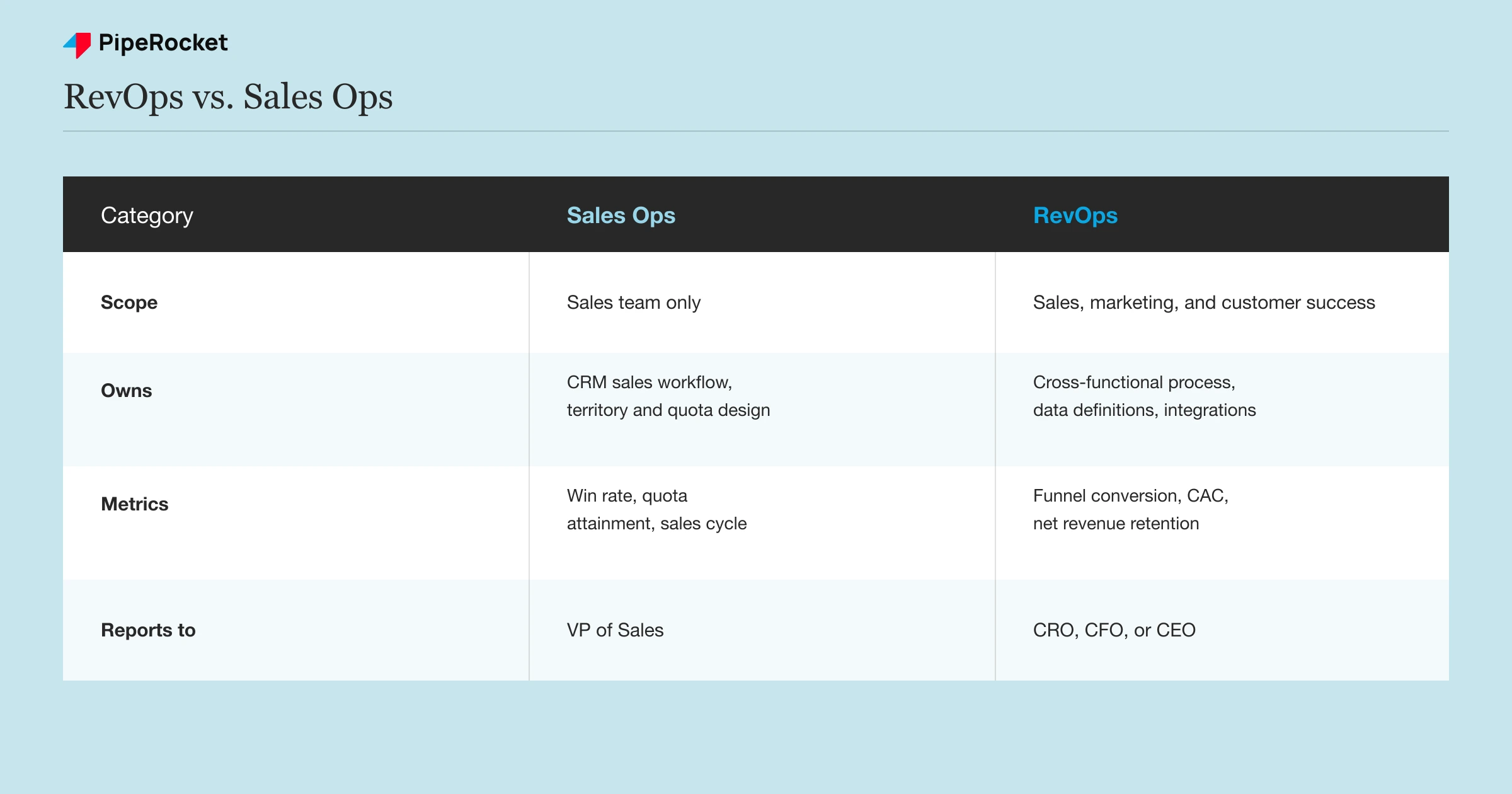
A company can run sales ops without RevOps. It’s much rarer to see a functioning RevOps team without a sales ops function nested inside it, because sales still needs its own operational layer even after the cross-functional one exists.
How to Implement RevOps: A Four-Phase Framework
RevOps implementation runs in four phases: audit the current handoffs and data, integrate the tech stack, automate routing and alerts, then optimize with shared dashboards. Doing them in order matters, because automating on top of broken data just scales the mess faster.
Phase 1: Audit
Map how a lead, opportunity, and renewal actually move today, and write down where each one gets stuck. List every tool in use and every manual handoff a person does by hand. The goal is an honest picture of the seams before you touch anything.
Phase 2: Integrate
Cut the redundant tools and connect what’s left so the CRM, marketing automation platform, and finance systems share one version of each record. Decide which system is authoritative for which field, then wire the integrations that keep the rest in sync.
Phase 3: Automate
Once the data is clean, automate the repetitive work: lead routing and scoring, stage transitions, and renewal or churn-risk alerts. Automating on clean, agreed definitions is what makes these rules trustworthy instead of another source of bad handoffs.
Phase 4: Optimize
Stand up shared dashboards that marketing, sales, and CS all read the same way, then review them on a set cadence, usually quarterly. This is where RevOps stops being a project and becomes an ongoing function that keeps the definitions from drifting.
How to Tell Your RevOps Setup Is Actually Working
A working RevOps function shows up in specific, measurable numbers, not in a general feeling that things are “smoother.” Track these:
- Lead response time. How long between a lead hitting sales-ready status and a rep making first contact. Anything past a few hours starts costing conversion.
- Handoff conversion rate . What percentage of marketing-qualified leads actually convert to a sales-accepted lead . A low number here usually means the qualification definition still isn’t shared.
- Forecast accuracy. How close the quarterly pipeline forecast lands to actual closed revenue. Wide misses point to inconsistent stage definitions across reps or teams.
- Net revenue retention. Whether customer success has enough visibility into account health to flag renewal risk before the cancellation email arrives.
- Customer acquisition cost (CAC). What it costs, fully loaded, to win one customer across marketing and sales spend. RevOps keeps this number consistent so finance and go-to-market read it the same way.
- Pipeline velocity. How fast qualified opportunities move through the funnel to closed revenue. Slowing velocity flags a stage or handoff that’s stalling deals.
- Churn rate. The percentage of customers or revenue lost in a period. Rising churn against flat NRR usually points to expansion masking a retention problem underneath.
If none of these numbers exist anywhere as a tracked, agreed-upon metric, that’s the real signal. The absence of a shared number is usually a bigger problem than a bad one, because at least a bad number tells you where to start.
Common Mistakes to Avoid
Building RevOps as a Reporting Team, Not an Operating One
A lot of companies stand up a “RevOps” title and hand it dashboards to build, with no authority to change process or systems. That’s reporting with a new name, and it produces the same disconnected numbers as before, just formatted better.
Skipping Sales and Customer Success When Designing the Handoff Process
Marketing often drives the first RevOps push, since it’s usually the team feeling the most pain from bad attribution and a fuzzy read on ICP fit. If sales and CS don’t help design the shared definitions, they won’t trust or follow them, and the old workaround habits creep back within a quarter.
Buying More Tools Instead of Fixing the Data Underneath Them
A new platform doesn’t fix a broken CRM field or an undefined lead score. It just adds another system that inherits the same bad data.
- Fix: resolve the data and process layer first. A new tool is only worth adding once the definitions it will inherit are actually correct.
Treating RevOps as a One-Time Project Instead of an Ongoing Function
Teams build the process, ship the dashboard, and move on. Then the sales team changes its stage names six months later, nobody updates the shared definitions, and the whole system quietly drifts back into three disconnected views of the same funnel.
How PipeRocket Digital Supports RevOps-Aligned Growth
We build the organic content and paid programs that feed directly into a RevOps-aligned funnel, so the leads marketing generates actually match what sales and customer success are set up to act on. That means content built around the same buying-stage definitions RevOps uses, not a separate marketing taxonomy that creates yet another handoff gap. If your team is rebuilding how marketing, sales, and CS work together, our SaaS SEO agency team can align content and pipeline reporting with your RevOps setup. Or get in touch to talk through where the gaps are.
Frequently Asked Questions
What is revenue operations?
Revenue operations is the function that unifies the process, data, and technology sales, marketing, and customer success all depend on, so those teams work from one shared set of definitions instead of three separate ones. It covers how leads get qualified and routed, which systems hold the source-of-truth data, and how renewal risk gets surfaced before it turns into churn. RevOps typically reports to a CRO , CFO, or CEO rather than sitting inside a single department.
What are the four pillars of revenue operations?
The four pillars are process alignment, technology management, data and analytics, and enablement. Process alignment standardizes handoffs between teams, technology management keeps the tool stack synced instead of contradicting itself, data and analytics gives everyone the same reporting numbers, and enablement gives reps and marketers the training and content to execute well. A RevOps function missing any one of these four usually shows a specific, recognizable symptom, like inconsistent lead scoring or forecasts that never match actual closed revenue.
What is the difference between sales operations and revenue operations?
Sales operations owns the sales team’s own tools, territory design, quota structure, and forecasting. Revenue operations is broader: it owns the shared infrastructure and data definitions across sales, marketing, and customer success, with sales ops typically operating as a function nested inside it. A company can run sales ops on its own, but a functioning RevOps team almost always still needs a sales ops layer underneath it for sales-specific execution.
Is revenue operations a good career path?
RevOps has grown into one of the faster-growing functions in SaaS because it sits at the intersection of process design, data analysis, and cross-functional influence, skills that transfer well across sales, marketing, and customer success roles. Career growth tends to reward people who can read a funnel’s data and also negotiate a shared process definition between teams that don’t naturally agree. Compensation and title structures still vary widely by company size, since the function is newer and less standardized than sales or marketing operations .
How to get a job in revenue operations?
Most RevOps hires come from sales ops, marketing ops, or data analyst roles. You move in by showing you can read funnel data and negotiate shared process definitions across teams that don’t naturally agree. Fluency in a CRM plus reporting tools is the common baseline.