
What Is an MQL in SaaS? Why the Number Gets Gamed
 Omar Sheriff
Last updated on
Omar Sheriff
Last updated on
An MQL, or Marketing Qualified Lead, is a lead that marketing has flagged as a good fit and engaged enough to be worth handing to sales. The threshold is usually a mix of firmographic fit and behavioral signals like content downloads or demo requests.
TL;DR
- MQL stands for Marketing Qualified Lead, a lead marketing believes is worth passing to sales.
- Most SaaS teams report MQL volume as a success metric, but volume alone says nothing about revenue.
- An MQL sits before the SAL stage, where sales formally accepts or rejects it.
- The MQL threshold usually comes from crossing a lead scoring cutoff, not a separate judgment call.
- A PLG SaaS with strong self-serve signups sometimes doesn’t need an MQL stage at all.
What Is an MQL in SaaS?
MQL is marketing’s judgment that a lead has crossed a fit-and-engagement threshold worth sales attention. It’s not proof of buying intent. It’s a threshold marketing set, and sales doesn’t always agree with where that line sits.
That distinction gets lost constantly. Teams present MQL count in board decks like it’s a revenue signal, when it’s really just a count of leads marketing decided met an internal bar. If sales rejects half of them, the MQL number was never measuring what the deck implied.
- Threshold-based, not intent-based: Crossing an MQL line means a lead matches criteria marketing set, not that the person is actively shopping.
- Owned by marketing, not sales: Marketing defines and adjusts the MQL bar. Sales reviews what crosses it, at the SAL stage.
- Usually score-driven: Most SaaS teams generate MQLs automatically once a lead score crosses a set number.
- Reversible by definition: An MQL isn’t a permanent status. A lead can be re-qualified, disqualified, or age out if nothing moves forward.
- A handoff point, not a finish line: MQL is where marketing’s job on that lead ends and sales’ job begins, not where the deal is won.
Consider a scheduling SaaS for dental clinics. Marketing lowered the MQL bar to hit a quarterly volume target, and MQL count jumped 40%. Sales rejected most of the new volume within a week, because lowering the bar didn’t create real intent.
Fast Fact: Most SaaS marketing teams report MQL volume in board decks more often than MQL-to-SQL conversion, even though the second number is the one that actually predicts revenue.
How Is an MQL Different from a SAL or SQL?
An MQL is marketing’s opinion that a lead is worth pursuing. A SAL is sales’ formal acceptance of that opinion. An SQL is confirmation, usually post-discovery-call, that a real opportunity exists.
The three stages exist because a single “qualified” label hides too much disagreement. Marketing and sales rarely define quality the same way, and collapsing three checkpoints into one status just buries that disagreement instead of resolving it.
- MQL: Marketing’s signal, based on fit and behavior, that a lead is worth a look.
- SAL: Sales’ explicit acceptance of that lead, with a documented reason if they reject it instead.
- SQL: Sales’ confirmation, after real qualification, that budget, authority, need, and timeline are all in place.
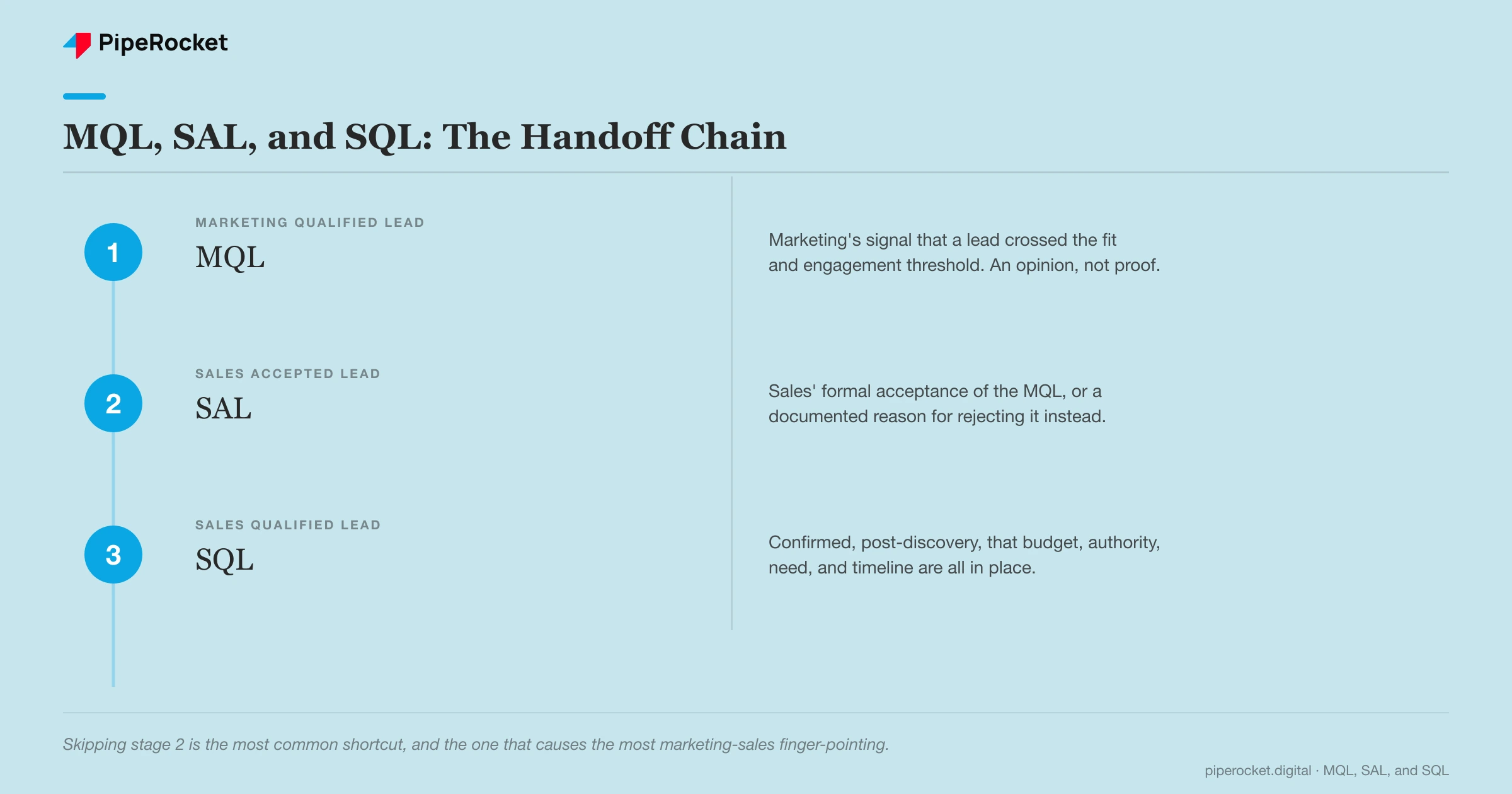
Skipping the SAL step is the most common shortcut, and it’s the one that causes the most finger-pointing. Without it, marketing sees an MQL sent and assumes progress, while sales quietly ignores leads they don’t trust, with no record of why.
Also read: best B2B marketing agencies for teams that need help formalizing the marketing-to-sales handoff.
How Do You Turn a Lead Into an MQL?
A lead becomes an MQL when it crosses your defined threshold for fit and engagement, usually calculated automatically inside your CRM or marketing automation platform once a lead score clears a set number.
How to Set Up MQL Criteria Step by Step
- Start from your ICP, not a template: Borrowing another company’s MQL criteria almost never fits your buyer, your price point, or your sales motion.
- Pick the fit signals that actually predict fit: Company size, industry, and role usually matter more than page count or session length.
- Weight high-intent behavior above generic engagement: A pricing page visit should count more than five blog reads, because it signals closer proximity to a decision.
- Set the threshold with sales in the room: A number marketing picks alone gets contested at the SAL stage every single time.
- Document what disqualifies a lead: Competitor domains, students, and job titles with no budget authority should subtract points, not just fail to add any.
- Test the threshold against real closed-won deals: If your last quarter’s closed-won accounts wouldn’t have hit MQL status, the bar is wrong.
- Revisit the threshold every quarter: Your ICP and product both shift, and a static MQL definition quietly drifts out of date.
Most teams do step one and skip the rest, which is exactly why MQL definitions go stale within two quarters of being set.
How Do You Know If Your MQL Definition Is Actually Working?
Your MQL definition is working if a meaningful share of MQLs get accepted at the SAL stage and go on to close. If sales rejects most MQLs, the definition is measuring the wrong things, no matter how much volume it produces.
Pull your MQL-to-SAL acceptance rate every month and watch the trend, not the single number. A definition that was accepted 70% of the time last quarter and 40% this quarter has drifted, even if nobody changed the criteria on paper.
- Track MQL-to-SAL acceptance, not MQL volume alone: Volume with a collapsing acceptance rate means the definition is getting worse, not better.
- Ask reps for rejection reasons, every time: A rejection without a reason gives marketing nothing to fix.
- Watch for volume spikes right before reporting periods: A sudden MQL jump before a board meeting is usually a sign the bar got quietly lowered.
A DevOps monitoring SaaS running a self-serve trial found its MQL definition barely mattered. Most real pipeline came straight from product usage signals, and the marketing-defined MQL stage just added a delay before sales saw activated accounts.
Fast Fact: A rep who rejects the same MQL source three months running has usually already stopped trusting that source, whether or not marketing ever finds out.
What Are the Most Common MQL Mistakes in SaaS?
The most common mistake is treating MQL volume as the success metric marketing reports up, instead of MQL-to-SQL or MQL-to-closed-won conversion. Volume is easy to inflate by lowering the bar, and a board deck full of inflated volume just sets up a harder conversation later.
The second common mistake is applying an MQL stage to a motion that doesn’t need one. A PLG SaaS with strong self-serve signups often has better signal from product usage than from any marketing-defined score, and forcing an MQL gate in front of that just adds friction.
- Reporting MQL count without conversion context: A number with no conversion rate attached tells nobody whether the pipeline is healthy.
- Letting marketing define MQL criteria alone: A definition sales never agreed to gets rejected at the SAL stage constantly.
- Copying another company’s MQL scoring template: Fit signals that predict a buyer at one price point rarely transfer to a different motion.
- Never sunsetting a stale definition: An MQL bar set two product versions ago is measuring an ICP that no longer exists.
A rigid MQL stage works well for a sales-led motion with a defined buying committee and a real handoff to manage. It works poorly for a self-serve or product-led motion, where usage data already tells you who’s ready before any marketing score does.
Frequently Asked Questions
1. What’s a realistic MQL-to-SQL conversion rate for a B2B SaaS company?
There’s no single universal benchmark, because the rate depends heavily on ACV, sales motion, and how strict the MQL definition is. A company with a loose MQL bar will show a lower MQL-to-SQL rate than one with a strict bar, even if both are converting the same absolute number of real opportunities. The number only means something compared against your own historical baseline, not against another company’s public figure.
2. Should a PLG SaaS with self-serve signups even use MQLs?
Often not, or at least not in the traditional form. Product usage data (feature adoption, seat expansion, activation milestones) is usually a stronger predictor of sales-readiness than a marketing-defined score built from page visits and firmographics. Many PLG companies replace the MQL stage entirely with a product-qualified-lead model, routing to sales based on in-product behavior instead of marketing engagement.
3. How do you fix an MQL definition that sales keeps rejecting?
Pull the last 20-30 rejected MQLs and look for the pattern in the rejection reasons, not just the count. If most rejections cite the same missing signal (wrong company size, wrong title, no budget authority), that signal needs to move into the MQL criteria itself, with sales agreeing to the new threshold before it goes live again.
The Bottom Line
MQL is a useful handoff signal only when marketing and sales agree on what it means and both sides track what happens to it after the handoff.
Report MQL-to-SQL conversion alongside volume, revisit the definition every quarter, and don’t force an MQL stage onto a motion where product usage already tells you more.
If you want help building a lead pipeline that reports the numbers that actually predict revenue, talk to our team or see our SaaS SEO work on turning organic traffic into qualified pipeline.