
What Is People Also Ask? Google's PAA Box, Explained for SaaS
 Kamaraj Mathiarasan (Kim)
Last updated on
Kamaraj Mathiarasan (Kim)
Last updated on
People Also Ask (PAA) is the expandable box of related questions Google shows inside search results, generated from real query clusters tied to what you searched. Click one question and it opens an answer plus new questions underneath it. It’s a live map of everything people ask around a topic.
TL;DR
- People Also Ask is a Google SERP feature showing related questions pulled from real query clusters around your search term.
- Each PAA question expands into a short answer and generates new related questions underneath it, which is why it’s called recursive.
- PAA differs from a featured snippet because it shows several linked questions instead of one answer to the original query.
- Most SEO advice treats PAA as a box to win with a 40-60 word answer, which misses what the box is actually telling you.
- Reading the full PAA tree for a keyword reveals the intent gaps your current content isn’t covering yet.
What Is People Also Ask?
People Also Ask is a box Google inserts into search results, usually a few positions down or right under the top result. It shows 3 to 6 questions related to your search. Click one and it expands into a short answer with a source link, then adds fresh questions below.
Most guides tell you to write a tight 40-60 word answer and try to win the box, treating every PAA question like a featured snippet target. That’s backwards. PAA questions aren’t hand-picked by an editor. They’re generated from real query patterns, the follow-up questions searchers actually type.
The box is a readout of the whole intent tree hanging off your keyword. Every question in it is a real, verified thing people search for, not a single prize to snipe.
- Query-cluster origin: Each question comes from search log patterns Google has already seen tied to your term, not from guessed relevance.
- Recursive expansion: Clicking a PAA question reveals its own answer and its own set of sub-questions, which can keep going for several layers.
- Position variability: PAA can appear near the top of the page, in the middle, or after several organic results, depending on the query.
- Snippet-style answers: Each expanded answer looks like a mini featured snippet, sourced from one page, with a link back to it.
- Device and location sensitivity: The exact questions shown can shift based on device type and searcher location, even for the same base term.
Consider a billing software company checking the PAA tree under “what is dunning management.” The obvious question wins one box. But the tree underneath also surfaces “how often should dunning emails go out” and “does dunning hurt customer trust,” neither of which that company has a page for.
What this means in practice: before you write a single word aimed at “winning” a PAA question, pull the full tree first. The questions you’re not answering matter more than the one you might rank for.
How Is PAA Different From a Featured Snippet?
A featured snippet answers the exact query you typed, in one box, at the top of the page. PAA shows several related but distinct questions, each with its own separate answer once expanded. They look similar once opened, but they’re solving different problems for Google.
A featured snippet is Google’s best single answer to “this search.” PAA is Google saying “here’s what else people in this search actually want to know.” That’s a meaningfully different signal for content planning.
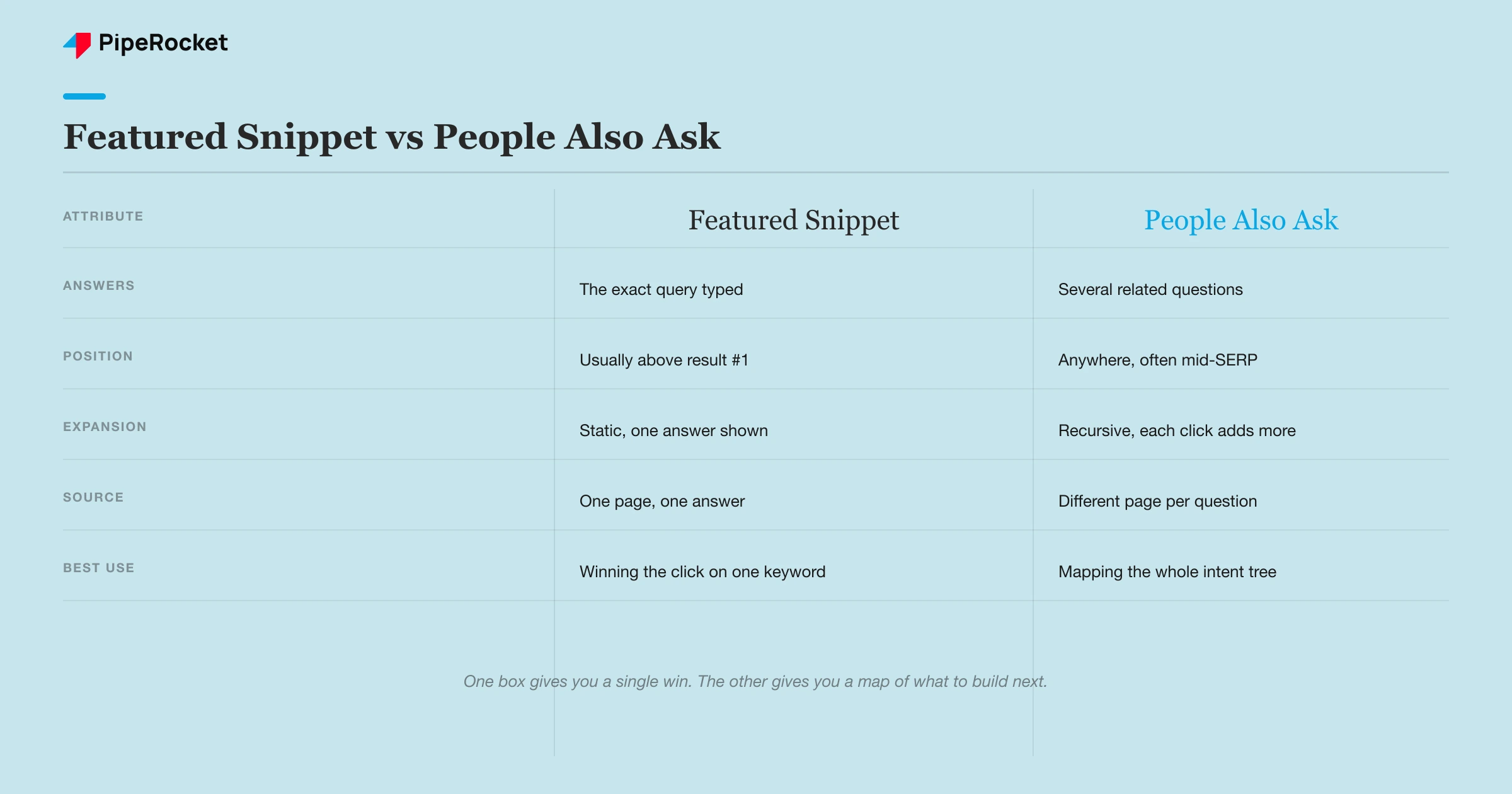
| Attribute | Featured Snippet | People Also Ask |
|---|---|---|
| Answers | The exact query typed | Several related questions |
| Position | Usually above organic result #1 | Anywhere on the page, often mid-SERP |
| Expansion | Static, one answer shown | Recursive, each click reveals more questions |
| Source | One page, one answer | Different page can source each question |
| Best use | Winning the click on your exact keyword | Mapping the intent tree around your keyword |
We’ve found teams that only chase featured snippets end up with one strong page and a blind spot around it. Teams that read the PAA tree first end up with a cluster instead.
Look at “SaaS churn rate” on a live SERP. One page might hold the snippet, but the PAA tree exposes several adjacent questions no single page on that site answers.
Also read: best B2B SEO agencies
How Does the Recursive PAA Expansion Actually Work?
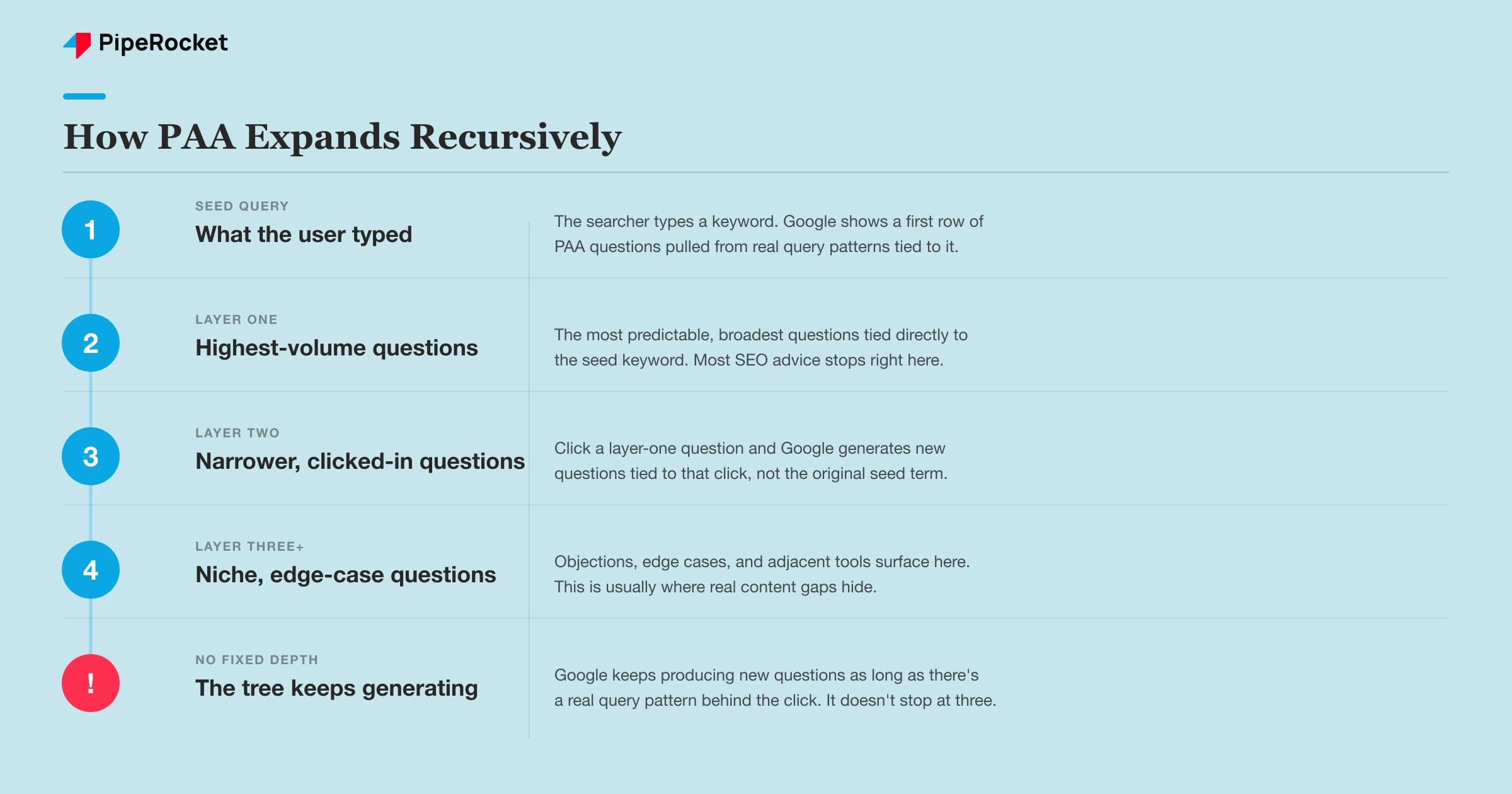
Each time you click a PAA question, Google shows you an answer and injects a fresh row of questions below it, generated the same way as the original set: from real query patterns tied to the question you just clicked, not the one you started with.
That means the tree drifts. Start at “what is people also ask” and three clicks deep you can land on questions with almost no obvious link back to your original search, but a very clear link to real searcher behavior.
- Layer one: Questions tied directly to your seed keyword, the most predictable and highest-volume layer.
- Layer two: Questions tied to whichever layer-one question you expand, already narrower and more specific.
- Layer three and beyond: Increasingly niche questions, often revealing objections, edge cases, or adjacent tools people ask about.
- No fixed depth: Google will keep generating new questions as long as there’s a real query pattern behind the click.
Fast Fact: Organic search drives 91.3% of SaaS traffic — AI-referred visits account for less than 9%.
I’ll be direct about the opinion here. Most teams stop at layer one because that’s what a browser extension scrapes for them. That’s a mistake, because layer two and three are where the actual content gaps live, not the obvious top-level questions everyone’s already targeting.
How Do You Mine PAA for Content Gaps?
You mine PAA by treating it as research, not as a box to snipe. Open your seed keyword’s SERP, expand every PAA question, and keep expanding the sub-questions that appear until the tree stops producing anything new or useful.
Write down every question your existing content doesn’t answer anywhere on the site, not just on the page you’re currently optimizing. That list is your content gap map for the keyword, built from verified search demand instead of a guess.
How to Mine a PAA Tree Step by Step
- Search the seed keyword in an incognito window: This avoids personalization skewing which questions Google shows you.
- Expand every first-layer question: Note the answer format Google chose (paragraph, list, or table) for each one.
- Click into two or three sub-questions per layer: Go at least two layers deep before you stop, since layer one is usually already covered somewhere on the web.
- Cross-check against your existing content: Mark which questions you already answer, partially answer, or don’t touch at all.
- Group unanswered questions by theme: Related unanswered questions often belong in the same section rather than separate pages.
- Decide page versus section: A cluster of related gaps might justify a new page; a single stray question might just need an FAQ entry.
- Re-run the tree quarterly: PAA trees shift as search behavior changes, so a gap map from a year ago is already stale.
This is the same discipline behind good keyword research : treat the SERP as the source of truth instead of a keyword tool’s guess. Our SaaS SEO agency runs this exact tree-mining pass before writing a single content brief for a new cluster.
Fast Fact: Organic search converts SaaS visitors at 0.92% — more than 3x the rate of AI-driven traffic at 0.26%.
Also read: best SaaS SEO agencies
Is It Worth Optimizing Content Just to Win the PAA Box?
Sometimes, but not as a strategy on its own. Winning a PAA box gives you a visibility bump and a link back to your page, but it’s a shallow win if the question has low intent or sits buried three clicks deep.
Here’s the real trade-off. Optimizing a page to win a specific PAA answer works when the question is high-intent and appears in layer one consistently. It fails when you chase a niche layer-three question, because you’ve spent effort on something almost nobody actually opens.
- High-intent PAA wins: Questions that repeat across multiple related seed keywords, signaling real recurring demand.
- Low-value PAA wins: Deep-layer questions that only appear after several clicks, rarely seen by an actual user.
- Structural fix, not a headline fix: Winning a box usually comes from clear, extractable answers already in your content, not a rewrite aimed only at PAA.
A nuanced warning: this works for informational, question-shaped keywords with a decent search volume. For a bottom-funnel term like a specific pricing comparison, chasing PAA boxes is often a waste, because the searcher isn’t looking for a quick answer, they’re looking to decide.
Frequently Asked Questions
1. Does winning a PAA box actually drive meaningful traffic?
It depends on where the question sits in the tree and how often it repeats across related seed keywords. A layer-one PAA question tied to a high-volume term can drive real clicks, especially since the answer links straight to your page. A layer-three question that only appears after two expansions rarely gets seen by enough people to matter, even if you’re the cited source.
2. Can two different pages on my site win different PAA questions for the same keyword?
Yes, and that’s often the better outcome. Since each PAA question can source its answer from a different page, a well-structured cluster with one page per sub-topic has more chances to appear across a single tree than one page trying to answer everything. This is different from keyword cannibalization, because the questions are distinct even if the seed keyword is shared.
3. How do I know if my PAA research is actually finding new gaps versus questions I already cover?
Cross-check every unanswered question against your full site, not just the page ranking for the seed keyword, since the answer might already live somewhere else. If a question keeps surfacing across three or more related seed keywords and nothing on your site addresses it clearly, that’s a genuine gap worth a new section or page, not just noise from the tree’s randomness.
The Bottom Line
Treat the PAA box as a research tool first and a ranking target second. The teams that build real topical depth are the ones reading the whole tree, not the ones chasing a single 50-word answer.
If you want a SaaS SEO agency that mines PAA trees as part of every content brief, reach out via our contact page or see how we approach SaaS SEO service .