
What Is Link Juice? Honest Guide for SaaS SEO Teams
 Kamaraj Mathiarasan (Kim)
Last updated on
Kamaraj Mathiarasan (Kim)
Last updated on
Link juice is the informal SEO term for the ranking authority a page passes to another through a link, drawn from the same math behind Google’s original PageRank. Google never coined the phrase. It’s SEO slang for a real, measurable mechanic in how pages earn rank.
TL;DR
- Link juice is a nickname for the authority that flows between pages through links, not a metric Google publishes or defines.
- Internal links, external links, and anchor text all carry link juice differently depending on placement and relevance.
- Nofollow tags used to let SEOs hoard link juice by starving unimportant pages, until Google’s 2009 patch closed that loophole.
- Too many outbound links on one page, or pages nothing else links to, dilute how much authority actually flows through a site.
- Chasing link juice with sculpting tricks wastes time that’s better spent building pages worth linking to in the first place.
What Is Link Juice?
Link juice describes the authority a page passes to another through a hyperlink. It’s not a term you’ll find in Google’s own documentation. It’s SEO slang built on top of PageRank, the original algorithm that scored pages by counting and weighing the links pointing at them.
Most explainers treat link juice like something you can hoard. Nofollow the pages you don’t care about and funnel everything toward your money page, and rankings are supposed to climb. That advice is a decade out of date.
Google patched the nofollow sculpting loophole in 2009, and authority sent through a nofollowed link doesn’t redirect to your other links anymore. It just disappears. Hoarding link juice with sculpting tricks doesn’t concentrate authority. It wastes links.
- Origin: Link juice comes from PageRank, the original Google algorithm that ranked pages based on the quantity and quality of links pointing to them.
- Not official: Google has never used the phrase “link juice” in any documentation. It’s shorthand SEOs invented to describe how authority moves.
- Directional: Authority flows in the direction of the link, from the linking page toward the page being linked to.
- Conditional: How much authority passes depends mainly on the linking page’s own authority and how many other links sit on that page.
- Not a lever anymore: Google’s 2009 update removed the sculpting trick that let SEOs redirect link juice by nofollowing certain links.
Consider a procurement SaaS for fintech teams that earns a link from a well-known compliance blog. That single link carries more authority than a dozen links from small, unrelated directories, because the linking page itself has weight to pass on.
In practice, chasing link volume without a plan wastes a link. One relevant, high-authority backlink does more for your domain authority than ten weak ones. No amount of sculpting fixes a link profile with no strong sources in it.
Also read: best SaaS SEO agencies
How Does Link Juice Actually Flow Through a Site?
Link juice flows through internal links and external links, plus the anchor text wrapped around each one. Each channel passes authority differently depending on context, and mixing them up is how a lot of link building effort gets wasted.
- Internal links: Pages on your own site pass authority to each other every time you link between them.
- External links (dofollow): A dofollow link from another domain passes authority the way PageRank originally intended, weighted by the linking site’s own strength.
- External links (nofollow): A nofollow link tells Google not to count it as a vote, though Google has said since 2019 it treats nofollow as a hint, not an absolute block.
- Anchor text: The words wrapped around a link tell Google what the destination page is about, so relevant anchor text does more than generic text like “click here.”
- Link position: Links higher up in the main content pass more weight than links buried in a footer or sidebar.
A compliance tool for healthcare SaaS teams that links from its homepage to a HIPAA guide, using the phrase “HIPAA compliance checklist” as anchor text, passes more relevant authority than the same link tucked into a footer labeled “resources.”
Fast Fact: Organic search drives 91.3% of SaaS traffic — AI-referred visits account for less than 9%.
What Dilutes Link Juice on a Page?
Two things dilute link juice on a page: too many outbound links splitting the same authority, and orphaned pages that no other page links to at all. Both are easy to miss because neither shows up as an error anywhere.
- Outbound link count: The more links on a page, the smaller the slice of authority each one gets, since PageRank-style scoring divides weight across every link on the page.
- Orphaned pages: A page with zero internal links pointing to it gets no authority passed to it, no matter how good the content is.
- Broken or redirected links: Every extra redirect hop between the linking page and the destination bleeds a small amount of authority along the way.
- Low-value link neighborhoods: Linking out to spammy or unrelated sites next to your important links can drag down how Google reads the whole page’s trust.
Imagine a project management tool for creative agencies that publishes 40 outbound links in a single “best tools” roundup. Each link on that page passes a smaller fraction of authority than a page with five carefully chosen links.
Most teams add outbound links freely and never think about dilution. That’s a mistake on pages meant to pass authority internally, like a homepage or a pillar guide.
Also read: best B2B SEO agencies
Does Internal Link Sculpting Still Work?
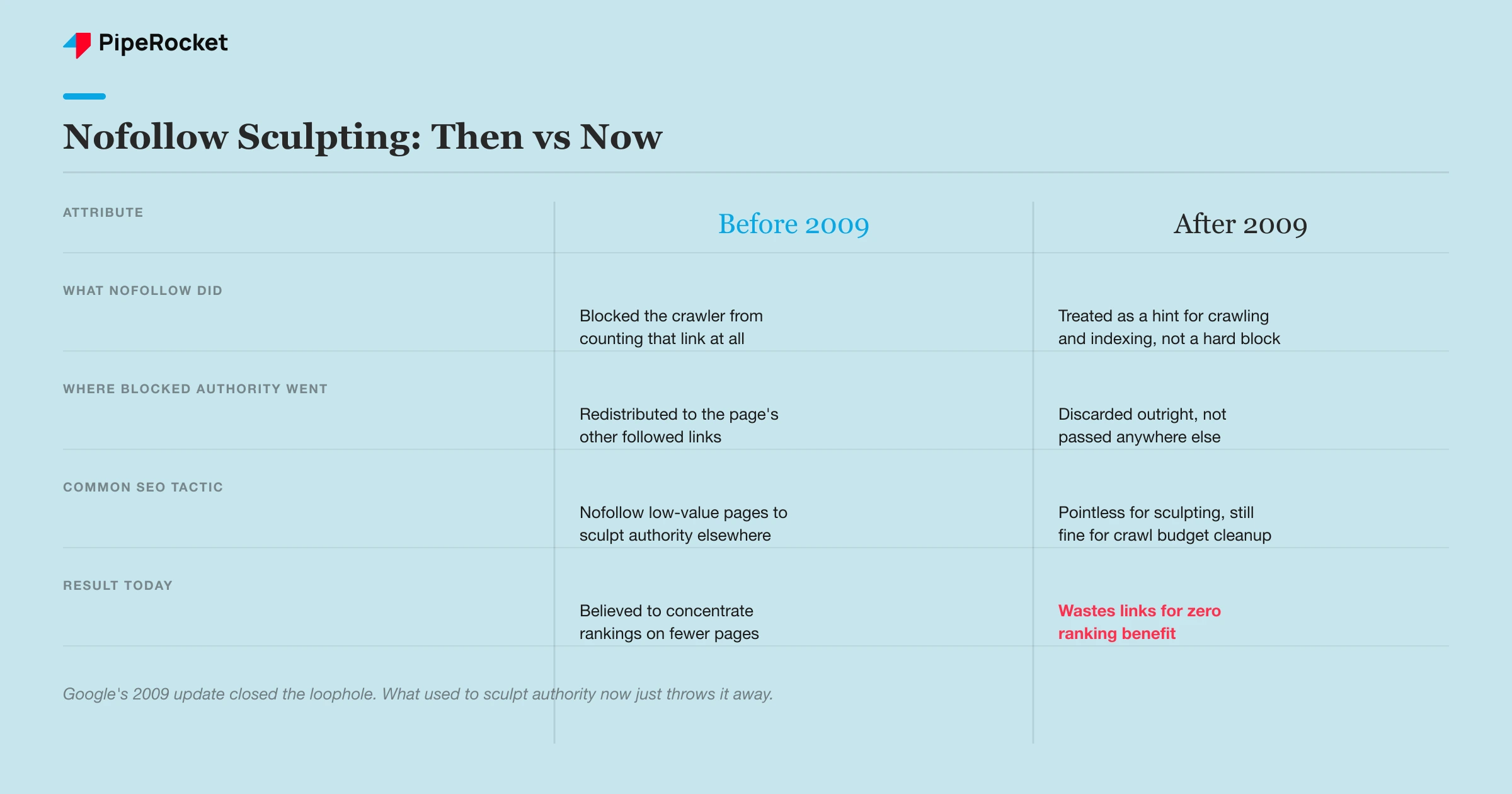
No, not the way it worked before 2009. Google’s nofollow patch means sculpting doesn’t redirect authority anymore, it just throws it away. SEOs used to nofollow low-value internal pages like login or Terms of Service links, believing the “saved” authority flowed to their other, followed links.
- Before 2009: SEOs nofollowed low-value pages, believing the blocked authority redistributed to the page’s other followed links.
- After 2009: Google changed the math so nofollowed link juice gets discarded, not redistributed, killing the sculpting trick outright.
- Today: Google treats nofollow, sponsored, and UGC tags as hints for crawling and indexing, not hard authority blocks, per its 2019 update.
- What still works: Pruning genuinely low-value pages from your navigation still helps, because it improves the site’s overall link structure.
Internal link sculpting gives you a tidier crawl budget on very large sites, but it fails to concentrate authority the way it used to. It’s worth doing for crawl efficiency on sites with thousands of pages, not for chasing rankings on a handful of key pages.
Most SEOs still nofollow internal utility pages hoping to preserve link juice for their money pages. That’s wrong because the algorithm that made sculpting work got patched over a decade ago.
This kind of pruning works for sprawling sites like marketplaces or directories drowning in thin pages. For a lean SaaS site with a few hundred pages, sculpting wastes time you could spend earning new links instead.
Fast Fact: Organic search converts SaaS visitors at 0.92% — more than 3x the rate of AI-driven traffic at 0.26%.
How Do You Structure Internal Links to Pass Authority Well?
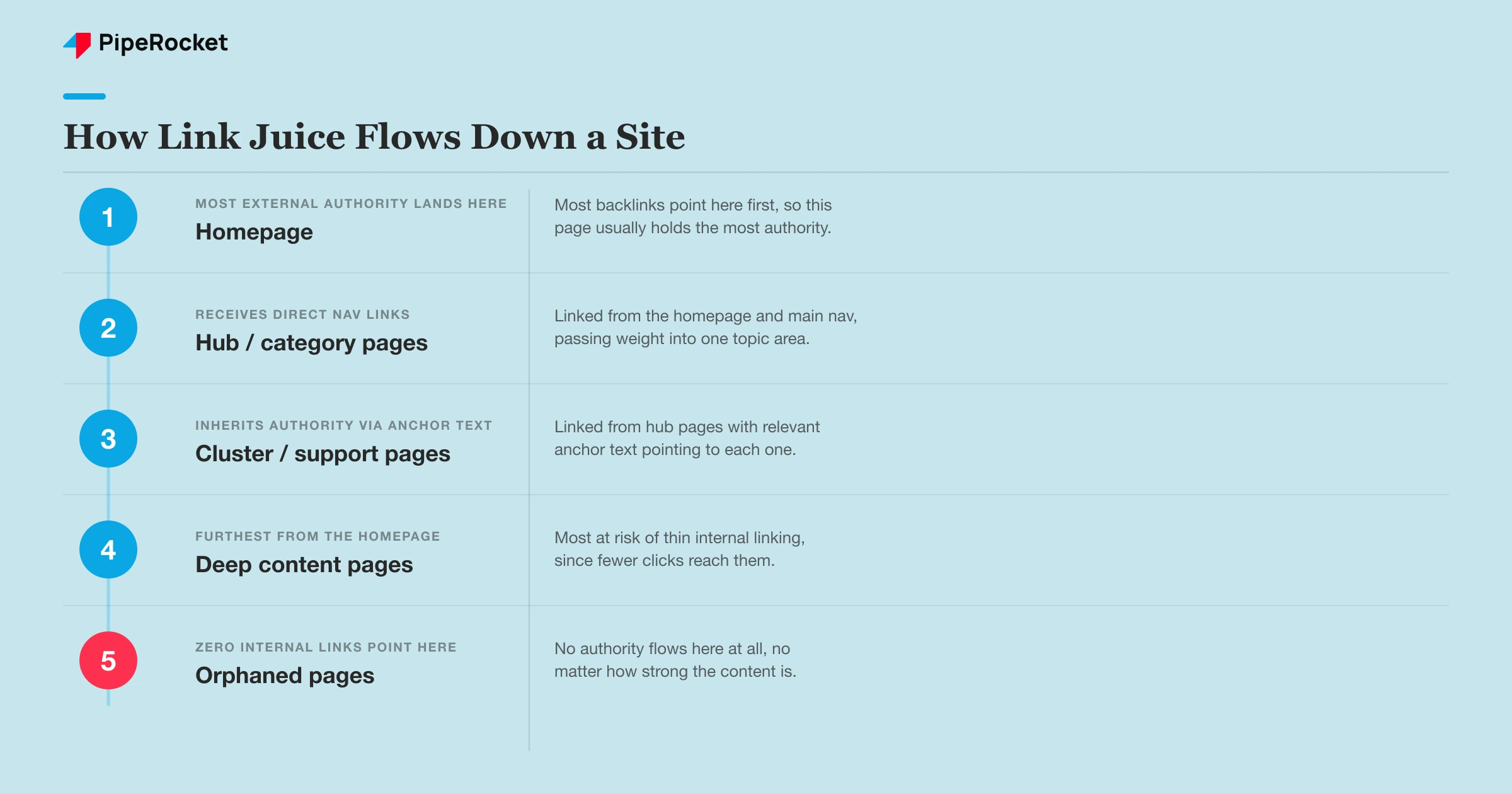
Link from high-authority pages down to the pages you most want to rank, and make sure every important page has at least one internal link pointing to it. That’s the whole job, though doing it consistently across a growing site is harder than it sounds.
- Link from strength: Point internal links from your homepage and top nav pages toward the pages carrying your main keywords.
- Avoid orphaning: Every page you want indexed and ranked needs at least one internal link from somewhere else on the site.
- Vary anchor text: Rotate relevant phrasing around the target keyword instead of repeating the exact match every time.
- Build hub pages: A pillar page that links out to supporting content concentrates authority and signals topical depth to Google.
- Audit orphans regularly: Run a crawl a few times a year to catch pages that lost their only internal link during a redesign or migration.
Getting this right across a growing site is a structural problem, not a one-page fix. That’s a deeper topic than link juice alone, and our guide on internal linking walks through the actual architecture.
Most teams build internal links as an afterthought while writing a post. That’s backwards. The pages you want to rank should decide the link structure before a single article gets written.
Also read: best SaaS marketing agencies
Frequently Asked Questions
1. Does a nofollow link ever pass any link juice?
Sometimes. Since Google’s 2019 update, nofollow, sponsored, and UGC attributes are treated as hints rather than hard blocks, so Google can still choose to crawl and weigh a nofollowed link in some cases. It’s not guaranteed, and you shouldn’t build a link strategy assuming nofollow links will count. Treat any authority from a nofollow link as a bonus, not a plan.
2. How long does it take for new link juice to show up in rankings?
It depends on how fast Google recrawls the linking page and how competitive the target keyword is. A high-authority site that gets crawled daily can pass a signal within weeks, while a slow-moving, low-authority source might take a few months to register. Rankings rarely move on one link alone. They tend to shift once a handful of relevant links accumulate.
3. Should I remove old outbound links to conserve link juice?
Only if they’re broken, irrelevant, or genuinely low value, not as a blanket rule. Stripping every outbound link to hoard authority ignores the fact that relevant outbound links to trustworthy sources are themselves a quality signal Google looks for. Audit for dead links and spammy neighbors, then leave the useful ones alone.
The Bottom Line
Link juice isn’t something you win by tricking the crawler. It’s something you earn by building a site worth linking to and structuring your internal links like you mean it. The sculpting tricks from the PageRank era are dead weight now.
If you want help auditing how authority actually moves through your site, reach out to our team or see our SaaS SEO service for how we approach internal link structure and authority flow.