
What Is Impression Share? The PPC Metric Most Teams Read Wrong
 Kamaraj Mathiarasan (Kim)
Last updated on
Kamaraj Mathiarasan (Kim)
Last updated on
Impression share is the percentage of impressions your ads actually received out of all the impressions they were eligible to receive. It’s Google’s way of telling you how much of the available auction you’re winning. A low number means you’re missing volume, but not always for the reason you think.
TL;DR
- Impression share is impressions received divided by eligible impressions, shown as a percentage in Google Ads .
- Google splits the missing share into lost-to-budget and lost-to-rank, and most teams never look at that split before reacting.
- Raising budget only fixes lost-to-budget. If your loss is mostly lost-to-rank, more spend can actually hide a targeting problem.
- Benchmarks differ a lot by campaign type, so a “good” impression share in Search looks weak in Shopping and unrealistic in Display.
- Chasing a high impression share on the wrong keywords burns budget on searches that were never going to convert.
What Is Impression Share?
Impression share tells you what slice of the available auction pie you’re actually winning. Google Ads defines “eligible impressions” as every auction your ad qualified to enter, based on your keywords, targeting, and geography. Your impression share is the percentage of those you actually won.
Here’s the part most people skip past: eligible impressions already excludes searches you didn’t target. If your keyword list is too narrow, your eligible pool shrinks, and impression share can look great while actual reach stays small.
A 90% impression share on 200 eligible impressions a day isn’t a win. It’s a signal your targeting is boxed in.
- Search impression share: the percentage of eligible search auctions your ad appeared in, shown at the campaign or ad group level.
- Lost to budget: the share you missed because your daily budget ran out before all eligible auctions were served.
- Lost to rank: the share you missed because your ad’s rank (bid times Quality Score) wasn’t high enough to show.
- Absolute top impression share: how often your ad was the very first result, a tighter and more useful cut than plain impression share.
- Content impression share: the Display Network version, measuring how often your ad showed on eligible placements.
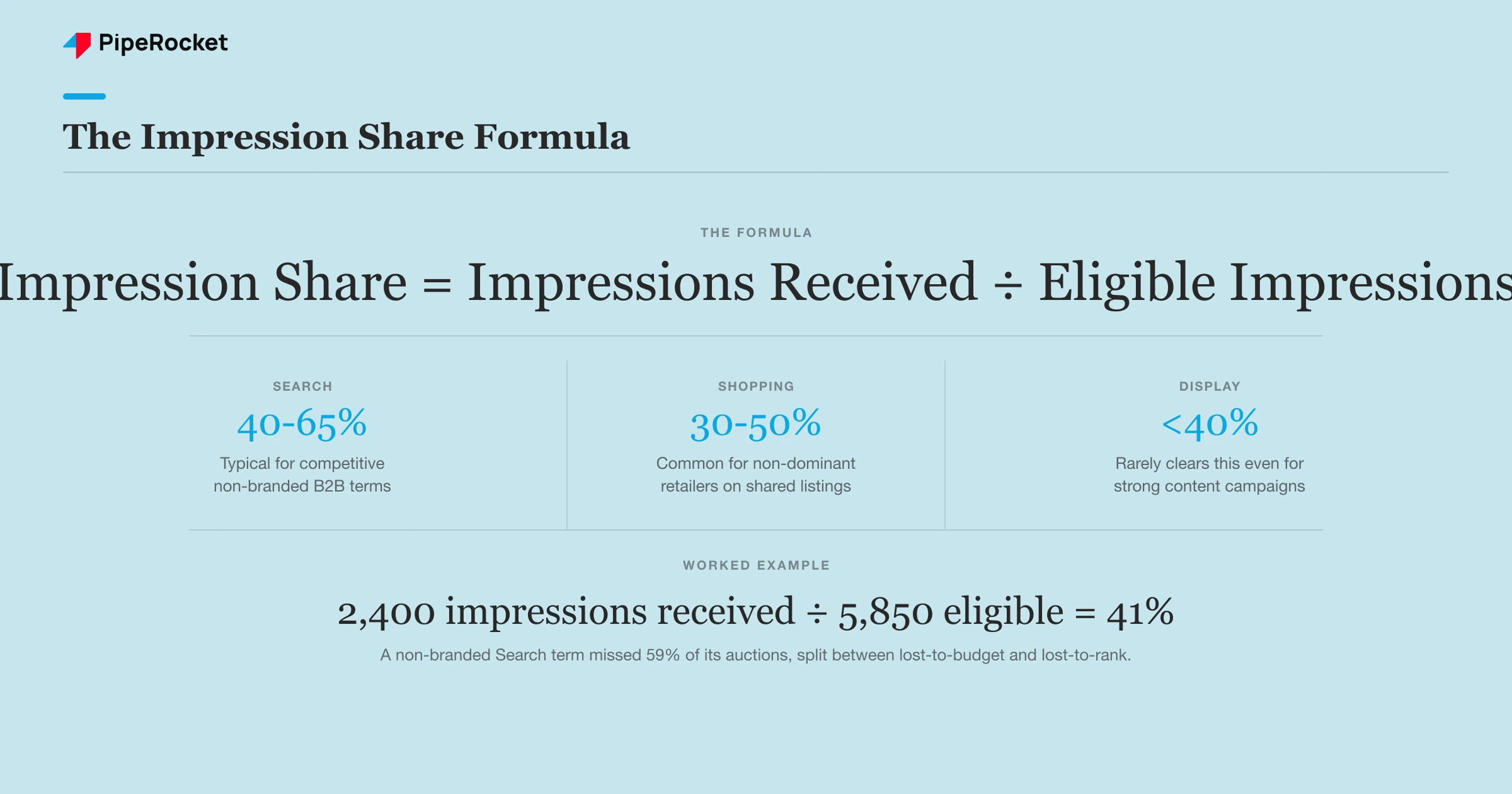
Consider a procurement SaaS running Search campaigns for “vendor risk management software.” Their impression share sits at 41%, and the instinct is to raise the daily budget. But the lost-to-rank number is 46%, more than double the lost-to-budget figure.
More money wouldn’t have moved the needle. It would have spent faster into the same rank ceiling.
Most teams treat “improve impression share” as a budget conversation by default. That’s backwards. Budget only solves lost-to-budget. If lost-to-rank is the bigger number, your ad copy, landing page relevance, or bids need work, not your wallet. Check both figures before you touch spend.
Fast Fact: Google Ads reports lost-to-rank and lost-to-budget as separate columns, but most accounts we’ve audited have never had both added to the same report.
Also read: best SaaS PPC agencies
How Do You Calculate Impression Share?
The formula is simple: Impression Share = Impressions Received ÷ Eligible Impressions, expressed as a percentage. Google calculates this automatically per campaign, ad group, or keyword, and it’s visible as a column you have to manually add to your reports.
- Impressions received: the actual number of times your ad was shown in the reporting window you selected.
- Eligible impressions: every auction your ad qualified for, whether it showed or not. Google estimates this, it doesn’t measure it directly.
- Reporting window matters: a 7-day impression share and a 30-day impression share on the same campaign can differ by 15 points or more if spend was uneven.
- Segment level changes the number: campaign-level impression share averages across keywords with very different performance, hiding weak spots.
A B2B expense management tool running three ad groups often sees one at 80% impression share and another at 22%, but the campaign average shows 55%. That blended number hides which ad group actually needs attention. Always pull impression share at the keyword or ad group level before deciding anything.
Also read: SaaS PPC service
Lost to Budget vs Lost to Rank: What’s the Real Difference?
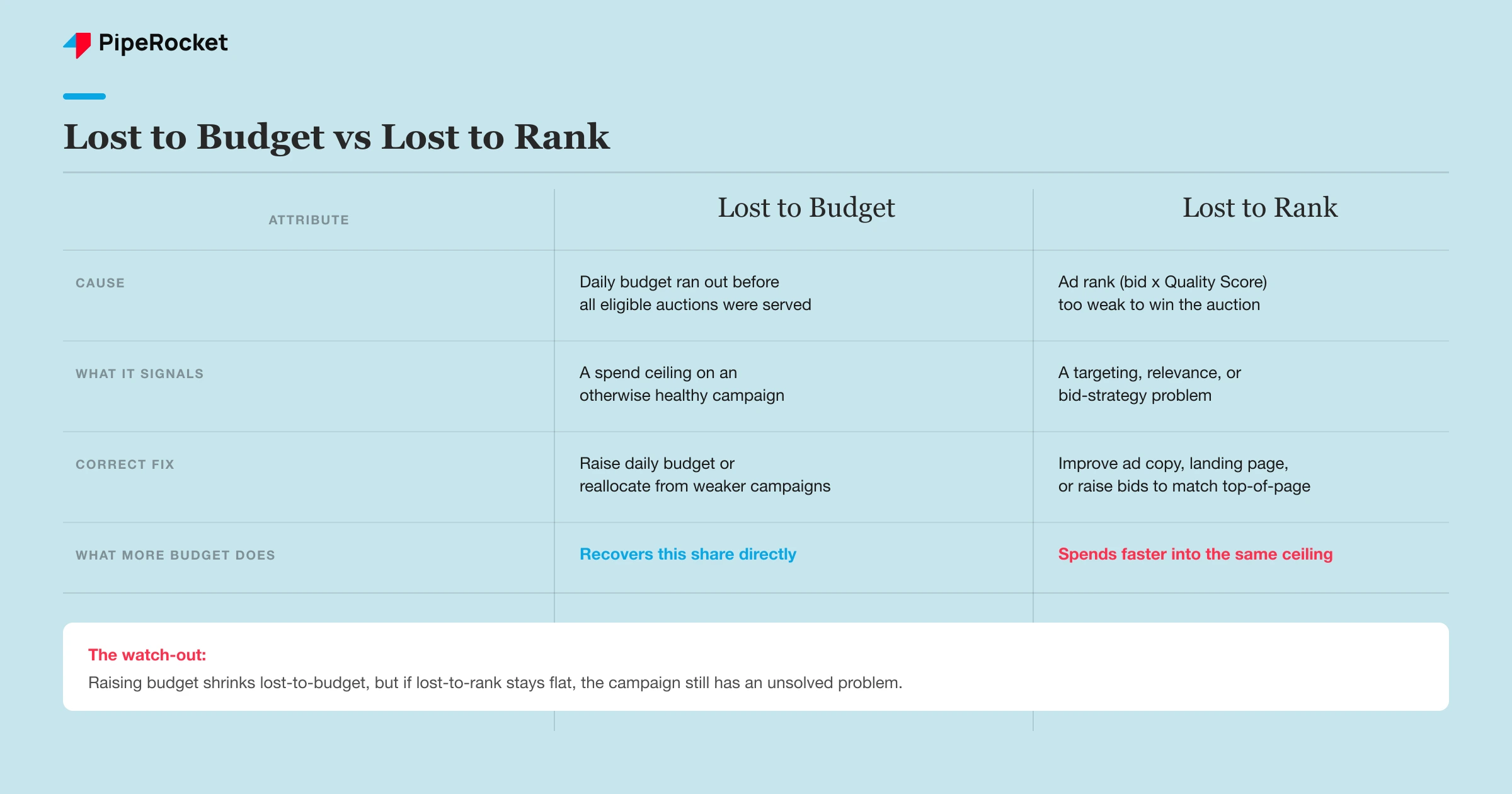
Lost to budget means Google would have shown your ad more, but your daily budget capped out before it could. Lost to rank means Google had budget room left but your ad rank wasn’t strong enough to win the auction. They point to completely different fixes.
- Lost to budget signals a spend ceiling: raising your daily budget, or shifting budget from underperforming campaigns, directly recovers this share.
- Lost to rank signals a quality or bid problem: your Quality Score , ad relevance, or bid amount is too weak to compete, and no amount of extra daily budget fixes that.
- Both can be nonzero at once: a campaign losing 30% to budget and 20% to rank has two separate problems, and fixing only one leaves the other capped.
- Rank losses often hide behind budget losses: teams raise budget, watch lost-to-budget shrink, and declare victory while lost-to-rank barely moves.
We’ve seen a compliance automation SaaS increase daily budget three times over six months chasing impression share. Lost-to-budget dropped each time. Lost-to-rank barely changed, sitting near 35% the whole period, because their landing pages hadn’t been touched since launch.
Most teams read a low impression share as a spend problem because that’s the fix that requires the least work. That’s the wrong instinct because a rank problem left unaddressed just burns the new budget on the same weak position, one auction at a time.
Also read: best B2B marketing agencies
What’s a Realistic Impression Share Benchmark by Campaign Type?
There’s no single “good” impression share number, it depends entirely on the campaign type you’re running. Search, Shopping, and Display each have different realistic ceilings based on how competitive and visual the format is.
- Search campaigns: a healthy branded-term impression share sits above 90%, while competitive non-branded B2B terms often land between 40% and 65% even for well-optimized accounts.
- Shopping campaigns: impression share tends to run lower than Search because more advertisers compete on identical product listings, with 30% to 50% being common for non-dominant retailers.
- Display campaigns: content impression share is usually the least meaningful of the three, since placement inventory is vast and even strong campaigns rarely clear 40%.
- Brand vs non-brand split: always benchmark these separately. A blended account average of 70% might mean 98% on brand and 35% on the terms that actually drive new pipeline.
A fintech SaaS targeting “AP automation software” shouldn’t expect Search impression share near their branded-term numbers. If a non-branded B2B term is sitting at 55%, that’s often already competitive, not a failure that needs fixing immediately.
Fast Fact: Shopping campaigns routinely sit 20 to 30 points below Search on impression share for the same advertiser, simply because more competitors bid on identical product listings.
Also read: best B2B SEO agencies
When Does Chasing High Impression Share Actually Hurt You?
Chasing impression share past the point where it makes commercial sense is a real trap. Pushing toward 90%+ impression share on a keyword usually means outbidding your way into auctions you’d normally lose, and that inflates your cost per click fast.
- Diminishing returns on bid increases: each extra point of impression share above roughly 70% to 80% typically costs disproportionately more than the point before it.
- Broad or low-intent terms inflate spend without pipeline: winning 95% of impressions on a vague research-stage keyword just means more unqualified clicks at a higher price.
- Auction inflation spreads: aggressively bidding up impression share on one keyword can raise the going rate for competitors, and yours, on adjacent terms too.
- It can mask a targeting problem: high impression share on the wrong keyword list feels like a win in the report while the account still isn’t producing qualified leads.
Here’s the real trade-off. Pushing impression share higher gives you more visibility in the auction, but it costs progressively more per point gained. It’s only worth it if the keyword is a genuine buyer-intent term. On a broad or exploratory keyword, that spend is better redirected.
This works when you’re defending a high-intent, bottom-funnel term against a real competitor threat. It fails when the “problem” keyword was never going to convert well in the first place, because you’re just paying more to lose the same customers, slower.
Also read: best SaaS marketing agencies
Frequently Asked Questions
1. How often should I check impression share, and at what level?
Check impression share weekly at the keyword or ad group level, not just the campaign average. Campaign-level numbers blend strong and weak segments together, so a stable 60% average can hide one ad group at 90% and another at 15%. Weekly checks also catch budget caps before they run for a full month unnoticed.
2. My lost-to-rank is high but my Quality Score already looks fine. What’s going on?
Quality Score and ad rank aren’t the same thing. Ad rank also factors in your bid and the expected impact of ad extensions, so a solid Quality Score with a bid set too conservatively can still lose on rank. Check your actual CPC bids against the top-of-page bid estimates Google Ads shows per keyword before assuming Quality Score is the whole story.
3. Should I prioritize fixing lost-to-budget or lost-to-rank first?
Fix lost-to-rank first if it’s the larger of the two numbers, because raising budget into a rank problem just spends faster without recovering more share. If lost-to-budget is clearly the bigger figure and your rank losses are already low, reallocating or raising budget will show results within days.
The Bottom Line
Impression share tells you how much of the auction you’re winning, but the number alone doesn’t tell you why. Pull the lost-to-budget and lost-to-rank split before you touch spend, and benchmark by campaign type instead of one blended target.
If you want a paid search team that reads this split correctly before recommending a fix, contact us or see how we approach paid search for SaaS .