
What Is a SKAG? Why Single Keyword Ad Groups Are Losing Ground
 Kamaraj Mathiarasan (Kim)
Last updated on
Kamaraj Mathiarasan (Kim)
Last updated on
A SKAG (Single Keyword Ad Group) is a Google Ads structure where one ad group contains exactly one keyword, matched to one tightly written ad. It was built to give advertisers total control over message match and Quality Score.
That control now costs more than it earns in most Smart Bidding accounts.
TL;DR
- A SKAG puts a single keyword in its own ad group so the ad copy can mirror the search term almost word for word.
- SKAGs were built for a manual-bidding era when Quality Score and exact match were the only real levers an advertiser had.
- Smart Bidding needs conversion volume to work, and splitting traffic into hundreds of SKAGs starves each one of the data it needs.
- STAGs and intent-based ad groups have replaced SKAGs in most accounts because they pool enough signal for automated bidding to learn from.
- SKAGs still make sense for a handful of low-volume, high-stakes keywords, like brand or legal terms, where message match still matters more than data volume.
What Is a SKAG?
A SKAG is a Google Ads ad group built around one keyword, usually in exact match, with an ad written to reflect that exact term. If your keyword is “SaaS SEO agency,” your headline says “SaaS SEO Agency” and nothing else lives in that ad group.
The idea was simple. The tighter the match between search term, keyword, and ad copy, the higher your Quality Score , and the lower your cost per click .
- One keyword, one ad group: No other keyword is allowed in, so every impression that ad group gets came from that exact term.
- Message match: The headline usually contains the keyword verbatim, which used to be the single biggest Quality Score lever available.
- Manual bid control: Each SKAG got its own bid, letting advertisers pay more for proven keywords and less for unproven ones.
- Granular reporting: Performance data rolled up cleanly to the keyword level, since nothing else shared the ad group.
- Heavy build overhead: A 200-keyword account meant 200 ad groups, each needing its own ad copy and negative keyword list.
Consider a compliance SaaS selling audit software to mid-market finance teams. Their team built a SKAG for every product-category keyword, each isolated: “audit management software,” “SOC 2 audit tool,” “compliance audit platform.”
That structure delivered exactly what SKAGs promised: predictable Quality Scores and clean attribution. What it didn’t deliver was enough conversions per ad group for Smart Bidding to learn anything once the account moved off manual CPC.
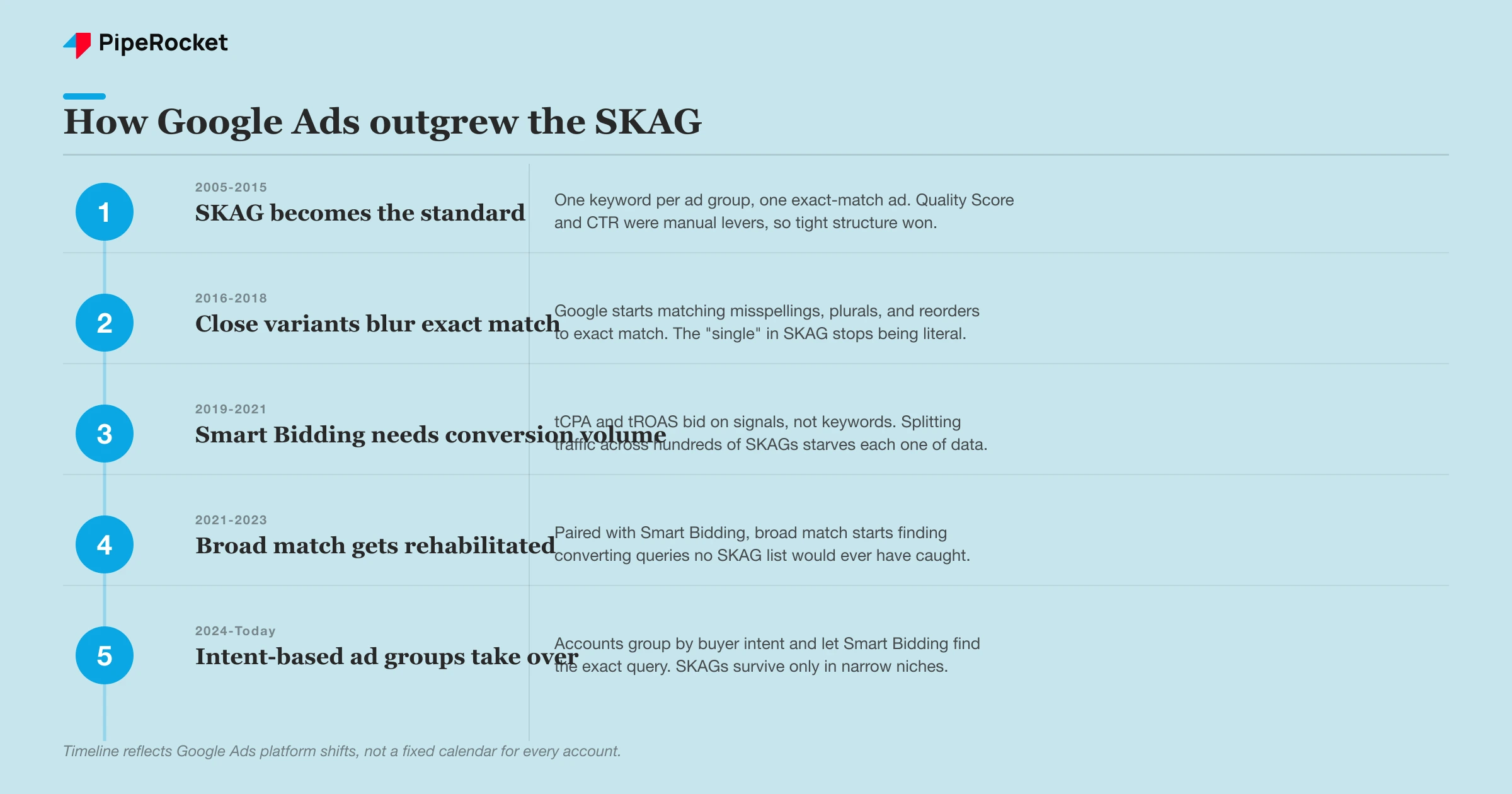
Most PPC guides skip this part: SKAGs were the right answer to a problem Google Ads doesn’t have anymore. Quality Score used to reward literal keyword-to-ad matching.
Google’s algorithm now weighs landing page relevance and predicted click-through rate using machine-learned signals, on top of your account’s historical performance. Those signals don’t care whether your headline repeats the keyword verbatim.
Building 300 SKAGs in 2026 to chase a Quality Score mechanism that’s already been superseded means optimizing for an auction that no longer exists.
Also read: best SaaS PPC agencies for paid search growth
Why Are SKAGs Losing Ground to Smart Bidding?
SKAGs lose ground because Smart Bidding runs on conversion data, and a SKAG structure starves every individual ad group of exactly that. Google’s automated bid strategies (Target CPA , Target ROAS , Maximize Conversions) need a meaningful sample size per ad group to model who’s likely to convert.
Splinter your account into 400 single-keyword groups and most of them never clear that threshold.
- Thin conversion data: A SKAG getting 8 clicks a month will almost never accumulate the 15-30 conversions per month Smart Bidding wants to optimize confidently.
- Learning phase resets: Every structural change (and SKAGs force a lot of them) throws the algorithm back into a learning phase with unstable, often worse performance.
- Close variant matching already broadens exact match: Google now matches plurals, misspellings, and reordered words to “exact match,” so the SKAG premise of total control was already loosening years before Smart Bidding took over.
- Automated bidding rewards pooled signal: tCPA and tROAS perform better with more data feeding one bid strategy, not less data split across many.
Fast Fact: Google’s automated bid strategies typically need roughly 15-30 conversions in the trailing 30 days per campaign to bid confidently, a volume most SKAG structures never reach at the ad group level.
Most teams still building SKAGs in 2026 are optimizing for a version of Google Ads that stopped existing around 2019. That’s not a controversial opinion inside PPC circles anymore, but plenty of legacy accounts haven’t caught up.
The fix isn’t abandoning structure. It’s consolidating it around intent instead of individual keywords.
Also read: top B2B PPC agencies for complex buying cycles
What Replaced the SKAG?
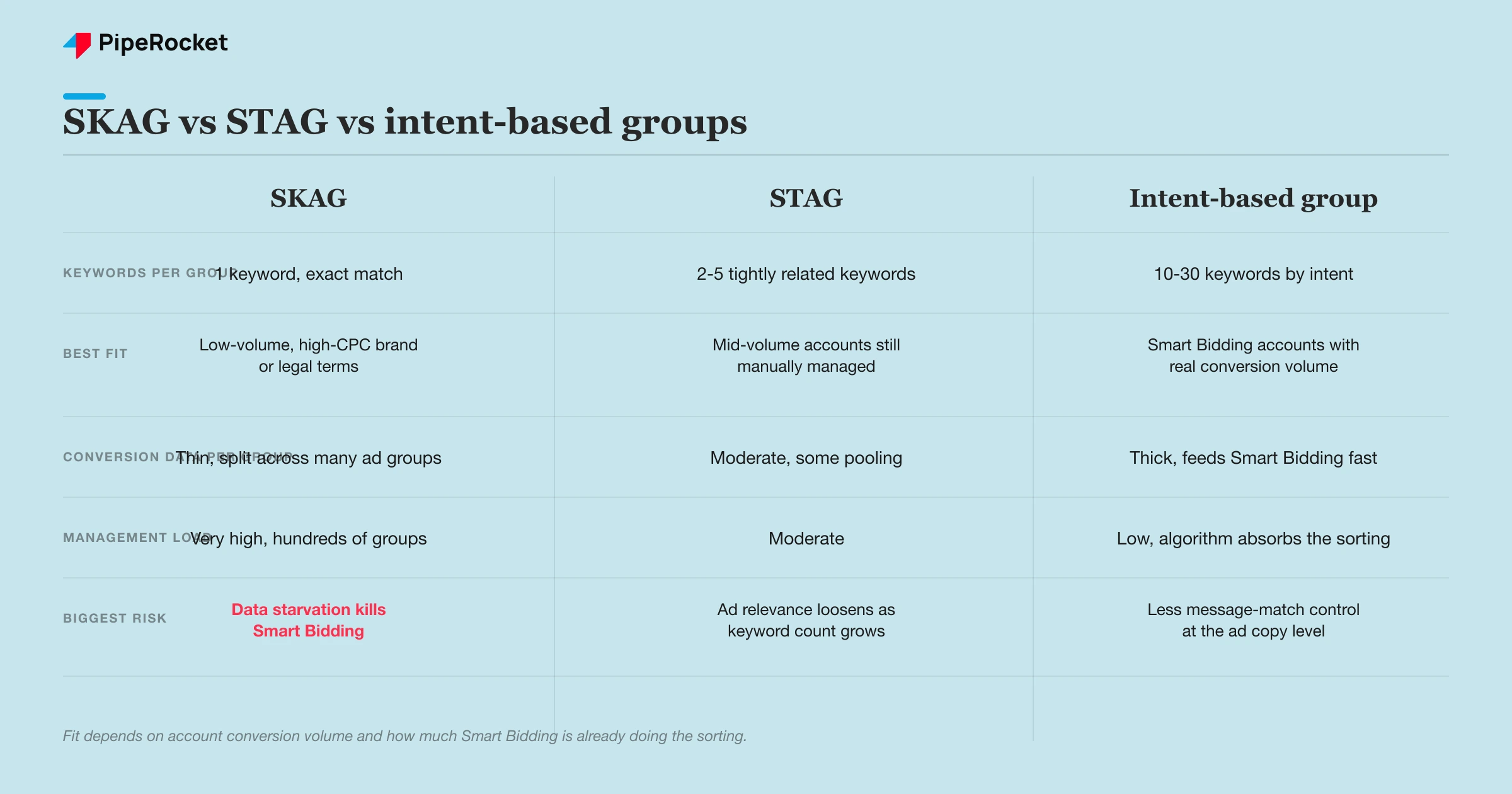
Two account structures have largely replaced the keyword-level SKAG: STAGs and intent-based ad groups. Both trade some of the SKAG’s granular control for enough pooled data to make Smart Bidding actually work.
STAGs (Single Theme Ad Groups)
A STAG groups 2 to 5 closely related keywords under one theme instead of isolating one keyword per group. “SaaS SEO agency,” “B2B SaaS SEO agency,” and “SaaS SEO company” might sit in one STAG, since a searcher typing any of them wants the same result.
STAGs keep most of the message-match benefit while giving each ad group enough combined traffic to be workable for automated bidding.
Intent-based ad groups
These go further, grouping 10 to 30 keywords by buyer intent rather than literal wording. One ad group might hold every keyword signaling “ready to compare vendors,” another every keyword signaling “just learning the category.”
Fast Fact: Intent-based ad groups commonly hold 10 to 30 keywords apiece, roughly 10 to 30 times the keyword count a strict SKAG policy would allow per group.
Ad copy speaks to the intent, not to a specific keyword string, so Smart Bidding gets a thick enough data pool per ad group to model conversion likelihood properly.
Broad match and Performance Max
Broad match used to be the enemy of tight SKAG structures, catching irrelevant queries a strict exact-match SKAG would never allow in. Paired with Smart Bidding, broad match now surfaces converting queries a keyword list would never have thought to include.
Performance Max takes that a step further and removes ad groups from the equation entirely. You feed it assets and goals, and Google’s automation decides which inventory and audience combinations to chase. There’s no keyword-level structure left to argue about, which is exactly why SKAG thinking doesn’t map onto it.
When Does a SKAG Still Make Sense?
A SKAG still earns its place on a short list of low-volume, high-stakes keywords where you need absolute control over the exact message shown, even if it means Smart Bidding never gets meaningful data for that term. Brand terms and legal or compliance-sensitive keywords are the two clearest cases.
- Branded terms: Bidding on your own company name benefits from a dedicated ad group with copy that’s unmistakably yours, regardless of volume.
- Legal and regulatory keywords: Terms tied to compliance claims often need copy reviewed and locked at the keyword level, which a shared ad group makes harder to guarantee.
- Genuinely low-volume, high-CPC niches: If a keyword generates so little traffic that pooling it with others wouldn’t meaningfully change Smart Bidding’s data anyway, isolating it costs you nothing.
- Competitor name campaigns: Bidding on a rival’s brand name works best with copy written specifically for that comparison, not blended with other intent.
I’ll be straight about this: a SKAG is a fine choice when the keyword’s stakes are about message control, not about feeding an algorithm. It’s the wrong choice when you’re applying that same logic to your 200 core product keywords out of habit.
Also read: best B2B Google Ads agencies for SaaS brands
What’s the Real Risk of Over-Segmenting a Google Ads Account?
Over-segmenting an account into too many SKAGs risks starving Smart Bidding of the data it needs. The damage compounds over time, since every new keyword becomes another thin ad group instead of adding weight to a group that already has momentum.
- Diluted conversion signal: Every SKAG competes for a slice of total traffic, so no single ad group gets enough volume to optimize well.
- Management drag: A 300-keyword account with a strict SKAG policy means 300 ad groups to write copy for, monitor, and prune. Most teams can’t sustain that.
- Slower learning phases: Structural sprawl means more frequent algorithm resets, and each reset costs performance for one to two weeks.
- False sense of control: Teams keep the SKAG structure because it feels rigorous, while the account quietly underperforms an intent-based structure running the same budget.
Here’s the trade-off, stated plainly: SKAGs give you granular attribution and tight message match, but they fail the moment your bid strategy depends on volume. That’s nearly every Smart Bidding account running today. It’s worth keeping a SKAG only where the keyword’s value comes from control, not from data density.
Picture a project management tool built for creative agencies. Their team ran a strict SKAG policy across 180 keywords for three years. When they consolidated into 22 intent-based ad groups and let Target ROAS run with real pooled data, the learning phase finally had something to learn from.
A structure built for manual bidding doesn’t automatically survive the move to automated bidding. That’s the actual lesson, not that SKAGs were bad practice by design.
Also read: SaaS PPC service options for teams scaling paid search
Frequently Asked Questions
1. Can I mix SKAGs and intent-based ad groups in the same account?
Yes, and most well-run accounts do exactly that. Keep SKAGs for the handful of branded, legal, or genuinely low-volume terms where message control matters more than data pooling, and run everything else through STAGs or intent-based ad groups. The mistake is applying one policy account-wide instead of matching structure to each keyword’s actual role. A hybrid approach usually outperforms either extreme.
2. How do I know if my account is over-segmented?
Check how many of your ad groups have fewer than 15 conversions in a trailing 30-day window. If that’s more than a third of your active ad groups, your structure is likely too fragmented for whatever bid strategy you’re running. Consolidating those thin ad groups into 3 to 5 related keywords each usually restores enough volume for Smart Bidding to optimize properly within a few weeks.
3. Will switching from SKAGs to intent-based groups hurt my Quality Score?
Not meaningfully, and it often helps. Quality Score now weighs landing page experience and predicted CTR using machine-learned signals more than literal keyword-to-headline matching, so consolidating keywords with genuinely shared intent rarely tanks relevance scores. Expect a short learning-phase dip after the restructure, typically one to two weeks, before performance stabilizes at or above where the SKAG structure had it.
The Bottom Line
Keep the SKAG for the handful of keywords where message control matters more than data volume, and consolidate everything else around intent. Structure your account by how much conversion data each ad group actually needs, not by a rule that made sense a decade ago.
If you want a second opinion on your current ad group structure, get in touch with our team , or see how our SaaS PPC service approaches account structure for Smart Bidding accounts.