
What Is Content Repurposing? Why Most of It Fails
 Kamaraj Mathiarasan (Kim)
Last updated on
Kamaraj Mathiarasan (Kim)
Last updated on
Content repurposing means adapting one piece of source content into a different format for a different channel, like turning a blog into a video script or a LinkedIn carousel. It only works when the format changes how the argument is told. Skip that step and it underperforms the original.
TL;DR
- Content repurposing means adapting existing content into new formats, not just copying the same text into a different wrapper.
- Most repurposed content underperforms the original because teams resize the argument instead of reshaping it for the new format’s real constraints.
- Only evergreen, already well-performing pieces are worth repurposing, thin or time-bound source content just multiplies weak output.
- A practical repurposing framework starts with the source’s core claim, not its sentence structure, and rebuilds from there.
- Over-repurposing thin material produces a pile of derivative posts that dilute your channel instead of strengthening it.
What Is Content Repurposing?
Content repurposing is the practice of adapting a piece of existing content, usually a blog or guide, into a new format for a different platform or audience. The mechanics sound simple: take what’s already written, chop it up, and post it somewhere new. That’s exactly where most teams go wrong.
Most repurposing advice is volume-stacking. Turn one blog into ten LinkedIn posts, a video, and an infographic, and call it a distribution strategy. That produces a pile of derivative content nobody engages with, because none of it changes with the format. It’s the same argument in a new outfit.
- Format-blind copying: Pasting blog paragraphs into a LinkedIn post with line breaks added. The argument never adjusts to how people actually read that platform.
- Constraint mismatch: A 2,000-word guide compressed to a 60-second video script loses its supporting evidence, so the video makes claims it can’t back up.
- Audience drift: The blog was written for a decision-maker researching vendors. The repurposed post got sent to a general LinkedIn audience with no context for why they’d care.
- No new entry point: Real repurposing gives someone a reason to engage who wouldn’t have read the original. Copy-paste repurposing just recycles the same reader.
- Missing the source’s actual strength: A guide’s strength is depth. A carousel’s strength is one sharp point per slide. Stripping the depth and calling it a carousel keeps neither strength.
Consider a project management SaaS for construction firms that published a strong guide on change order tracking. The team then “repurposed” it into six LinkedIn posts, each one paragraph of the guide lightly reworded. Engagement was flat. Nobody reacts to a paragraph fragment with no argument of its own.
What this means in practice: repurposing isn’t a distribution multiplier by default. It’s a rewrite exercise disguised as a shortcut, and skipping the rewrite is why most of it doesn’t land.
Also read: best SaaS marketing agencies
What Does Real Content Repurposing Actually Look Like?
Real repurposing means reshaping the argument to fit the new format’s actual constraints, not resizing the same sentences to fit a smaller box. The format changes what the argument can do, so the argument has to change too.
A blog can build a case across ten paragraphs with evidence stacked in order. A LinkedIn post has about three seconds to earn a second sentence. A video has to hold attention with voice and pacing, not headers and bullets. Each medium rewards its own shape of argument.
- Pick one claim, not the whole piece: A 2,000-word guide might contain four separate arguable points. Repurposing means choosing the sharpest one and building a new piece around it.
- Match the medium’s proof style: A blog proves a point with data and examples. A LinkedIn post proves it with a strong opening line and a specific detail. Different proof, same underlying claim.
- Write for the new platform’s reading behavior: LinkedIn readers scan in the first line. Video viewers need the hook before they can read anything at all. Design for that, not for symmetry with the source.
- Treat the repurposed piece as its own draft: If you wouldn’t publish it as a standalone piece of writing, it’s not repurposing. It’s copying.
Most teams treat repurposing as compression. That’s wrong because compression keeps the source’s structure and just cuts words, and structure is exactly what needs to change between formats. What works instead is extraction: pull the one idea worth carrying, then write it fresh for where it’s landing.
Fast Fact: Organic search drives 91.3% of SaaS traffic, AI-referred visits account for less than 9%, which is why the source piece that gets repurposed usually needs to be the one already earning organic visibility.
Also read: best B2B marketing agencies
Which Source Content Is Actually Worth Repurposing?
Only content that’s already evergreen and already performing is worth the repurposing effort. A piece that’s timely, thin, or hasn’t proven it resonates has nothing durable to extract in the first place.
Evergreen content , the kind covered under content marketing fundamentals, holds up because the underlying question doesn’t expire. A guide on “how to calculate SaaS churn” stays relevant for years. A post reacting to a product announcement from last quarter doesn’t.
- Proven performance first: If the original blog or guide already ranks, gets shared, or converts, that’s a signal the argument works. Repurpose winners, not hopefuls.
- Evergreen over time-bound: News reactions, feature launches, and seasonal content lose relevance fast. Repurposing them just spreads a shelf-dated argument across more channels.
- Depth worth extracting: A piece needs more than one usable idea inside it. If the source only makes one point across 1,500 words, there’s nothing left to pull into a second format.
- Real evidence inside it: Source content built on genuine research, data, or a client story travels well. Source content that’s mostly opinion with no backing falls apart once it’s stripped of its original context.
I’ve watched teams repurpose their weakest, least-read blog just because it happened to be next in the content calendar . That’s backwards. Repurposing should follow performance data, not publishing order.
Also read: best B2B SEO agencies
What’s a Practical Framework for Repurposing Content?
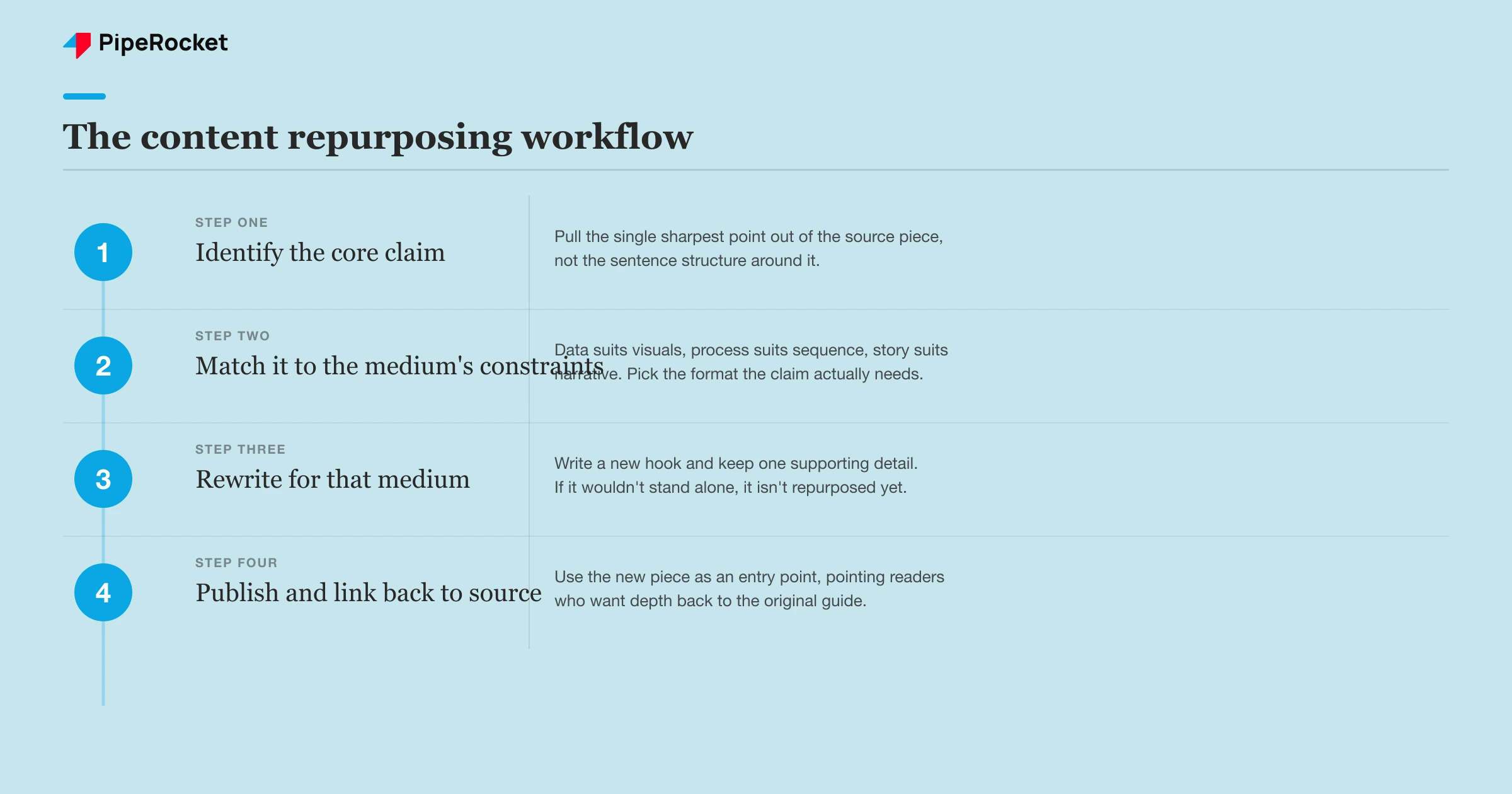
A practical repurposing framework starts by identifying the source’s strongest single claim, then asks what format best proves that specific claim to a specific audience. Everything downstream follows from that one decision.
Start with the source piece and ask what actually made it work. Was it a contrarian point? A concrete example? A number nobody else had? That’s the seed, not the paragraph structure around it.
Choosing the Right Format
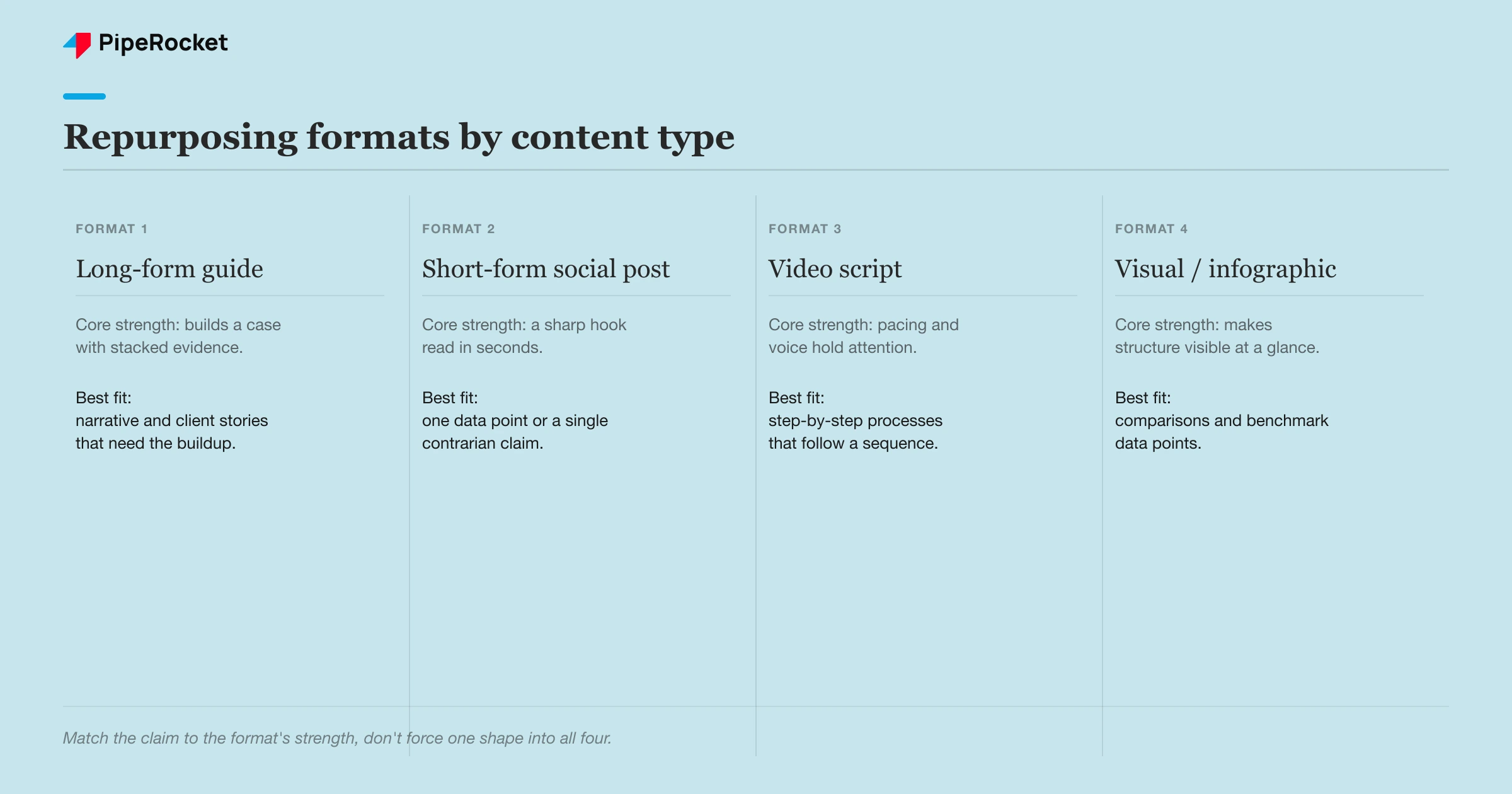
Not every claim fits every format. A data-driven point (like a specific benchmark or trend) works well as a short-form post or a chart. A process-based point (like a step-by-step framework) works better as a video walkthrough or a carousel, because sequence is easier to follow visually than in prose.
A narrative point, like a client turnaround story, works best kept close to its original long-form shape. Compressing a story into three bullet points kills the thing that made it work: the buildup.
- Match claim type to format: Data points suit visuals, processes suit sequences, stories suit narrative formats. Don’t force a story into bullet points.
- Rewrite the hook first: The opening line of the repurposed piece should be written fresh for that platform’s scroll behavior, never copied from the source’s intro paragraph.
- Keep one supporting detail, not five: A LinkedIn post or short video can carry one piece of evidence convincingly. Cramming in every stat from the source dilutes all of them.
- Link back to the source for depth: The repurposed piece should point readers who want more toward the original, using it as the entry point rather than trying to replace it.
Different formats need different production effort, and a video script or an infographic like the one comparing formats below often takes more time than the original social post ever did.
If your team is figuring out how repurposing fits into a broader content plan, a SaaS SEO agency can help map which pieces are worth the rewrite before you spend the hours doing it.
Also read: best SaaS PPC agencies
When Does Repurposing Actually Backfire?
Repurposing backfires when the source material is thin, and you multiply that thinness across five channels instead of fixing it in one. Volume doesn’t rescue a weak argument, it just spreads the weakness further.
Repurposing gives you more touchpoints from one piece of research, which saves real production time. But it fails when the source never earned attention on its own, because there’s nothing worth adapting in the first place. It’s worth doing when the original is already proven and evergreen.
This works well for teams with a small backlog of strong, evergreen pillar content and limited time to create net-new material every week. For teams still building that backlog, it fails, because there’s nothing strong enough yet to repurpose. Forcing it just produces five weak posts instead of one.
- The thin-source trap: Repurposing a 600-word blog with no original research into six formats doesn’t create six good pieces. It creates six thin ones.
- The volume treadmill: Chasing a repurposing quota (ten pieces per blog) trains a team to think in outputs instead of whether anyone’s actually reading them.
- The context loss: A stat that made sense with the paragraph around it can mislead readers once it’s isolated in a social post with no supporting explanation.
I’d rather see a team repurpose one genuinely strong guide into two well-made pieces than take five average posts and turn them into twenty mediocre ones. The second approach looks productive on a content calendar and does nothing for actual reach.
Fast Fact: Teams that track repurposed content by engagement per piece, not total pieces published, tend to notice the volume treadmill far earlier than teams tracking output alone.
Also read: best enterprise SEO agencies
Frequently Asked Questions
1. How do I know if a repurposed piece is actually working versus just filling a content calendar?
Check whether the repurposed piece gets engagement on its own terms, not whether it exists. A repurposed LinkedIn post should get comments or shares independent of the original blog’s traffic. If it consistently underperforms your normal posting average, the rewrite step was probably skipped and it’s worth pulling that format from rotation until you fix the process.
2. Should I repurpose a piece before or after it’s proven itself organically?
Wait until the source content has proven it resonates, usually a few months of steady traffic or engagement, before repurposing it. Repurposing something untested just spreads an unproven argument across more channels. The exception is a piece built on a real client result or verified data you’re confident holds up regardless of how the blog itself performs.
3. What’s the biggest sign a team is over-repurposing rather than genuinely adapting content?
The clearest sign is a repurposing quota tied to source count rather than quality, like a rule that every blog becomes ten pieces regardless of its depth. If your repurposed content increasingly gets built from your newest post instead of your best-performing one, you’ve shifted from adaptation to a volume habit that dilutes the channel.
The Bottom Line
Repurposing isn’t a shortcut around writing, it’s a second writing pass aimed at a different format’s actual strengths. Pick your strongest evergreen pieces, rewrite for the medium, and skip the rest.
If you want help figuring out which pieces in your content library are actually worth that effort, reach out to our team or see how our SaaS SEO service approaches content that compounds instead of multiplying.