
What Is a Link Farm? The Old Trick Wearing a New Disguise
 Kamaraj Mathiarasan (Kim)
Last updated on
Kamaraj Mathiarasan (Kim)
Last updated on
A link farm is a network of websites built only to trade, sell, or manufacture backlinks to each other, with little or no real content behind them. Google’s Penguin update and its successors were built to catch these networks. The catch: most link farms today don’t look old-school anymore.
TL;DR
- A link farm is a group of low-value sites built purely to exchange or sell links, not to serve real readers.
- Google’s Penguin algorithm and its later updates were designed to detect link farm patterns and devalue the links.
- Modern link farms often disguise themselves as guest post networks, “authority” blogs, or AI-generated content sites.
- A paid link placement can be farm-adjacent even when the site looks legitimate and has real traffic.
- Vetting a link vendor for content quality and outbound link patterns matters more than checking domain authority alone.
What Is a Link Farm?
Most people picture a link farm as a wall of spammy .info sites with random keywords stuffed into gibberish articles. That picture is outdated. A link farm is just a group of sites that exist to pass link value around, not to inform anyone. The packaging changed. The mechanics didn’t.
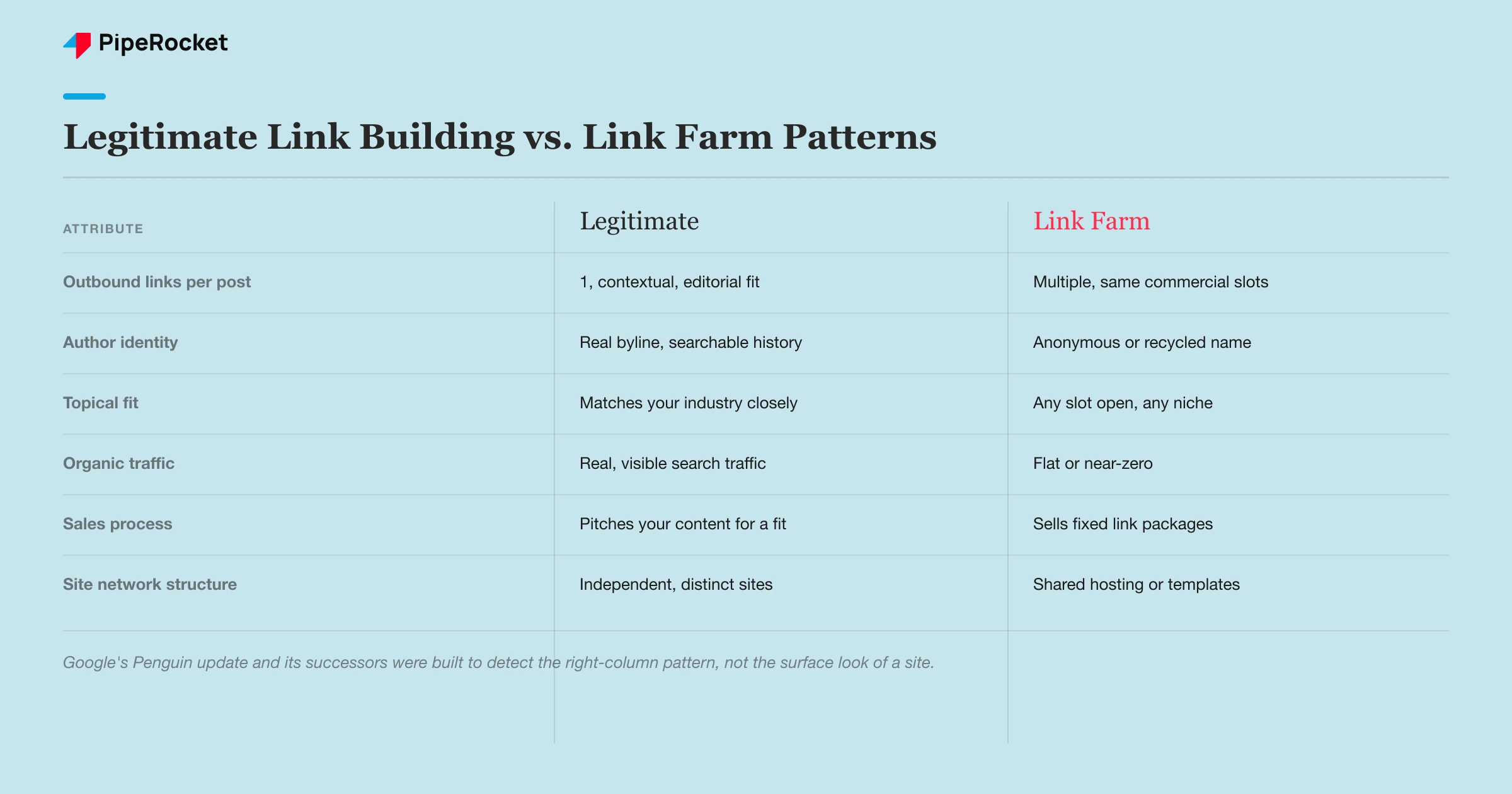
Here’s what most explainers skip: link farms didn’t disappear after Penguin. They evolved into things that pass a casual look. A “guest post network” publishing the same 40 sponsors’ links every week is a link farm. So is a PBN dressed up with a logo and an “About Us” page.
A cluster of AI-generated content sites quietly swapping links with each other counts too, even when each site looks like it has its own voice.
- Reciprocal link swapping: Sites agree to link to each other purely to inflate authority signals, with no editorial reason for the link to exist.
- Sold placements at scale: A network sells the same handful of outbound link slots to dozens of buyers a month, on sites with almost no organic traffic.
- Thin or spun content: Articles exist only to host the links. The text is filler, often AI-generated, and never meant to be read.
- Shared infrastructure: Many farm sites share hosting, templates, or ownership, which is exactly the pattern Google’s algorithms are trained to flag.
- No real audience: Traffic, if any, comes from the links themselves, not from organic search or referrals.
Picture a compliance SaaS buying “10 guest posts” from a vendor for a flat monthly fee. The vendor publishes on the same 12 sites every client gets placed on. That’s not guest posting. That’s a link farm with a sales page.
What this means in practice: a clean, modern-looking site can still be a link farm. What actually matters is whether an editor found your content worth citing, or someone simply paid to make the link appear.
Also read: how the best SaaS SEO agencies vet link building vendors before recommending them to clients
How Does Google Detect Link Farms?
Google detects link farms mainly through link graph patterns, not by reading every article on every site. Penguin, launched in 2012, was the first major algorithm built specifically to devalue manipulative link schemes at scale.
- Unnatural link velocity: A sudden spike in backlinks from unrelated, low-authority domains is a red flag Google’s systems weigh heavily.
- Reciprocal and circular patterns: When Site A links to Site B, Site B links to Site C, and Site C links back to Site A, with no topical reason, that pattern gets flagged.
- Shared footprints: Common IP ranges, registrars, or templated site structures across “different” domains expose the network.
- Anchor text over-optimization: Farms tend to use exact-match commercial anchor text repeatedly, which reads as manufactured rather than organic.
- Low or fake engagement: Little organic traffic, no social signals, no branded search volume around the linking domain.
Fast Fact: Organic search drives 91.3% of SaaS traffic, AI-referred visits account for less than 9%.
Penguin’s successors folded this detection into Google’s core algorithm instead of running as a separate filter. That’s why farm penalties now often show up as a quiet ranking drop , not a manual action notice .
Most teams assume they’d know if they’d been caught. They wouldn’t. That’s the wrong assumption to carry into any link building decision.
What Are the Warning Signs a Paid Link Is Farm-Adjacent?
A paid link is farm-adjacent when the site exists mainly to sell placements, even if the content reads fine and the design looks polished. This is the gap most guides never cover, because it’s uncomfortable for anyone selling links.
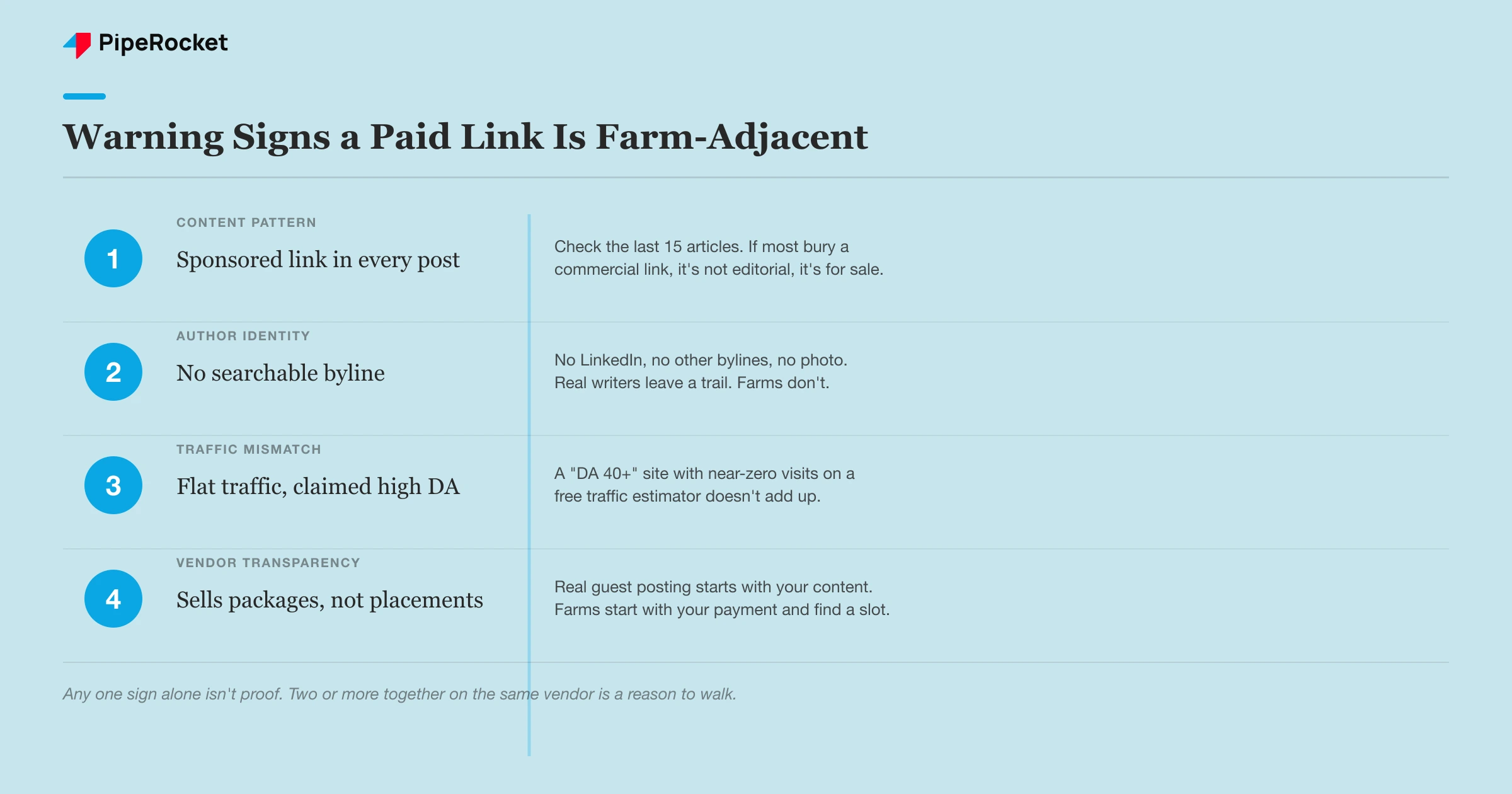
- Every article has an outbound “sponsored” link buried in it: Check the site’s last 15 posts. If most contain a commercial link to an unrelated brand, that’s the tell.
- No author has a real, searchable identity: Bylines with no LinkedIn, no other bylines anywhere, and no photo are common on farm-adjacent sites.
- Traffic is flat or fabricated-looking: A quick check on a free traffic estimator showing near-zero visits despite claimed “DA 40+” is a mismatch worth questioning.
- The vendor sells “packages” instead of pitching your content: Real guest posting starts with your content and finds a fit. Farms start with your payment and find a slot.
- Topical relevance is an afterthought: A fintech SaaS getting placed on a general lifestyle blog “because they had an opening” is a sign the network doesn’t care what it’s linking to.
Most teams assume that if a link vendor has a nice-looking dashboard and case studies, the links are safe. That’s wrong, because a polished sales process says nothing about whether the underlying sites are real. The dashboard sells confidence, not link quality.
Also read: best B2B SEO agencies that disclose their actual link building process instead of just reporting a metric
How Do You Vet a Link Building Vendor?
You vet a link building vendor by checking their site portfolio for the same red flags Google checks for, before you pay for anything. Ask for the exact list of sites they’d place you on. If they won’t share it before payment, that’s already an answer.
- Ask for the live site list first: A vendor confident in their network will show you where you’re landing before you commit, not after.
- Check outbound link count per article: Open five recent posts on their sites. More than one or two commercial outbound links per post is a farm signal.
- Search the domain name plus “review” or “guest post”: Farm networks tend to have a trail of Reddit or forum complaints from other buyers.
- Look for topical fit, not just DA: A site with DA 45 that covers unrelated topics is worse for you than a DA 25 site that’s actually in your niche.
- Ask how long the site has been publishing: Networks spin up fresh domains constantly. A site with under a year of consistent posting is higher risk.
A real trade-off worth naming: vetting every vendor this closely slows down your link building timeline, sometimes by weeks. It’s worth it because a batch of farm links can undo months of domain authority building in one algorithm update. We’d rather move slower and keep what we’ve built.
Consider a project management SaaS for construction teams that took on a “50 links in 30 days” vendor to hit a Q3 target. Three placements later turned out to be part of a flagged PBN. The site’s backlink profile needed a disavow cleanup that outlasted the original campaign.
What’s the Real Cost of Using a Link Farm?
The real cost of using a link farm goes past a potential penalty. You lose the time and trust spent cleaning it up, on top of links that were never going to move the needle in the first place.
- Wasted spend: Farm links rarely pass meaningful authority even before any penalty, because Google’s systems increasingly discount the whole network.
- Disavow overhead: Cleaning a toxic backlink profile means auditing every link, filing a disavow file, and waiting through an uncertain recovery window.
- Compounding risk: One farm-adjacent link rarely tanks a site alone, but a pattern of them across months builds exactly the footprint Penguin’s successors look for.
- Opportunity cost: The budget spent on farm placements is budget not spent on the best B2B marketing agencies style earned coverage that actually compounds.
A contrarian insight worth sitting with: cheap link packages are marketed as “safe” because they’re indirect. That’s wrong, because indirection isn’t the same as deniability. Google doesn’t need to prove intent. It just needs to see the pattern, and patterns are exactly what algorithms are built to find.
A nuanced warning: this risk is highest for SaaS and B2B sites competing on commercial, high-intent keywords, where Google scrutinizes the link profile more. For a low-competition, hyper-local niche, a single farm link might go unnoticed. That’s not a reason to gamble.
Fast Fact: Organic search converts SaaS visitors at 0.92%, more than 3x the rate of AI-driven traffic at 0.26%.
Frequently Asked Questions
1. If I got links from a network years ago and never saw a penalty, am I safe now?
Not necessarily. Penguin’s successors run continuously inside Google’s core algorithm, so old links can get devalued in a later update even without a visible penalty at the time. Run a fresh backlink audit at least once a year, especially if you’ve ever used cheap guest posting or directory packages. If you find farm patterns, disavow them rather than waiting to see if they’ll cause a problem.
2. How do I tell the difference between a legitimate guest post and one from a link farm in a real scenario?
Look at the site’s last 10 to 15 articles as a set. A legitimate guest post site publishes on a mix of topics with maybe one contextual link per piece, written by identifiable authors. A farm-adjacent site shows a repeating pattern: every article has a commercial outbound link, often to unrelated industries, from anonymous or recycled bylines.
3. Should I prioritize removing existing farm links or building new clean ones first?
Audit and disavow suspected farm links first. New high-quality links won’t offset an active toxic pattern Google is already discounting, and cleaning up buys you a more stable baseline. Once the audit is done, shift budget toward earned coverage and relevant guest placements, which compound instead of decaying.
The Bottom Line
Link farms didn’t get stamped out. They got better disguises, and the packages that look safest on a sales page are often the riskiest thing you can buy. Vet the site list before you vet the price.
If you want a link building process built around vetted, relevant placements instead of packages, reach out to our team or see our SaaS SEO service for how we approach it.