What Is Lead Scoring in SaaS? How the Model Actually Works
 Ranjeeth Kumar
Last updated on
Ranjeeth Kumar
Last updated on
Lead scoring is the process of assigning a numeric value to a lead based on how well it fits your ideal customer and how engaged it’s been. The score combines firmographic fit with behavioral signals like page visits, demo requests, and content downloads, so sales knows who to call first.
What You Need to Know About Lead Scoring
- Lead scoring ranks leads by fit and behavior so sales spends time on accounts most likely to close.
- Most SaaS teams build a scoring model once at launch and never revisit it as their ICP shifts.
- A simple two-variable model (fit plus intent) usually outperforms a complex model with a dozen weighted attributes nobody maintains.
- Lead scoring is not the same as lead generation : scoring ranks leads that already exist, generation creates new ones.
- A model that scores for volume instead of conversion quietly erodes sales trust in every lead marketing sends over.
What Is Lead Scoring?
Lead scoring assigns points to a lead across two dimensions: fit (does this account match your ICP) and intent (is this person showing buying behavior). Add the two together, and you get a number that tells sales where to focus first.
Most teams get the mechanics right and the philosophy wrong. They add attribute after attribute, job title, company size, industry, funding stage, page depth, until the model has 15 weighted variables nobody remembers the reasoning behind. That complexity doesn’t make the score more accurate.
It makes it unmaintainable, because nobody revisits 15 variables every quarter.
- Fit score: Firmographic and demographic attributes that predict whether an account matches your ICP, set once and revisited quarterly.
- Intent score: Behavioral signals like pricing page visits, demo requests, and product usage that predict active buying interest.
- Threshold: The combined score at which a lead gets routed to sales, usually tuned from historical conversion data instead of a guess.
- Decay: Older behavioral signals should count for less than fresh ones. A demo request from six months ago isn’t the same signal as one from yesterday.
- Negative scoring: Points subtracted for disqualifying signals like a personal email domain or a job title with no budget authority.
Consider a procurement SaaS selling to mid-market manufacturers. Their original model weighted 12 attributes, including “downloaded a blog post,” which every visitor did. Collapsing to two variables (fit and intent) made the score sharper, not weaker.
For a $100K+ enterprise deal specifically, the intent inputs worth feeding into that model go beyond form fills. Our SEO lead’s framing for enterprise pipeline is “stop chasing traffic, start chasing signals”: who visited which pages and how often is itself an intent signal worth scoring, not just a demo request or a pricing-page click. Organic content that answers a real buying question and shows up in an aggregator mention is doing lead-scoring work even before anyone fills out a form, which is easy to miss if the model only counts form-based behavior.
The Lead Scoring Formula
A lead scoring model works by adding a fit score to an intent score, then comparing the total against a threshold that routes the lead to sales, marketing nurture, or disqualification. The two scores come from different data sources and get calculated separately before they’re combined.
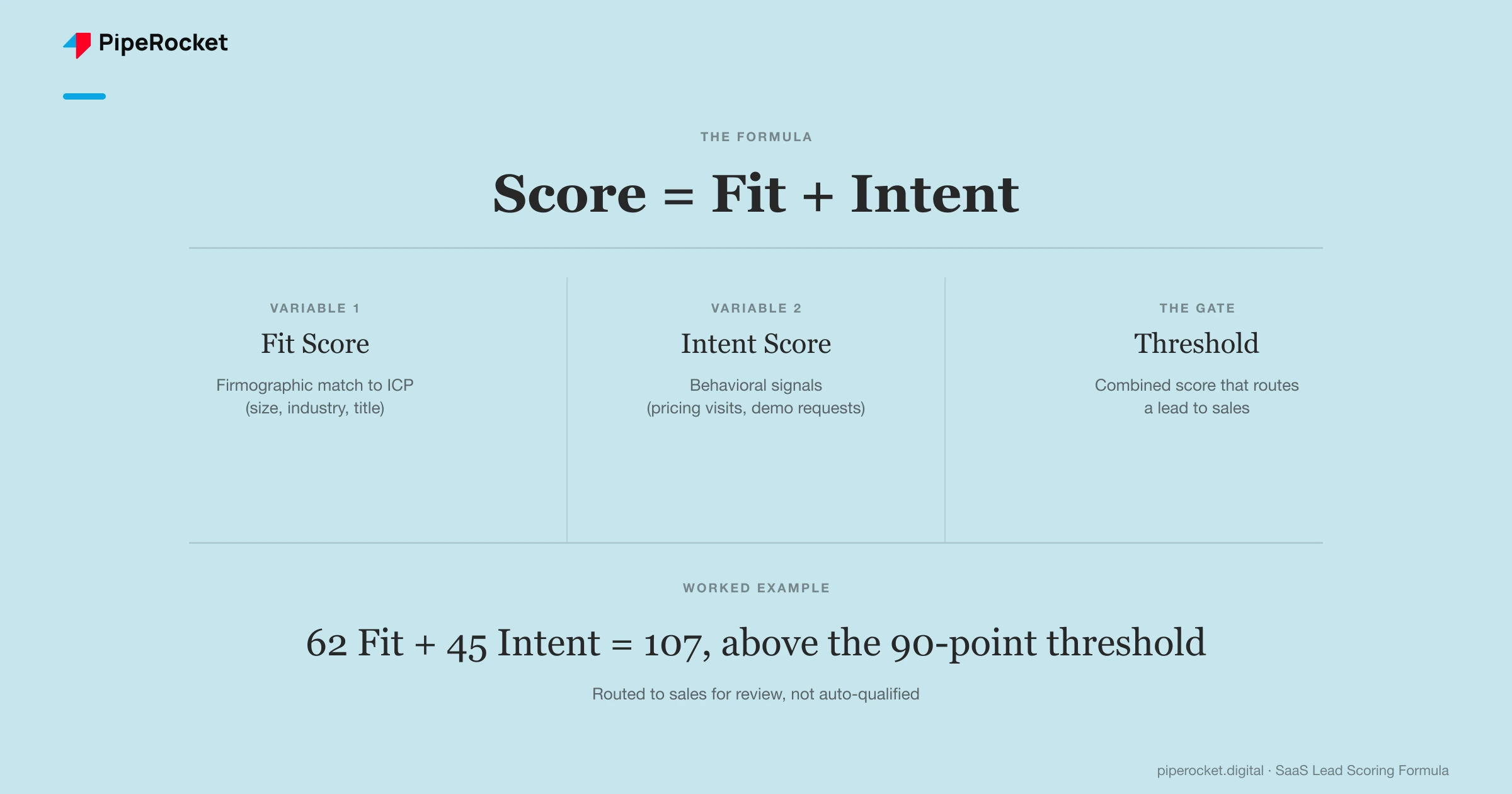
Fit comes from firmographic data, usually pulled from a CRM enrichment tool or self-reported on a form. Intent comes from behavioral tracking across your site, product, and email engagement. Most CRMs and marketing automation platforms calculate both natively.
How to Build a Lead Scoring Model Step by Step
- Define your ICP first: You can’t score fit against an ICP you haven’t written down, so start there before touching a scoring tool.
- Pick 3-5 fit attributes, not 15: Company size, industry, and job title cover most of what predicts fit. Resist adding more.
- Weight behavior by buying signal strength: A pricing page visit should score higher than a blog read, because it signals closer proximity to purchase.
- Set decay rules: Cut old behavioral points in half after 30-60 days so stale activity stops inflating the score.
- Add negative scoring: Subtract points for disqualifiers like competitor domains or students, so a busy but wrong-fit lead can’t outscore a quiet but perfect one.
- Validate against closed-won data: Pull your last 50 closed-won deals and check whether your model would have scored them highly. If not, the weights are wrong.
- Review the model quarterly: Your ICP moves as your product moves. A model that was accurate in January can be wrong by June.
Most teams treat that last step as optional. That’s the mistake that turns a good model into a stale one within two quarters.
Lead Scoring vs. Lead Qualification: What’s the Difference?
Lead scoring produces a number. Lead qualification is the human or process decision that number feeds into, deciding whether a lead is worth a sales rep’s time right now.
Scoring is continuous and automated, running in the background on every lead in your database. Qualification is a checkpoint, often the moment a lead crosses the routing threshold and a rep reviews it before accepting or rejecting.
- Scoring is a signal: A high score means “worth a look,” rather than “definitely qualified.” Reps still apply judgment.
- Qualification adds context scoring can’t: A rep on a discovery call learns about budget and timeline that no behavioral score captures.
- Scoring feeds qualification: The score should narrow the pool a rep reviews, rather than replace the review entirely.
This is also where lead scoring differs from lead generation . Generation is about creating new leads through content, ads, and outreach. Scoring only ranks leads that already exist in your database.
For a deeper look at how the qualification handoff between marketing and sales actually works, see our breakdown of the SAL stage and MQL .
How Do You Know If Your Lead Scoring Model Is Working?
Your model is working if the leads sales accepts at high scores convert to opportunities at a meaningfully higher rate than random leads pulled from your database. If that gap doesn’t exist, the score has no predictive value at all.
Pull a quarter of scored leads and split them into high, medium, and low score bands. Check the conversion rate to opportunity for each band. A working model shows a clear step-down between bands.
A broken model shows roughly the same conversion rate across all three, which means the scoring criteria aren’t actually correlated with who buys.
- Track score-to-opportunity conversion over score-to-MQL: MQL volume is easy to inflate. Opportunity conversion is harder to fake and the number that matters.
- Ask sales what they ignore: If reps routinely skip high-scored leads, the model is rewarding the wrong signals and reps have already figured that out.
- Watch for score inflation over time: If your average score keeps climbing without a matching rise in close rate, someone’s gaming the inputs.
A compliance SaaS for healthcare billing teams found its top-scored leads converted at the same rate as its lowest tier. The scoring model was rewarding page depth, a signal that turned out to mean nothing for that buyer.
Common Mistakes to Avoid
Scoring for MQL Volume Instead of Opportunity Conversion
Most SaaS teams score for volume because it’s the easier number to report up. That’s wrong because a pile of high-scored leads that don’t convert wastes sales time and erodes trust in every future lead marketing sends.
Copying Another Company’s Scoring Template
A model built for a $50/month self-serve tool doesn’t transfer to an enterprise deal with a five-person buying committee , because the behavioral signals that predict intent are completely different at each price point.
Treating All Page Visits as Equal Signals
A pricing page visit and a careers page visit are not the same intent signal, but many default templates score them identically. Weight by buying-signal strength, not by traffic volume.
Never Revalidating Against Closed-Won Data
A model nobody checks against actual outcomes just encodes an old guess forever. Pull closed-won and closed-lost data every quarter and check whether the weights still hold up.
Complex scoring works for teams with enough volume and historical data to validate the weights. For an early-stage SaaS with under 200 closed deals, a simple binary fit-and-intent model beats an elaborate one every time, because there isn’t enough data yet to justify the complexity.
How PipeRocket Digital Supports Lead Scoring That Holds Up
We build the organic and paid pipeline that feeds a scoring model worth trusting, so the leads marketing generates match the fit and intent signals sales actually acts on. If you want help building that pipeline, our SaaS SEO agency team can align content and lead quality with your scoring criteria, or get in touch to talk through where your model needs work.
Frequently Asked Questions
What’s the difference between lead scoring and predictive (AI-based) lead scoring?
Traditional lead scoring uses manually assigned point values for fit and behavior attributes that a person defines. Predictive scoring uses machine learning to find patterns in historical closed-won and closed-lost data, then assigns scores based on those learned patterns instead of manual rules. Predictive models can surface non-obvious signals a human wouldn’t think to weight, but they need enough historical deal volume, usually several hundred closed deals, to train on. Below that volume, a manual model built from your own judgment will outperform a predictive one with too little data to learn from.
When should a SaaS company introduce formal lead scoring versus staying manual?
Once inbound lead volume outpaces what a rep can manually triage in a day, usually somewhere past 50-100 new leads a week, manual review starts missing good leads buried in the queue. Below that volume, a rep can eyeball every lead faster than a scoring model can be built and maintained. Introducing scoring too early just adds process overhead to a problem that doesn’t exist yet.
How often should a lead scoring model be recalibrated?
Review the model every quarter at minimum, and immediately after any major shift in ICP, pricing, or product positioning. A model built around last year’s buyer profile will misfire the moment your ICP moves, even if nobody remembers to update the weights. Teams that skip this review are usually the ones asking why their MQL-to-SQL conversion rate keeps drifting for no obvious reason.