What Is Brand Awareness? A B2B SaaS Marketer's Guide
 Omar Sheriff
Last updated on
Omar Sheriff
Last updated on
Brand awareness is how easily your target buyers recognize your company name, logo, or product when they encounter it, and how quickly they recall you when a relevant problem shows up. It’s the foundation every other marketing motion sits on top of.
The Short Version
- Brand awareness measures how well a defined audience recognizes and recalls your company, not how many people have vaguely heard of you.
- It builds in stages: recognition (they spot your logo), recall (they name you unprompted), and top-of-mind status (you’re the first name that comes up in the category).
- You measure it through branded search volume, direct traffic, survey-based recall, and share of voice against named competitors, not vanity impressions.
- For B2B SaaS, awareness only pays off if it reaches the 6 to 10 people on the buying committee, not a broad consumer audience.
- Skip awareness entirely and the trust it builds still has to get built somewhere. Your sales team ends up creating it one call at a time instead.
What Brand Awareness Actually Means for a B2B SaaS Company
Brand awareness refers to how familiar a specific, defined audience is with your company, not how many total people know your name. That distinction matters more in B2B SaaS than almost anywhere else.
A consumer brand can win by being famous to millions of casual buyers. A B2B SaaS company selling a $40,000-a-year compliance tool doesn’t need millions of people to know it. It needs a small set of people at maybe 2,000 target accounts to recognize the name and trust it enough to take a call:
- The compliance lead who owns the buying decision
- The CFO who signs off on the spend
- The security reviewer who has to approve the vendor
Most generic advice on brand awareness comes from consumer marketing: get your logo everywhere, run a jingle, chase reach. That’s the wrong model here. A B2B SaaS buying committee doesn’t discover you through a billboard. They discover you through a Google search for a comparison, a peer mention on LinkedIn, a G2 category page, or a colleague who used you at a previous company.
Why Reach Alone Is a Vanity Number in B2B
Reaching a lot of people who can’t buy from you or influence the purchase is exposure with no commercial value attached, and it’s the metric most awareness budgets get judged on by mistake.
A B2B SaaS company can run a LinkedIn campaign that gets 500,000 impressions and moves nothing, because the audience wasn’t filtered to the actual buying committee. That committee usually includes:
- The economic buyer who controls budget
- The technical evaluator who tests the product
- The end user who lives in it daily
- Whoever signs off on security or compliance
Awareness that doesn’t reach those specific roles is just noise with a budget attached.
Why B2B Awareness Compounds Slower Than B2C
B2B buying cycles run three to eighteen months, so awareness built today often doesn’t convert into pipeline for two or three quarters. That lag is why awareness spend gets cut first when budgets tighten, and why it needs its own success metrics instead of being judged on last-click conversions.
A consumer brand can run a campaign and see sales lift within weeks. A B2B SaaS company runs an awareness push, and the buyer who saw it doesn’t have a live problem yet, so they file the name away.
Three quarters later, a vendor evaluation kicks off, and that stored name gets pulled into the shortlist. Judging the original campaign on 30-day conversions misses the entire mechanism.
The Three Stages of Brand Awareness
Brand awareness moves through three distinct stages, and each one requires a different kind of marketing effort to reach. Treating them as one blob is where most awareness budgets get wasted.
| Stage | What it means | How you build it |
|---|---|---|
| Recognition | The buyer sees your logo, name, or product and knows they’ve encountered it before | Consistent visual identity across ads, LinkedIn, review sites, and search results |
| Recall | The buyer can name your company unprompted when asked about the category | Repeated exposure tied to the specific problem you solve, not generic brand messaging |
| Top-of-mind | Your company is the first name a buyer thinks of in your category | Category ownership through content, community presence, and being the default comparison point |
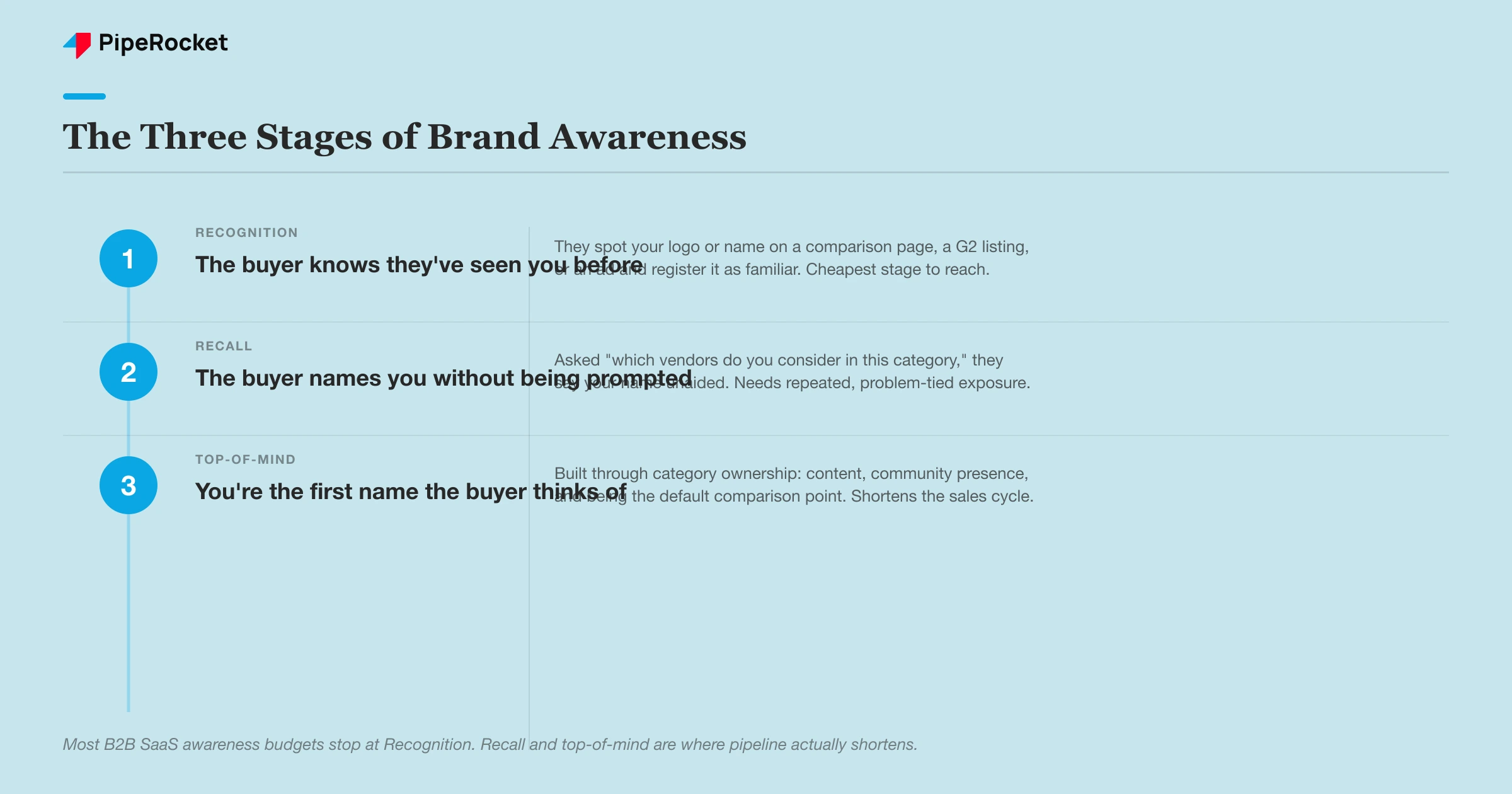
Recognition is the cheapest stage to reach and the easiest to fake with paid reach. Top-of-mind is the hardest and the only one that actually shortens your sales cycle, because a buyer who thinks of you first invites you into the deal instead of you having to fight your way in through outbound.
Recognition Comes Before Trust, Not Instead of It
Recognition alone doesn’t win deals, and treating it as the finish line leaves the actual conversion work undone. A buyer can recognize your logo from a G2 page and still choose a competitor they recall more clearly when the RFP goes out.
This is where a lot of B2B SaaS marketing budgets stall. Teams run enough retargeting to get recognized, declare “brand awareness” done, and wonder why demo requests didn’t move. Recognition is step one of three, not the whole job.
Why Brand Awareness Matters for a B2B SaaS Pipeline
Brand awareness matters because it shortens the path a buying committee takes from “we have a problem” to “let’s talk to this vendor,” and it does that in three concrete ways.
- It builds trust before the sales call starts. A buyer who already recognizes your name walks into a demo assuming you’re a legitimate option, instead of making your rep spend the first ten minutes establishing credibility.
- It beats out competitors buyers haven’t heard of. When a shortlist comes down to a familiar name and an unknown one, the familiar name gets the benefit of the doubt on every unclear feature comparison.
- It shortens the sales cycle, which is the real revenue impact. A buying committee that already knows your name skips the “who even is this vendor” research step and moves straight into evaluation, which is the difference between a 3-month and a 6-month deal in most B2B SaaS categories.
None of that shows up as a line item on a campaign report. It shows up as a shorter time-to-close and a higher win rate against competitors nobody on the committee had heard of before the deal started.
How to Measure Brand Awareness in B2B SaaS
Brand awareness is measured through a mix of search behavior, direct engagement, and survey-based recall, since no single metric captures all three stages on its own. Each metric maps to a different stage, and using only one gives a distorted read.
| Metric | What it captures | Best measured via |
|---|---|---|
| Branded search volume | How many people are actively looking for you by name | Google Search Console, Ahrefs/Semrush branded keyword tracking |
| Direct traffic | Buyers who type your URL or use a saved bookmark instead of clicking a search result | Google Analytics source/medium report |
| Share of voice | How often you’re mentioned versus named competitors, in your category | Semrush/Sprout Social share-of-voice tools, manual SERP tracking on comparison terms |
| Aided/unaided recall | Whether your target audience can name you when prompted or unprompted about the category | Third-party brand surveys (SurveyMonkey, Wynter, or a sales-team-run buyer survey) |
| Social/community mentions | Organic conversations about your product outside your own channels | LinkedIn/Reddit/G2 mention tracking, review velocity |
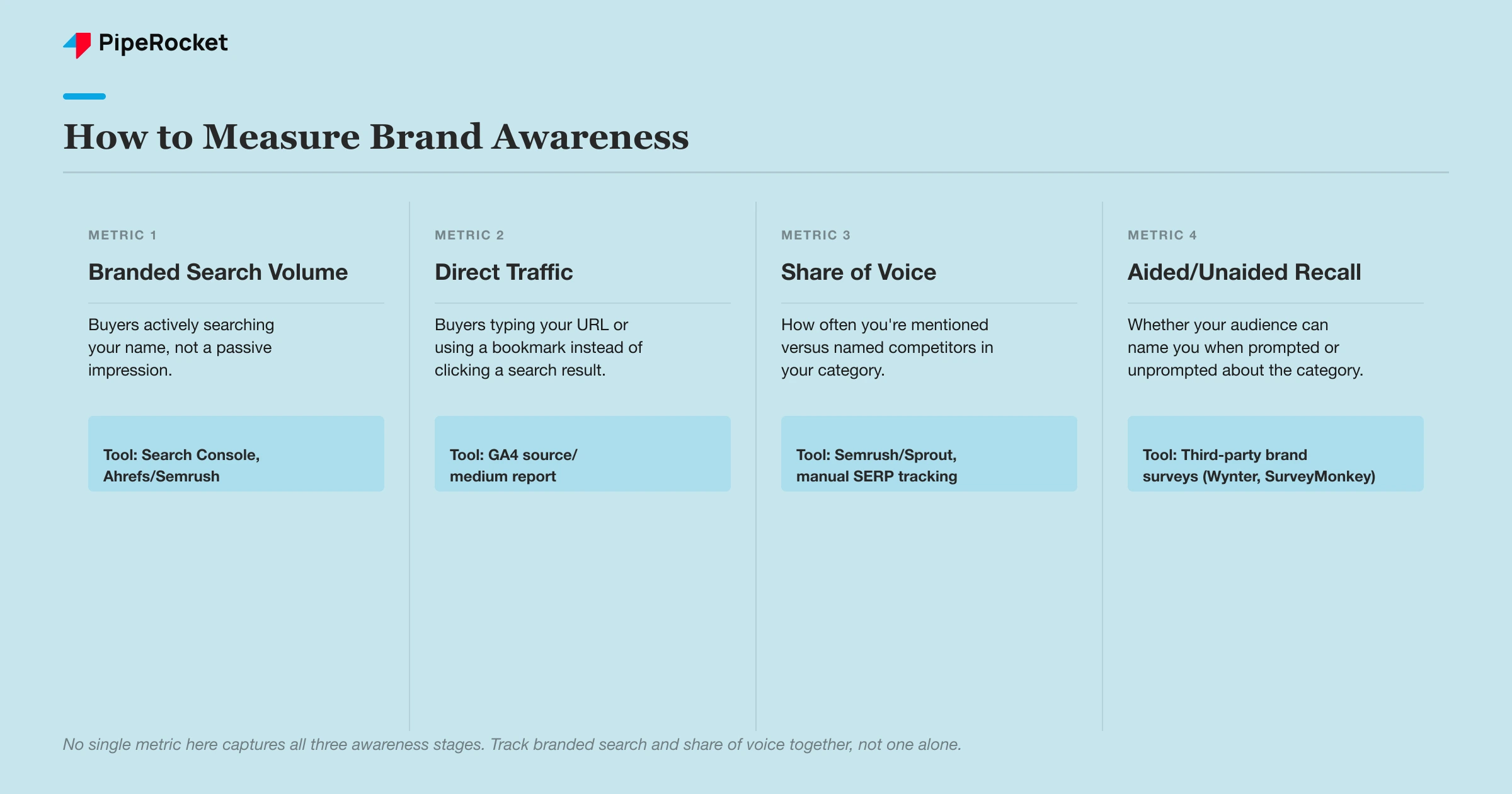
Branded search volume is the most useful proxy for B2B SaaS specifically, because it’s a buyer taking a deliberate action to find you, not a passive impression. A 20% quarter-over-quarter lift in branded search tells you awareness is converting into active interest, even before a single form gets filled.
Share of voice matters just as much, and it’s the one most teams skip. If your branded search is growing but a competitor’s is growing faster in the same category, they’re pulling ahead in the same fight, even though your own numbers look fine in isolation.
How to Build Brand Awareness Without Wasting Budget
Building brand awareness in B2B SaaS means putting your name in front of the specific roles on the buying committee, repeatedly, in the places they already research vendors. That’s a narrower and more disciplined job than a typical consumer awareness campaign.
Own the Comparison and Category Pages Buyers Already Search
Buyers researching a category type “[category] tools” or “[Competitor] alternatives” long before they know your name, so ranking on those pages puts you in the recall set at the exact moment it forms. This works because you’re inserting yourself into an existing search habit instead of trying to create a new one.
A compliance SaaS for fintech teams that ranks on “SOC 2 automation tools” and “[bigger competitor] alternatives” gets recognized by evaluators who weren’t searching for it by name yet. That’s cheaper and more durable than paid reach, because the page keeps working long after the campaign budget runs out.
Show Up Where the Buying Committee Actually Spends Time
B2B buyers trust peer mentions and community discussion more than paid messaging, so consistent presence on LinkedIn, G2, and relevant Slack or Reddit communities builds recall faster than ad spend alone. A founder or exec who posts real operating detail, not generic thought leadership , gets remembered in a way a company page post rarely does.
This is slower to show results than a paid campaign, and that’s exactly why most teams skip it. It compounds over quarters, and once a founder or team member is a known voice in a niche community, that recall doesn’t need to be repurchased every month like ad impressions do.
Use Paid Awareness Campaigns to Reinforce, Not Replace, Organic Presence
Paid awareness campaigns work best as a multiplier on top of search and community presence, not as a standalone strategy, because paid reach disappears the moment spend stops. A LinkedIn awareness campaign aimed at a tightly filtered list of target accounts and titles reinforces a name buyers are already encountering elsewhere.
Running paid awareness in isolation, with no organic presence underneath it, means every dollar of recall gets rented, never owned. The moment budget gets cut, so does the awareness.
Common Mistakes to Avoid
Targeting a Broad Consumer-Style Audience
Running an awareness campaign at “marketers” or “tech decision-makers” as a whole wastes spend on people who will never be part of the buying committee.
- Fix: filter to the specific job titles, company size, and industry that actually evaluate and sign off on your category of product.
Judging Awareness Campaigns on Last-Click Conversion
Awareness campaigns rarely produce a same-week demo request, and grading them that way gets them cut before they’ve had time to work.
- Fix: track branded search lift, direct traffic, and share of voice instead, over a 60 to 90 day window that matches how B2B buying cycles actually move.
Confusing Follower Count With Recall
A LinkedIn page with 10,000 followers means very little if none of them can name your product unprompted when a peer asks for a recommendation in your category. Followers are an audience you’ve collected. Recall is proof they’ll actually think of you when it counts.
Stopping Awareness Spend the Moment Pipeline Doesn’t Move Immediately
Cutting awareness budget after one quarter because it didn’t produce pipeline treats a multi-quarter mechanism like a same-month lever. If branded search and direct traffic are trending up even without a pipeline spike yet, that’s the leading indicator working exactly as it should.
How PipeRocket Digital Builds Brand Awareness Into SaaS SEO Programs
We build awareness into the organic layer instead of treating it as a separate paid initiative. That means ranking category and comparison pages , tracking branded search lift as a core KPI, and building content around the actual buying committee instead of a broad audience.
If you’re running a SaaS SEO program and want awareness metrics tracked alongside pipeline, get in touch and we’ll show you what that looks like for your category.
Frequently Asked Questions
What is brand awareness?
Brand awareness is the degree to which your target buyers recognize and recall your company or product when they encounter it or think about your category. In B2B SaaS, it’s specifically measured against the buying committee for your product, not a general population, since reaching people who can’t influence a purchase doesn’t move the metric that matters.
What are the three types of brand awareness?
The three stages are recognition (spotting your logo or name as familiar), recall (naming your company unprompted when asked about the category), and top-of-mind (being the first name a buyer thinks of). They build in that order, and skipping straight to a “we want to be top-of-mind” goal without first securing recognition and recall usually produces campaigns with no foundation to build on.
What are the four stages of brand awareness?
Some frameworks, including Aaker’s brand awareness pyramid, split brand awareness into four stages instead of three by adding “brand unaware” as the starting point before recognition: the buyer has never encountered your name at all, so it hasn’t entered the picture yet. From there it moves through the same recognition, recall, and top-of-mind progression covered above. For B2B SaaS selling into a net-new category, that base stage can also mean the buyer hasn’t recognized the problem itself yet, which makes the climb to recall even longer.
What is an example of brand awareness?
A concrete example in B2B SaaS is a compliance evaluator who, without being prompted, names your company alongside two competitors when a colleague asks which SOC 2 automation tool to consider. That’s recall in action: the evaluator encountered your brand enough times, through comparison content, peer mentions, or a previous project, that your name surfaced without a search or an ad in front of them.