What Is Share of Voice? SOV Formula, SEO, Paid, and PR Explained
 Kamaraj Mathiarasan (Kim)
Last updated on
Kamaraj Mathiarasan (Kim)
Last updated on

Share of voice measures how much of the market’s total attention, mentions, or advertising visibility your brand captures compared to every competitor in your category. It’s a slice of a pie: the bigger your slice, the more of the category conversation you own, and the harder you are to ignore.
TL;DR
- Share of voice is the percentage of total category visibility, mentions, or spend that belongs to your brand instead of your competitors.
- The core formula divides your brand’s metric (mentions, impressions, or spend) by the total market’s metric, then multiplies by 100.
- SOV means something different in SEO, paid media, PR, and social. Each channel tracks a different metric under the same name.
- AI search adds a newer version of SOV: how often a brand gets cited or mentioned in AI-generated answers, beyond blue-link rankings.
- SOV matters because it’s a leading indicator. It moves months before pipeline does, and it’s one of the few metrics that tells you if you’re gaining or losing ground on competitors who aren’t running the same campaigns you are.
- To raise SOV, put budget and content into the channel where your gap to the category leader is widest, rather than spreading effort evenly across all four.
What Is Share of Voice, Exactly?
Share of voice is the ratio of your brand’s presence in a market to the total presence of every brand competing for the same attention. Marketers borrowed the term from advertising, where it originally meant ad spend as a percentage of total category ad spend, and it’s since expanded to cover search rankings, media mentions, and social conversation.
The idea behind it hasn’t changed much since consumer brands started using it to justify ad budgets decades ago. If your category spends $10 million a year on advertising and your brand accounts for $2 million of it, you hold 20% share of voice. That number becomes useful the moment you compare it to your actual market share, because a gap between the two tells you something real.
The Classic SOV Formula
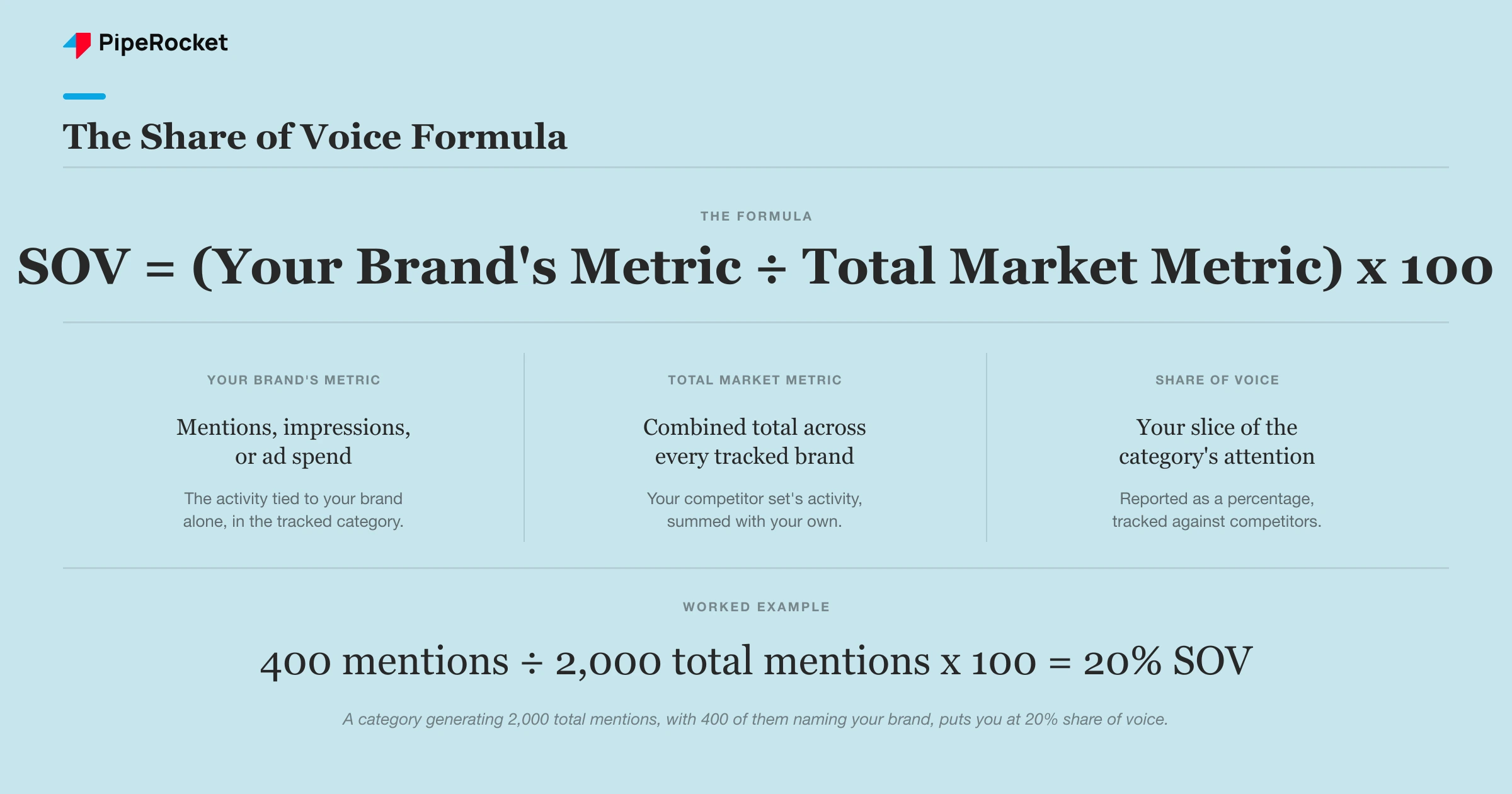
The baseline formula is the same regardless of channel, only the inputs change.
| Variable | What it measures |
|---|---|
| Your Brand’s Metric | Your mentions, impressions, or ad spend in the category |
| Total Market Metric | The combined mentions, impressions, or spend across all competing brands |
| Share of Voice | (Your Brand’s Metric ÷ Total Market Metric) × 100 |
So if you’re tracking media mentions and your brand got 400 mentions in a category that generated 2,000 total mentions across every competitor, your share of voice is 20%. The formula stays fixed. What counts as “your metric” is where SOV splits into different disciplines, and that split is exactly where most teams get confused about which number to report.
Share of Voice by Channel, at a Glance
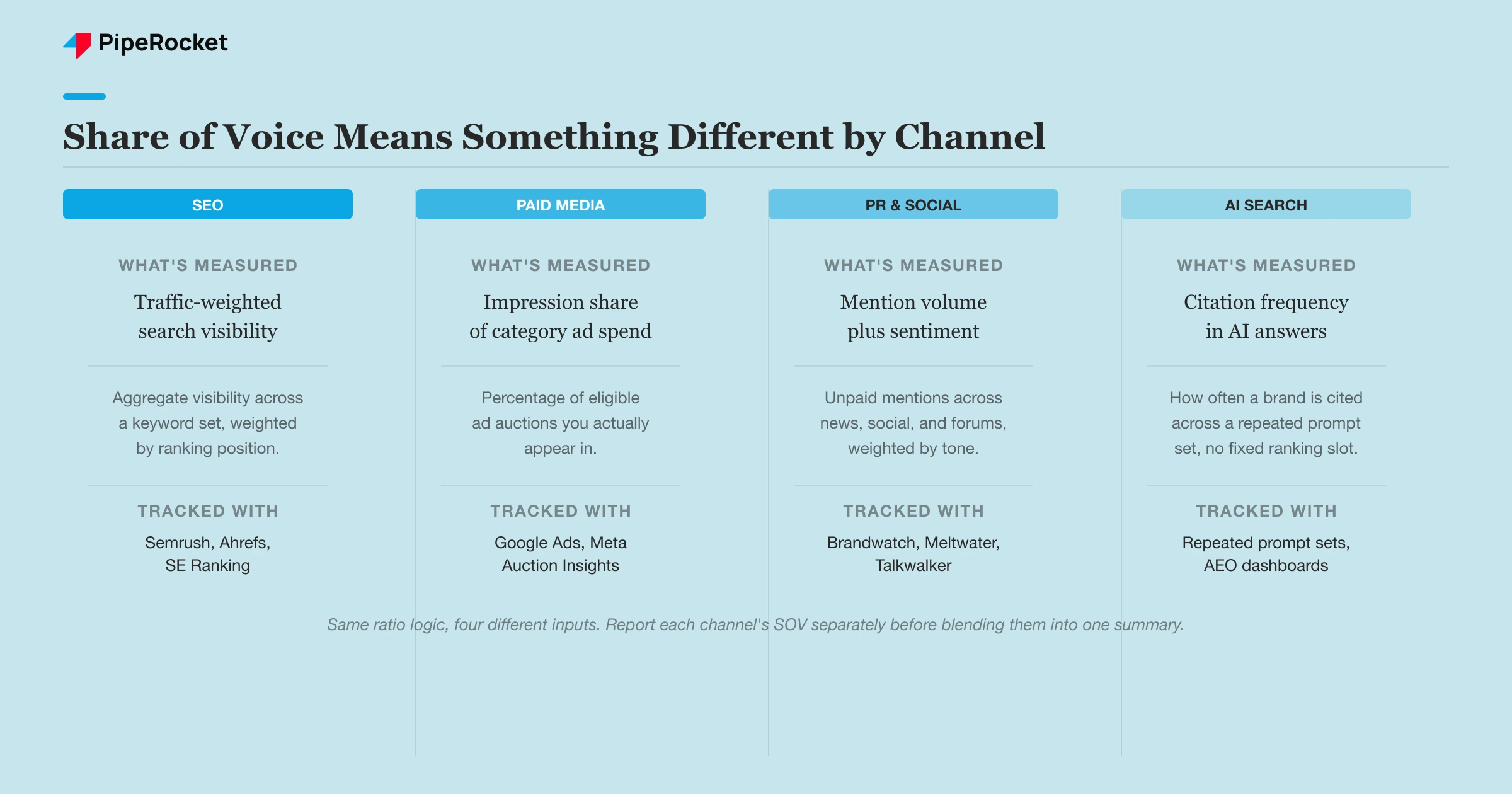
Before going deeper into each channel, here’s the short version: the ratio is always the same, only the input and the tool change.
| Channel | What it measures | Tracked with | Watch out for |
|---|---|---|---|
| SEO | Traffic-weighted search visibility across a keyword set | Semrush, Ahrefs, SE Ranking | Branded keywords inflating the number |
| Paid media | Impression share of category ad spend | Google Ads Impression Share, Auction Insights | Visibility disappears the moment budget stops |
| PR and social | Mention volume plus sentiment | Brandwatch, Meltwater, Talkwalker | Raw volume hiding a backlash spike |
| AI search | Citation frequency across a repeated prompt set | Repeated prompts, AEO dashboards | No fixed ranking slot, so one snapshot is meaningless |
Share of Voice in SEO: Aggregate SERP Visibility
SEO share of voice measures aggregate visibility across an entire keyword portfolio, weighted by how much traffic each position actually pulls, not just whether you rank number one for a handful of terms.
A brand ranking third for fifty keywords can carry a higher SEO share of voice than a brand ranking first for five keywords, because the traffic pool behind fifty terms is bigger than the traffic pool behind five. Most rank-tracking tools (Semrush, Ahrefs, SE Ranking) calculate it the same way:
- Assign a click-through weight to each ranking position
- Sum the estimated traffic your domain would capture across the tracked keyword list
- Divide by the total traffic available across those keywords for every domain that shows up
Note: SEO share of voice is only as good as the keyword list feeding it. Track the wrong keywords, and the number is meaningless. Teams commonly celebrate a rising SOV number that’s entirely driven by branded search growth, which measures existing awareness, not new visibility earned.
If you want the number to mean something, track it against a non-branded keyword set tied to your actual category, and check it against a topical authority view of your site instead of a raw keyword count.
Share of Voice in Paid Media: The Original Definition
Paid media share of voice is the metric SOV started as: your ad spend or ad impressions as a percentage of the total ad spend or impressions in your category. It asks who’s buying the most attention right now, a narrower question than the SEO version’s “who’s winning organically.”
On Google Ads, this shows up directly as Impression Share, a built-in metric that tells you what percentage of eligible auctions your ads actually appeared in:
- Lost to budget: you’re capped by spend
- Lost to rank: your quality score or bids aren’t competitive enough to win the auction even when you have budget left
Note: Higher paid SOV buys visibility fast, but it’s rented. The moment budget stops, the share disappears, unlike SEO share of voice, which decays slowly because rankings don’t vanish the day you stop publishing. Paid SOV works for a launch or a competitive response; it breaks as a long-term strategy if it’s the only lever you’re pulling, since you’re paying every month for a slice of attention that organic and PR channels could hold for free.
Share of Voice in PR and Social: Counting the Conversation
PR and social share of voice measures how often your brand gets named across earned media and social conversation (news coverage, social mentions, @-tags, and branded hashtags) compared to how often competitors get named in that same conversation. Unlike paid SOV, nobody’s buying this placement directly. It’s a measure of who the market is talking about, unprompted.
On the social side specifically, the tracked signals are brand mentions , @-tags, and hashtags: every time your handle or a campaign hashtag surfaces in a post, it counts as one unit of category conversation. On the PR side, the units are news articles and media coverage. Both feed the same ratio, which is why they share one channel here even though some frameworks break them into separate buckets.
Tools built for this (Brandwatch, Meltwater, Talkwalker) pull mentions from news coverage, social posts, forums, and review sites, then tag each mention by brand and sentiment. The formula is the same ratio: your brand’s mention count divided by the total mention count across tracked competitors, times 100.
What makes PR/social SOV different from the other two is that it captures sentiment alongside volume. A brand with a smaller mention count but overwhelmingly positive coverage can be in a stronger position than a brand with more mentions that are mostly complaints or crisis coverage. Reporting raw SOV without a sentiment split is how a PR team ends up celebrating a spike that’s actually a backlash.
When to Weight SOV by Sentiment
Weight your SOV number by sentiment whenever the mention spike coincides with a controversy, a product recall, or a viral complaint thread, because raw volume treats a five-star review and a public complaint as identical data points. Run it unweighted for steady-state category tracking, where sentiment tends to stay stable and volume alone tells you whether you’re gaining or losing ground.
AI Share of Voice: The Newest Version of the Same Idea
AI share of voice measures how often a brand gets mentioned or cited in AI-generated answers, like ChatGPT responses or Google’s AI Overviews , compared to competitors, for a defined set of prompts in that category. It’s the same ratio logic as every other SOV type, just applied to a channel that didn’t exist five years ago.
The mechanics differ from search SOV in one important way: there’s no fixed ranking position to measure. A brand either gets mentioned in the generated answer or it doesn’t, and the same prompt can return a different set of brands each time it’s asked. That’s why tracking AI SOV properly means running the same prompt set repeatedly and measuring mention frequency, not a single snapshot.
We built out the full mechanics of this, including citation rate and answer repeatability, in our guide to AEO performance metrics , and you can get a rough read on your own gap-to-leader with our AI Share of Voice calculator .
Treat AI SOV as one input on a dashboard. A single mention-rate score tells you almost nothing about whether those mentions are driving qualified traffic, which is exactly the trap most AI-visibility tools set for buyers right now.
Why Share of Voice Matters More Than a Vanity Metric
Share of voice earns its place on a dashboard because it moves before pipeline does, giving you a warning or a green light months ahead of revenue numbers. If your SOV is climbing while a competitor’s is flat, you’re winning attention before you’ve won a single deal from it, which is exactly the lead time a marketing budget review needs.
The second reason it matters is comparative context. Most marketing metrics tell you how you’re doing in isolation: traffic went up, mentions went up, spend went up. SOV forces a comparison against the field, so a 20% traffic increase means something different if your category’s total traffic doubled and your slice of it actually shrank.
The Real Trade-Off With SOV as a Metric
SOV works as a directional signal, telling you whether you’re gaining or losing ground relative to competitors over time. It breaks as a standalone success metric, because a rising SOV number with no change in qualified pipeline usually means the visibility gain is happening in the wrong segment, the wrong keywords, or the wrong channel for your actual buyers. Track it alongside a bottom-of-funnel metric, never alone.
How to Increase Your Share of Voice
To increase your share of voice, pour effort into the channel where your gap to the category leader is widest, then attack that channel with its own levers: more non-branded ranking content in SEO, higher impression share in paid, more earned mentions in PR and social. Spreading effort evenly across all four moves the number slowest.
The channel-by-channel levers that actually move SOV:
| Channel | Levers that raise SOV |
|---|---|
| SEO | Publish against non-branded category keywords you don’t yet rank for, improve positions on terms where you sit 4-10, and build topical depth so you cover a wider slice of the keyword pool |
| Paid media | Raise budget on campaigns losing impression share to budget, and improve quality score or bids on campaigns losing to rank |
| PR and social | Run brand awareness campaigns, pitch earned coverage, and give people a reason to @-tag your handle or use a campaign hashtag |
| AI search | Earn citations on the sources AI assistants pull from, and publish clear, quotable answers to the prompts buyers actually ask |
Pick one channel per quarter rather than all four at once. The widest gap is where the same unit of effort buys the most incremental share, and a focused push produces a trend line you can actually read against your competitor set.
Common Mistakes to Avoid When Tracking Share of Voice
The most common share of voice mistake is blending every channel into one number, which hides what actually moved and leaves you guessing when it drops. The rest come from the same root cause: treating SOV as a single, portable figure instead of a channel-specific one. These are the ones I see most often.
Mixing Channels Into One Number
A blended “share of voice” figure hides which channel actually moved, because SEO visibility, ad impressions, and social mentions get folded into one number nobody can trace back to a cause. When it drops, you’re stuck guessing which of the three broke. Keep each channel’s SOV in its own row, and only roll them up in a summary view once each is understood on its own.
Tracking Branded Keywords as SEO Volume
This one’s an easy trap. Include your own brand name in the keyword set feeding SEO share of voice, and the number quietly fills up with searches from people who already know you. That’s existing awareness dressed up as new visibility. Before reporting the figure to leadership:
- Pull the keyword list feeding the SOV calculation
- Strip every branded term and brand-plus-modifier query
- Recalculate on the non-branded set only
Ignoring Sentiment in PR and Social SOV
A spike driven by backlash looks identical to a spike driven by good coverage if you’re only counting volume. Reporting mention volume without a sentiment breakdown treats a viral complaint the same as a glowing review. Pull sentiment alongside volume every time, especially right after a spike.
Picking the Wrong Competitor Set
The wrong competitor list flatters you without meaning anything, whether it’s missing the one rival who’s genuinely eating your category’s attention or padding the field with brands that don’t actually compete for your buyer. Rebuild the set from who shows up in your real deal cycles and lost-deal reports, not from a generic industry list someone put together two years ago.
How to Measure Share of Voice Without a Single Wrong Number
Measuring SOV well means picking the right tool and inputs for each channel instead of hunting for one dashboard that claims to do it all.
- SEO: Semrush, Ahrefs, or SE Ranking’s visibility/SOV reports, run against a non-branded keyword set tied to your category.
- Paid media: Google Ads’ built-in Impression Share and Auction Insights reports. Meta doesn’t expose a true category-wide impression share, so estimate your paid SOV there from your reach and spend against known competitor activity.
- PR and social: Brandwatch, Meltwater, or Talkwalker, pulling mention volume and sentiment across news, social, and forums.
- AI search: a defined prompt set run repeatedly through the major AI assistants, tracking citation and mention frequency over time.
Pull each of these on a monthly cadence at minimum, since SOV moves slower than daily traffic and daily checks mostly add noise. Compare each channel’s trend line against the same competitor set every time, so the number means the same thing quarter over quarter.
How PipeRocket Digital Helps SaaS Brands Grow Their Share of Voice
We build SOV tracking into the SEO and content programs we run for SaaS clients, because a rising ranking count means nothing if a competitor is still capturing more of the category’s total search visibility. Our SaaS SEO agency team ties SEO share of voice to a real non-branded keyword set.
Our SaaS PPC team reports paid impression share alongside it, so you’re never guessing which channel moved the number. If you want a second set of eyes on where your category’s attention is actually going, reach out to PipeRocket .
Frequently Asked Questions
What is share of voice?
Share of voice is a metric that shows what percentage of a market’s total visibility, mentions, or advertising spend belongs to your brand instead of your competitors. It’s calculated by dividing your brand’s figure by the combined total across every tracked competitor, then multiplying by 100.
The metric applies across SEO, paid media, PR, social, and now AI search, with each channel measuring a different underlying number under the same name.
How do I calculate my share of voice?
Divide your brand’s metric (mentions, impressions, or ad spend) by the combined total for every competitor in the category, then multiply by 100. If your brand got 400 mentions in a category with 2,000 total mentions, your share of voice is 20%.
The formula (Your Brand’s Metric / Total Market Metric) x 100 stays fixed across every channel. Only the input changes: mentions for PR and social, impressions or spend for paid, traffic-weighted visibility for SEO.
What is a good share of voice percentage?
A good share of voice is one that meets or exceeds your actual market share, since a SOV number below your market share usually signals you’re losing ground even while revenue holds steady for now.
There’s no universal target percentage; it depends entirely on how many competitors you’re splitting the category with. A market with three real competitors makes 30%+ a reasonable target, while a market with fifteen makes 10% competitive.
What is share of voice in paid search?
Share of voice in paid search, usually called Impression Share inside Google Ads, is the percentage of eligible auctions your ads actually appeared in out of every auction you were eligible to enter.
Google reports it directly on the campaign dashboard, broken into lost-to-budget and lost-to-rank splits so you know whether spend or bid competitiveness is capping your visibility. It only measures paid placements, not organic rankings or ad-free mentions.
What is the difference between share of voice and market share?
Share of voice measures attention and visibility, while market share measures actual revenue or unit sales within a category. A brand can hold a high share of voice through spend or mention volume without holding a proportional market share yet, which is usually a sign that visibility hasn’t converted to demand.
The reverse gap, high market share with low share of voice, tends to show up in mature categories where an established brand has stopped investing in new visibility.
What does 100% share of voice mean?
A 100% share of voice means your brand is the only one showing up in whatever you measured, whether that’s every tracked keyword, every ad auction, or every mention in a set of news sources. In practice this is rare and usually temporary.
It shows up most often in one of three situations: a niche category with almost no competitors, the window right after a competitor exits, or a narrow paid campaign where you’re the only bidder on a keyword set. A 100% reading on one channel or one keyword list doesn’t mean total market dominance. Check the competitor set and the scope before treating it as proof you’ve won the category.