SaaS Thought Leadership Strategy: An Executive-Led Playbook
 Kamaraj Mathiarasan (Kim)
Last updated on
Kamaraj Mathiarasan (Kim)
Last updated on
A SaaS thought leadership strategy is the system you use to turn your founders and subject-matter experts into a recognisable point of view the market trusts. It’s the opinion only your company can credibly hold, sourced from the people who actually built the product and sold it.
Most SaaS teams confuse this with publishing more. They add posts, add a newsletter, add a podcast, and wonder why nothing lands. This guide is about the harder, better version: getting a real opinion out of your executives and compounding it into authority that search engines and AI answers keep citing.
TL;DR
- The play is a supply problem: Executive-led thought leadership means extracting a defensible point of view from your founders and SMEs before you ever worry about posting cadence.
- The POV lives in your people: Your best original insight is trapped in sales calls, product decisions, and founder frustrations. Interviewing for it beats inventing it.
- Founder-led vs brand-led is a real choice: A visible founder converts faster on trust; a brand-led program survives when the founder leaves or won’t post. Pick deliberately.
- One interview funds a quarter: A structured SME interview produces the raw opinion, examples, and objections that a whole content cluster gets built from.
- Authority compounds into citations: Thought leadership done around one category earns the topical depth that ranks BOFU pages and gets your brand named inside AI answers.
- Measure influence over applause: Track share of voice, branded search, and pipeline touched, because most of the impact hides in channels last-click never credits.
Why “Post More on LinkedIn” Isn’t a Thought Leadership Strategy
Publishing volume is the most common substitute for having something to say. A team commits to five posts a week from the company page, hits the cadence for two months, and the only thing that grows is the posting streak. The buyers they wanted to reach never engaged because there was no idea worth engaging with.
Thought leadership is a supply problem before it’s a distribution problem. You can’t schedule your way to a point of view. The distribution mechanics matter, and they deserve their own playbook, but they only pay off once there’s a real opinion to distribute.
Here’s the distinction that changes how you staff this:
- Content marketing answers the questions buyers already type into Google.
- Thought leadership takes a position on a question the market is still arguing about.
The first can be produced by a writer working from a keyword map. The second needs an actual expert with scars, because a defensible opinion comes from having been wrong before and having watched what worked. That’s why executive-led thought leadership is its own play, and why it fails when you hand it to someone with no first-hand exposure to the problem.
Most SaaS founders sit on genuinely contrarian views and never publish them, because they assume the take is obvious. It isn’t obvious to a buyer three years behind them. The whole job of this strategy is getting that view out of their head and in front of the right people, consistently.
Where the Point of View Actually Comes From
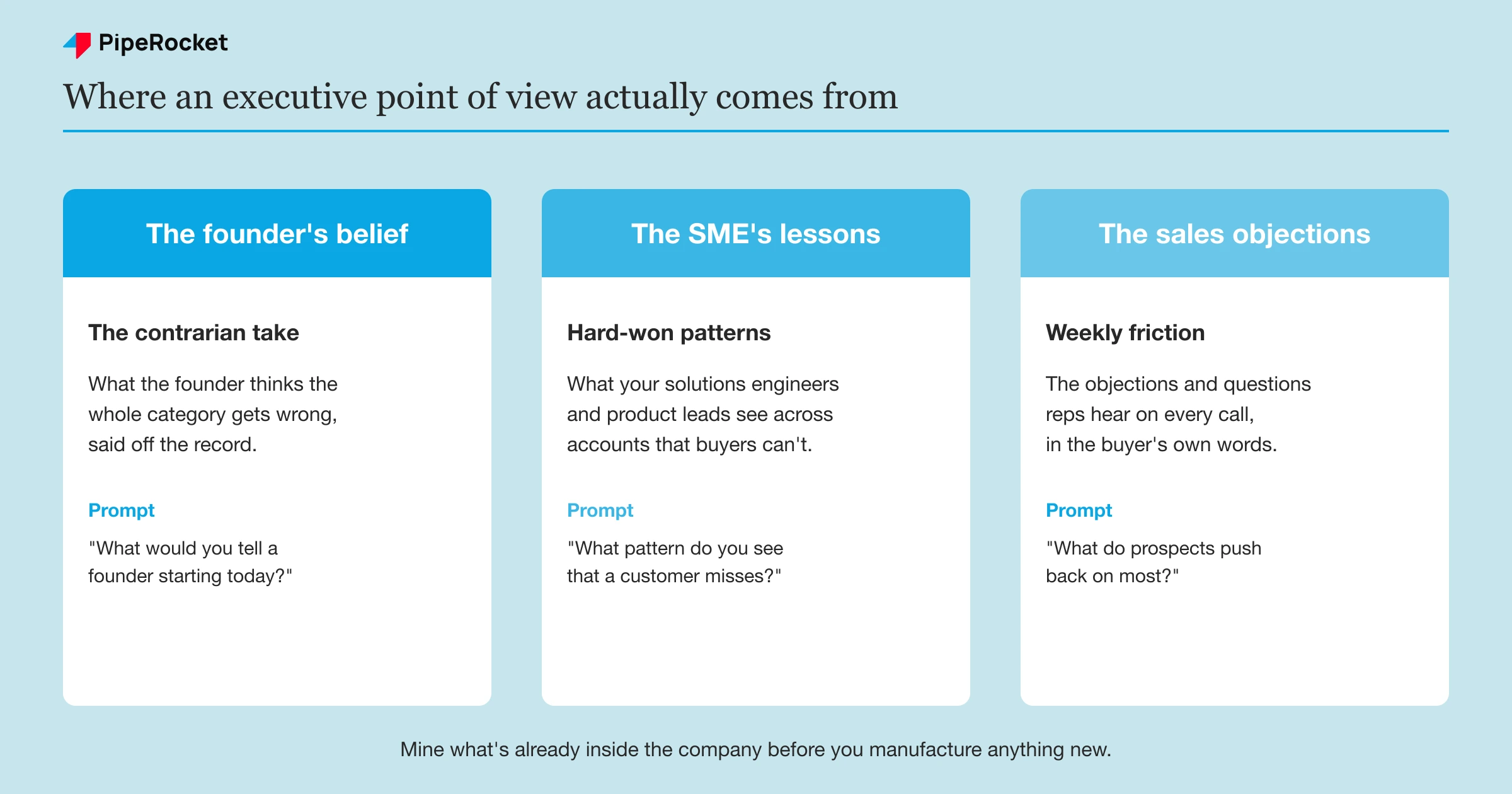
Your best original insight already exists inside the company. It’s sitting in the founder’s head, in the arguments your product team had about the roadmap, and in the objections your sales reps hear every single week. The strategy is to mine what’s already there rather than manufacture something new.
The reason this matters commercially: the Content Marketing Institute’s 2026 research found the most effective B2B teams point to content relevance and quality as the number-one factor driving results, cited by 65% of them. Relevance and quality are exactly what you get when the source is a real expert instead of a brief handed to someone guessing at the topic.
Get the founder’s real opinions out of their head
Founders default to safe, on-message statements when you put them in front of a camera. The gold is in what they say off the record, when they’re frustrated. “Everyone in our category benchmarks the wrong metric” is a thought leadership angle. “We’re a leading platform for X” is a boilerplate no buyer remembers.
Get them talking about what the rest of the industry gets wrong, what they’d tell a founder starting today, and the decision they made that everyone advised against. Those three prompts pull out more usable material than a month of solo brainstorming.
Interview your SMEs like a journalist would
Your solutions engineers, your head of product, and your senior CS leads carry deep, specific knowledge that never reaches the market. They’re subject-matter experts who don’t think of themselves as writers, so the insight stays locked in Slack threads and QBRs.
Treat them as sources. Book 45 minutes, record it, and ask about the pattern they see across accounts that a customer wouldn’t notice from the inside. One good SME interview surfaces the kind of specific, hard-won claim that generic content can never fake.
Commit to the one belief you’ll defend
A point of view means picking a hill. If your content could have been published by any competitor, it isn’t thought leadership, it’s filler with your logo on it. Decide the single argument your company will make repeatedly and stake it out.
For a compliance SaaS built for fintech teams, that hill might be that most SOC 2 programs optimise for the audit instead of actual security. It’s specific, it’s arguable, and every asset can ladder back to it. That consistency is what buyers start to associate with your name.
Founder-Led vs Brand-Led: Who Should Be the Face
The face of your program is a strategic decision, not a personality contest. A visible, willing founder is the strongest asset you have, because buyers trust a person faster than they trust a company page. When we run founder-led content for clients, it consistently outperforms brand-account posts, because people trust people, not logos.
But a founder-led program has a single point of failure. If the founder gets busy, loses interest, or leaves, the whole engine stalls. A brand-led or multi-expert program is slower to build trust and survives leadership changes. Most SaaS companies need a blend, weighted by stage.
| Dimension | Founder-led | Brand-led / multi-expert |
|---|---|---|
| Trust velocity | Fast, buyers connect with a person | Slower, trust accrues to the company |
| Best stage | Seed to Series B, founder is the story | Series C onward, or founder won’t post |
| Key risk | Stalls if the founder disengages or exits | Feels corporate, harder to make distinctive |
| Distribution engine | Founder’s personal profile and network | Company channels plus a bench of SMEs |
| Effort to sustain | High personal time from one person | Spread across a team, more coordinable |
The honest trade-off: founder-led works when your founder has a real opinion and will spend the time, and it breaks the moment that stops being true. If your founder won’t commit to a weekly rhythm, don’t build the program on their shoulders. Build a bench of two or three SME voices instead, and let the founder amplify rather than originate.
One pattern worth naming: brand demand built through a strong founder presence lowers your cost per opportunity over time, because the market arrives already trusting you. We’ve watched cost per opportunity drop quarter over quarter for teams that stayed consistent, purely because buyers stopped needing to be convinced the company was credible.
How to Run the SME Interview That Produces a Year of Content
One good interview is the highest-leverage hour in this whole strategy. Done right, a single 45-minute session with a founder or SME produces the raw opinion, the examples, and the objections that a full content cluster gets built from. The mistake is treating it as a quote-gathering call instead of the source of the whole program.
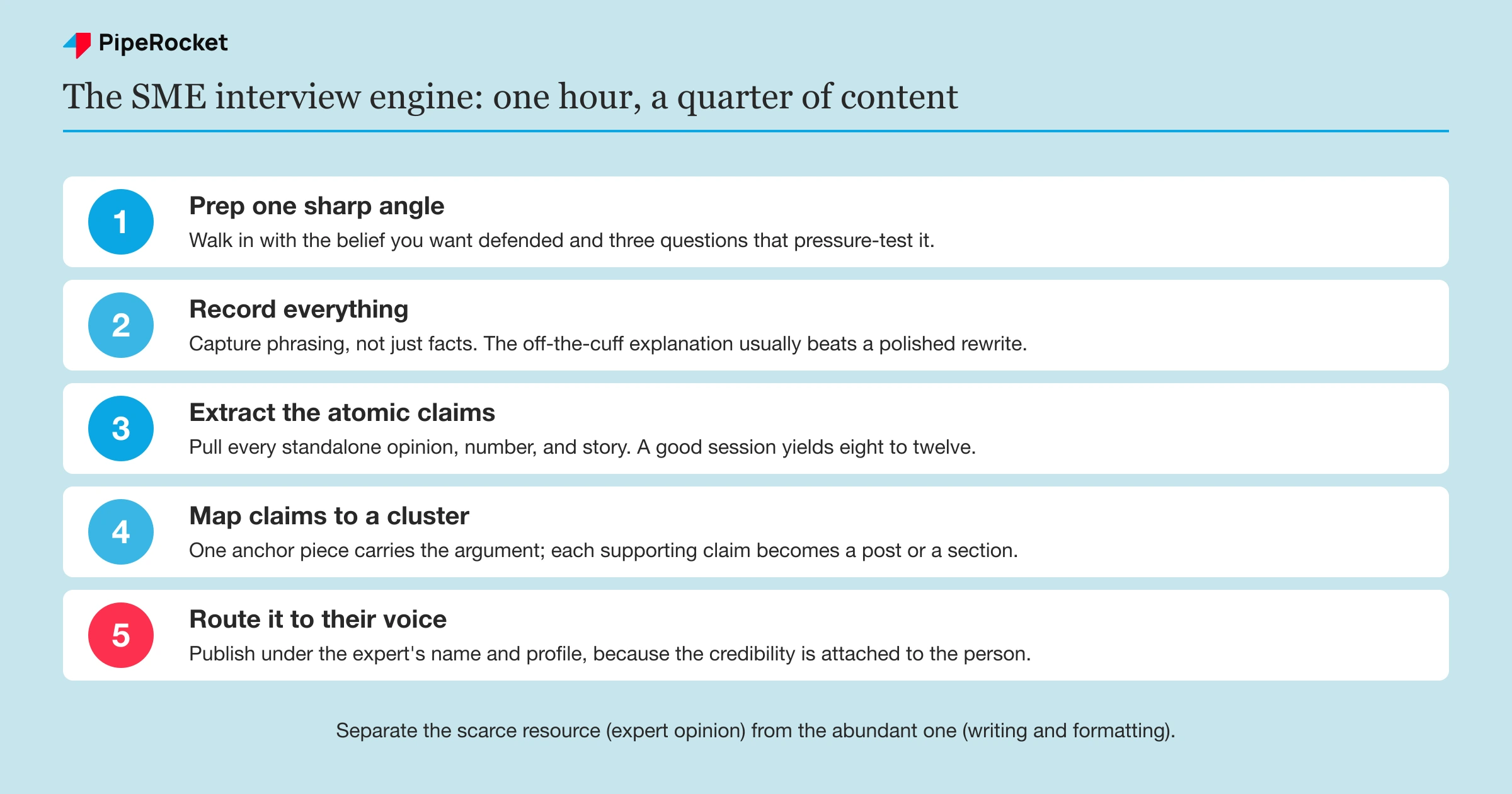
Run it in five moves:
- Prep one sharp angle. Don’t walk in with “tell me about our product.” Walk in with the specific belief you want them to defend and the three questions that pressure-test it.
- Record everything. You’re capturing phrasing, not just facts. The way an expert explains something off the cuff is usually better than anything a writer polishes later.
- Extract the atomic claims. Pull every standalone opinion, number, and story out of the transcript. A good session yields eight to twelve of these.
- Map claims to a cluster. One anchor piece carries the core argument. Each supporting claim becomes a shorter post, a newsletter section, or a talking point.
- Route it to their voice. Publish under the expert’s name and on their profile where it fits, because the credibility is attached to the person.
The reason this works: it separates the scarce resource (expert time and opinion) from the abundant one (writing and formatting). Your founder spends 45 minutes; your content team spends the next month building on it. Try to make the expert write it all themselves and the program dies inside a quarter, because that’s not their job and they’ll drop it.
A note on AI drafting. It’s fine to use a model to shape a transcript into a first draft, but a model with no context just produces confident, generic prose. Feed it the real transcript, the real examples, and the real objections first, or you get exactly the sea of sameness this strategy is supposed to escape.
How Thought Leadership Compounds Into Authority and AI Citations
This is where an executive-led program pays off in ways a content calendar never does. A consistent point of view around one category builds the topical depth that search engines reward and that AI answer engines pull from when they cite sources. The opinion is the content; the authority is the compounding asset.
Everyone’s been told top-of-funnel content is dying because AI now answers informational queries directly. So teams retreat to bottom-of-funnel pages only. The problem is that BOFU pages don’t rank in isolation. The best “best X” and “X alternatives” pages sit on page two without real authority behind them, and thought leadership is how you build that authority honestly.
Pick one category and go deep enough to be cited
The winning move is authority-led: pick one category to dominate rather than ten to dabble in, then build genuinely deep material around it. When we do this for clients, the deep support content earns citations and warms buyers, and the commercial pages finally start ranking because the site has earned the right to.
A point of view is what makes that depth worth reading. Ten shallow posts on ten topics teach a search engine nothing about what you’re an authority on. Thirty pieces circling one defensible argument teach it exactly that, and they give journalists and analysts a reason to reference you.
Picture a data-observability SaaS whose founder believes most teams monitor pipelines but ignore data quality until something breaks. Every asset can extend that single argument: the founder’s posts, the benchmark report, the comparison pages , the FAQ answers. A buyer researching the category keeps hitting the same coherent worldview, and so does every crawler and AI engine indexing it.
Understand why AI engines cite authoritative voices
AI answer engines lean on the same signals traditional search does: content quality, entity credibility, and who else references you. In our own review of AI answers for competitive B2B queries, neutral and authoritative sources get cited far more often than promotional pages, which is why we’ve focused on building genuine credibility for clients rather than chasing the metric.
The 2025 B2B Thought Leadership Impact Report from Edelman and LinkedIn makes the commercial case plainly: high-quality thought leadership builds the credibility and authority that moves buyers, and decision-makers actively prefer it over standard marketing collateral when they’re sizing up a vendor.
There’s a mechanism behind the AI angle worth understanding. Across the 53 B2B SaaS brands we analysed over eight months, only 11.8% of AI-referred sessions carried brand-name intent, versus 28.1% for organic. AI surfaces categories before it surfaces brands, so the companies that own a category point of view are the ones that get named when a buyer finally asks an AI engine “who’s best at this.”
Common Mistakes to Avoid
Most thought leadership programs don’t fail because the ideas are bad. They fail because of predictable execution errors that drain the effort before it compounds. These are the ones we see most.
Outsourcing the opinion to someone with no scars
The fastest way to kill a program is to hand it to a writer with no exposure to the actual problem and ask them to “sound like a thought leader.” They’ll produce competent, forgettable prose because they have no real position to take. Writers should shape and distribute the expert’s opinion. They can’t originate it.
Chasing volume until quality collapses
When the goal quietly shifts from saying something to hitting a posting quota, credibility erodes. Mediocre material published often does more damage than nothing at all, because it teaches your audience that your name isn’t worth stopping for. Fewer, sharper pieces beat a firehose of takes every time.
Spreading across ten topics instead of owning one
A founder who posts about hiring on Monday, fundraising on Tuesday, and product on Wednesday builds a personal following, not category authority. Buyers can’t associate you with an idea if you touch a different idea every day. Discipline about the one hill is what makes the compounding work.
Judging it on last-click attribution
Thought leadership works upstream of the click. Judge it by the demo form that credits organic or direct, and you’ll conclude it doesn’t work and cut it right as it starts paying off. The influence shows up in sales calls and branded search long before it shows up in a conversion report.
How to Know It’s Working
Thought leadership is famously hard to measure, and few marketing teams can cleanly link it to business outcomes. The answer is to track the signals that reflect real influence rather than the ones that reflect applause.
Watch these, roughly in order of how much they matter:
- Pipeline touched: Deals where a prospect references your content, or where the contact first engaged through an executive’s post. Ask your sales team; they hear it on calls.
- Branded search volume: A rising number of people searching your company or founder’s name directly is the clearest downstream signal that the ideas are landing.
- Share of voice : How often your brand and your executives get mentioned, quoted, or cited relative to competitors in your category.
- Deep engagement: Not likes. Saves, shares, comments with substance, and replies from the actual titles you’re trying to reach.
Be realistic about timelines. You’ll see engagement signals inside 60 to 90 days, but the commercial payoff for enterprise sales cycles takes six to twelve months of consistency. Cut it at month three and you’ve paid the cost without collecting the return.
One warning on tooling. There’s no Search Console for AI engines, so the dashboards promising to track your “AI visibility” rely on synthetic prompts and guesswork rather than real user queries. Treat them as directional at best. If your fundamentals and your authority are strong, you’re likely already showing up in AI answers without a dashboard confirming it.
How PipeRocket Helps SaaS Teams Build Thought Leadership
We build executive-led programs the way we build everything: around outcomes, not output. We run the SME interviews that pull a real point of view out of your founders, shape it into a content cluster that ranks, and tie the authority back to pipeline instead of vanity metrics. If you want the search and citation side built properly, our SaaS SEO agency team owns that execution, and for the wider program you can compare the best B2B marketing agencies before you commit. Want to talk it through? Reach out to us here .
Frequently Asked Questions
What is a SaaS thought leadership strategy?
It’s the system a software company uses to turn its founders and experts into a trusted, recognisable point of view in its category. Rather than publishing generic content, it extracts original, evidence-based opinions from the people closest to the product and the customer, then distributes them consistently. The goal is to build authority that shortens sales cycles and gets your brand referenced by buyers, journalists, and increasingly AI answer engines. It sits above regular content marketing because it takes a position rather than just answering questions.
How do you measure the ROI of thought leadership?
You measure influence signals, because thought leadership works upstream of the direct conversion. The metrics that matter most are pipeline touched (deals where a prospect engaged with your content or an executive’s post), branded search volume, and share of voice against competitors. Deep engagement from your target titles beats raw follower counts. Expect engagement signals within 60 to 90 days, but give commercial results six to twelve months in longer enterprise cycles. Last-click attribution will consistently undercount it, so don’t judge the program on it alone.
Should the founder or the brand be the face of thought leadership?
It depends on your stage and your founder’s willingness to commit. A founder-led program builds trust faster because buyers connect with a person, and it works best from seed through Series B when the founder is genuinely the story. Its risk is a single point of failure if the founder disengages or leaves. A brand-led or multi-expert program is slower to build trust but survives leadership changes. Most SaaS companies run a blend, with the founder originating the sharpest opinions and a bench of SMEs sustaining the cadence.