SaaS CRO Strategy: A Pipeline-First Framework
 Praveen Ravi
Last updated on
Praveen Ravi
Last updated on
Most SaaS teams treat CRO as a pile of button tests and hope one of them lifts signups. We treat it as a program that answers one question and keeps answering it: is this page turning qualified traffic into pipeline, or just into activity? A CRO strategy is the system behind that question.
TL;DR
- CRO is a pipeline program: For B2B SaaS, the conversion that counts is a lead sales can actually close, so tie every experiment to qualified pipeline downstream.
- The framework compounds: Research, prioritize, test, then learn, run as a loop, so each cycle feeds the next instead of firing one-off tests.
- Prioritize before you build: Score every idea with ICE or PIE so the team works the highest-impact leaks first and stops shipping cosmetic tweaks.
- Focus shifts by stage: Where you place CRO effort changes from awareness to activation, and the “conversion” you optimize changes with it.
- Most mistakes are self-inflicted: Button tests before diagnosis, optimizing junk signups, and calling tests early produce fake wins that cost real pipeline.
- Measure by page type and pipeline: Judge each page against its own benchmark, then trace whether CRO moved qualified pipeline downstream.
- A program needs an owner: CRO stalls without clear ownership, a research cadence, and a prioritized roadmap everyone can see.
Why SaaS CRO Is a Pipeline Program
The metric most SaaS teams optimize is the wrong one. They chase signup rate or trial starts, celebrate a lift, and then wonder why the sales team is still starved. A CRO strategy that ends at the signup form is optimizing the easy half of the problem and ignoring the half that pays the bills.
Here’s the contrarian part. In B2B SaaS, doubling your conversion rate can hurt you if you double the wrong conversions. More trials from people who’ll never buy just means more work for sales and dirtier data for your ad platforms. Unqualified volume is a cost your CRM and your ad targeting both pay for.
This is why CRO and paid acquisition aren’t rival budgets. CRO raises the yield on traffic you already pay for, so a two-point lift on a page taking qualified demand can match the pipeline impact of a much larger media spend. The catch is that the lift has to survive the handoff to sales, or you’ve just made a prettier leak.
So the goal of a real CRO program is to move qualified pipeline, and it treats the whole path as the unit of work: visitor, lead, MQL, SQL, and paid. Optimizing one step in isolation is how you get a page that “converts” beautifully and produces nothing sales can use.
A Signup Isn’t a Conversion Until Sales Can Use It
A demo request from a student researching a term paper counts as a conversion in your dashboard and as noise in your CRM. B2B buying is a committee decision, so a single form fill rarely represents a ready buyer. The real conversion event is the moment a qualified account enters a sales conversation.
That reframes what you optimize for. Instead of stripping every qualifier to lift form completion, you sometimes add friction on purpose, like a work-email requirement or a one-line qualifier, to raise the quality of who gets through. The right amount of friction is the amount that filters out who sales can’t close.
Micro Conversions Tell You Where, Macro Conversions Tell You Whether
Split your metrics into two jobs. Micro conversions, like video plays, pricing-page views, and feature-page clicks, tell you where attention builds and where it dies. Macro conversions, like demo booked and trial-to-paid, tell you whether the program actually moved money.
You need both. Micro conversions are your diagnostic layer, showing which step leaks. Macro conversions are your verdict, confirming that fixing the leak changed the outcome that matters. Track only macro and you’re blind to the why; track only micro and you’ll optimize a click that never becomes revenue.
The CRO Framework That Actually Compounds
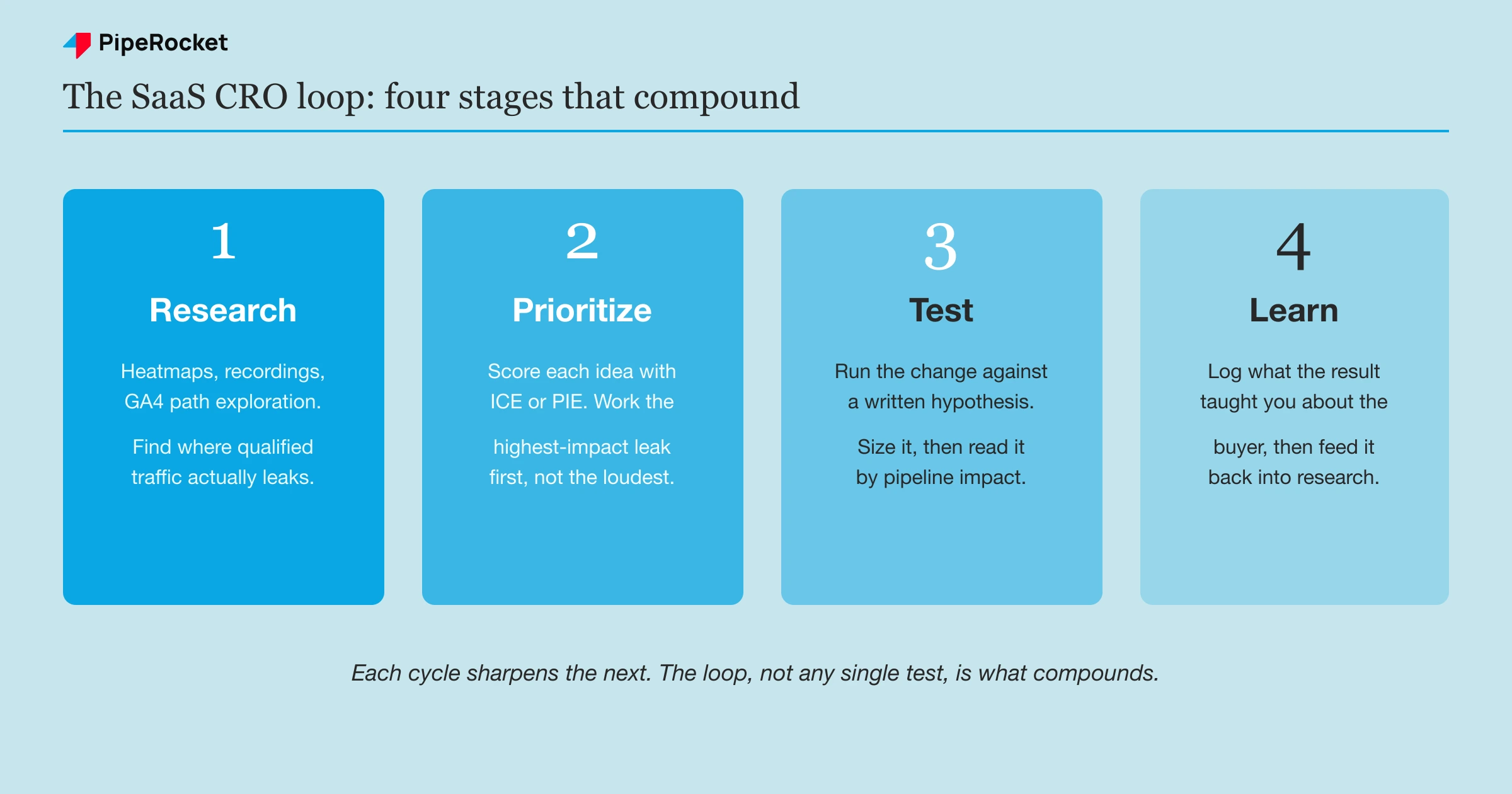
A CRO strategy runs as a continuous loop, never a checklist you finish once. Four stages: research to find where you’re losing people, prioritize what to fix first, test the change, then learn from the result and feed it back into research. Skip any stage and the whole thing degrades into guessing.
The compounding comes from the loop. Every test, win or lose, teaches you something about how your buyers behave, and that insight sharpens the next hypothesis. Teams that treat CRO as a series of disconnected experiments never build that knowledge, so they keep testing from zero.
Start Every Program With Research
You can’t optimize a page until you know where it actually leaks, and opinions won’t tell you. Behavior data will. Heatmaps show where people click and where they stall, session recordings show the moment they give up, and a GA4 path exploration shows where they drop off before the demo.
We audited a $10M SaaS company with roughly 100K monthly visits and flat conversions for eight months, despite more content and more traffic. The data told the real story fast. Only about 4% of traffic was bottom-funnel, only 2% of those clicked the CTA, and only 10% of those filled the form.
Run that math and roughly 4,000 visitors produced about 10 form fills. That’s a conversion problem sitting underneath a traffic story, and no amount of extra content was going to fix it. Research is what separates “we think the hero is weak” from “we can see 90% of users leave before they scroll.”
Turn What You Find Into Testable Hypotheses
A finding is not a plan. “Users drop off after the first fold” is an observation. Turn it into a hypothesis with a mechanism: because the fold leads with a feature instead of the outcome, visitors can’t tell what the product does, so rewriting it around the buyer’s problem will lift CTA clicks.
Good hypotheses name the change, the expected effect, and the metric that proves it. That structure keeps you honest, because a test either supports the mechanism or it doesn’t. Vague hypotheses produce vague results you can rationalize either way.
Prioritize Before You Build Anything
You’ll always have more ideas than you can test, so the discipline is choosing. Score every hypothesis against expected impact and effort before anyone touches a page. The next section covers how, but the principle holds here: the backlog is ranked, and the team works from the top.
How to Prioritize What to Test (ICE vs PIE)
Prioritization is where most CRO programs quietly fall apart. Without a scoring model, the roadmap follows whoever has the most authority or the loudest hunch, and the highest-impact leaks sit untouched while the team ships cosmetic tweaks. Two simple frameworks fix this.
| Framework | Scores each idea on | Best when |
|---|---|---|
| ICE | Impact, Confidence, Ease (rate each 1-10, average them) | You want speed and a lean team ranking a big backlog fast |
| PIE | Potential, Importance, Ease | You’re weighing pages against each other and traffic value matters |
Both give you a ranked list instead of a debate. ICE is quicker and works well when one team owns the backlog. PIE leans harder on how much traffic and revenue a page already carries, so it suits deciding which page to work on, not just which test.
Fit CRO Into Where the Money Is Already Leaking
Prioritization also means knowing where CRO belongs in the wider spend picture. Our team runs an “Eagle’s View” first: spend and return by channel and page, then sort everything into three buckets.
- High spend, no return: usually wrong targeting or a broken page, so fix or cut it.
- Low spend, high return: starving winners, so feed them budget now.
- High spend, low ROI: the traffic is fine but the page isn’t, and that’s exactly where CRO earns its keep.
That third bucket is the one people miss. When qualified traffic is already arriving and the conversion still won’t move, you don’t need more ads or more content. You need the page to do its job. As a rough anchor, a lot of B2B SaaS pages should convert visitors to leads around 3%, with Lead-to-MQL in the 45-50% range, so measure against something.
Where to Focus CRO by Funnel Stage
CRO isn’t one job applied evenly across the site. What you optimize, and what “conversion” even means, changes with the stage the visitor is in. A pricing page and a top-of-funnel blog post are two different conversations, and treating them the same is how good pages underperform.
| Funnel stage | Typical page | The conversion to optimize | Where CRO effort goes |
|---|---|---|---|
| Awareness | Blog, guide | Newsletter or asset opt-in | Clear next step, contextual CTA, not a hard demo push |
| Consideration | Comparison, use-case | Demo request | Objection handling, honest comparison tables, proof |
| Decision | Pricing, product, landing page | Demo booked or trial start | Fold clarity, one strong CTA, friction removal |
| Activation | Onboarding, first-run | Trial to paid | Time to first value, guided setup, removing setup friction |
At the awareness stage, pushing a demo too early kills the page. The win is a lighter commitment and a clear path deeper into the site. By the decision stage the visitor is comparing options, so clarity and a single obvious action beat clever design every time.
Activation is the stage most marketing teams forget, and it’s often where the biggest money hides. A great trial signup means nothing if the user never reaches first value. Shortening time to that first “aha” moment does more for revenue than another homepage test. Treat trial-to-paid as a conversion step you own.
The tactics inside these stages each have their own depth, and this strategy sets the priorities while the tactic guides run the plays:
- Running the experiments: how to A/B test SaaS landing pages .
- The page mechanics: optimizing SaaS landing pages .
- The trust layer: SaaS social proof .
One pattern worth stealing from paid landing pages : kill the optionality. When a decision-stage page offers three competing actions, most visitors take none. Strip it to one ask, repeat that same CTA down the page, and write the headline around the outcome the buyer wants rather than the feature you built.
Common Mistakes to Avoid
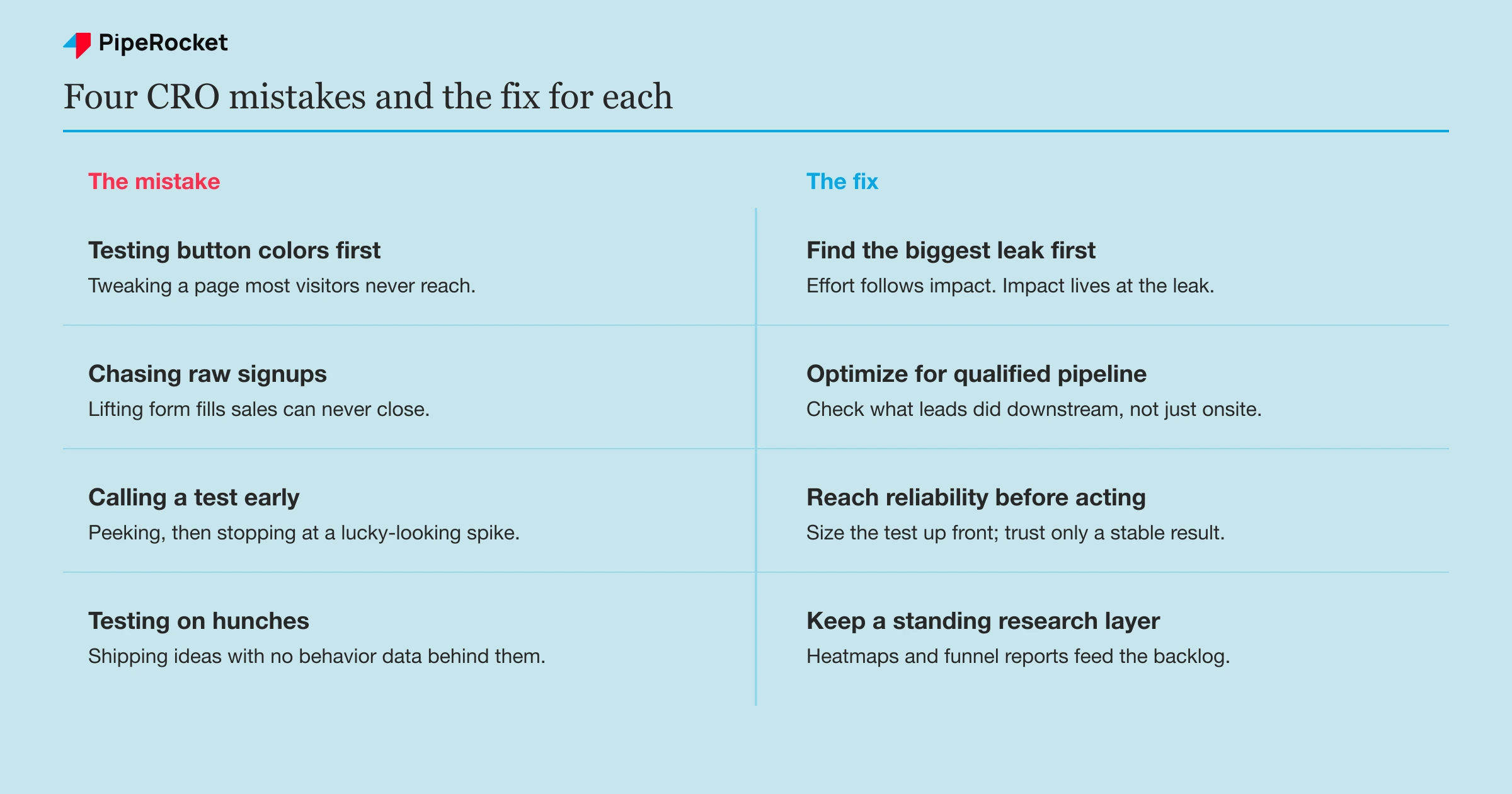
Most failed CRO programs don’t fail on tactics. They fail on a handful of habits that feel productive and quietly waste months. Here are the ones we see most.
Testing Button Colors Before You’ve Found the Leak
Micro-optimizations are seductive because they’re easy to ship. The problem is that changing a button color on a page nobody reaches won’t move anything. If 90% of visitors leave at the fold, the button below it is irrelevant. Find the biggest leak first, then decide what’s worth testing there. Effort should follow impact, and impact lives at the leak.
Optimizing for Signups Your Sales Team Can’t Close
A page that lifts form fills by stripping every qualifier often just floods sales with junk. The dashboard looks great and the pipeline doesn’t move. Before you celebrate a conversion lift, ask what happened to those leads downstream. If MQL-to-SQL fell as fast as signups rose, the page got worse while the dashboard looked better.
Declaring a Winner Before the Test Is Reliable
The urge to peek at results and stop the moment a variant looks good is how teams ship changes that were pure noise. A “win” read too early reverses the second you roll it out. Sizing and reading a test correctly is a discipline of its own, covered separately in the A/B testing guide. For strategy, the rule is simple: don’t act on a result you can’t trust.
Running CRO With No Research Layer
The most expensive mistake is testing on hunches. When a team skips straight to ideas without looking at behavior data, they’re optimizing a page they don’t understand. Every program needs a standing research habit, heatmaps, recordings, and funnel reports, feeding the backlog. Without it, you’re just redecorating a page you can’t see clearly.
How to Measure Whether CRO Is Working
Measure CRO against pipeline, and judge every page by its own job. A single site-wide conversion number hides which pages are winning and which are quietly bleeding. The teams that get this right report by page type and trace each change all the way to revenue.
Benchmark Each Page Against Its Own Job
Different pages carry different intent, so hold each to the right bar:
- Comparison and alternatives pages : high intent, should convert around 3-4%.
- Top-of-funnel blog posts: often near 0.75%, frequently on an asset download.
Hold a blog post to a comparison page ’s standard and you’ll cut pages that were doing their job fine. Report conversion by page type so a strong page and a weak one never get averaged into the same misleading number.
Trace the Chain All the Way to Pipeline
A CTA-click lift means nothing if demos booked stayed flat. The chain you care about runs from the on-page metric through to qualified pipeline, and every link has to hold.
So build the wiring once: instrument every conversion event, then stitch it to the CRM so a form fill can be traced to an MQL, an SQL, and a closed deal. Without that plumbing, you can report a better-converting page and never prove it produced revenue finance would count.
Data is also how you win the argument internally, which is often the hard part.
One client’s paid traffic was around 70% qualified and almost none of it converted, and the client didn’t believe the page was the problem. Microsoft Clarity showed 90% of users dropping right after the first fold, and GA4 showed a page that should hit 15-20% CTA clicks limping under 5%.
With the data in hand, the fix was obvious: redesign the first two folds for clarity, rewrite the copy around the customer’s problem, and cut form fields. A month later, CTA clicks went from 4.5% to 13% and conversion from zero to 2.75%.
Building the CRO Program: Team, Cadence, and Roadmap
CRO fails most often because nobody owns it. It sits between marketing, design, product, and sales, so everyone assumes someone else runs it and no one does. Name an owner. That person doesn’t do all the work, but they hold the research cadence, the backlog, and the roadmap, and they’re accountable for pipeline impact.
The cadence matters as much as the owner. A workable rhythm looks like this:
- Weekly: review behavior data and add new findings to the backlog.
- Every cycle: score new hypotheses with ICE or PIE and re-rank.
- Monthly: review shipped tests, log what you learned, and update the roadmap.
The roadmap itself is just your prioritized backlog made visible. When the highest-impact experiments are ranked and everyone can see why, you stop relitigating priorities every week and start compounding. Sales input belongs in that room too, because they know which leads actually close and which pages produce ghosts.
A CRO program run this way stops being a scramble of one-off tests and becomes a system. It’s slower to feel exciting than a viral button test, but it’s the version that keeps lifting pipeline quarter after quarter, which is the only version worth building.
How PipeRocket Helps SaaS Teams Build a CRO Program
We build CRO as a pipeline system. We start from behavior data, find where qualified traffic actually leaks, and prioritize fixes by impact so the roadmap works the money first. Our SaaS PPC team ties paid landing pages to closed pipeline, and our SaaS SEO side does the same for organic pages, so the whole funnel converts instead of just the ad. If you want this built properly, talk to us .
Frequently Asked Questions
What is a good conversion rate for B2B SaaS?
It depends heavily on the stage and page type, so judge against the right benchmark. Visitor-to-lead sits around 2-3% across many sites, while high-intent pages like comparison and pricing pages should push higher. Trial-to-paid typically lands between 10-25%, with anything above 25% signaling strong product-market fit . A single site-wide average hides more than it tells, so measure each page against pages doing the same job.
What is the difference between CRO and A/B testing?
CRO is the whole program: research, prioritization, testing, and learning aimed at converting more qualified visitors. A/B testing is one method inside it, a controlled way to prove whether a specific change caused a shift in behavior. You can do CRO without A/B testing, for example on low-traffic pages where you redesign off behavior data and measure before and after. But A/B tests are only useful when research and prioritization have already told you what’s worth testing.
How long does CRO take to show results?
Some fixes move numbers within weeks, especially when research surfaces a clear, severe leak like a broken fold or a heavy form. Bigger structural gains compound over months as tests accumulate into real knowledge about your buyers. The honest answer is that CRO is a continuous program, so the teams that win treat it that way instead of expecting one test to transform the funnel. Set that expectation with stakeholders early, so a slow first month doesn’t get the program killed before it compounds.