Most SaaS pages treat social proof as decoration: a logo strip under the fold, a vague “trusted by 500+ companies” line, three testimonials nobody reads. The proof is technically there. It just doesn’t do any work, because it doesn’t answer the question the buyer is actually asking at that moment.
TL;DR
- Why most proof gets ignored: A logo bar and “trusted by 500+ teams” read as wallpaper because they don’t match the doubt the buyer has right now.
- Which types actually convert: Named, specific proof that states a real outcome beats a bigger logo the reader can’t relate to.
- Where to place it by stage: Early-stage visitors need category credibility; late-stage buyers need proof that someone exactly like them succeeded.
- The mistakes that kill proof: Carousels, anonymous quotes, buried ratings, and unbacked claims dilute the proof you do have.
- How to borrow authority: G2 ratings, review counts, and third-party citations carry trust your own site can’t manufacture.
Why Most SaaS Social Proof Gets Ignored
Teams rarely forget social proof. The real problem is that they use the impressive-but-generic kind, and buyers have learned to skip it. “Trusted by 500+ companies” tells a reader nothing about whether a company like theirs got a result like the one they want. It’s a claim about you that leaves the buyer’s actual doubt unanswered.
Here’s the pattern we keep seeing when a paid or organic page underperforms: the ads or the rankings are fine, traffic is landing, but the page doesn’t earn the conversion. One of the most common leaks is proof that’s technically present but says nothing specific. A wall of logos the visitor doesn’t recognise does less than one named customer they do.
Every Proof Element Should Answer a Live Question
Every piece of proof on a page should shut down a specific doubt. A buyer reading your pricing page has moved past whether you exist. They’re wondering whether a company their size regretted paying you. Proof that ignores the live question is just visual filler.
The test we use: for each proof element, name the objection it kills. If you can’t, it’s decoration. A quote that says “great product, easy to use” kills no objection. A quote that says “we cut onboarding from six weeks to nine days” kills the “this’ll be a painful rollout” fear that stalls SaaS deals.
“Impressive” and “Relatable” Are Not the Same Thing
A logo from a Fortune 500 name looks impressive, but a mid-market buyer often reads it as “not built for me.” The proof that converts is the proof the reader sees themselves in. A 40-person fintech team wants to see another 40-person fintech team, and an enterprise bank does little for them.
That doesn’t mean hide the big names. It means don’t let them crowd out the relatable ones. If your ICP is Series A SaaS, the customer story that moves them is another Series A SaaS company with a result they’d want. The enterprise account you’re proudest of internally does less work here.
Which Types of Social Proof Actually Convert
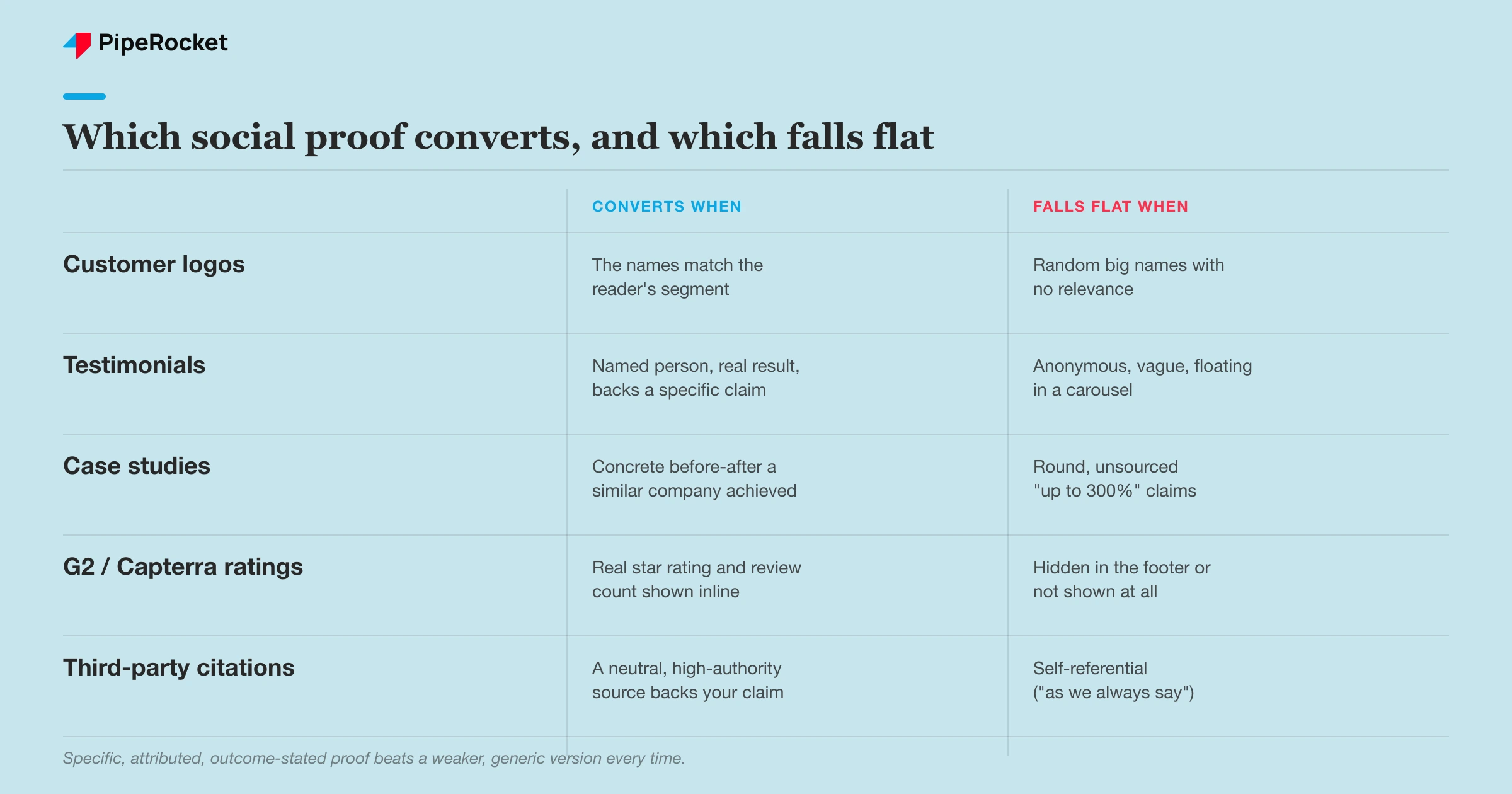
The proof that lifts conversions shares three traits: it’s specific, it’s attributed to a real person or company, and it states an outcome. Everything else is a weaker version of that. Here’s how the common types stack up.
| Proof type | Converts when | Falls flat when |
|---|---|---|
| Customer logos | The names match the reader’s segment | They’re random big names with no relevance |
| Testimonials | Named person, real result, backs a specific claim | Anonymous, vague (“great tool!”), floating in a carousel |
| Case studies / numbers | Concrete before-after a similar company achieved | Round, unsourced “up to 300%” claims |
| G2 / Capterra ratings | Real star rating + review count shown inline | Hidden in the footer or not shown at all |
| Third-party citations | A neutral, high-authority source backs your claim | Self-referential (“as we always say”) |
Named Beats Anonymous, Every Time
An anonymous testimonial is barely proof at all, because the reader can’t verify it and assumes you wrote it. A quote with a full name, title, company, and ideally a face reads as real. The more identifying detail, the more weight it carries.
We’ve seen this play out on landing pages where the page itself was the leak while the ads were doing their job. Swapping “trusted by 500+ companies” for named customers with real quotes and defined outcomes was one of the fixes that moved results. Specific proof did the persuading that the generic version couldn’t.
Numbers Only Work When They’re Sourced and Believable
A big percentage with no source (“increase conversions by up to 300%”) triggers skepticism instead of trust. A modest number attached to a named company and a real timeframe (“cut reporting time in half at a 200-person logistics SaaS”) gets believed. Believable and specific beats big and vague.
Warning: never round a customer’s result up or invent a range to make it sound better. In trust-heavy SaaS categories, one number a buyer can disprove poisons every other claim on the page.
Where to Place Proof by Buying Stage
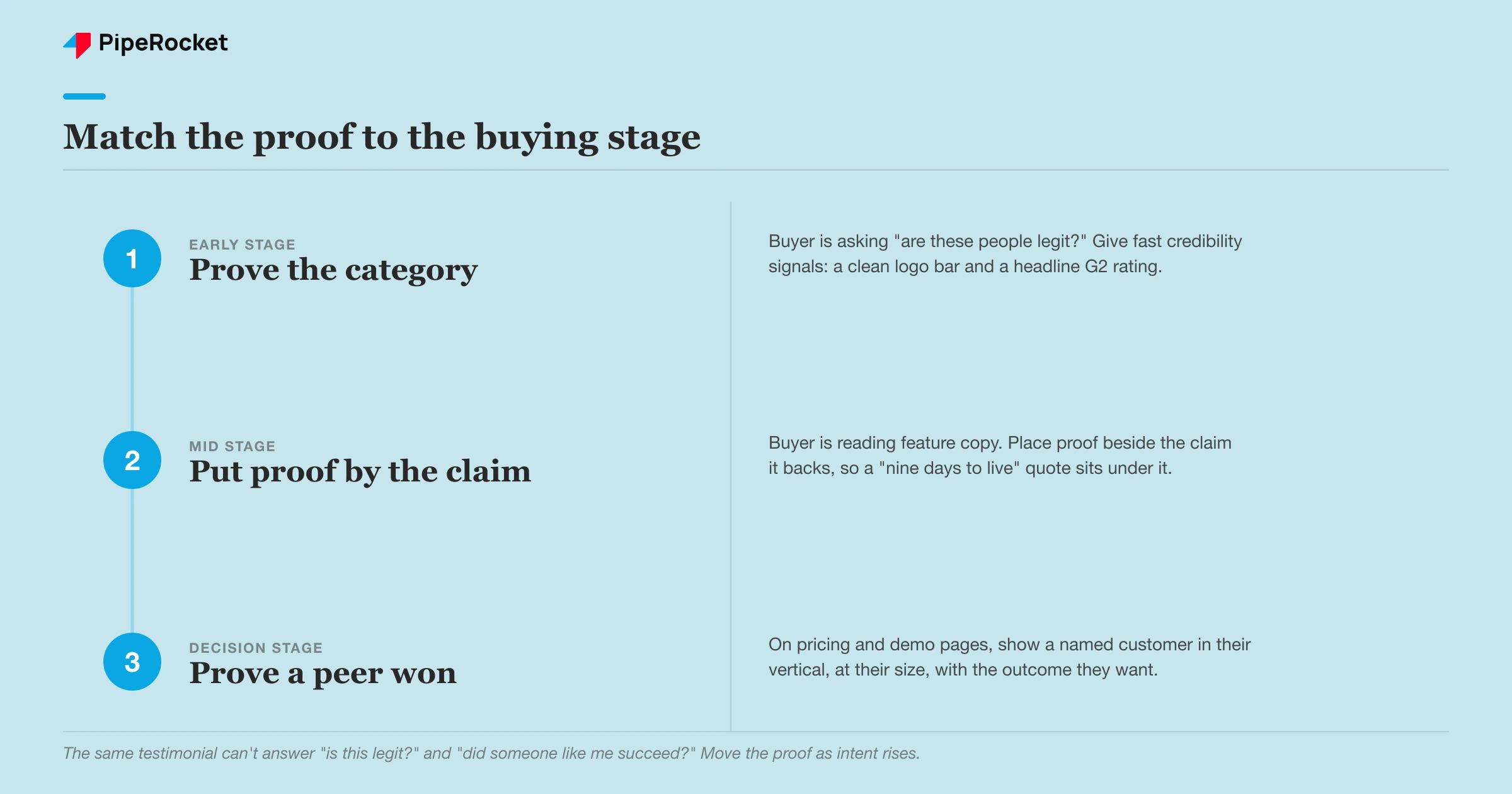
Match the proof to where the buyer is, because a first-time visitor and a pricing-page visitor have completely different doubts. Early on, the reader is asking “is this a real, credible category leader?” Later, they’re asking “did someone exactly like me succeed with this?” The same testimonial doesn’t answer both.
Early Stage: Prove the Category First
A top-of-funnel visitor who just found you needs fast credibility signals, and a detailed case study they’re not ready to read only slows them down. This is where a clean logo bar and a headline G2 rating earn their place. They answer “are these people legit?” in three seconds.
Keep it light here. The job is to buy enough trust that the reader keeps scrolling, well short of closing the deal. Save the deep proof for when they’ve shown intent.
Decision Stage: Prove That Someone Like Them Won
On pricing pages, comparison pages , and demo pages, the reader is close and looking for a reason to say yes or an excuse to leave. This is where peer-specific proof does the heavy lifting: a named customer in their vertical, at their size, with the outcome they want.
In trust-heavy categories the effect is even stronger. Across the 53 B2B SaaS brands we analysed over 8 months, cybersecurity buyers converted organic leads to sales-qualified leads at 81% versus 20% from AI referrals, because they verify a vendor through their own research before they commit.
So put the proof that survives that scrutiny, real customers and real certifications, right where the decision happens.
Put Proof Next to the Claim It Backs
Proof works hardest when it sits beside the claim it supports, right where the reader is reading, instead of quarantined in a testimonials section. A line about fast onboarding should have the “nine days to live” quote right under it. A reader deep in your feature copy rarely scrolls back to a carousel to check whether anyone verified what you just said.
Our team has watched heatmaps on live SaaS pages show exactly this: readers clicking mid-paragraph, on the claim itself, expecting proof or a next step to be right there. Inline, contextual proof catches that intent. A distant proof section misses it.
The Mistakes That Quietly Kill Your Proof
Most social-proof failures come from proof that’s been watered down until it stops persuading, rather than from proof being absent. These are the patterns we see most often.
Dumping ten testimonials in an auto-rotating carousel
The instinct is that more testimonials mean more persuasion, so teams pile everything into a slider that cycles on its own. What actually happens is that each quote gets a fraction of a second on screen, the reader never controls the pace, and none of them get read. This quietly costs SaaS teams because the page looks busy with proof while converting as if it had none, and nobody notices since the testimonials are technically present. The fix is to stop treating quantity as the goal. Pick the two or three quotes that kill the objections your buyers actually raise, and let them sit still on the page where a reader can pause and absorb them. Stillness and relevance beat rotation and volume every time.
Publishing an anonymous quote with no name or company
An anonymous testimonial (no name, no company, no title, no face) reads as something you could have written yourself, so the reader mentally discounts it to zero. It fills space and feels like proof to the marketer who added it, which is exactly why the mistake stays invisible: the page appears to have testimonials, but each one carries no weight. This quietly costs SaaS teams because they believe the section is working while buyers skim past it. The fix is attribution. Every quote should carry a real person’s name, their title, and their company, ideally with a headshot or logo. If a customer won’t let you name them, the quote is not ready to publish. A named source the reader can verify is the entire reason a testimonial persuades.
Burying a strong rating in the footer
Teams earn a genuinely strong G2 or Capterra rating, then hide it in the site footer or on a lonely reviews page nobody visits. The signal that could reduce a buyer’s risk sits far from the moment the buyer is deciding, so it does no work. This quietly costs SaaS teams because the asset exists, which makes the section feel handled, but its placement means it never reaches the point of hesitation. The fix is proximity: if you have a 4.7 with a visible review count, show it inline near your primary call to action, where a buyer weighing the click will actually see it. Proof only converts when it appears at the moment of doubt, not when it is filed away where a curious visitor might eventually dig it up.
Showing enterprise logos on a page selling to startups
Logo walls are borrowed authority, but only when the logos match the reader. Enterprise brand names on a page aimed at early-stage startups impress the marketer who assembled them and alienate the buyer, who reads them as a signal that the product is priced and built for someone much larger than they are. This quietly costs SaaS teams because the logos look prestigious internally while quietly telling the wrong segment they are in the wrong place. The fix is to match the proof to the audience of each page. Show startups other startups they recognize, and reserve the enterprise names for enterprise-facing pages. Relevance to the specific reader beats raw prestige, because a buyer trusts proof from companies that look like their own far more than proof from a name they can only aspire to.
Making a bold claim with nothing to back it
A line like “boost productivity by 40 percent” with no customer, no source, and no timeframe reads as pure marketing, so a skeptical buyer discounts it on sight and, worse, starts doubting the claims around it too. This quietly costs SaaS teams because the number feels persuasive to the person who wrote it, while the reader treats an unbacked figure as a red flag rather than evidence. The fix is to only publish a claim you can attribute. Tie the outcome to a named customer, a case study, or a cited third-party source so the reader can trace where it came from. If you cannot back a number honestly, cut it: a modest claim you can prove outperforms an impressive one you cannot, because credibility, once dented, drags down everything else on the page.
The through-line is dilution. One specific, named, relevant proof point outperforms a page stuffed with generic ones, and the generic ones actively cost you by making the page feel like a brochure.
How to Borrow Authority You Haven’t Built Yet
A newer SaaS brand can’t lean on a decade of customer logos, but it can borrow trust from sources buyers already believe. Third-party validation carries authority your own site never can, because the reader knows you don’t control it.
The cleanest version is review-platform proof. A real G2 or Capterra rating with a visible review count is a signal you didn’t write and can’t fake, which is exactly why it converts. Show the star rating and the number of reviews inline, and if you have Review schema in place, you can earn star rich-snippets in search that lift click-through before the visit even starts.
Beyond ratings, cite neutral high-authority sources when you make a market claim. When we’ve needed to rank and convert against giant review sites, pulling in real, dated third-party data and citing where it came from borrowed those sources’ authority and made our own page more credible. Acting like a neutral source rather than a salesperson is itself a form of proof.
How PipeRocket Helps SaaS Teams Turn Proof Into Pipeline
We treat social proof as a conversion lever rather than a decoration, wiring the right proof into the right page at the right stage so it kills the objection a buyer actually has. As a SaaS SEO agency , we build pages that rank for high-intent search and then convert that traffic with proof buyers believe: named customers, real ratings, and outcomes tied to the reader’s segment. If your pages get traffic but the pipeline isn’t moving, talk to our team and we’ll find where the proof is leaking.
Frequently Asked Questions
What is social proof in SaaS marketing?
Social proof in SaaS is any evidence that other people or companies trust and succeed with your product, used to reduce a prospect’s risk of buying. It includes customer logos, named testimonials, case studies, G2 and Capterra ratings, review counts, and third-party citations. The point is to answer the doubt a buyer has at a given moment, so a testimonial that names a company like theirs and states a real outcome carries far more weight than a generic “trusted by thousands” claim.
Where should I put testimonials on a SaaS landing page?
Put testimonials next to the specific claim they back up, and treat a standalone testimonials section as a supplement rather than the main placement. If a section promises fast onboarding, the quote about a quick rollout should sit right there. Reserve early-page space for quick credibility signals like a logo bar or a headline rating, and place peer-specific customer proof near the decision points, your pricing, comparison, and demo areas, where the buyer is looking for a reason to commit.
Does social proof actually improve conversion rates?
Yes, but only when it’s specific, relevant, and believable. Generic proof like an anonymous quote or an unrecognisable logo bar gets ignored because it doesn’t address the reader’s real doubt. Proof that names a customer like the reader, states a concrete outcome, and sits beside the claim it supports is what moves conversions. In trust-heavy categories buyers verify vendors before committing, so credible, checkable proof matters even more there.