
Top SaaS Marketing Challenges & How to Solve Them
 Kamaraj Mathiarasan (Kim)
Last updated on
Kamaraj Mathiarasan (Kim)
Last updated on
You have the product, the team, and the budget, but growth still feels harder than it should. If that sounds familiar, you are not alone. The saas marketing challenges we keep hearing about in 2026 are not new, but they have gotten sharper, and the playbooks that worked two years ago are not cutting it anymore.
TL;DR
- SaaS marketing challenges are the recurring strategic and operational obstacles that prevent software companies from acquiring, converting, and retaining customers profitably
- Rising CAC has made paid channels less reliable as a primary growth lever for most B2B SaaS teams
- Dark social and untracked buyer touchpoints mean shortlists form before you can measure their influence
- Churn and retention issues often expose positioning gaps that no amount of campaign spend can fix
- Proving marketing ROI keeps getting harder as buying committees grow to 6-10 stakeholders and touchpoints multiply across channels you cannot fully track
- Content built for one persona misses the CFO, IT, and end-user readers who all have to sign off before a SaaS deal closes
- Most saas marketing problems are deeply interconnected. Solving one without addressing the others produces limited and short-lived results
What Are SaaS Marketing Challenges?
SaaS marketing challenges are the specific obstacles software companies face when trying to grow revenue efficiently through acquisition, conversion, and retention.
Unlike traditional product businesses, SaaS growth depends on recurring revenue, which means every marketing decision has a compounding effect, good or bad.
The most persistent challenges are rising customer acquisition costs, difficulty proving attribution across long buying cycles, churn that quietly erodes growth metrics, and buyers who complete most of their research before ever engaging with your team.
These challenges are not unique to any one stage or size, but they get sharper as you scale and your growth model demands more precision from every channel you run.
Here is the quick map before we go deep on each one.
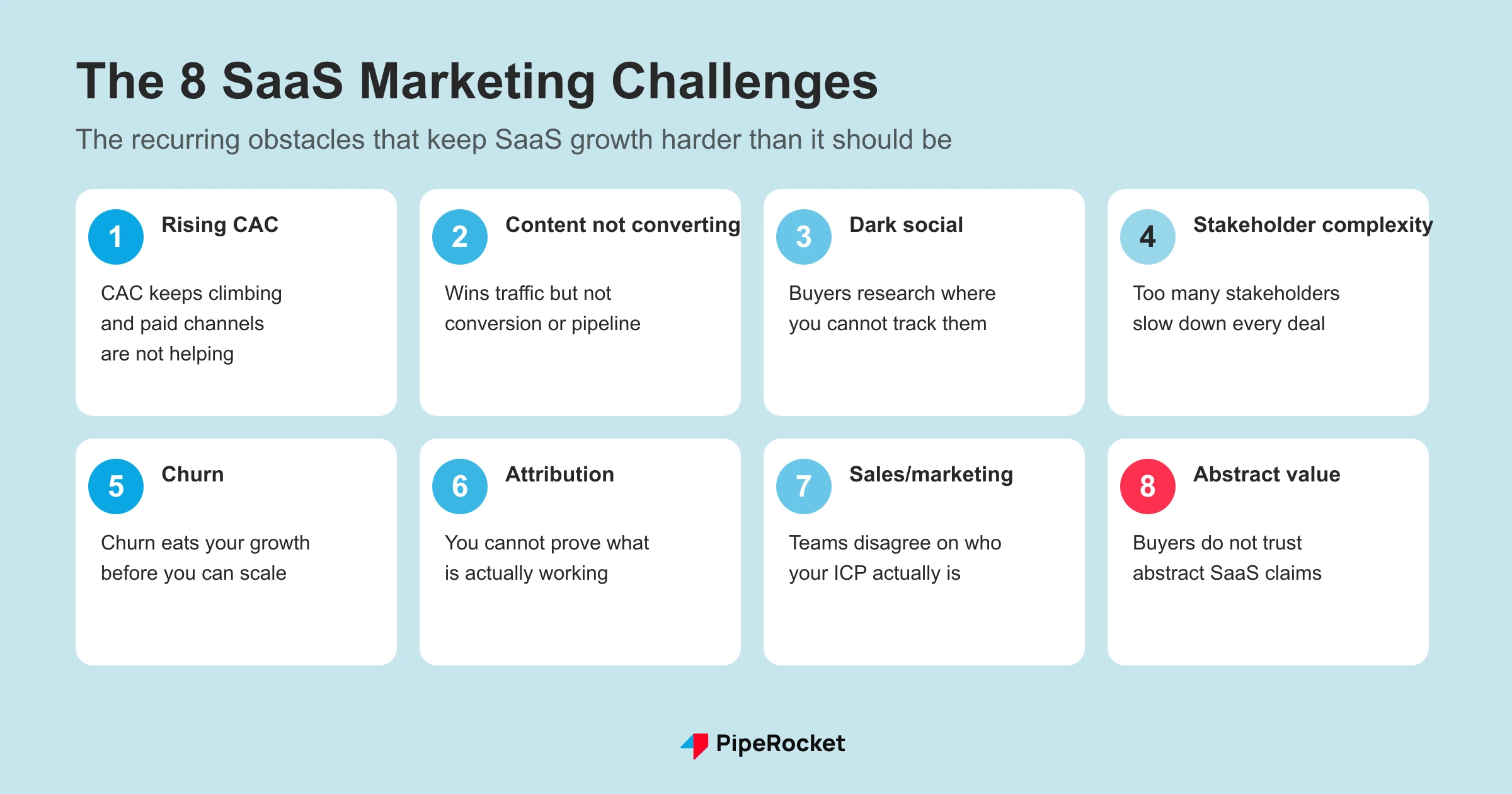
| Challenge | Root cause | The fix |
|---|---|---|
| Rising CAC | Channel saturation, ad blindness | Shift to compounding channels, tighten paid to high intent |
| Content not converting | Traffic targeted without buyer intent | Map to journey stages, add CTAs, audit before creating |
| Dark social | Research happens where you cannot track | Be useful and visible in buyer communities |
| Stakeholder complexity | Committee of many decision makers | Build content for every persona in the room |
| Churn | Wrong-fit customers, expectation gaps | Tighten ICP, align messaging, invest post-sale |
| Attribution | Multi-touch, offline, dark social influence | Blend analytics with self-reported signals |
| Sales/marketing misalignment | Teams disagree on who the ICP is | Agree one ICP definition, shared messaging and handoff |
| Proving abstract value | Software benefits feel intangible | Show outcomes with proof, demos, and customer evidence |
I’ve seen the “content not converting” row play out on a $10M SaaS client directly: traffic was growing nicely at roughly 100K visits, but conversions sat flat for eight months despite more content, more keywords, more traffic. Digging in, only 4% of that traffic was BOFU, of that only 2% clicked through to the demo page, and only 10% of those filled the form, so 4,000 visitors were producing about 10 form fills. That’s a conversion problem wearing a traffic problem’s clothes. The fix was three changes with no added traffic at all: a single-field form with the CTA turned into a same-page popup, a GA4 Path Exploration report to find the actual drop-off points and add exit and on-scroll CTAs there, and contextual CTAs that vary by page intent instead of one generic site-wide button. CTA clicks went from 2% to 6%, demo-form conversion rose 55%, in two weeks, with zero extra traffic.
Why SaaS Marketing Challenges Feel Different Than They Used To
SaaS marketing feels harder now because four shifts hit at once: acquisition costs rose about 60%, buyers research in untracked channels, categories are saturated with near-identical tools, and AI is changing how people find information. The old playbooks assumed none of these.
Founders and marketing leaders look at their numbers and feel like something shifted, but they cannot pinpoint exactly what. Here is what actually changed.
- Customer acquisition costs climbed roughly 60% over the past five years across most B2B SaaS categories (Paddle ), while growth rates compressed at the same time
- Buyers do more research on their own before ever talking to your sales team, often in places you cannot track
- Market saturation means a dozen tools with near-identical positioning sit in almost every category
- AI is reshaping how people find information, so your content strategy from last year might already be outdated
These are not isolated saas marketing problems. They are interconnected, and that is why fixing one at a time rarely works. You need to see how they feed into each other before you can address them effectively.
The rest of this guide walks through the eight challenges we see most, and what we would actually do about each one.
Challenge 1: Your CAC Keeps Climbing and Paid Channels Are Not Helping
Rising CAC is the number one SaaS marketing challenge: paid channels keep getting more expensive as more companies bid for the same audiences, ad blindness grows, and returns flatten. The fix is to stop leaning on paid as the primary growth lever and shift toward compounding channels.
This is the one we hear first in almost every conversation. You are spending more to acquire each customer, your paid channels are getting more expensive, and the return is flattening.
Why This Keeps Getting Worse
More SaaS companies are competing for the same keywords and audiences on paid platforms, which drives up costs for everyone. Buyers have developed strong ad blindness, especially in B2B where they are bombarded daily. And attribution is getting murkier, so you are not even sure which spend is driving results.
CAC payback periods are still long even where they have improved. The median SaaS payback sits around 16 months, and bottom-quartile teams wait two years or more to recoup what they spend on each customer (Benchmarkit ). That kind of payback means your paid spend takes many months to return value, so a heavy paid mix ties up cash you could be compounding elsewhere.
What We Would Do About It
The goal is not to abandon paid entirely. It is to stop relying on it as your primary growth lever when the economics no longer support it.
- Invest in organic search and content that builds long-term traffic you do not have to pay for repeatedly
- Build a referral engine by making your existing customers a growth channel through incentives and advocacy programs
- Focus paid spend on retargeting and BOFU campaigns where intent is highest, rather than spraying budget across cold awareness ads
Our SaaS PPC service is built around exactly this model: tight targeting, high-intent audiences, and budgets that compound rather than burn. When you shift your mix toward those channels, your blended CAC drops over time instead of climbing with every budget cycle.
Challenge 2: Your Content Wins Traffic but Not Conversion or Pipeline
Content that targets keywords without buyer intent optimizes for raw traffic instead of bottom-of-funnel pipeline. It ranks and gets read, but never converts because there is no path from article to next step and no perspective that beats the top five results.
This is one of the most frustrating saas marketing pain points because it feels like you are doing the right thing. You have a blog, you are publishing regularly, maybe you even have a decent content team. But the content is not converting.
Where This Usually Breaks Down
In most cases, the issue is not the content quality itself. It is that the content targets keywords without considering buyer intent, which means you are attracting traffic that will never buy. There is no clear path from content to conversion, so someone reads your article and then has nowhere to go. Or the content reads like everyone else’s, covering the same ground as the top five results with nothing distinctive.
What we keep seeing is that teams measure content success by traffic and rankings, but never connect it to pipeline. The content might be “working” by SEO metrics while completely failing as a business asset.
What We Would Do About It
Start by auditing what you already have before creating anything new. In our experience, fixing existing content often delivers faster results than publishing new pieces, especially when the issue is conversion rather than traffic.
- Map every piece of content to a stage in the buyer journey and make sure you have coverage at awareness, consideration, and decision stages
- Add clear, relevant CTAs to every article that connect to the logical next step for that reader
- Write from experience, not from research, because your content needs a perspective that makes it worth reading over the competition
If you need help finding the right agency to fix this, we put together a guide on the best SaaS marketing agencies for 2026 that breaks down what to look for and what to avoid.
From what we have observed, companies that take a month to restructure and optimize their existing library before ramping up production see pipeline impact within 90 days.
Challenge 3: Your Buyers Are Doing Their Research Where You Cannot Track Them
Dark social is buyer research that happens in untrackable channels: Slack communities, LinkedIn DMs, podcasts, and peer conversations. Buyers form opinions and build shortlists there long before they fill out a demo form, so the decision is mostly made by the time you can measure any touchpoint.
This is one of the saas marketing challenges that is genuinely new in its scale.
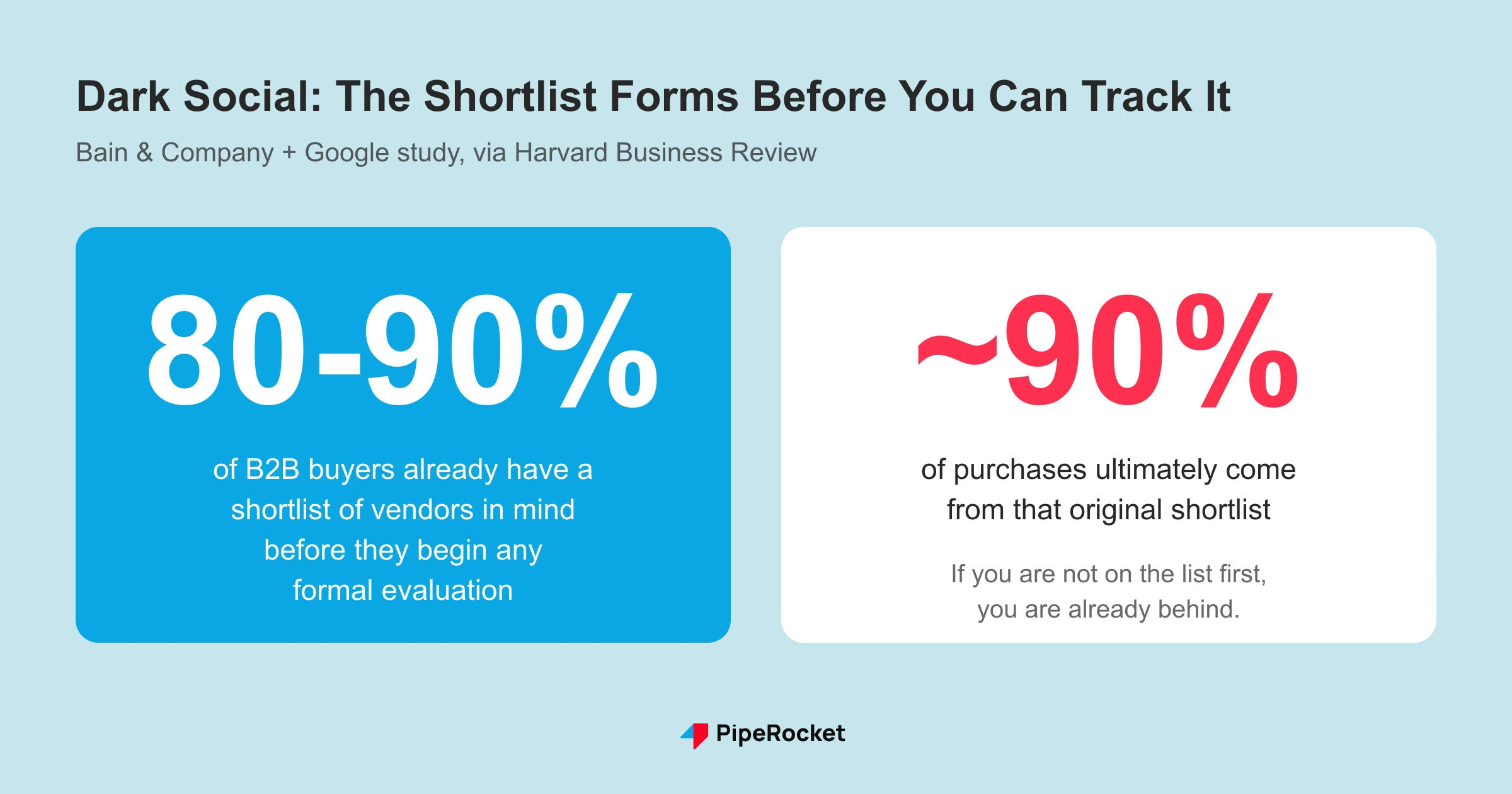
A joint study by Bain & Company and Google found that 80 to 90% of B2B buyers already have a shortlist of vendors in mind before they begin any formal evaluation. Around 90% of purchases ultimately come from that original shortlist (Harvard Business Review ). If you are not on the list before the formal process begins, you are already behind.
Why This Matters for Your Marketing
Traditional attribution models miss the touchpoints that actually influenced the decision. If you are only optimizing for what you can measure in your analytics, you are optimizing for the wrong things. The channels that show up cleanly in your dashboard are often the last touch, not the one that actually drove the decision.
What We Would Do About It
You cannot control dark social, but you can influence it by being genuinely useful and visible in the spaces where your buyers spend their time.
- Show up where your buyers hang out by participating genuinely in communities, not just dropping links
- Invest in thought leadership that gives your founders and experts a voice in the conversations your buyers are already having
- Create content worth sharing, the kind of insights that get forwarded in Slack channels and referenced in peer conversations
- Ask new customers how they heard about you in a freeform text field, not a dropdown, because the real answer is almost never “Google ad”
Account-based strategies pair well with this approach. Our guide on LinkedIn Account-Based Marketing covers how to stay visible to the exact accounts you are targeting, even when you cannot see their research behaviour directly.
Challenge 4: Too Many Stakeholders Are Slowing Down Every Deal
Most SaaS marketing still writes for one imagined reader. But in reality, the buying process involves a committee of six to ten decision makers, each armed with four to five pieces of independent research they bring to the table (Gartner ). That is a lot of opinions to align before anyone signs a contract.
What This Looks Like in Practice
Your champion loves the product but cannot get budget approval from finance. The IT team has security concerns your marketing materials do not address. The end users want ease of use while the manager wants reporting and oversight. Everyone needs to agree, and your content only speaks to one of them.
The saas marketing problems around long sales cycles usually are not about the cycle itself. They are about not equipping your champion with the right ammunition to close the internal sell.
What We Would Do About It
Think of your marketing content as a toolkit your champion can use to sell internally on your behalf.
- Create content for each stakeholder persona, not just the primary buyer but the CFO, the IT lead, and the end user
- Build a resource library with materials specifically designed to address each stakeholder’s concerns
- Use case studies that speak to different priorities: one focused on ROI for the CFO, another on implementation ease for IT, another on daily workflow for end users
When you arm your champion with the right content for every person in the room, deals move faster because the internal conversations happen with better information. This is also where Marketing Operations becomes critical. You need systems that track which content is actually being used and whether it is moving deals forward.
Challenge 5: Churn Is Eating Your Growth Before You Can Scale
You can acquire customers all day long, and it will not matter if they are leaving just as fast. Churn is one of those saas marketing pain points that does not always feel like a marketing problem, but it almost always has marketing roots.
For context, even a low-looking monthly churn rate compounds to significant annual losses once you do the math. Even what looks like a small monthly number means you are replacing a substantial portion of your customer base every year just to stay flat.
Where Marketing Connects to Churn
The connection between marketing and churn is more direct than most teams realize. Three patterns show up again and again.
- You attracted the wrong customers by targeting keywords and messaging that pulled in people who were never a great fit
- You overpromised in the sales process, setting expectations your product could not meet
- You dropped the customer after the sale, with no onboarding content, no education, and no reason to stay engaged
What We Would Do About It
- Tighten your ICP targeting so your marketing attracts customers who will actually succeed with your product
- Align your marketing messaging with the real product experience so there is no gap between what was promised and what is delivered
- Build post-sale content like onboarding sequences, feature education, and best practice guides that keep customers engaged and getting value
- Track which acquisition channels produce the highest-LTV customers and double down on those, even if they have higher upfront CAC
From what we have observed, reducing churn by even a few percentage points has a bigger impact on growth than increasing acquisition by 20%. The math just works that way with subscription models because the compounding effect of retained revenue is enormous.
Challenge 6: You Cannot Prove What Is Actually Working
Attribution in SaaS marketing has always been messy, but it has gotten genuinely harder. Multi-touch journeys, dark social, long sales cycles, and multiple stakeholders make it nearly impossible to draw a clean line from a marketing activity to a closed deal.
Why Traditional Attribution Falls Short
Last-touch attribution gives all the credit to the final touchpoint and ignores everything that came before. First-touch attribution overvalues awareness and ignores what actually closed the deal. Multi-touch models are better but still miss the offline and dark social influences that we talked about earlier.
Forrester’s State of Business Buying study found that an average of 13 people inside an organization are now involved in a typical B2B buying decision, with 89% of purchases spanning two or more departments (Forrester ). Trying to assign precise credit across that many stakeholders is a losing game if you are aiming for perfection.
What We Would Do About It
The companies that get stuck on this are the ones trying to measure everything with perfect precision. The ones that grow are the ones that get comfortable with directionally correct data and move fast.
- Use self-reported attribution alongside your analytics, asking customers directly how they found you and what influenced their decision
- Track leading indicators like content engagement, demo request sources, and pipeline velocity rather than trying to attribute every dollar perfectly
- Adopt a blended approach that combines quantitative data with qualitative signals from your sales team about what buyers are telling them
- Accept that not everything is measurable and allocate a portion of budget to activities that are hard to track but clearly influence pipeline, like community participation and thought leadership
The best attribution setup we have seen is not the most sophisticated one. It is the one that combines numbers with narratives and gives leadership enough confidence to keep investing in what works.
Challenge 7: Sales and Marketing Disagree on Who Your ICP Actually Is
When sales and marketing are misaligned on the ideal customer profile, the ICP drifts and messaging goes mixed: marketing attracts one kind of buyer while sales chases another. Leads look fine on a dashboard but convert poorly, and each team blames the other instead of the shared definition gap.
Where This Shows Up
You see it in the handoff. Marketing celebrates MQL volume, sales calls those leads unqualified, and the two teams argue over lead quality rather than fixing the targeting that created it. Underneath, there is no single written definition of who you are actually for.
That drift also feeds the churn problem in Challenge 5. When the two teams pull in different directions, you sign customers who were never a strong fit, and they leave within a year.
What We Would Do About It
- Write one ICP definition together and put it where both teams work from it, including firmographics, use case, and disqualifiers
- Agree on shared messaging so the story a prospect hears in an ad matches the one they hear on a sales call
- Define the lead handoff with clear criteria for what counts as sales-ready, then review misfires together every month
- Report on pipeline and revenue as one funnel, so both teams own the same number instead of separate vanity metrics
Challenge 8: Buyers Do Not Trust Abstract SaaS Value Claims
Because cloud software is intangible and constantly updated, explaining abstract benefits fast is hard, and buyers discount claims they cannot verify. Trust is the barrier: prospects want proof the outcome is real before they commit, so vague “boost productivity” messaging gets ignored.
Why Abstract Value Is a Hard Sell
Your buyer cannot hold your product or watch it work on a shelf. The value lives in outcomes that play out over months, and every competitor promises the same benefits in the same language. Without proof, your claims sound identical to everyone else’s, and the buyer defaults to whoever feels safest.
This ties back to dark social in Challenge 3: trust often gets built in peer conversations and communities before a buyer ever reaches your site.
What We Would Do About It
- Lead with outcomes and evidence, using specific numbers, before-and-after results, and named customer stories rather than adjectives
- Make the product tangible with interactive demos, free trials, and short product tours that let buyers see value themselves
- Use social proof heavily: case studies, reviews, and testimonials from customers who look like the buyer you are trying to win
- Show the mechanism, so buyers understand how the outcome happens and why it is repeatable for them
Several of these challenges are organic-search problems underneath, and the SaaS SEO agency shortlist covers teams that treat them that way.
How PipeRocket Digital Solves Your SaaS Marketing Challenges
At PipeRocket Digital , we work with B2B SaaS companies that are dealing with exactly these saas marketing challenges, and we approach every engagement by connecting marketing directly to pipeline outcomes.
What makes us different is that we have seen these patterns enough times to know what actually works and what just looks good in a deck.
Across SaaS SEO , paid campaigns, and marketing operations , our SaaS marketing agency does not sell generic playbooks. We build strategies around your specific product, your buyers, and the challenges that are actually holding your growth back.
If any of this resonated and you want to talk through what it would look like for your situation, we would love to have that conversation.
Conclusion
The saas marketing challenges we have covered here are not going away. CAC will keep rising, buyers will keep doing their research in the dark, and proving ROI will keep getting harder. But every one of these problems has a strategic fix.
- Rising CAC: shift toward compounding channels and tighten your paid spend to high-intent audiences
- Content not converting: map to buyer intent, add clear CTAs, and audit before you create more
- Dark social: show up where your buyers are and create content worth sharing
- Stakeholder complexity: build content for every persona in the buying committee
- Churn: tighten your ICP, align messaging to reality, and invest in post-sale content
- Attribution: blend quantitative data with self-reported signals and stop chasing perfect measurement
- Sales/marketing misalignment: agree on one written ICP, shared messaging, and a clear lead handoff
- Proving abstract value: lead with outcomes, proof, and demos so buyers can verify the benefit
What we keep seeing is that the companies who treat these as interconnected saas marketing problems rather than isolated issues are the ones that break through. Fix them as a system, and growth gets a lot easier.
Frequently Asked Questions About SaaS Marketing Challenges
1. What is the biggest challenge in SaaS marketing right now?
From what we see across the SaaS companies we work with, the biggest challenge is not any single problem but the combination of rising CAC, buyers who research entirely outside your trackable channels, and the pressure to prove ROI in a model where the full value of a customer plays out over months or years. Each of those challenges is manageable on its own, but when they compound, marketing starts to feel like it is not working even when it is.
2. Why is customer acquisition so expensive for SaaS companies compared to other industries?
SaaS companies are competing for the same buyers across the same channels, which drives up the cost of every paid impression. Beyond that, SaaS buying decisions involve multiple stakeholders with longer evaluation cycles, which means more touchpoints before a deal closes and a higher total cost per acquisition . The companies that solve this shift their mix toward channels that build audience over time, like SEO, community, and content, rather than channels that reset to zero every month.
3. How do you reduce churn when it looks like a product problem but has marketing roots?
Churn almost always has roots in marketing, even when it shows up in product metrics. If you are attracting customers who are not a strong fit for the product, they will churn no matter how good the product is. Start by auditing which customer segments stay the longest and which leave fastest, then trace those patterns back to where those customers came from and what messaging brought them in. You will almost always find that your highest-churn cohorts came from your broadest, least-targeted campaigns.
4. How long does it realistically take to see results from SaaS content marketing?
In our experience, you can see initial ranking movement and traffic gains within three to six months from a focused content strategy. Meaningful pipeline impact, where organic is consistently contributing to demo requests and closed deals, typically takes six to twelve months. That timeline is frustrating for teams used to paid channel feedback loops, but the compounding nature of organic content means that results tend to accelerate significantly in months nine through eighteen rather than flattening out.
5. What is dark social and why should SaaS marketers care about it?
Dark social refers to all the conversations and content sharing that happens in private or hard-to-track channels, including Slack communities, WhatsApp groups, LinkedIn DMs, forwarded emails, and word-of-mouth recommendations. For SaaS companies, this matters because a significant portion of your buyers’ research and vendor shortlisting happens here before they ever visit your website. You cannot track it with traditional analytics, but you can influence it by building a strong brand presence, creating content worth sharing, and showing up consistently in the communities your buyers trust.
6. What does SaaS marketing mean?
SaaS marketing is how software companies acquire, convert, and retain customers for a subscription product. Because revenue recurs, it focuses on efficient acquisition, activation, and retention rather than one-time sales.
7. What are the biggest challenges in marketing SaaS?
The biggest SaaS marketing challenges are rising CAC, a crowded market of near-identical tools, buyers researching in untracked channels, weak attribution, churn, and proving abstract software value to a multi-person buying committee.
8. How do you market to a buying committee with different priorities?
The key is thinking of your marketing content as a toolkit rather than a single message. Your champion needs something to help them build the internal business case. Your CFO stakeholder needs ROI framing and payback period data. Your IT evaluator needs security and integration documentation. Your end user needs to understand the day-to-day workflow improvement. Building dedicated assets for each of these conversations is more work upfront, but it removes the barriers that kill deals in the later stages of evaluation.

