SaaS Demand Generation Strategy: Building Awareness Before the Search Starts
 Praveen Ravi
Last updated on
Praveen Ravi
Last updated on
Most demand generation playbooks were written for a world where a rep talks to a prospect before that prospect makes up their mind. SaaS buyers don’t work that way anymore.
They try the product, read the reviews, ask a community, and form an opinion long before a salesperson ever gets a calendar invite.
TL;DR
- SaaS runs on a different clock: Consideration windows are shorter, buyers self-serve most of the research, and the product itself is doing marketing whether you planned for it or not.
- Category education comes first: If your category is still forming, your job is to teach buyers the problem and the criteria before you ever mention your product name.
- The product is a channel: Free tools, freemium tiers, and in-product moments create awareness at a scale most content teams can’t match.
- Communities move faster than campaigns: Showing up where SaaS buyers already argue about tools builds trust that ads can’t buy.
- One argument, every channel: Category-education ideas work best landing as content, paid, and community pushes together in the same launch window.
- Awareness needs its own scoreboard: Branded search, share of voice, and community mentions tell you if demand is building, long before any of it turns into a lead.
Why SaaS Demand Generation Doesn’t Work Like Traditional B2B
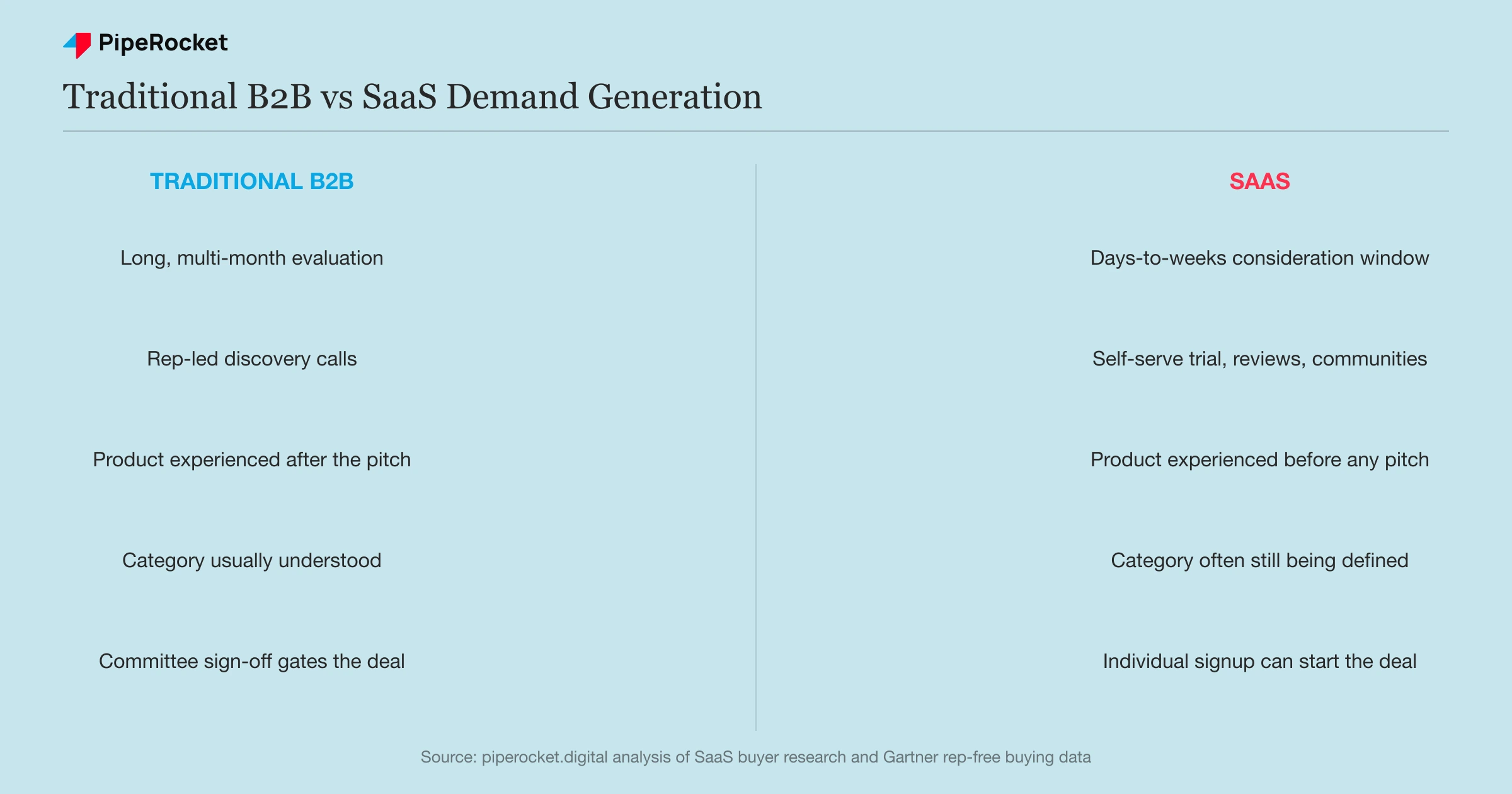
Traditional B2B demand generation assumes a buyer who needs permission, budget sign-off, and a demo before they’ll form an opinion. SaaS buyers form opinions first and ask for budget later. That’s the whole difference, and it changes almost everything about how demand should get built.
A manufacturing company evaluating an ERP might spend eighteen months in committee before touching the product. A team lead evaluating a project management tool can sign up, invite three teammates, and have an opinion by Thursday. Treat both buyers the same way and the SaaS one will have already decided before your nurture sequence sends email two.
Buyers Skip the Sales Rep Before You Even Know They Exist
Most SaaS evaluation happens with nobody from your company in the room. A Gartner survey found 67% of B2B buyers now prefer a rep-free buying experience , and SaaS is the category where that preference is easiest to act on because the product is usually one signup away.
This means your demand generation has to do the convincing before a rep ever gets involved. If the only place a buyer can learn what your product actually does is a sales call, you’ve built a funnel for a buyer who doesn’t exist anymore.
The people who show up ready to buy already made up their minds somewhere else: a review site, a trial, a Slack community, a comparison post.
Your Product Is Doing Marketing Whether You Planned It or Not
Every signup, every shared workspace, every “invite a teammate” prompt is a marketing touchpoint you didn’t write copy for. In traditional B2B, the product is what marketing sells. In SaaS, the product is often the first thing a prospect experiences, before they’ve read a single page of your website.
We’ve seen SaaS teams pour budget into top-of-funnel content while their own onboarding flow, empty-state screens, and free-tier limits are quietly telling new users the opposite story. If the product experience contradicts the brand promise, no amount of category-education content fixes it.
Demand generation for SaaS has to reach into the product surface itself, well past the marketing site’s edge.
Build Category Awareness Before Anyone Searches for You
If your category is still forming or still confused with an adjacent one, your first job isn’t lead generation . It’s teaching the market what to call the problem and how to judge a solution. Skip this step and you’ll spend years fighting for a keyword nobody searches because they don’t know the category exists yet.
This is genuinely different work from the general B2B demand-gen playbook, which usually assumes the category is already understood and the fight is over which vendor wins it. A new SaaS category has to win the “does this problem deserve its own tool” argument before it can win any vendor comparison.
Name the Problem Before You Name Your Product
Buyers can’t search for a category they don’t have a name for, so the first content job is naming the pain in language the market already uses. Watch how your own prospects describe the problem in support tickets, sales call transcripts, and community threads. Publish against the words prospects actually use, straight from those transcripts.
A compliance SaaS for fintech teams might discover its buyers keep saying “audit prep is eating my week” rather than anything close to the vendor’s own category label. Content built around “audit prep” earns attention a piece built around the internal product category name never will.
We’ve watched this show up at the AI-search layer too: someone searched “SaaS SEO agency in USA,” and Google’s AI didn’t return ten blue links, it named agencies directly, with the citation pulled straight from a Reddit thread, ours included. That’s the community-awareness play in its purest form. You don’t earn that placement by having the loudest ad spend; you earn it by showing up, credibly, in the threads where your category gets argued about before anyone types a brand name into a search bar.
Teach the Buying Criteria You Want Judged By
Once the problem has a name, the next job is teaching buyers what a good solution looks like, using criteria that happen to favor how you built the product. This is category education doing double duty as positioning.
A tool with real-time sync can publish content that frames “real-time vs batch sync” as the criteria that matters. Every buyer who reads it now evaluates every competitor through that lens.
This only works if the criteria are genuinely defensible on their own merits. Buyers who feel steered rather than informed will notice, and SaaS buyer communities talk. A criteria framework that can’t survive a Reddit thread is a thinly disguised feature comparison wearing a category-education costume.
Let Your Product Create Demand for Itself
Product-led awareness works because it lets the buyer experience the value claim instead of reading it. A free tool, a freemium tier, or a generous trial turns your product into a piece of top-of-funnel content that also happens to be the actual thing you sell.
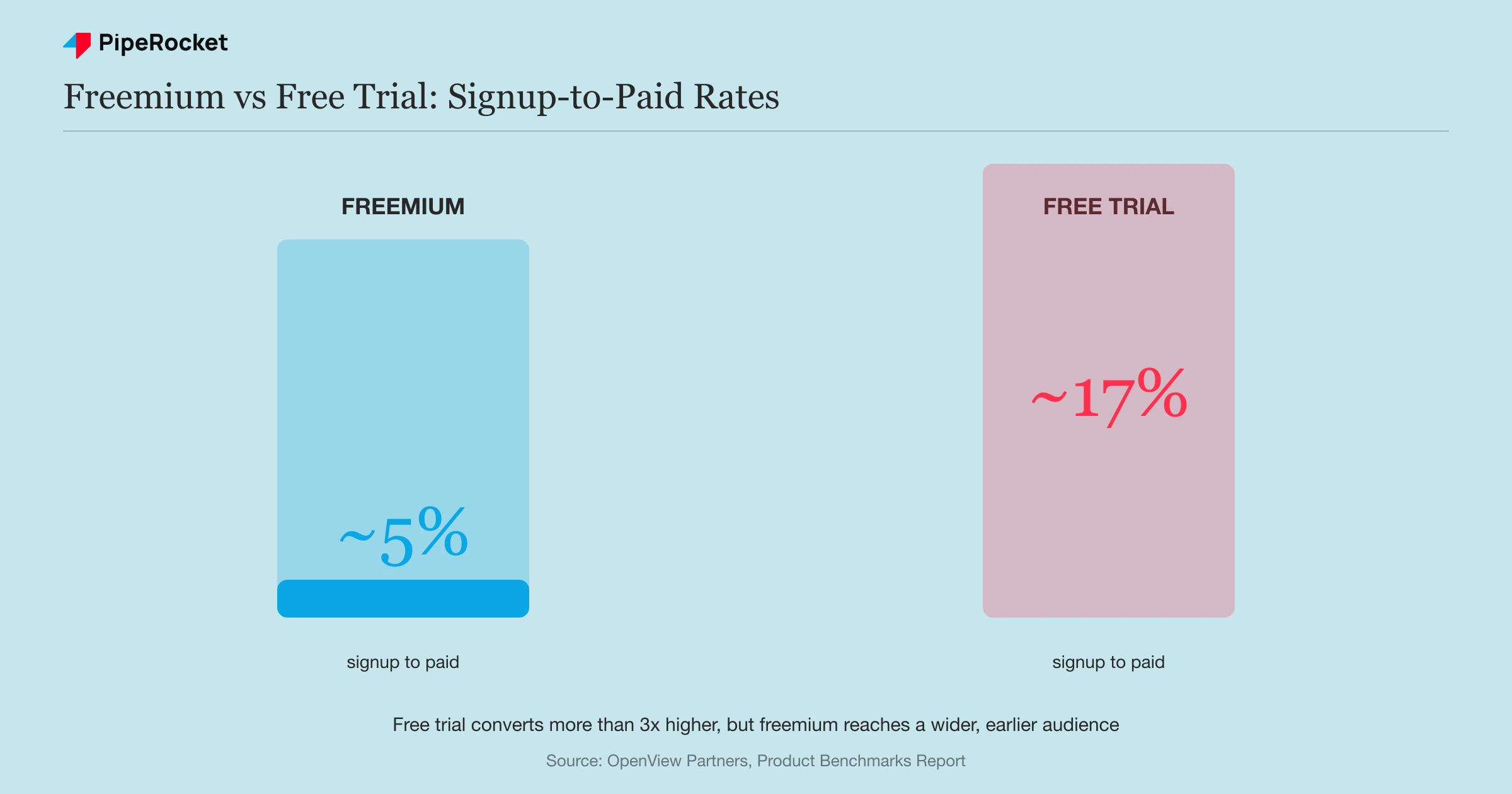
The economics back this up, though not evenly. OpenView’s Product Benchmarks research found freemium products convert about 5% of signups to paid, while free-trial products convert closer to 17%, more than three times higher, largely because a trial’s expiration date creates urgency that an open-ended free tier never does.
That gap matters for how you plan the strategy. Freemium is built for reach and awareness. A free trial is built for conversion once someone already intends to buy. Confuse the two and you’ll either give away too much value with no urgency, or gate too much value before anyone’s convinced enough to start a clock.
| Freemium | Free trial | |
|---|---|---|
| Primary job | Awareness and reach | Conversion of intent-ready buyers |
| Typical signup-to-paid rate | ~5% (OpenView) | ~17% (OpenView) |
| Best when | Category is unfamiliar, product has viral/collaborative use | Buyer already knows the category and is comparing vendors |
| Main risk | Giving away enough value that paying never feels necessary | Setting the trial window too short for a genuinely complex evaluation |
Free Tools Are Distribution in Disguise
A narrow, genuinely useful free tool (a calculator, a checker, a generator adjacent to your core product) spreads because people share things that actually help them. It puts your brand in front of buyers who were never going to search your category name, because the tool solves a smaller problem that sits next to the big one you actually sell.
The tool has to be good enough to stand on its own, or it reads as a lead magnet wearing a disguise, and SaaS buyers spot that instantly.
Take a scheduling SaaS built for recruiting teams. Instead of gating every feature behind a demo request, it ships a free interview-availability poll tool that anyone can use without an account.
Recruiters who’ve never heard of the core product start using the poll tool weekly, and a share of them eventually ask what else the company builds. The tool did the awareness work months before a sales conversation happened.
Freemium Visibility Beats Freemium Revenue
The real payoff of a freemium tier is usually the visibility, not the small slice who convert on their own. Teammates get invited into a shared workspace, screenshots end up in Slack threads, and a free-tier user becomes an internal champion long before there’s a budget conversation. Judge freemium mainly on how far it spreads inside accounts.
Build Where the Buyers Already Talk
SaaS buyers research inside communities your marketing team doesn’t control: niche Slack groups, subreddits built around a job function, LinkedIn groups, and peer review sites where the conversation happens with or without you. Community-led awareness means showing up honestly in those spaces and, over time, building spaces of your own.
Companies running structured community programs have reported meaningfully lower blended acquisition costs than paid-only programs, because the community does the trust-building work that an ad can’t. That’s the real trade-off: community takes months to build credibility, while a paid campaign can be live tomorrow. It also can’t be switched off and on with a budget line the way paid can.
Show Up in Communities You Don’t Own
Answering questions in a subreddit, a Slack community, or a LinkedIn group your buyers already use builds credibility faster than almost any owned channel, provided the answers are genuinely useful and don’t read as marketing. The moment a reply looks like it exists to plug a product, the community notices and the trust drops instantly.
The realistic goal here is earning a reputation as the account people recognize as consistently helpful. That reputation compounds slowly and pays off when someone in that same community later asks “has anyone used [category] tools?”
Build the One You Do Own Slowly
An owned community (a Slack workspace, a Discord, a private forum) only works once there’s a real reason for members to talk to each other, beyond talking to you. A community that only exists to funnel people back to your product features feels hollow within a month, and members can tell the difference between a space built for them and a space built for your pipeline.
Start narrower than feels comfortable. A community for “heads of RevOps at Series B SaaS companies” will feel alive faster than one open to “anyone interested in RevOps,” because the narrower group actually shares problems worth discussing.
Picture a fintech compliance SaaS launching a broad “compliance professionals” Slack that stalls at a few dozen mostly silent members. Narrowing the invite to “audit leads at fintech SaaS companies under 500 employees” would change the conversation almost immediately.
Everyone in that narrower room is solving the same specific version of the problem, so there’s actually something to compare notes on.
Run Integrated Campaigns, Not Channel Silos
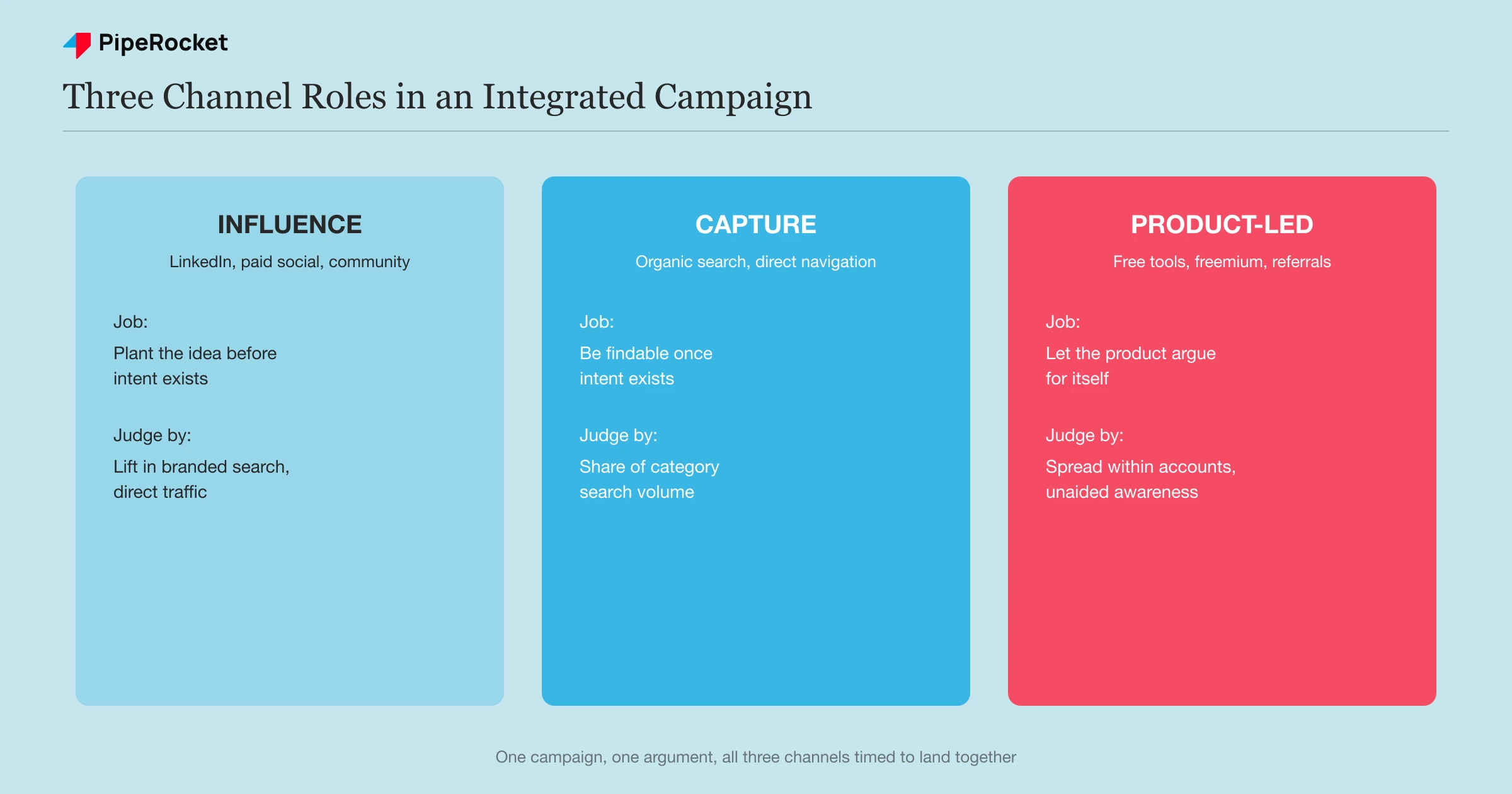
Demand creation works best as one campaign expressed across channels, rather than five disconnected channel plans that happen to launch the same month. A category-education idea should show up as a blog post, a LinkedIn point of view, a community discussion prompt, and a piece of paid content, all making the same argument in the language native to each channel.
The reason this matters more in SaaS than in traditional B2B is speed. A SaaS buyer’s evaluation window might be measured in days, so a campaign that takes six weeks to roll out across channels one at a time will miss half its audience before it’s fully live everywhere.
Different channels also play genuinely different roles, and treating them as interchangeable wastes budget. Paid social and LinkedIn are influence channels: nobody scrolling is in buying mode, so the job is planting the idea rather than closing it. Search and direct traffic are capture channels: someone’s already looking, so the job is being findable.
Our team measures the influence channels on lift (did branded search and direct traffic rise after a campaign ran) rather than last-click credit. Last-click makes a working influence channel look like it’s doing nothing.
| Channel type | Examples | Job in demand generation | How to judge it |
|---|---|---|---|
| Influence | LinkedIn, paid social, community | Plant the idea before intent exists | Lift in branded search, direct traffic, community mentions |
| Capture | Organic search, direct navigation | Be findable once intent exists | Share of category search volume, branded query growth |
| Product-led | Free tools, freemium, in-app referrals | Let the product argue for itself | Spread within accounts, unaided awareness |
An integrated campaign might publish a category-education report, cut it into a LinkedIn carousel that argues one finding, seed the same finding as a discussion starter in a relevant community, and run paid social against the report’s landing page for two weeks. Four channels, one idea, timed to land in the same window instead of trickling out over a quarter.
This is where a lot of SaaS marketing teams default back into silos without noticing. The content team owns the report, the paid team owns the ad, and the community lead owns the Slack post, and each ships on their own calendar because that’s how the org chart is set up.
The fix is a shared campaign brief that names the one argument every channel has to carry, plus a single launch week every channel plans around instead of working from three separate roadmaps.
Common Mistakes to Avoid
Measuring Awareness Work by Lead Volume
Judging a category-education report or a community push by how many leads it captured this week kills the programs that take longest to prove out and are usually the ones building the most durable demand. Awareness work needs awareness metrics. Grading it on lead volume is grading a marathon runner on their first-mile split.
Treating the Free Tier as a Lead Form With Extra Steps
A freemium product or free tool designed purely to collect an email address, with the actual utility gated behind it, doesn’t spread. Buyers can tell when the “free” version exists to harvest contact details rather than deliver value, and they end up sharing the honestly useful tools instead.
Copying a Competitor’s Community Instead of Building One With a Reason to Exist
Launching a Slack community because a competitor has one, without a distinct reason for members to show up, produces a ghost town by month two. A community needs its own gravity: a niche narrow enough that members actually need each other, beyond your product updates.
Running Every Channel on the Same Cadence
Publishing the category-education report, the LinkedIn post, and the paid campaign weeks apart instead of in the same window turns one integrated campaign into three disconnected pushes that never reinforce each other. Given how short SaaS evaluation windows run, a staggered rollout means half your audience never sees the full argument.
Waiting Until the Product Feels Perfect to Start Building Awareness
Holding off on demand generation until the product is fully polished means the awareness clock starts months later than it needs to, and competitors with a rougher but earlier product often own the category conversation by the time yours ships. Product-led awareness works with an honest, useful early version. It doesn’t require a finished one.
How to Know Your Demand Generation Is Actually Working
Demand generation succeeds when more of the right people know who you are and trust you before they ever fill out a form, so the metrics have to measure awareness and trust directly instead of borrowing lead-gen numbers that belong to a different stage of the funnel.
Track these signals monthly and read them together as a single trend:
- Branded search volume: Are more people searching your company or product name specifically, month over month?
- Direct traffic: Is more traffic arriving with no referral source at all, meaning someone typed your URL because they already knew it?
- Share of voice in your category: Are you showing up in more of the comparison threads, review sites, and community discussions than you were two quarters ago?
- Community engagement: Are people replying to your posts in owned or third-party communities without prompting, and is that engagement growing?
- Unaided awareness: In sales calls and win-loss interviews, are prospects mentioning your brand before your rep does?
None of these numbers convert directly into revenue on their own, and that’s the point. They’re leading indicators that tell you whether the pool of people who’ll eventually convert is growing. Watching these alongside branded search and direct traffic for a quarter or two shows you the trend line, which matters more than any single month’s number.
How PipeRocket Digital Builds SaaS Demand Generation
We build the awareness layer that gets a SaaS brand recognized before a buyer ever searches its name: category-education content, community-native distribution, and paid programs that plant ideas instead of chasing last-click credit.
If you’re launching into a category that doesn’t have a name yet, or trying to get your product talked about outside your own website, our SaaS SEO and SaaS PPC teams, part of our SaaS marketing agency practice, run the content and paid sides of that program together. Get in touch if you want a second opinion on where your demand generation is actually leaking.
Frequently Asked Questions
What’s the difference between demand generation and lead generation for SaaS?
Demand generation builds awareness and trust with people who aren’t actively looking to buy yet, using category education, community presence, and product-led visibility. Lead generation captures and qualifies the people who are already showing intent, through forms, scoring, and routing. Demand generation fills the pool; lead generation pulls people out of it once they’re ready.
How long does SaaS demand generation take to show results?
Category-education content and community programs typically need two to three months before branded search and direct traffic show a clear upward trend, since the goal is building trust rather than triggering an immediate action. Product-led channels like freemium can show signup growth faster, but the deeper account-level spread that makes freemium valuable still takes a few months to build momentum.
Does demand generation still matter if my SaaS product has a strong freemium tier?
Yes, and arguably more, because a freemium tier only works if people know to try it. A generous free tier with no awareness behind it just sits there converting the small trickle of visitors who stumble onto your site directly. Demand generation is what gets enough of the right people into that free tier for its natural spread mechanics to kick in.