SaaS ABM Strategy: The Cross-Channel Framework That Actually Moves Pipeline
 Praveen Ravi
Last updated on
Praveen Ravi
Last updated on
A SaaS ABM strategy treats high-value target accounts as distinct markets, aligns sales and marketing around one agreed account list, and engages the whole buying committee with personalized, multi-channel campaigns rather than casting a wide net.
Most SaaS teams that say they run ABM actually run a target account list bolted onto their existing demand gen motion. The list gets built once, dropped into an ad platform, and nobody touches it again until the quarterly review shows flat pipeline.
TL;DR
- Define your ICP and revenue target before you build any list: tiering and personalization only work once you know who you’re chasing and what a win is worth.
- Tier accounts before you touch a single channel: split your target list into 1:1, 1:few, and 1:many groups, because a whale account and a scale account need entirely different plays.
- Get sales and marketing to sign off on the same list: a shared, agreed account list is the actual alignment artifact, more useful than any kickoff meeting.
- Map the buying committee inside each target account: SaaS deals with three or more stakeholders need role-specific messaging across the whole committee.
- Score accounts on fit and intent together: firmographic fit tells you who could buy, intent signals tell you who’s close, and either signal alone leaves sales chasing the wrong accounts.
- Measure the program on account engagement and pipeline influenced: ABM succeeds or fails on whether target accounts move through the funnel.
Why a Generic ABM Motion Falls Apart in SaaS
ABM built for enterprise software assumes a buying committee that’s already formed and a sales cycle measured in quarters. Most SaaS deals, especially below the six-figure ACV mark, don’t work that way.
The committee is smaller, the cycle is shorter, and the product often sells itself into the account before anyone in marketing knows the deal exists.
That mismatch is why so many SaaS ABM programs stall after the first quarter. Teams import a framework built for a $200K enterprise sale and apply it to a $15K annual contract with three stakeholders and a 45-day sales cycle. The tiering still holds. The cadence, the content depth, and the channel mix don’t.
What actually breaks after launch has nothing to do with the account list itself
Building a target account list is the easy part. Any RevOps tool can pull 500 companies that match your ICP in an afternoon.
What breaks ABM programs is what happens after launch:
- Nobody owns the list. No one is accountable for keeping it current, so it drifts.
- Sales stops trusting it within two months, because half the accounts already churned or never fit.
- Marketing keeps running a stale list, because rebuilding it feels like starting over.
Our team treats the list as a living asset with a monthly owner instead of a one-time export. That single change fixes more broken ABM programs than any new tactic layered on top.
Ownership matters more than the tool doing the owning. A shared spreadsheet with a named owner beats an expensive ABM platform nobody logs into after the first month. The platform can wait. The habit of reviewing the list can’t.
Step 1: Define Your ICP and Revenue Goals Before You Build a List
Every ABM program starts with two decisions, and both set the size of your target list, the tier thresholds, and the budget each account can justify:
- Who your ideal customer is: the firmographic and behavioral pattern your best current customers share.
- What a won account is worth: the revenue goal that decides how many accounts you can realistically work.
Get both on paper first. The detail on each follows.
Your ideal customer profile is the firmographic and behavioral pattern your best current customers share: company size, industry, tech stack, revenue band, and the trigger that made them buy. Write it from real closed-won data, not a wishlist of logos you’d like to land.
Then attach a revenue goal to the program. A team chasing five six-figure logos runs a different motion than a team chasing 200 mid-market accounts at a $15K annual contract. The number decides how many accounts you can realistically work and how deep the personalization goes.
Without both, tiering becomes guesswork. You can’t say an account belongs in the 1:1 tier if you haven’t defined what makes an account worth that investment in the first place.
Step 2: Build the Account Tiers Before You Build Anything Else
SaaS ABM uses three account tiers: 1:1 for a handful of must-win accounts, 1:few for small groups sharing a trait, and 1:many for your broad ICP segment. Revenue potential and personalization depth decide which tier an account lands in.
Account tiering decides everything downstream: how much content you write, how personal that content gets, and how much budget and rep time each account earns.
Get the tiers wrong and you’ll either burn a sales rep’s week on an account too small to justify it, or send a generic email sequence to the one account that would have closed with a phone call.
The standard three-tier split works for SaaS almost unchanged from how it works in enterprise software, just at a smaller scale.
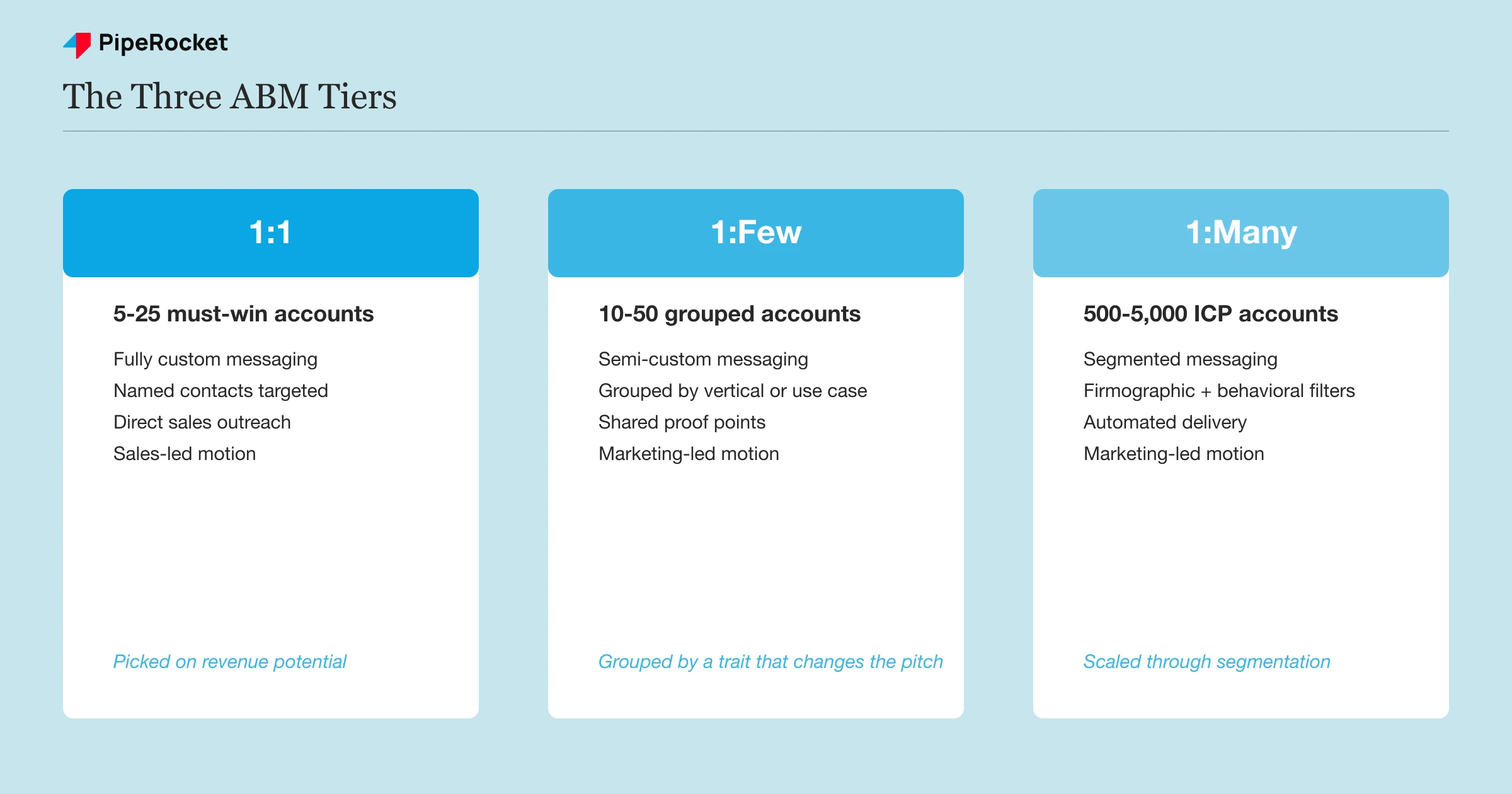
| Tier | Account count | Personalization level | Who drives it |
|---|---|---|---|
| 1:1 | 5 to 25 must-win accounts | Fully custom: named contacts, tailored messaging, direct outreach | Sales-led, marketing supports |
| 1:few | 10 to 50 accounts grouped by shared trait (vertical, tech stack, use case) | Semi-custom: shared theme, account-specific proof points | Marketing-led, sales engaged per group |
| 1:many | 500 to 5,000 accounts matching your ICP | Scaled: segmented by firmographic and behavioral filters, not individual accounts | Marketing-led, automated |
Pick 1:1 accounts on revenue potential, and defend that choice out loud
The 1:1 list should be short enough that every account has a named sales owner and a specific reason it made the cut. That reason is usually deal size or strategic value, a logo that opens a whole vertical.
It should hold up when a rep asks why the account is there. “We’ve talked to someone there before” is a familiarity signal, not a reason.
A good test: if you removed an account from the 1:1 list and dropped it into 1:many, would anyone notice or push back? If the answer is no, it probably belongs in a lower tier already. Reserve the top tier for accounts where losing that specific deal would actually sting.
Group 1:few accounts by a trait that genuinely changes the pitch
A 1:few cluster only earns its place if the shared trait actually changes what you say to those accounts. Grouping by industry works well, because a fintech compliance pitch genuinely differs from a healthcare one, down to the objections a buyer raises and the proof points that land.
Grouping by a trait like “companies with 50 to 200 employees” rarely earns its own content, because company size alone doesn’t change the argument you’re making.
Before you build a 1:few cluster, write down the one sentence that changes for that group. If you can’t write that sentence, the cluster is still just a smaller list.
Use case works as a grouping trait almost as well as industry. A cluster of accounts evaluating your product to replace a legacy tool needs migration-focused proof, while a cluster evaluating it as a first-time purchase needs category education instead. Same product, two different arguments, two different clusters.
Step 3: Get Sales and Marketing to Agree on the Same List Before Anything Launches
ABM lives or dies on one artifact: a target account list both teams have actually signed off on, not one marketing built and sales was told about. Without that agreement, sales quietly ignores accounts marketing is spending budget on, and marketing keeps running campaigns against accounts sales already disqualified.
The fix is a recurring list review, not a one-time kickoff. Sit sales and marketing in the same room monthly and walk the list account by account. A rep who says an account just churned or never had budget authority should get that account pulled immediately, not left in the sequence for another quarter.
Three questions settle most list disagreements fast:
- Does this account match our ICP on paper, and has sales confirmed it’s a real opportunity, not just a lookalike?
- Who owns follow-up when marketing generates engagement, sales or a shared queue that nobody checks?
- What does sales do differently once an account crosses into the 1:1 tier?
Skip that last question and you’ll end up with a list that looks tiered on a spreadsheet but gets treated identically in practice.
Picture a compliance SaaS built for fintech teams. Marketing flags an account as 1:1 because the company matches every firmographic filter. Sales already knows the account just signed with a competitor last quarter and pulls it from the list in the same review. Without that monthly check, marketing would have spent weeks building a custom landing page for a deal that was never open.
Step 4: Map the Buying Committee Inside Each Account
A SaaS account is not one buyer. Map the buying committee inside each target account, then tailor messaging by role, because a finance lead, an IT owner, and the day-to-day user each judge your product on different criteria.
Most SaaS deals close with three or more people weighing in. Marketing to the account as if it were a single persona means your message lands with one stakeholder and reads as noise to the rest. Before you write a line of copy for a 1:1 or 1:few account, list who sits on the committee and what each of them cares about.
A practical starting map for a mid-market SaaS purchase:
| Committee role | What they judge you on | The message that lands |
|---|---|---|
| Economic buyer (VP, exec) | ROI, payback period, strategic fit | Business outcome and revenue impact |
| Technical evaluator (IT, security) | Integration, data handling, admin overhead | Security posture, API depth, migration path |
| End user / champion (ops, day-to-day) | Ease of use, time saved, support quality | Workflow fit and quick time-to-value |
Account penetration, reaching more of that committee, is the signal that a deal is real. Two engaged stakeholders out of six is a weaker position than five out of six, even when the click volume looks identical. Reaching the whole committee is what separates ABM from a single-thread demand gen touch.
Step 5: Build Account Content and Personalization to Match the Tier
Personalization depth scales down as tier size scales up: fully custom content for the 1:1 list, one shared insight per 1:few cluster, and segmented messaging for the 1:many pool. The channel an account meets you on matters far less than how deeply the content speaks to that account.
The channel an account meets you on matters far less than how deeply the content speaks to that specific account, and that’s the layer most teams skip when they think ABM means running paid ads against a target list. Personalization is a content and research discipline first. Paid media is one way to deliver it, not the strategy itself.
1:1 content should name the account’s actual situation
For a 1:1 account, generic pain-point copy reads as noise. The content should reference the account’s product, its stated priorities from a recent earnings call or job posting, or a specific competitor it’s evaluating.
A landing page built for one named account, even a simple one, outperforms a polished generic page almost every time. The prospect can tell the difference between “written for someone like you” and “written for you.”
1:few content should carry one shared insight the group hasn’t already seen elsewhere
A 1:few cluster earns a shared asset like a vertical-specific guide or a benchmark report, built once and reused across the group.
The trap is treating that shared asset as a template where you swap the company name in the header and call it personalized. The insight inside has to be genuinely specific to that group’s situation, built from real research into what that vertical actually cares about, or the accounts will notice the recycling within the first two emails.
1:many content scales through segmentation instead of true personalization
At the 1:many tier, real 1:1 personalization isn’t realistic across thousands of accounts, and pretending otherwise burns time better spent elsewhere. Segment by firmographic filters like industry, size, and region, and by behavioral filters like pages visited and content downloaded, then let the messaging vary by segment rather than by individual account.
If you’re layering paid media on top of any of these tiers, the tactical execution, ad platform setup, budget splits by tier, and cross-channel retargeting sequences live in PipeRocket’s ABM paid playbook . This guide is the strategic layer that decides who gets targeted and why. That guide is the tactical layer for how you reach them once the list and tiers are set.
Step 6: Score Accounts on Fit and Intent Together
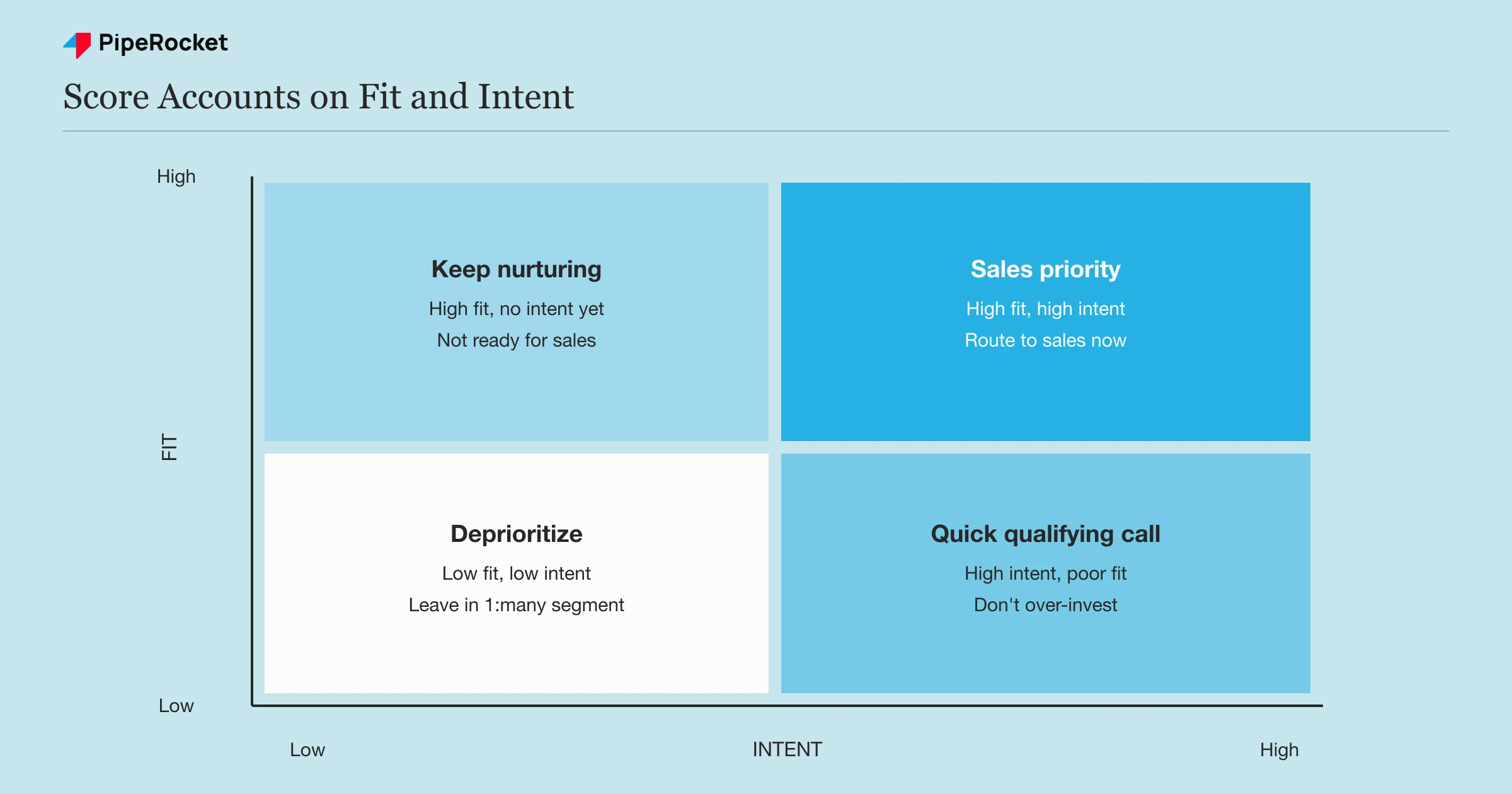
Fit tells you who could theoretically buy. Intent tells you who’s actually close to buying right now. A scoring model that only measures one of the two sends sales chasing accounts that match the ICP on paper but show zero buying signal, or accounts showing intent that will never close because they don’t fit the product.
Fit scoring runs on firmographic data: company size, industry, tech stack, and whether the account matches your best current customers. Intent scoring runs on behavior: which pages an account visited, whether multiple people from the same company engaged with content, third-party intent data showing research activity on competitor or category terms, and direct signals like demo requests or pricing page visits.
The accounts worth sales time sit in the overlap of both. An account scoring model that ignores this overlap and just ranks by a single composite number tends to flatten exactly the distinction sales needs.
| High fit | Low fit | |
|---|---|---|
| High intent | Sales priority: work now | Quick qualifying call, don’t over-invest |
| Low intent | Keep nurturing, not yet | Deprioritize |
Intent data comes from a few sources that cover most of what you need:
- Your own site analytics. Which accounts are visiting pricing pages or repeat-visiting product pages.
- Third-party intent providers. Accounts researching category terms across the web, even before they’ve visited your site.
- Sales conversations and support tickets. A renewal question or a feature request often reveals real budget and timing that no external tool would catch.
Warning: don’t treat a single spike as a score. One pricing-page visit from a new IP could be a competitor’s sales rep doing research, not a buyer. Look for a pattern across at least two or three signals from the same account before treating it as real intent worth acting on.
One penetration tactic worth knowing before you fund the 1:many tier: you can raise how much of a target-account list actually sees your messaging without spending an extra dollar. With 100 target accounts, a platform’s delivery algorithm doesn’t cycle through all 100, it keeps hitting the same handful who’ve already “memorized” the brand while the rest never see it, the same way a rep might keep calling the same 30 of 100 prospects out of habit. Dynamic exclusions fix this: pull your highly-engaged accounts out of the prospecting pool and push the freed budget to the accounts that haven’t seen you yet, then run a small separate campaign to nurture the engaged group. Two audiences, two jobs, reach and nurture, instead of one audience doing neither well.
Step 7: How to Roll Out an ABM Program Without Stalling in Month One
Launch the 1:1 tier first, then layer in 1:few and 1:many once the sales-marketing review habit is running. Sequencing the tiers instead of launching all three at once is what keeps a program from stalling in its first month.
Most SaaS teams either try to launch every tier at once or spend so long planning that nothing ships for a quarter. Both approaches fail for the same reason: they treat ABM as a single big project instead of a sequence of smaller, provable steps.
Sequence the tiers in this order:
- Start with 1:1 alone. It’s the smallest list, the easiest to get sales buy-in on, and the fastest to show a result worth pointing to. A handful of engaged whale accounts in month one beats a half-built 1:many segment that hasn’t launched.
- Layer in 1:few once the 1:1 motion has a working rhythm: sales meeting cadence, content requests, a shared tracking sheet.
- Add 1:many last. By now the tiering discipline and the sales-marketing review habit are already built, so scaling the list is easier than building the habit from scratch at every tier at once.
Set a 90-day checkpoint before judging anything
ABM accounts move slower than a typical demand gen lead, especially at the 1:1 tier where the sales cycle might run four to six months on its own. Give the program a real 90-day checkpoint before drawing conclusions, and judge it on engagement and pipeline movement rather than closed revenue that early.
At the 90-day mark, check three things:
- Has account engagement increased across the target list compared to a baseline period?
- Has sales actually worked the accounts marketing flagged as engaged?
- Has at least one account moved to a new stage in the pipeline?
Two out of three is a program worth continuing and adjusting. Zero out of three means the list, the content, or the sales handoff needs a real look before you add more budget.
Common Mistakes to Avoid
Treating the account list as a one-time project
Building the list once and letting it sit unmaintained for two quarters is the single most common way ABM programs quietly die. Accounts churn, buying committees change, and a list built in January is stale by June. Assign a monthly owner whose job is to add, remove, and re-tier accounts as reality changes.
Running the same content across every tier
Sending the same nurture sequence to a 1:1 whale account and a 1:many segment defeats the entire point of tiering. A program where content stays identical across tiers is really just a segmented email list with extra steps.
Letting marketing build the list without sales veto power
A list marketing builds alone and hands to sales as a done deal invites quiet rejection. Sales stops working the accounts they didn’t help choose, and the whole program loses momentum without anyone officially killing it.
Measuring the program on the same metrics as a demand gen campaign
Judging an ABM program by cost per lead or click-through rate misreads what ABM is built to do. A 1:1 account might take four months of engagement before a single form fill happens. Judging that account dead by month two throws away exactly the accounts the program exists to win.
Step 8: Measure the Program on Account Engagement and Pipeline Influenced
Measure a SaaS ABM program on three numbers: account engagement, account penetration, and pipeline influenced. These track whether target accounts are moving through the funnel, which is what ABM exists to do, rather than whether any single channel performed well in isolation.
- Account engagement. How many people at a target account interacted with your brand across every channel combined in a given period. Five stakeholders at a whale account engaging with content is a stronger signal than a hundred anonymous clicks from accounts you can’t identify.
- Account penetration. How deep you’ve reached into a target account’s buying committee . Two engaged stakeholders out of a six-person committee is a weaker position than five out of six, even if the click volume looks identical on a report.
- Pipeline influenced. Whether target accounts actually opened opportunities, and at what velocity compared to non-ABM accounts. If tiered accounts consistently close faster or at higher deal values than the general pipeline, the program is working, even if the top-line lead count looks unimpressive next to a volume campaign.
Build a simple monthly dashboard around these three numbers rather than a sprawling report nobody reads. List every 1:1 and 1:few account down one column, with engagement, penetration, and pipeline stage across the row.
A quick scan tells a sales leader exactly which accounts are heating up and which have gone cold, without digging through separate reports from every channel. Report the dashboard to sales leadership directly, not just to marketing’s own team.
The moment sales sees their target accounts tracked with the same rigor as their pipeline, the program stops feeling like a marketing side project. It starts feeling like a shared asset both teams actually use.
Why/How PipeRocket Digital Helps With This
We build the account tiering, scoring model, and sales-marketing alignment process before we ever touch an ad platform, because that’s the layer most SaaS ABM programs skip. If you’re ready to run the paid execution on top of a solid list, our SaaS PPC team handles the channel mix, and our account-based marketing agency page covers the ABM-specific model in more depth.
You can also see how we compare against other options on the best SaaS marketing agencies list, or get in touch if you want a second opinion on your current account list.
Frequently Asked Questions
What is an ABM strategy?
An ABM strategy picks a defined list of high-value accounts, aligns sales and marketing around that one list, and engages the whole buying committee with personalized, multi-channel campaigns instead of chasing broad lead volume.
What are the three types of ABM in SaaS?
The three types are 1:1 (fully custom outreach to 5 to 25 must-win accounts), 1:few (semi-custom content for small groups sharing a trait), and 1:many (segmented messaging across your broad ICP pool). Personalization depth scales down as the list scales up.
What’s the difference between ABM and regular demand generation?
Demand generation casts a wide net and lets the funnel qualify leads after the fact. ABM starts by choosing the accounts you want as customers before any content goes out, then builds the entire motion, content, outreach, and sales engagement, around that specific list. The targeting decision happens first in ABM and last in demand gen.
How many accounts should a SaaS company put in its 1:1 tier?
Keep the 1:1 tier small enough that every account has a named sales owner who can realistically give it individual attention, usually somewhere between 5 and 25 accounts depending on team size. If you can’t name why a specific account deserves that level of investment beyond “we’ve heard of them,” it belongs in the 1:few tier instead.
Do you need a dedicated ABM platform to run this framework?
No. The framework works with a shared spreadsheet, a CRM, and a monthly review meeting between sales and marketing. Dedicated ABM platforms add intent data and automation that help at scale, particularly for the 1:many tier, but they don’t replace the tiering, alignment, and content discipline this guide describes. Many SaaS teams run a functional 1:1 and 1:few program for months before a platform becomes necessary.
What does an ABM tech stack include?
A minimal ABM tech stack is a CRM plus a marketing automation tool and a shared account list. A fuller ABM martech stack adds an intent-data provider, an ad-targeting platform for account-level delivery, and a dashboard for engagement and pipeline. Start small and add tools only when a tier demands them.