AI Agents for SEO: What They Are and How They Help
 Kamaraj Mathiarasan (Kim)
Last updated on
Kamaraj Mathiarasan (Kim)
Last updated on
An AI agent for SEO is software given a goal, like “fix why rankings dropped,” that plans its own steps and acts, instead of following a fixed script you wrote in advance.
TL;DR
- AI agents work toward a goal you set and decide their own steps to reach it, acting on outcomes instead of running a script you built in advance.
- The core capabilities in 2026 span six jobs: keyword research, competitor and gap analysis, content drafting (scored for AI-citation engines as well as classic ranking), technical audits (schema markup, meta title rewrites, alt text), rank tracking, and drop recovery.
- Most SEO software you already own is instruction-following, like a rank tracker that emails you a chart, while software that investigates a drop and proposes a fix is exercising real goal-orientation.
- The repeatable, data-heavy parts are safe to delegate now, but deciding what your site should be about still needs a person.
- Agents connect large language models to live tools like Search Console and crawlers, often through APIs or the Model Context Protocol, then plan and run multi-step work instead of a fixed script.
- Left unchecked, an agent publishing at scale produces hundreds of thin pages, so keep a human on anything that ships to a live site.
- Adoption fails most often when a team treats an agent like a full replacement for a strategist instead of scoping it narrow and expanding access only after it earns trust.
What an AI Agent for SEO Actually Is
An AI agent for SEO (often called an SEO agent) is autonomous software that plans, executes, and iterates on SEO work toward a goal you set, rather than following a fixed sequence of steps you scripted for it. It connects to external tools and data sources, like Search Console or a crawler, then figures out what data to pull, what to check next, and what to change. You tell it the outcome you want.
This guide covers agents that do SEO work, not optimizing your site so AI agents can read it, which is a separate topic.
That connection is what separates an AI SEO agent from a plain AI writing tool. A writing tool generates text when you prompt it. An agent reaches out to live data, decides its own next step, and takes multi-step action across tools, frequently through connectors like the Model Context Protocol (MCP) that let it read from Search Console or an SEO API directly.
That’s a different relationship to the work than most SEO software gives you. A rank tracker checks positions on a schedule and reports what it finds. A keyword tool pulls volume and difficulty for a list you feed it. Both are useful, and neither decides anything. They run the same steps every time, regardless of what the data shows.
An agent behaves differently once it hits something unexpected. If a page’s traffic craters overnight, a static tool logs the drop. An agent investigates it, checking:
- Whether the SERP layout changed
- Whether a competitor published something new
- Whether a featured snippet moved
- Whether Google shipped an update that week
It picks its own path through that investigation based on what it finds at each step, not a checklist written months earlier.
The distinction that matters here is goal-orientation versus instruction-orientation. Give a fixed automation an instruction and it does that one thing, the same way, every time. Give an agent a goal and it chooses the sequence of actions to reach it, adjusting when the first approach fails. That’s the line worth holding onto, because most of what gets marketed as “AI SEO” today is still the first kind.
What Do AI Agents for SEO Actually Do?
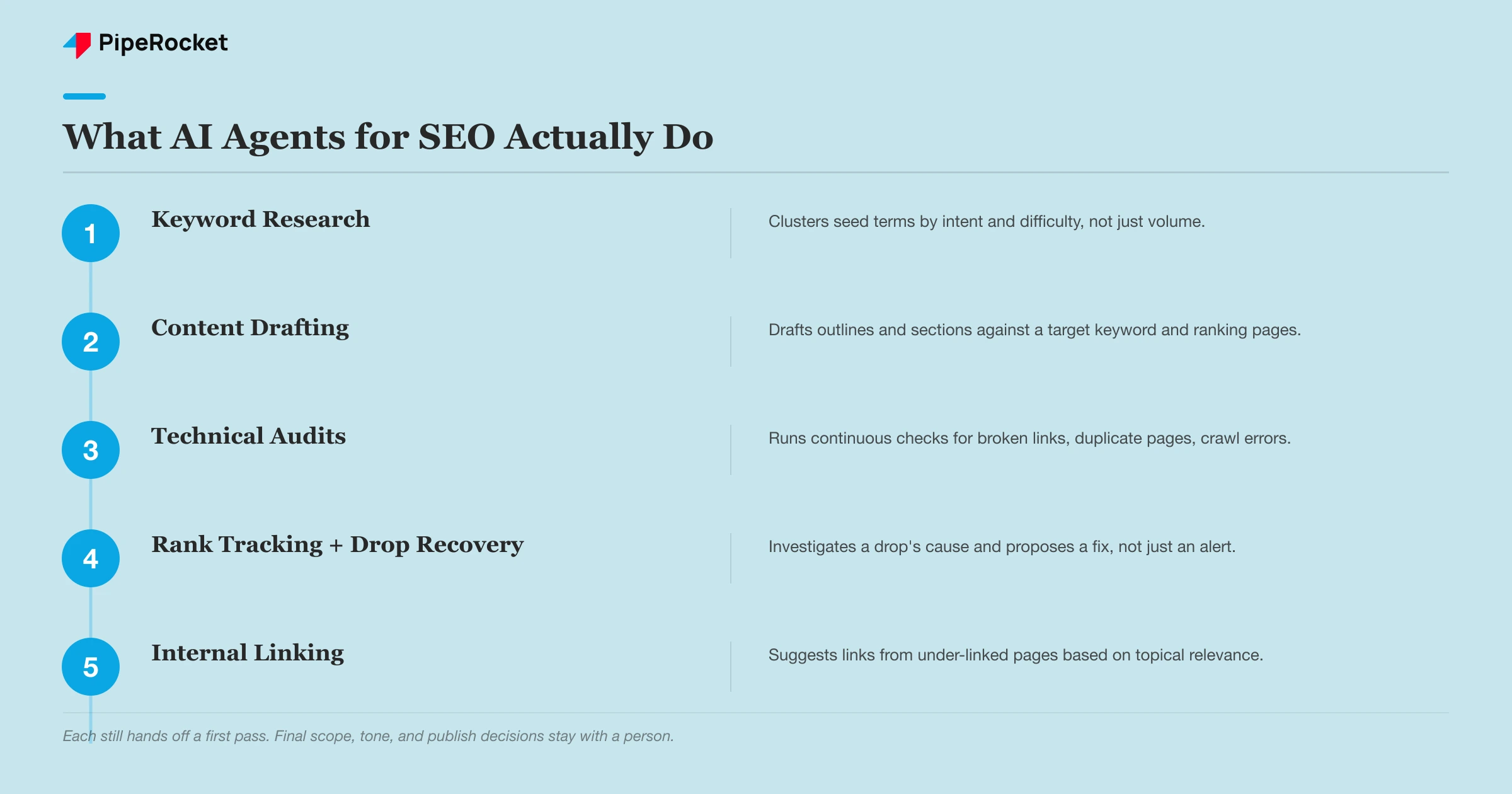
Six jobs make up most of the real capability in production today. Each one used to take a person hours; an agent now runs the first pass in minutes and hands back something to review.
Keyword Research That Groups Intent, Not Just Volume
An agent pulls a seed list, clusters it by search intent and difficulty, and flags which clusters map to which stage of your funnel, instead of handing you a flat spreadsheet sorted by volume. It’s doing the sorting work a junior analyst used to do by hand, at a scale no person keeps up with across a few thousand terms.
Competitor and Gap Analysis
An agent scans the top-ranking pages for a target query and reports what they cover that you don’t: missing headings, content gaps, and keyword or rank opportunities to close. It reads the structure of a dozen competitor URLs at once, work a person could do by hand but rarely has time to run across a full topic.
The output is a list of concrete additions tied to pages already ranking, which is a more grounded brief than a blank-page keyword list. A person still decides which gaps are worth filling for the business.
Content Drafting and On-Page Optimization
Agents draft outlines and full sections against a target keyword and a set of ranking pages, then check the draft before handing it off against on-page factors like:
- Heading structure
- Internal links
- Keyword coverage
Newer agents also score the draft for AI-citation and answer engines, checking whether it is structured to be quoted in AI Overviews and chat answers as well as ranked in classic search. The draft is a starting point. Voice, accuracy, and the actual argument still need a person.
Technical SEO Audits
Instead of a monthly crawl report, an agent can run continuous checks for missing H1s, broken links, duplicate content , and crawl errors , and flag issues close to when they appear rather than weeks later.
Many agents also propose fixes on the spot: rewriting weak meta titles, generating image alt text, and suggesting schema markup for pages that lack it. That shift from scheduled to continuous is the practical difference between a tool and an agent here.
Rank Tracking and Drop Recovery
This is where the goal-orientation shows up most clearly. When a tracked keyword drops, the agent doesn’t just alert you. It checks competitor changes, SERP feature shifts, and algorithm update timing, and proposes what’s likely driving the drop before you’ve opened the dashboard.
The same watch catches content decay, the slow traffic slide of an older page as competitors refresh theirs, which is a distinct problem from a single overnight keyword drop and easy to miss without a continuous eye on it. Newer agents also track brand visibility in AI answers, whether your pages get cited in AI Overviews and chat engines, not only where you sit in classic Google positions.
Internal Linking Suggestions
Agents can scan a site’s existing pages and suggest which orphaned or under-linked pages need internal links from which sources, based on topical relevance and existing link equity, a task that used to mean manually crawling a site map.
Why Most SEO Tools Aren’t Actually Agents
Most tools sold as AI agents for SEO are instruction-following under the hood, even when marketed with “AI” in the name. Most software sitting in an SEO team’s stack today runs that way. It runs a fixed pipeline: pull data, apply a rule, output a result. Ask it something outside that pipeline and it has nothing to offer.
The tell is what happens when the situation changes. A traditional rank tracker keeps checking the same keywords the same way whether traffic is stable or in free fall. It has no branching logic for “something’s wrong, go find out why.”
An agent’s value only shows up in that branch: when the expected path breaks and it has to decide what to check next on its own.
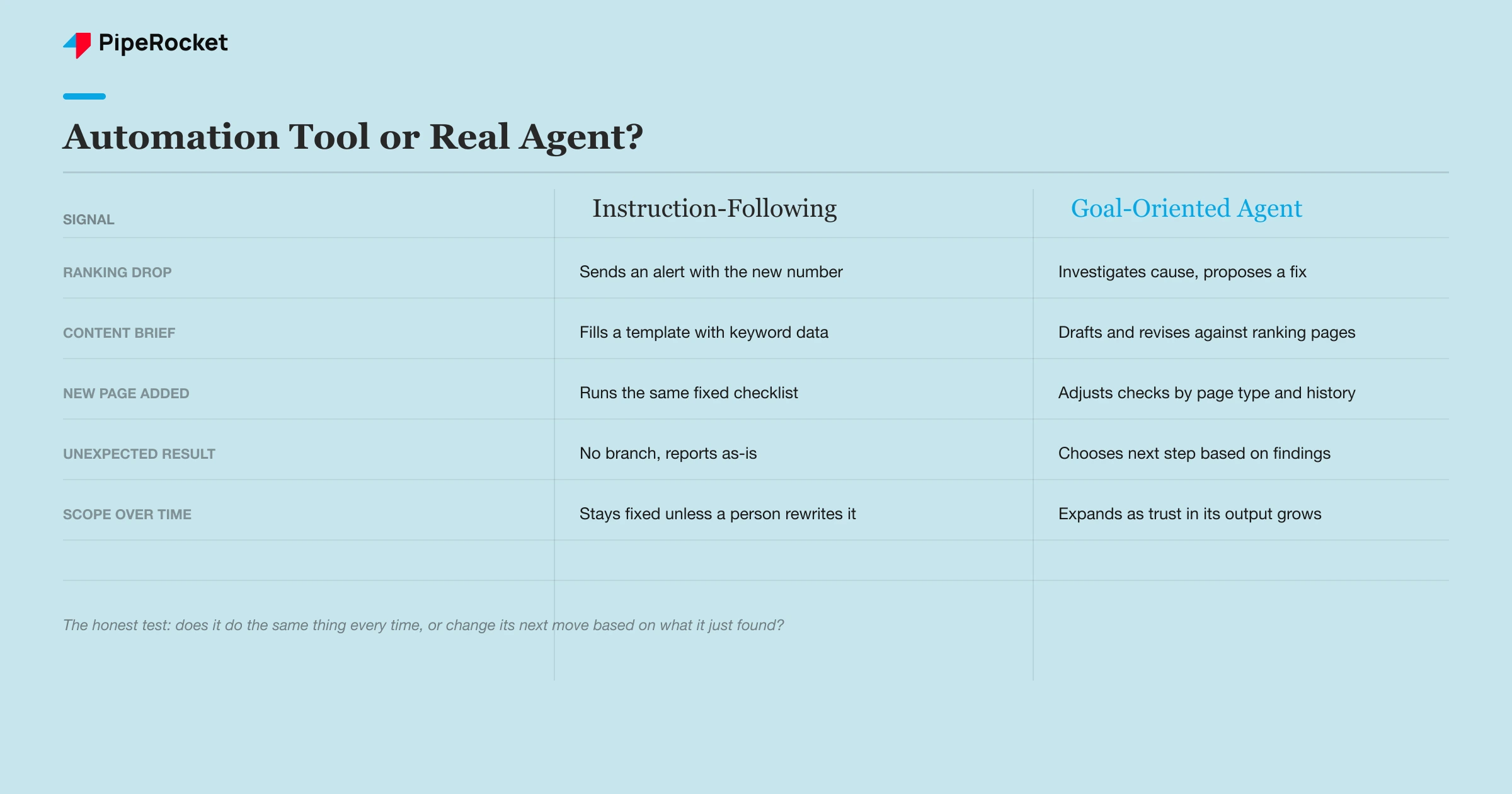
| Signal | Instruction-following tool | Goal-oriented agent |
|---|---|---|
| Given a keyword drop | Sends an alert with the new number | Investigates cause, proposes a fix |
| Given a content brief | Fills a template with keyword data | Drafts and revises against ranking pages |
| Given a new page | Runs the same fixed checklist | Adjusts checks based on page type and history |
| Given an unexpected result | No branch, reports as-is | Chooses next step based on what it found |
That table is also the honest test to run against any tool your team already pays for. If it does the same thing regardless of input, it’s automation. If it changes its next move based on what it just found, it’s closer to an agent.
What to Delegate Now vs. What Stays Human-Reviewed
The hard decision with AI agents for SEO is what to hand off. The safe delegation line runs through repeatability and reversibility, not through how flashy the task sounds. Data-heavy, repeatable diagnostic work is safe to hand off. Anything that ships to a live site or represents your brand’s judgment needs a person in the loop before it goes live.
Delegate to an agent now:
- First-pass keyword clustering and intent grouping across large seed lists
- Continuous technical crawl monitoring for structural issues
- Initial drop-diagnosis reports when rankings move
- Draft outlines and first-pass content drafts against a target keyword
- Internal linking suggestions across a large site
Keep human-reviewed before it ships:
- Final published copy, tone, and factual claims
- Which keywords or topics the site should actually target this quarter
- Any fix an agent proposes that touches site architecture or redirects
- Client-facing reporting and the story behind a ranking change
A SaaS company running a lean content team is a good test case. Handing an agent the first-pass keyword clustering for a 3,000-term seed list, and the initial technical crawl for a 200-page docs site, frees up real hours. Publishing whatever draft it writes without an editor reading it is a different decision entirely, and it’s the one that gets teams into trouble.
The pattern holds across company size, too. A two-person marketing team at an early-stage SaaS company gets the most leverage from agents, since there’s no one to hand the repetitive diagnostic work to anyway. A larger team with a dedicated content and technical SEO staff gets less raw time back, but still benefits from having a first-pass triage step running continuously instead of waiting for the next scheduled audit.
How to Evaluate and Adopt an AI SEO Agent
The safest way in is one narrow, well-defined job first, before you expand scope. Pick something with a fast feedback loop, like technical audits or keyword clustering, where you can check the output against what you already know within a day or two.
Watch these during the trial:
- Keep it on one workflow. Pick a single job, like a technical audit or keyword clustering, and nothing else until it earns more.
- Connect it only to verified data. Wire it to real sources like Search Console or a crawler before you trust a word of its diagnosis, and keep raw model output out of the inputs.
- Whether it explains its reasoning. An agent that just outputs a recommendation with no visible logic is harder to trust and harder to catch when it’s wrong.
- How it handles being wrong. Every agent misreads a situation eventually. What matters is whether it flags uncertainty or states a guess with false confidence.
- Keep a human review before anything ships. Read the output before it publishes or changes a live page, then expand scope one job at a time based on how it performed on the last.
There are three broad ways to actually get an SEO AI agent running, and the right one depends on how much you want to build versus buy:
| Approach | What it is | Best when |
|---|---|---|
| Chatbot plus MCP connectors | Wire a general LLM chat (Claude, ChatGPT) to your data through MCP connectors for Search Console, a crawler, or an SEO API, then prompt it through a workflow | You have technical comfort, want full control, and are testing what an agent can do before committing budget |
| Agent-builder platform | Assemble a repeatable agent in a workflow tool (for example n8n or a no-code agent builder) that chains steps and triggers on a schedule | You want a reusable, shareable workflow without maintaining custom code |
| Purpose-built SEO agent platform | Buy a vendor product built specifically for SEO tasks, with data sources and guardrails already wired in | You want fastest time to value and less setup, and are fine trading flexibility for a packaged tool |
Whichever route you pick, start with one narrow workflow and connect it to verified data before you widen its scope.
One more thing to watch as you scope the work: agents increasingly tie into AI-answer visibility, so treat getting cited in AI engines as part of the goal. Our AI SEO strategy and framework post and our LLM SEO guide cover how that visibility work sits alongside classic ranking.
For a side-by-side look at specific vendors and where each one is strongest, see our best AI SEO tools roundup rather than treating this article as a buying guide. This piece is about the category and how it fits into a program; that one compares the actual products.
Common Mistakes to Avoid
Treating an Agent as a Replacement for Strategy
An agent optimizes toward the goal you gave it. It doesn’t decide whether that goal is the right one for your business this quarter. Teams that hand over “grow organic traffic” without defining what traffic actually matters end up with agents chasing volume instead of pipeline, which is the same mistake a junior hire makes without direction.
Skipping Human Review on Published Output
This is a quality problem on a single draft. A draft that reads clean and hits the right keywords can still contain a claim that isn’t true, or a tone that doesn’t match your brand. Publishing one straight to a live page removes the one check that catches a bad fact or off-brand line before a customer sees it.
Giving an Agent Too Much Scope Too Fast
Granting full site access and auto-publish permissions in week one, before you’ve watched how it handles being wrong, is how a plausible-looking fix ends up live on a page it shouldn’t have touched. Expand access in steps, tied to how it’s performed on the narrower job first.
Letting an Agent Publish at Scale Without Checks
This is a volume problem, separate from any single draft’s quality. Pointing an agent at “publish more pages” without a cap is how a site ends up with hundreds of thin, near-duplicate pages that drag down its quality signals.
The agent will happily generate that volume because it’s the goal it was handed, and the bloat can trigger a Google penalty instead of building authority. Cap how much ships per cycle, regardless of how good each page looks on its own.
Assuming More Automation Always Means Less Work
Reviewing an agent’s output, correcting its misreads, and adjusting its scope is real work, just a different kind than doing the task by hand. Teams that budget zero hours for oversight end up either blocking the agent entirely or shipping its mistakes.
For the wider SEO program this fits into, our guide to SaaS SEO covers how these pieces connect to topical authority and pipeline, and our AI SEO strategy and framework post covers how AI visibility work fits alongside traditional ranking work.
How PipeRocket Helps SaaS Teams Adopt AI Agents the Right Way
We build the review layer most teams skip: scoping what an agent touches, checking its diagnosis against real data, and keeping publish decisions with a person. That’s part of our AI SEO services for teams adding agent-driven tools to an existing program. Want a second opinion on where an agent fits in your stack? Get in touch .
Frequently Asked Questions
What is an AI agent for SEO?
An AI agent for SEO (also called an SEO agent) is autonomous software that plans and executes SEO tasks toward a goal you set, such as recovering a ranking drop or auditing a site, rather than running a fixed script. It decides its own next step based on what it finds, which is what separates it from standard SEO automation tools.
How is an AI SEO agent different from SEO automation?
Automation follows the same fixed steps every time regardless of the result. An agent evaluates what it finds at each step and adjusts its next action, so a ranking drop triggers investigation and a proposed cause rather than just an alert. Most tools marketed as “AI-powered” are still automation under that test.
Can AI agents do SEO?
Yes, there is AI that can do SEO. AI agents already run keyword clustering, continuous technical audits, drop diagnosis, and first-pass content drafts on their own. What still needs a person is final published copy, which topics to target, and any fix that touches site architecture.
Is SEO dead or evolving in 2026?
SEO is evolving rather than dying. The work is shifting toward AI-answer visibility, with agents taking over repeatable research and audits while humans still own strategy, final copy, and which topics to target.
What are the best AI agents or tools for SEO right now?
They fall into three categories: a general chat model wired to your data through MCP connectors, a no-code agent builder that chains steps on a schedule, and a purpose-built SEO agent platform with data and guardrails prewired. Our best AI SEO tools listicle compares specific vendors in each.