A few months ago, I was looking at one of our listicle pages and noticed something. Google’s AI Overview for the query was producing a “what is” paragraph at the top, defining the category before listing tools.
Our listicle didn’t have that section. It was built the traditional way: intro, list, FAQ. No definition block.
So I did something unconventional. I inserted a “what is” section directly into the listicle. It felt odd (these pages aren’t supposed to need that). But within a short time after the update, AIO cited us.
That’s the gap-first method in a nutshell. Find what AIO is actually extracting for your query. Check if your page supplies it. If it doesn’t, add it. The rest of this article is how to do it systematically.
TL;DR
- Why SaaS pages get skipped: They’re structured to convert, not to answer. AIO needs extractable answers; feature lists and CTAs give it nothing to pull.
- Two citation signals: On-page clarity (clear keyword meaning, answer-first structure, AI terms) and off-page trust (third-party listicles, brand mentions, G2/Clutch presence). You need both layers.
- The gap-first audit: Search your target query, identify the answer type AIO is extracting, compare it to your page, and insert the missing section early. It works because you’re giving AIO exactly what it needs.
- Where to apply it: Prioritise pages where an AIO already fires for the target query. The audit takes roughly 20 minutes per page and rarely requires a full rewrite.
Why Most SaaS Pages Get Skipped by AIOs
SaaS pages are almost universally structured to convert. That’s not a criticism, it’s just how they’re built. Product features, benefit statements, social proof, CTAs. That structure works for conversion. It does not work for AIO citation.
Your page is selling. AIO is looking for an answer.
AI Overviews extract specific answer types depending on the query. A definition query gets a paragraph. A “how to” query gets numbered steps. A comparison query gets criteria and differences. AIO is running a kind of extraction job on the web.
When it hits your page and finds feature bullets and a “Book a Demo” block in the first fold, there’s nothing to extract. It moves on. The page is doing its job perfectly, just not the job AIO needs done.
Most SaaS teams don’t realise this because they’re optimising the same page for two incompatible goals: close a visitor, and answer a question completely enough to be cited. Those can coexist, but only if you build for both.
The off-page blindspot SaaS teams ignore
Even a well-structured page can get skipped if Google has never seen your brand anywhere else.
Here’s how I think about it: if your SaaS company appears only on your own website, Google has one data point. If it appears on third-party listicles, in Reddit threads, and across G2 review pages, Google has a network of signals confirming you’re a real, recognised entity in the category.
That matters for AIO citation. When Google assembles an answer, it’s drawing on sources it trusts. If your brand shows up in the places Google respects, that trust compounds over time. If you’re absent from all of them, even a well-written page is asking Google to take a risk.
The Two Signals That Drive AIO Citations
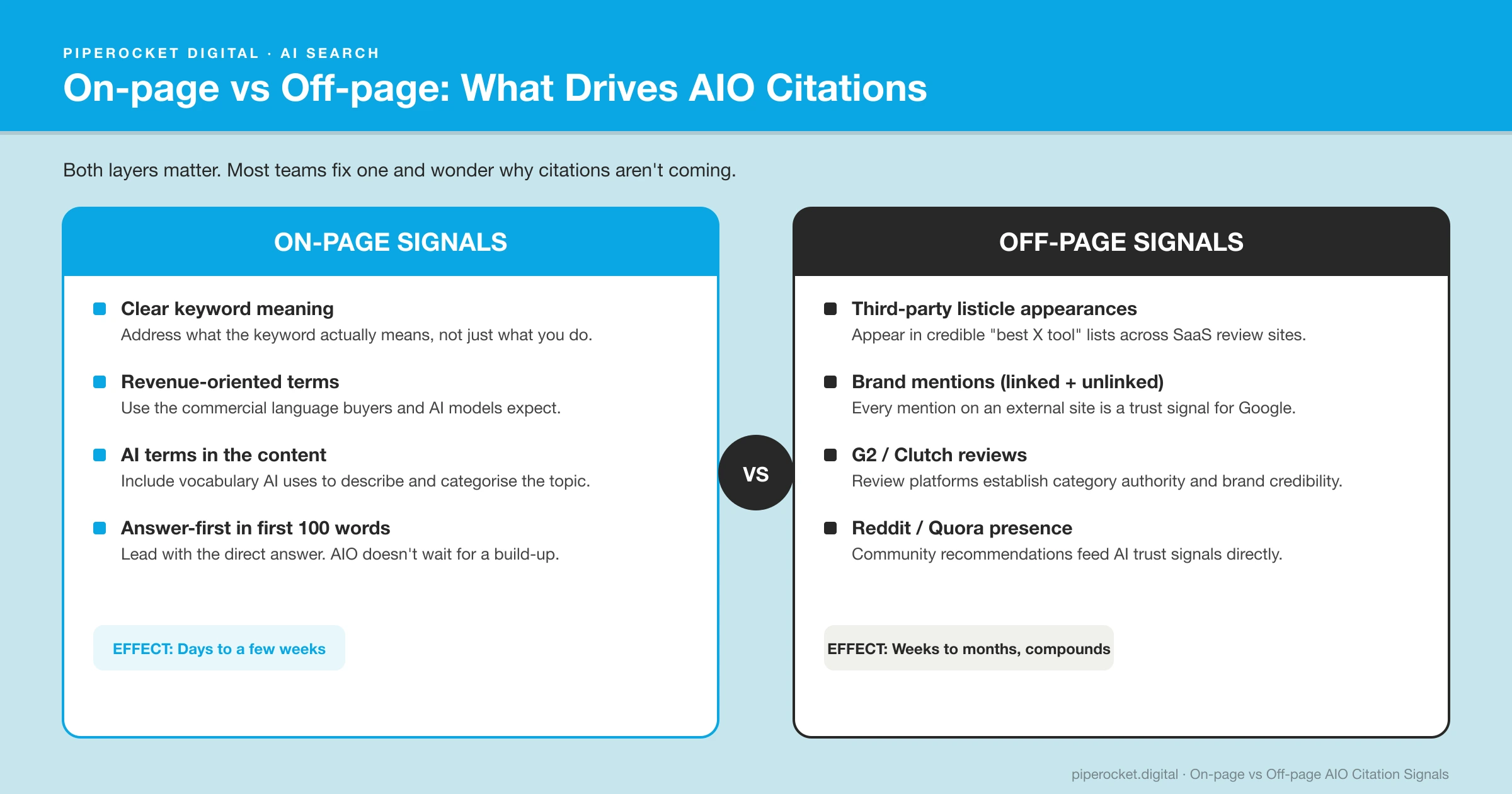
From what I’ve seen across clients, AIO citation comes down to two distinct layers. Most teams fix one and wonder why citations aren’t coming.
On-page: clarity of meaning wins over cleverness
The on-page layer is about making your page’s meaning unmistakable. AIO needs to extract a specific answer, and it can only do that if the page clearly addresses:
- The core meaning of the keyword (what this thing actually is, not just what you do with it)
- Revenue-oriented terms that signal the query has commercial relevance
- AI terms that appear in how AI systems describe the category
Answer-first structure is the delivery mechanism. Put the direct answer in the first 100 words of a section, not 300 words into a narrative build-up. AIO doesn’t wait for you to get to the point.
The pages that get cited tend to be the ones that read like a well-briefed expert answering a direct question. Not a sales page. Not a long-form essay. A clear, specific answer. That same answer-first structure is what wins question keywords in classic search, too, and it’s the same conversational-query skill that used to be called voice search SEO .
Off-page: appearing in other people’s lists is a citation signal
The off-page layer is about brand trust, and it’s built in places you don’t control.
Third-party listicles are probably the most direct signal. If Google sees your brand consistently appearing on “best X tool” lists across multiple credible sites, it treats that as an endorsement. It’s a signal that you’re a recognised entity in the category, not just a company claiming to be.
Unlinked brand mentions matter too. These all feed the same trust signal, and Google aggregates them:
- A Reddit thread where someone recommends your tool
- A comparison page on a SaaS review site
- A G2 profile with real reviews
The compounding effect is real. Building off-page presence is slow, but once it’s there, it reinforces every on-page insert you make. The two layers work together. Build on-page alone and Google may not trust the source enough to cite it.
| Signal Layer | What it covers | How to action it | How fast it takes effect |
|---|---|---|---|
| On-page | Clear keyword meaning, revenue terms, AI terms, answer-first first 100 words | Add definition blocks, restructure answer placement, match AIO output type | Days to a few weeks after indexing |
| Off-page | Third-party listicle appearances, brand mentions (linked + unlinked), G2/Clutch reviews, Reddit/Quora presence | Pitch for listicle inclusions, build G2/Clutch profiles, engage in relevant Reddit threads | Weeks to months; compounds over time |
The Gap-First Approach: Find What AIO Needs, Then Supply It
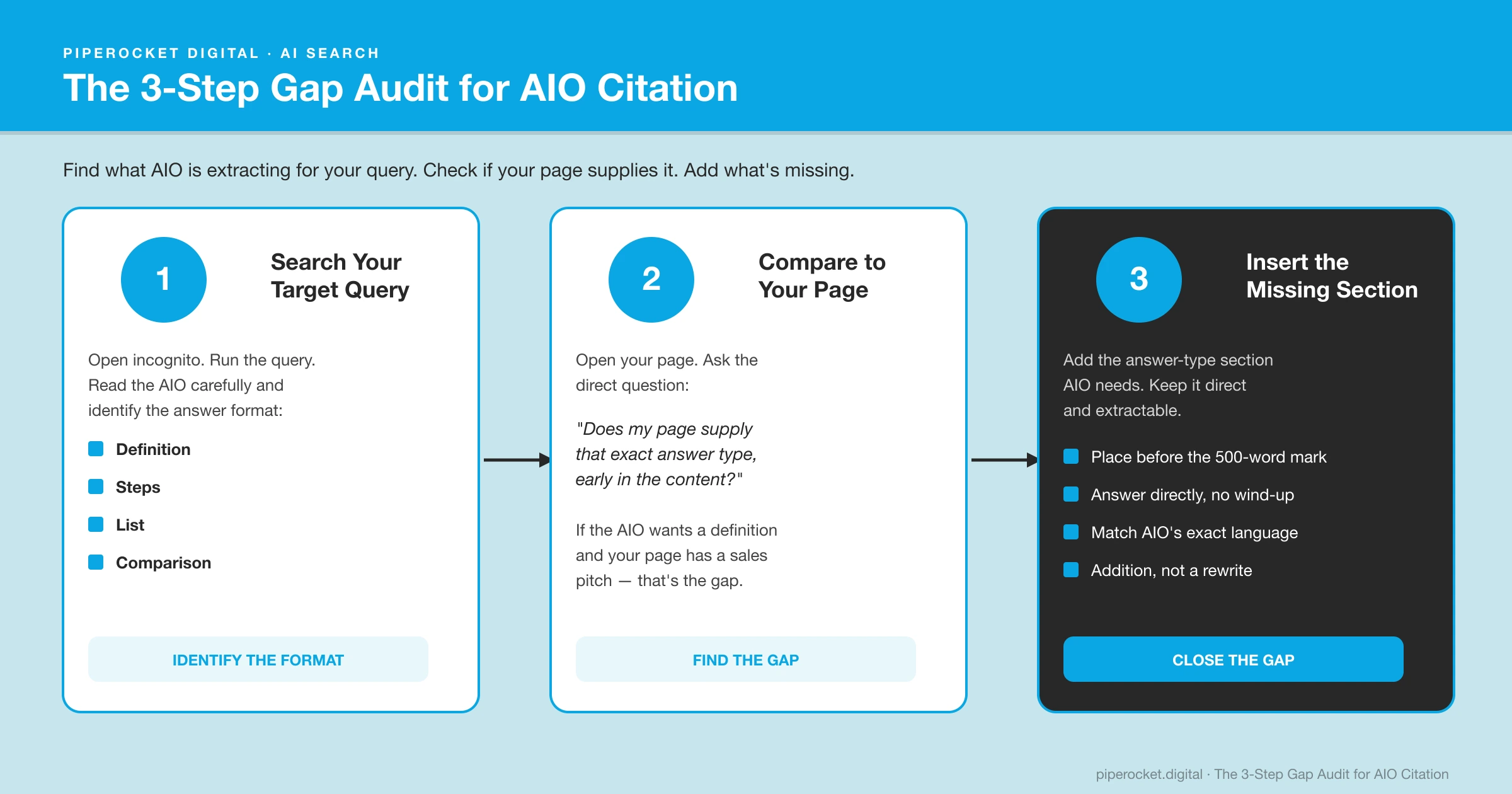
This is the most effective thing I’ve found for getting cited. It sounds simple because it is. The principle is: find the exact answer type AIO is extracting for your query, then check if your page provides it. If it doesn’t, add it.
Step 1: Search your target query and read the AIO
Open an incognito window and run the query you want to rank for. Look at the AI Overview if one fires. Don’t just skim it. Read it carefully and ask: what answer format is AIO using?
The common formats are:
- Definition: AIO opens with a “what is” paragraph, then elaborates
- Steps: AIO outputs numbered instructions for how to do something
- List: AIO names tools, options, or criteria
- Comparison: AIO distinguishes between two or more approaches or products
Identifying the format is the crucial step. Once you know the format, you know what your page needs to supply.
Step 2: Compare the AIO output to your page
Now look at your page with that format in mind. Does it directly provide that answer type, early in the content?
Finding the gap in our own listicle
This is where I found our gap. The AIO for the listicle query was producing a definition paragraph. It was answering “what is this category of tool?” as its first output. Our listicle didn’t have that. It launched straight into the list, like most listicles do.
So I added a “what is” block near the top of the page. A short, clear definition of the category, written the way you’d explain it to someone who just encountered the term. Not a long explanation. Two or three clean paragraphs that answered the definition question directly.
Within a short time, AIO cited that section. It had found the exact answer type it needed, now supplied in extractable form, early in the page.
This is the kind of gap most teams miss. They look at their page and see a complete, well-written piece.
“Complete” for a conversion page and “complete” for AIO citation are different standards. AIO cares about one thing: can it extract the specific answer format it’s assembling for the query?
Step 3: Insert the missing section
Once you’ve identified the gap, the fix is usually an addition, not a rewrite. You’re not changing the page’s structure or purpose. You’re adding the specific answer block AIO needs, in the format it’s using, early enough in the page that it registers.
A few things that matter for extractability:
- Place the answer section before the 500-word mark when possible
- Write the answer directly, without a long wind-up
- Use the same language the AIO uses to describe the concept. If AIO says “compliance automation,” your definition should use “compliance automation,” not a synonym
AIO doesn’t care whether a “what is” block is conventional for a listicle. It cares whether the block exists and whether it answers the question clearly. Page convention is your concern. Extractability is AIO’s concern.
How to Apply This to Your SaaS Pages
Most pages need a targeted addition, not a full rewrite. The audit is roughly a 20-minute-per-page exercise if you do it methodically.
-
Prioritise pages where an AIO already fires for the target query. If no AIO exists for that query, there’s nothing to get cited in yet. Start with pages where the AIO is active and where you already have some organic presence.
-
Run the gap audit. Search the query in incognito. Identify the AIO answer format. Open your page and check whether that format is present in the first half of the content.
-
Make the on-page insert. Add the answer-type section that’s missing. A “what is” block for definition queries, a clean numbered section for “how to” queries, a comparison block for comparison queries. Keep it direct and extractable.
-
Activate the off-page layer. If your brand doesn’t appear in third-party listicles or on G2/Clutch, that’s a parallel workstream. Getting cited on three or four credible SaaS round-up sites makes every on-page change more likely to stick.
Take a concrete example. A SaaS compliance tool for fintech teams targets the query “compliance automation for fintech.” The AIO produces a definition paragraph about what compliance automation means in fintech. Their page opens with a benefits list. There’s no definition block for AIO to pull from.
The fix is specific: add a short “what is compliance automation for fintech” section near the top of the page, written to answer that exact question. That’s the insert. Combined with a G2 profile and a couple of fintech-focused SaaS round-up appearances, the off-page layer starts working alongside it.
Why PipeRocket Focuses on AIO Citation as Part of SaaS SEO
At PipeRocket, AIO citation is a systematic part of how we approach client pages. We run the gap audit across existing content, identify the missing answer types, and make the targeted inserts.
Alongside that, we build the off-page brand signal layer: third-party appearances, review profiles, the presence that gives Google a reason to trust a citation.
If you want to know how we approach this as part of our AEO and GEO services (and how we compare to other AEO agencies for AI visibility tracking and reporting ), or want to run this audit on your own pages, reach out and we can walk through it together .
Frequently Asked Questions
Do I need to rank in the top 10 to get cited in Google AI Overviews?
No. Studies of AIO citation patterns show roughly 62% of cited pages don’t rank in the organic top 10 for the same query — only 38% of cited pages also hold a top-10 organic ranking. AIO is not simply pulling from the top organic results.
It’s selecting pages that best supply the specific answer format it needs, regardless of rank. A page on position 14 with a clean, extractable definition block can be cited ahead of a page on position 3 that doesn’t supply that format.
Why is Google not citing my SaaS pages even though they rank well?
The most common reason is a format mismatch. SaaS pages are built for conversion: feature lists, CTAs, benefit statements, social proof . That structure ranks fine. But AIO runs an extraction job on the page and finds sales architecture, not a direct answer.
The second common reason is missing off-page brand signals. If Google hasn’t seen your brand appear in third-party contexts (listicles, review platforms, community discussions), it has limited trust to extend to a citation.
Can a listicle or comparison page get cited in an AI Overview?
Yes, and we’ve seen it happen with our own content. The mechanism is the same: identify what answer type the AIO is extracting for the query, then check whether the page provides it.
For a listicle query, AIO often wants a definition of the category before listing tools. Most listicles don’t have that section because it feels unconventional for the format.
Adding it, written clearly and placed early, gives AIO something to pull from. The format of the page doesn’t disqualify it. The presence or absence of the required answer type does.