Most teams still chase question keywords to win the featured snippet. The snippet still exists, but an AI Overview usually sits above it now and takes most of the click value before a reader ever scrolls to the blue links, so the snippet is no longer the target it once was.
The goal is to be the concise, well-structured answer that both the snippet and the AI Overview pull from. The on-page craft is the same as before, but the payoff is bigger.
Here’s how we find the question queries worth targeting, and how we structure the lead answer so a SaaS page can actually win that slot.
TL;DR
- Snippet-first advice is dated: AI Overviews sit above featured snippets and absorb the click. Both surfaces extract the same way, so optimize the answer once and win both.
- Find real questions, not modifier guesses: Pull from People Also Ask, “how/what/why/can” modifiers, Search Console query data, and forums where your buyers actually ask.
- Match the answer to the question shape: Definition questions want a tight paragraph, process questions want steps, comparison questions want a table. Mismatched format loses the slot.
- Structure the page to win a cluster: Build it as stacked question-and-answer units so one page can win the answer slot for many related questions at once.
- Measure the slot, not a score: AI-visibility tools are directional at best. Track which questions you win the answer slot for, not a made-up share-of-model number.
- Avoid the common slot-killers: Don’t bury the answer below the heading, drift to synonyms, mismatch the format, or ignore the off-page signals that earn the citation.
Why “Optimizing for the Featured Snippet” Is Dated Advice
The featured snippet is no longer the top of the page for most question queries. An AI Overview renders above it, answers the question inline, and the reader often gets what they came for without a single click. Treating the snippet as the finish line means you’re optimizing for the second-place slot.
The mechanism underneath both surfaces is the same, which is the good news. AI Overviews and featured snippets are both extraction jobs. Google reads the page, finds the cleanest answer to the question, and lifts it. A page built to win the snippet is mostly built to win the AIO too, if the answer is genuinely extractable.
Most SaaS teams get this wrong in one of two ways:
- They write a 1,200-word essay that buries the answer in paragraph four, so there’s nothing clean to extract.
- They stuff a question into an H2 and then never actually answer it in the next two sentences.
Both fail the same test. If a reader can’t get the answer from the first lines under the heading, neither can Google’s extractor.
Our team has watched first-hand experience and clear structure become the ranking signal here. AI systems are looking for conviction and a direct answer, not anonymous filler around a keyword. A page that answers the question plainly, written by someone who’s clearly done the work, beats a longer page that circles it.
The real trade-off: depth versus extractability
You can write for depth or write for extraction, and the instinct is to pick one. Win the answer slot and you concede some of the long, narrative authority a pillar page builds. Write the long narrative and the extractor has nothing clean to pull.
Lead with the extractable answer, then go deep below it. The first 50 words serve the snippet and the AIO. Everything after serves the reader who stays and the topical signal that helps the page rank at all.
Step 1: Find the Question Keywords Worth Targeting
Start where your buyers actually ask questions, not where a keyword tool guesses they might. Question keyword research is a sourcing problem before it’s a volume problem. The best questions for a SaaS page often have low reported volume and high buying intent, which most tools rank near the bottom.
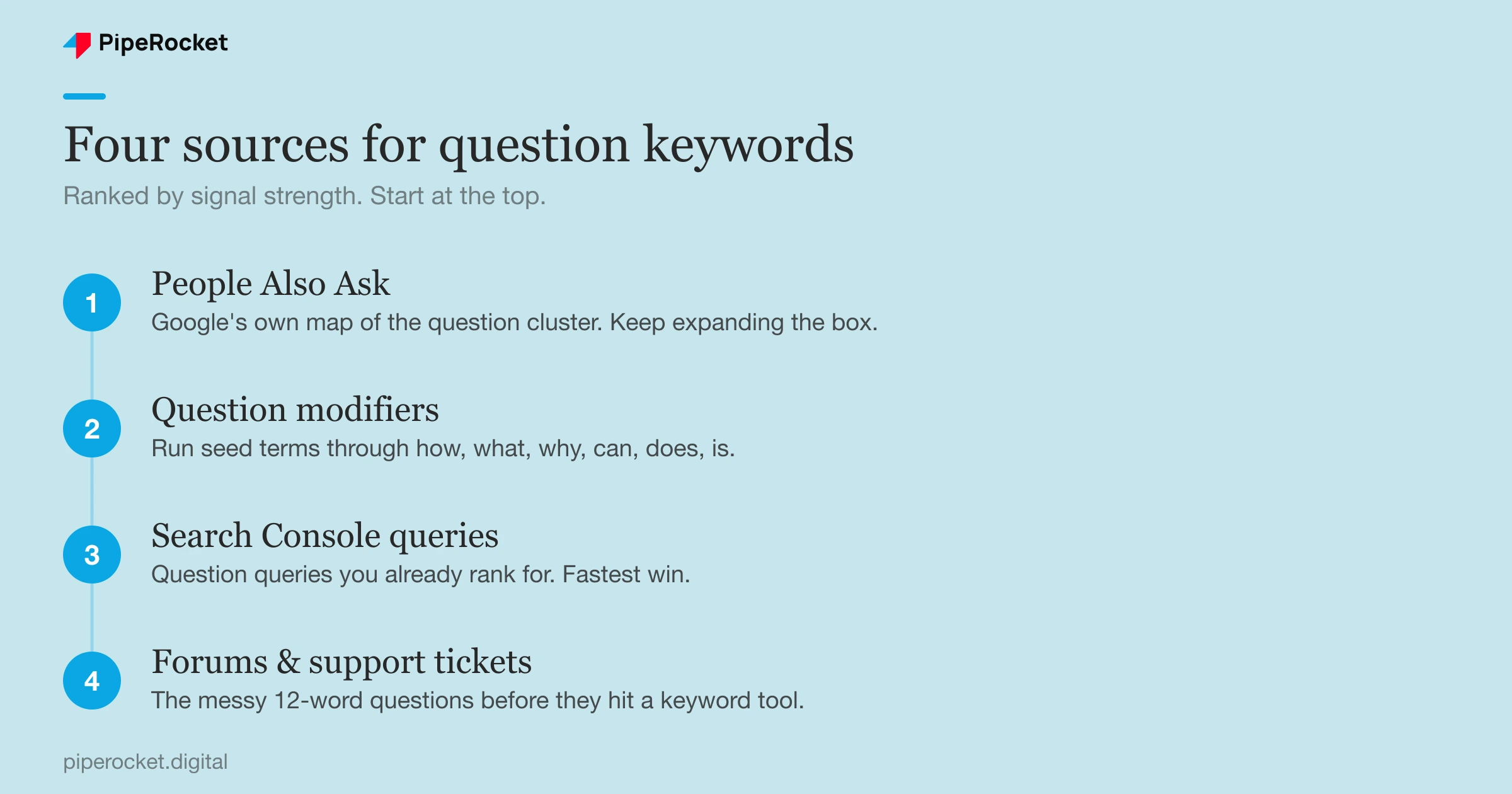
Pull from four sources, in roughly this priority:
- People Also Ask : Search your core term, expand the PAA box, and keep clicking. Each click loads more related questions. This is Google telling you the question cluster it already associates with the topic.
- Question modifiers: Take your seed term and run it through “how,” “what,” “why,” “can,” “does,” and “is.” A tool like AlsoAsked or AnswerThePublic maps these fast, but the modifiers matter more than the tool.
- Search Console question queries: Filter your existing Performance report for queries containing question words. These are questions you already get impressions for, which means you’re close to the slot and just haven’t won it.
- Forums and communities: Reddit, Slack groups, and your own support tickets. Sales and CS hear the messy 12-word questions before they ever show up in a keyword tool.
Search Console is your fastest win
The questions you already rank for on page two are easier to win than brand-new ones. Open the Performance report, filter queries for question words, and sort by impressions.
A query sitting at position 8 to 15 with real impressions is a page that’s close. Google already considers you relevant. You just haven’t given it a clean enough answer to promote.
This is where the easy gains live. A compliance SaaS for fintech teams might find “what is SOC 2 evidence collection” pulling impressions on a page that never actually defines the term in extractable form. Adding a tight 45-word answer near the top is often the whole fix.
Group questions, don’t chase them one by one
A single product topic fans out into dozens of questions, and you don’t need a page per question. Cluster them. “What is X,” “how does X work,” and “why use X” usually belong on one page as sequential H2s, while “X vs Y” and “X pricing” earn their own decision-stage pages.
The test for a standalone page: would the answer need a meaningfully different page type? A definition and a how-to can share a guide. A comparison question needs a comparison page . Map the cluster first, then decide where each answer lives.
Step 2: Match the Answer Format to the Question Type
The format of your lead answer has to match what the question is actually asking, or Google won’t extract it. A definition question answered with a numbered list gets skipped. A process question answered with one dense paragraph gets skipped. The extractor is pattern-matching question shape to answer shape.
Here’s how the common question types map to the answer format that wins the slot:
| Question type | Example query | Answer format that wins | Lead answer length |
|---|---|---|---|
| Definition | “what is product analytics” | One tight paragraph, term defined in the first sentence | 40 to 55 words |
| Process | “how to set up SSO” | Numbered steps, one action per step | Short intro line + 4 to 7 steps |
| Comparison | “Segment vs Mixpanel” | Comparison table, criteria in rows | Table + one-line verdict |
| Yes/No | “does HubSpot have an API” | Direct yes/no in the first sentence, then the caveat | 30 to 45 words |
| Reason | “why is my SaaS churn high” | Short paragraph naming the cause, then the list of factors | 40 to 55 words |
The pattern across all of them: answer the literal question in the first sentence, in the format the question implies. Don’t warm up. Don’t define three adjacent terms first. State the answer, then support it.
Write the lead answer like a briefed expert, not a blog intro
The strongest lead answers read like an expert answering a direct question in a meeting. No throat-clearing, no “in this section we’ll cover,” just the answer. Keep it self-contained so it makes sense lifted out of the page entirely, because that’s exactly what an AI Overview does to it.
A good rule: write the answer so it would still make sense if it were the only thing on the page. Use the same words the question uses. If the query says “compliance automation,” your answer says “compliance automation,” not a clever synonym.
The extractor matches language literally, so a synonym can cost you the slot you’d otherwise win.
Step 3: Structure the Page So It Wins More Than One Question
Build the page as a stack of question-and-answer units, not one long argument. Each H2 is a real question phrased the way a buyer would ask it, and the first lines under it answer that exact question in the matching format.
Do this well and one page can win the answer slot for a whole cluster of related questions at once.
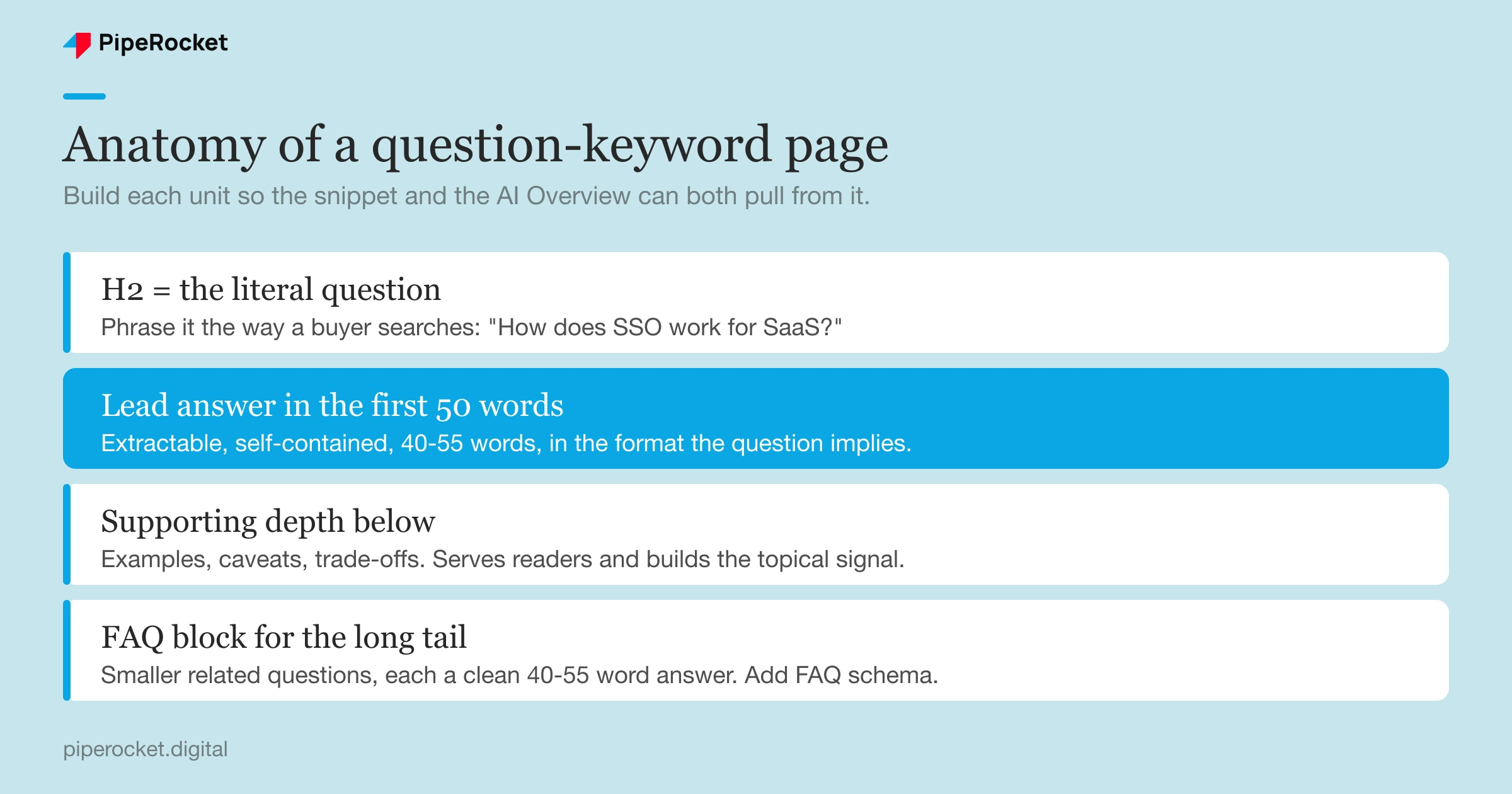
The structure that works for a question-led page:
- H2 as the literal question. “How does SSO work for SaaS?” beats “Understanding SSO.” The heading should match search phrasing.
- Lead answer in the first 50 words. Extractable, self-contained, in the right format for the question type.
- Supporting depth below. Examples, caveats, the trade-offs. This serves readers and builds the topical signal that gets the page ranking in the first place.
- An FAQ block for the long tail. The smaller related questions that don’t deserve a full H2 still get a clean 40-to-55-word answer each.
FAQ and Review schema earn their place here too. Marking up your question blocks with FAQ schema can win rich results that lift click-through, and the structured markup reinforces for Google which text answers which question. It’s a small lift with a real payoff on question-heavy pages.
This works when your questions genuinely fan out from one topic and share a page type. It breaks when you force unrelated questions onto one page just to win more slots. A definition page padded with pricing and comparison questions confuses the page’s purpose and usually wins none of them cleanly. Keep the cluster tight.
Step 4: Measure Whether You’re Actually Winning the Slot
Track which questions you win the answer slot for, not a synthetic AI-visibility score. The honest reality in 2026: most LLM and share-of-model tracking tools are guesswork. Treat their numbers as directional estimates, never as precise measurement, because the systems they’re trying to read change daily and personalize every output.
What you can actually measure reliably:
- Search Console position for your question queries. Movement from position 8 to position 3 on a question query is real and trackable.
- Manual SERP checks in incognito. Search the target question and look: is your page in the featured snippet, and is it cited in the AI Overview? Do this for your priority questions on a schedule.
- Click-through on question queries. If you hold the answer slot, CTR behavior tells you whether the surface is sending clicks or absorbing them.
The thing to accept: holding the AIO slot doesn’t guarantee clicks the way a snippet once did. Sometimes you win the citation and the reader still gets their answer without visiting. That’s not failure. The visibility and the brand association still compound, even when this single query doesn’t convert a click.
So don’t measure question-keyword work on raw clicks alone. Measure whether you’re the source the answer gets built from across your priority questions, and whether the pages winning those slots are the ones tied to buying decisions.
Common Mistakes That Cost You the Answer Slot
The most common mistake is writing the question into a heading and then not answering it for three paragraphs. The heading promises an answer, the extractor reads the next 50 words, finds a wind-up instead, and moves on. The heading is a contract. Pay it off immediately.
A few more that we see constantly:
- Synonym drift. The question says “onboarding automation,” the answer says “user activation workflows.” The extractor matches language literally, so it skips you.
- Format mismatch. Answering a “how to” question with a definition paragraph, or a definition with a list. Match the shape.
- One giant page for every question. Cramming unrelated questions onto one URL to chase more slots dilutes the page and wins fewer.
- Optimizing only for the snippet. Building the answer block but ignoring the off-page brand signals that make Google trust the source enough to cite it in an AI Overview.
That last one matters most in 2026. A clean answer block gets you eligible. Whether Google actually pulls your page into the AI Overview also depends on whether it trusts your brand as a source, which is built off-page over time.
How PipeRocket Digital Wins Question Keywords for SaaS
We build question-keyword pages to win the answer slot, not just the snippet. That means sourcing the real questions your buyers ask, structuring extractable lead answers in the format each question demands, and tying the winning pages to buying decisions instead of vanity traffic.
If you want this built as part of a SaaS SEO engagement , reach out and we’ll walk through your question clusters together . Or want to see how we compare to other SaaS SEO agencies ? Start there.
Frequently Asked Questions
What are question keywords in SEO?
Question keywords are search queries phrased as questions, usually starting with how, what, why, can, does, or is. They signal that a searcher wants a direct answer rather than a list of options. In SaaS SEO , they’re valuable because a well-structured answer can win the featured snippet and the AI Overview citation for that query.
Are featured snippets still worth targeting in 2026?
Yes, but not as the main prize. AI Overviews now sit above featured snippets and absorb most of the click value, so the snippet alone captures less than it used to. The better goal is being the concise, extractable answer that both the snippet and the AI Overview pull from, since the on-page work is the same for both.
How do I find question keywords for my SaaS product?
Pull from four sources: People Also Ask boxes on the SERP, question modifiers like how and why run against your seed terms, your Search Console queries filtered for question words, and forums or support tickets where buyers ask in their own words.
Search Console is the fastest win because those are questions you already rank for and just haven’t won the answer slot for yet.
How long should the answer to a question keyword be?
Keep the lead answer to roughly 40 to 55 words for definition and reason questions, and a short intro line plus numbered steps for process questions. The answer should be self-contained, so it still makes sense if it’s lifted out of the page entirely. Put the depth, examples, and caveats below the lead answer, not inside it.