Most SaaS teams pick a paid channel before they’ve decided what they’re actually buying. They open Google Ads because it’s fastest, or they run LinkedIn because a competitor does, and the budget gets committed before anyone maps it to a deal size or a funnel stage.
This guide is the layer above the individual channels. It’s the operating map for the whole paid mix, so before you touch a single campaign you know which channel fits your economics, how to split the money across the funnel, and what number tells you it’s working.
TL;DR
- The channel follows the deal size: low-ACV products can win on one channel, but a high-ACV committee deal needs a mix, because no single channel reaches a whole buying group.
- Fund capture before you create demand: max out high-intent search first, then layer in the influence channels once you’ve saturated the traffic that’s already looking for you.
- Retargeting and ABM decide who stays in the room: they don’t create demand, they keep the accounts you’ve already touched moving toward a decision.
- Split budget by intent: the biggest share goes to the stage where buyers are closest to a decision, and top-of-funnel earns its money as an audience-builder.
- Measure paid on pipeline: cost per SQL, pipeline sourced, and CAC by channel are the numbers that matter, and influence channels get judged on lift over last click.
- Know when you’re not ready: without a clear value proposition and enough budget to run a real three-month test, paid buys you an expensive education instead of pipeline.
Why SaaS Paid Marketing Is a Portfolio Problem
The mistake I see most often isn’t a bad channel. It’s a channel picked in isolation, with no relationship to the deal it’s supposed to close. Paid marketing for SaaS is a portfolio problem. You’re deciding how to spread a fixed budget across channels that each do a different job, and the right split changes with what you sell.
Here’s the belief I want to push back on: that there’s a “best” paid channel for SaaS. There isn’t. There’s a best channel for a $99-a-month self-serve tool and a completely different one for a $180k enterprise platform. Ask “which channel should we run” and you’ve already skipped the question that decides the answer.
The single variable that governs the whole plan is deal size. The higher the deal size, the more the channel mix matters. A low-ACV product can win on a single channel, but a high-ACV deal is a committee decision, and no single channel reaches a whole committee.
That one idea reshapes everything downstream. It tells you how many channels to run, how to weight them, and what you’re even allowed to call a conversion. So the rest of this guide is organised around it: pick the mix your economics can afford, then fund it in the order that protects your budget.
How to Choose Your Paid Channels for SaaS
Choose channels by matching the job each one does to where your buyer actually is. Paid channels sort into two roles, and confusing the two is where most budgets leak. Some channels capture demand that already exists. Others create or influence demand that isn’t in-market yet.
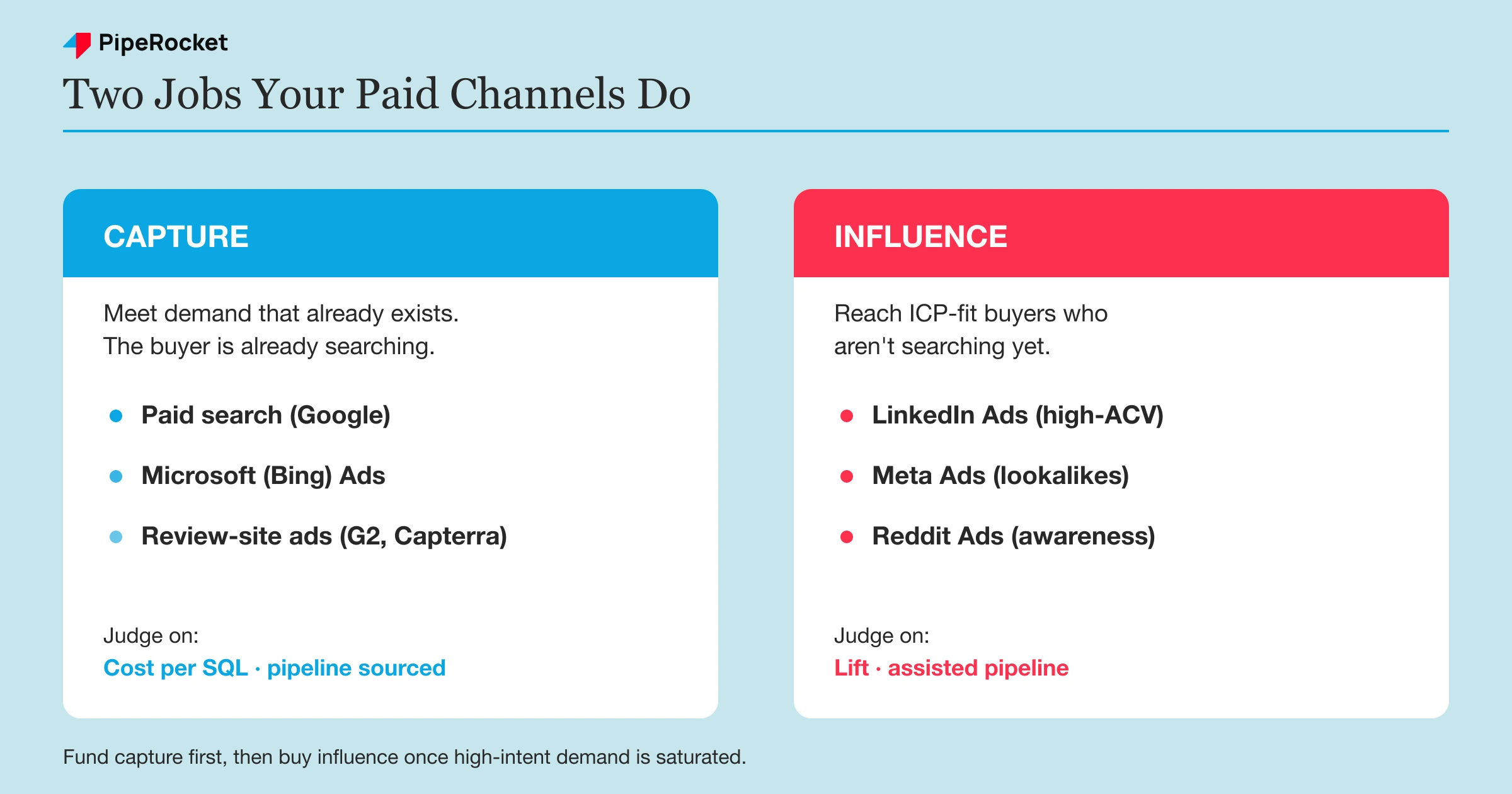
Search is a capture channel. Somebody types “best onboarding software for SaaS teams” because they already have the problem and they’re shopping. Paid social, on the other hand, interrupts someone who’s scrolling and plants a seed for later. Both are useful. They are not interchangeable, and they don’t get judged the same way.
Here’s how the main channels line up by role and by the deal size they suit best:
| Channel | Role | Best fit | Judge it on |
|---|---|---|---|
| Paid search (Google) | Capture existing demand | Any ACV with real search volume | Cost per SQL, pipeline sourced |
| Microsoft (Bing) Ads | Capture, cheaper CPC | Enterprise / older-skewing ICPs | Cost per SQL, incremental volume |
| LinkedIn Ads | Influence by job title | High-ACV, committee deals | Lift, assisted pipeline |
| Meta Ads | Influence via lookalikes | PLG and mid-ACV with a user base | Lift, lead quality |
| Reddit Ads | Awareness | Community-led categories | Reach, assisted pipeline |
| Review-site ads (G2, Capterra) | Capture late-stage intent | Categories buyers shortlist on | Demo requests, close rate |
Let Deal Size Decide How Many Channels You Run
Before you weigh channels against each other, the deal size tells you how many you should be running at all. A low-ACV, self-serve product can build a healthy pipeline on one strong channel, usually paid search, because a single person makes the call and the math works on volume. Adding channels there often just fragments a budget that was doing fine concentrated.
A high-ACV deal flips that. When the purchase is a committee decision with four or five people weighing in, no single channel touches all of them. Search reaches the person actively shopping, but the VP who has to approve the spend and the security lead who has to sign off aren’t searching your keywords. Reaching them takes influence channels layered on top, which is why the mix widens as the contract value climbs.
That’s the practical version of the rule: the higher the deal size, the more the channel mix matters. Read your average contract value first, and it tells you whether you’re running a focused single-channel program or a coordinated multi-channel one.
Start with search because the intent is already there
Search gets funded first for one reason: the buyer is already looking. When someone searches a category or comparison term, they’ve raised their hand, so your job is to be there and to be relevant. This is the highest-converting paid traffic most SaaS companies will ever buy, which is why I saturate it before spending anywhere else.
Google is the default, but don’t ignore Microsoft Ads . On one SaaS account we ran, the identical category keyword cost about $18 per click on Microsoft versus $61 on Google, roughly 70% cheaper for the same intent, and it actually pulled more volume on that term. Older and more enterprise-skewed audiences over-index on Bing, so for a lot of B2B SaaS it’s found money sitting next to the channel everyone already runs.
Use LinkedIn and Meta to influence the buyers search can’t reach
Paid social exists to reach buyers who fit your ICP but aren’t searching yet. Nobody on LinkedIn is in buying mode, they’re scrolling, so the ad plants a seed for the week they actually need you. That’s influence, not capture, and it changes how you measure it.
LinkedIn earns its high CPC only on high-ACV B2B, because you’re paying for precision targeting by job title, company, and seniority. Meta plays a different game. It’s strongest when you build a tight lookalike off your real product users rather than broad interest targeting. One of our best-performing Meta campaigns was a fintech SaaS client running a lead campaign on a 1% lookalike of active users, and a narrow lookalike beat broad targeting every time we tested it.
Treat Reddit and review sites as their own jobs
Reddit and review-site ads round out the mix, and each does something the big channels don’t. Reddit is an awareness channel, like LinkedIn, not a closing channel, so judge it on reach and assisted pipeline rather than last-click demos. Run it when your category has real community discussion and you want to be part of it.
Review sites like G2 and Capterra are the opposite. They catch buyers at the very end, comparing a shortlist with a card half out of their pocket. Category-leader placements on those sites are some of the most in-market clicks you can buy. The trade-off is scale, since the volume is capped by how many people are actively shopping your category that month.
How to Split Your Paid Budget Across the Funnel
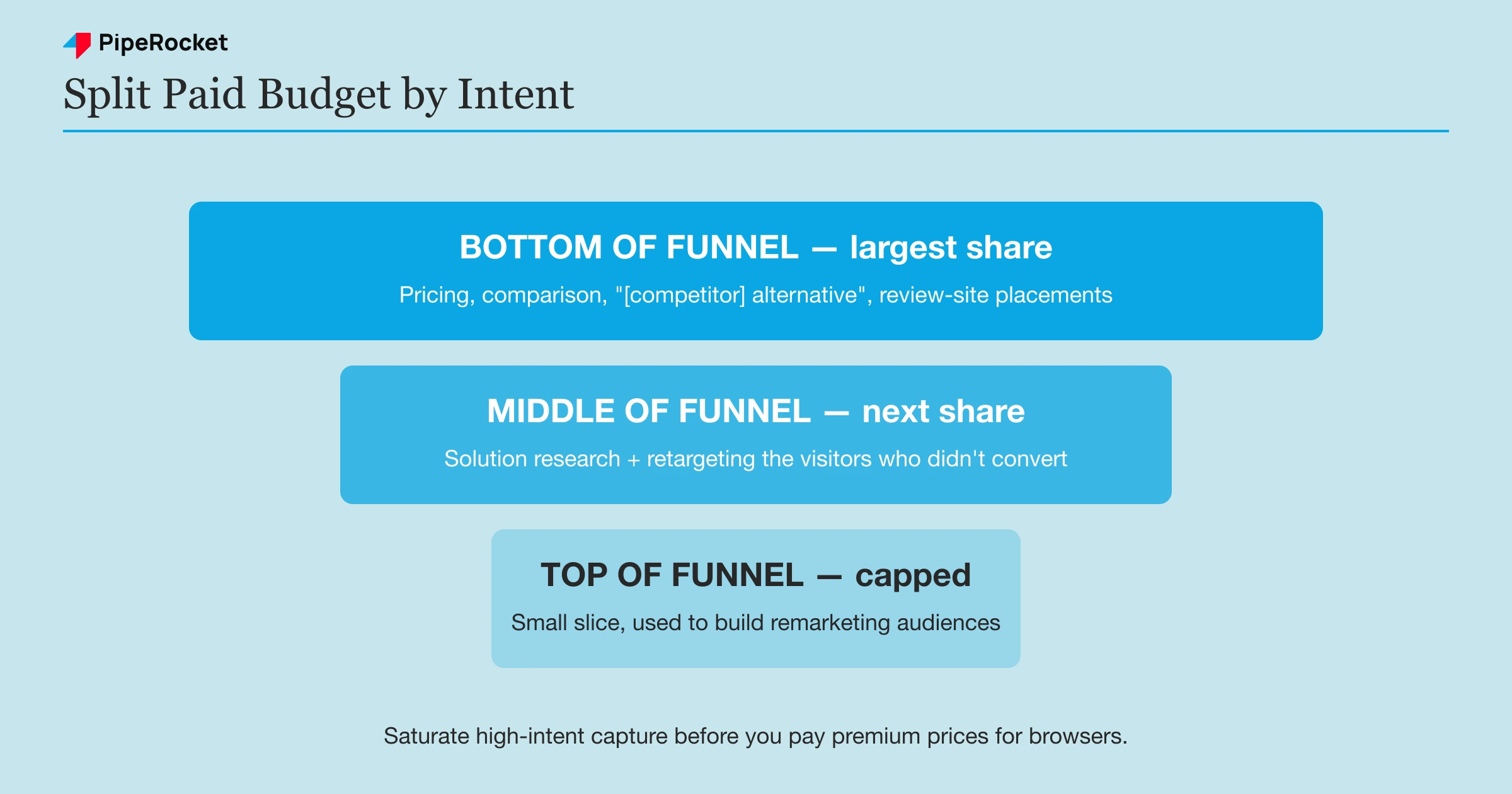
Split budget by intent, and put the biggest share where the buyer is closest to a decision. Even distribution across the funnel feels fair, but it quietly funds the stage that converts worst. The discipline is to fund capture before you create demand.
I’m ruthless about this in paid. Don’t start SaaS paid marketing on top-of-funnel awareness terms. Broad educational searches like “what is employee engagement” bring in students, researchers, and people months away from buying, and they burn budget fast. Start every client on bottom and middle of funnel, the people searching “best employee engagement software” or “X vs Y.” Only when you’ve genuinely saturated the high-intent spend and can’t deploy more profitably do you open the top of the funnel to scale.
Weight the money toward bottom of funnel
Bottom-of-funnel keywords get the largest slice because the buyer is already evaluating. Pricing terms, comparison terms, “[competitor] alternative,” and category-leader review placements all sit here. This is where the credit card comes out, so this is where a disproportionate share of spend belongs.
Middle of funnel gets the next slice. These are buyers who know they have a problem and are researching approaches, and the spend here feeds demos, guides, and nurture rather than an instant close. It’s also where retargeting starts to earn its keep, catching the people who visited a comparison page but didn’t convert.
Cap top of funnel and make it build audiences
Top of funnel gets the smallest share, and its real job isn’t direct conversion. Cap the spend and treat it as a remarketing-audience builder rather than a lead machine. The awareness click rarely converts on the first visit, but it puts the right person into an audience you can re-engage cheaply later.
That’s the whole logic of funding capture first. You’re not ignoring the top of the funnel, you’re refusing to pay premium acquisition prices for browsers when there’s still in-market demand you haven’t captured yet. A weekend spent maxing out high-intent search returns more than the same money sprinkled across awareness.
Let retargeting and ABM decide who stays in the room
Retargeting and ABM aren’t a funnel stage, they’re the connective tissue that keeps touched accounts moving. Retargeting re-engages visitors who didn’t convert, and it’s usually your most cost-efficient spend because the audience already knows you. A clean move is to tag visitors who came from a paid search ad, then retarget those same high-intent users on LinkedIn with proof and case studies.
ABM is where paid social gets sharp for high-ACV deals. Because LinkedIn charges by impression, run against an ABM list so every paid impression lands on a company that can actually afford the product. Match the tier to the account value: 1:1 for must-win whale accounts, 1:few for a cluster of similar companies, and 1:many to scale across a broad ICP list.
How to Measure SaaS Paid Marketing
Measure paid on pipeline and judge each channel by the job it was hired to do. The fastest way to make bad decisions is to hold every channel to the same last-click standard, because capture and influence channels behave completely differently.
Start with the eagle’s-eye view: spend by channel against cost per SQL. That single view surfaces the bleeders, like a LinkedIn line eating 60% of the budget for 10% of the SQLs. Once you can see it, you can fix it. From there, the metrics that actually matter aren’t CPL and click volume:
- Cost per SQL filtered to leads your sales team actually works
- Pipeline sourced by paid, tracked as opportunity value in your CRM
- CAC by channel, so you know which channels produce customers at a sustainable cost
Judge Influence Channels on Lift
Influence channels break last-click attribution, so measure the lift instead. LinkedIn and Meta plant seeds that convert later through a branded search or a direct visit, and your attribution tool will hand that credit to “organic” or “direct.” Judge those campaigns on last click and you’ll pause the ones that were working.
The read is simpler than it sounds. After you launch a heavy influence campaign, watch whether direct traffic rises, whether branded searches climb, and whether total leads go up even when the channel isn’t claiming credit. If you were getting around 10 leads a month on search alone and adding LinkedIn pushes you to a steady 13 to 15, it’s working, no matter what the last-click report says.
Watch the channels that hide their own data
Some paid surfaces don’t give you enough to optimise, and you should know that going in. Running ChatGPT ads , for example, you get impressions, clicks, conversions, CTR , and average CPC, but you can’t see where the ad was actually shown. For a channel you’re meant to optimise, that placement blind spot is the story, and it should shape how much budget you’re willing to commit before the reporting catches up.
Common Mistakes to Avoid in SaaS Paid Marketing
Picking the channel before the deal size
The most expensive mistake is committing to a channel because it’s familiar, then reverse-engineering a rationale. A team runs LinkedIn on a $40-a-month self-serve product and watches the high CPC destroy the unit economics, because LinkedIn only pays back on high-ACV deals. Decide what you’re selling and to whom, and the channel mix mostly picks itself.
Spreading budget evenly across the funnel
Splitting spend equally across awareness, consideration, and decision feels balanced, but it funds the worst-converting stage at the expense of the best. Awareness clicks rarely convert on the first visit, and pouring premium money into them while in-market demand goes uncaptured is how budgets underperform quietly for months. Weight the money toward intent.
Judging every channel by last-click
Holding an influence channel to a capture channel’s standard kills good campaigns. When you measure LinkedIn or Meta purely on last-click demos, you punish them for doing exactly what they’re built to do, which is warm a buyer who converts later through another path. Match the metric to the channel’s role or you’ll cut the wrong line.
Running paid before you’re ready
A SaaS product isn’t ready for paid until it has a clear value proposition and enough budget and patience to run a genuine three-month test. Without those, you’re not buying pipeline, you’re buying an expensive education. Paid amplifies whatever’s already true about your positioning, so if the positioning is muddy, paid just spends faster to prove it.
How to Know Which Channel to Add Next
Add the next channel only when you’ve saturated the one you have. The instinct at the first sign of plateau is to open a new channel, but more often the current channel still has room you haven’t used. Before you expand, ask whether you’ve truly maxed out impression share on your high-intent search terms, because that’s almost always the cheapest pipeline you can buy.
When search genuinely can’t absorb more budget profitably, the deal size tells you where to go next. For a low-ACV, high-volume product, that usually means Meta lookalikes or scaling into broader search. For a high-ACV committee sale, it means layering LinkedIn ABM on top so you’re influencing the four or five people search will never reach.
A compliance SaaS for fintech teams, for example, might exhaust high-intent search fast because the category is narrow. That’s the signal to add LinkedIn ABM against a named account list, not to keep bidding up the same handful of keywords. The sequence is always the same: saturate capture, then buy influence, then keep the touched accounts moving with retargeting.
The through-line for the whole plan is that paid marketing rewards patience with sequencing. Teams that win aren’t running the most channels, they’re funding the right one to its ceiling before they add the next.
How PipeRocket Helps SaaS Teams Build Their Paid Mix
Most paid agencies start with the campaign. We start with your deal size, your sales conversations, and your real buying triggers, then build the mix around who actually buys. We fund capture before demand creation, weight budget by intent, and measure against SQLs and pipeline instead of clicks.
Our SaaS PPC service is built for founders and marketing leaders who want pipeline contribution by channel, not another platform dashboard. If you’d rather have a team run this for you, reach out to us here and we’ll map your paid mix to your economics.
Frequently Asked Questions
How much should a B2B SaaS company spend on paid marketing?
There’s no single percentage, and the honest answer is to work backwards from pipeline targets rather than copy a benchmark. That said, paid media is typically the largest discretionary line in a SaaS marketing budget, with Gartner’s 2025 CMO Spend Survey putting digital channels at 61.1% of total marketing spend (Gartner ). Decide how many SQLs you need and what your cost per SQL is, and the budget floor falls out of that math. Companies spending too little never accumulate enough data to learn what works.
Which paid channel is best for B2B SaaS?
It depends entirely on your deal size, which is why there’s no universal answer. Low-ACV products can win on a single high-volume channel like paid search, while high-ACV deals involve a committee and need a mix, because no single channel reaches every decision-maker. Search captures buyers already looking for you, and LinkedIn or Meta influences buyers who fit your ICP but aren’t searching yet. Start with capture, prove the economics, then add influence channels as you scale.
What’s the difference between paid search and paid social for SaaS?
Paid search captures existing demand, and paid social creates or influences it. When someone searches a category or comparison term, they’ve already got the problem and they’re shopping, so search intent is high and pipeline timelines are shorter. Paid social interrupts someone who fits your ICP but isn’t in-market yet, planting a seed that converts later through a branded search or direct visit. Because of that, you judge search on cost per SQL and last-click conversions, but you judge social on lift and assisted pipeline.