ChatGPT Ads for SaaS: What's Live and How to Run Them
 Immanual D M
Last updated on
Immanual D M
Last updated on
ChatGPT ads are real, they’re live, and you can buy them yourself right now through OpenAI’s self-serve Ads Manager. That’s the part most “future of AI advertising” takes get wrong. This isn’t a rumor anymore.
But “live” doesn’t mean “worth your SaaS budget yet.” Those are two different questions, and I’m going to answer both. Here’s exactly what OpenAI has confirmed, how the Ads Manager actually works, and where a B2B SaaS marketer should be cautious before moving spend.
TL;DR
- The status is confirmed. OpenAI started testing ads in ChatGPT in February 2026 and opened a self-serve Ads Manager to US advertisers on May 5, 2026, with no minimum spend.
- The format is narrow. One ad unit type: a sponsored card below the answer with a name, image, copy, and a link. No search-style keyword bidding.
- Targeting reads the conversation topic. There are no keywords, cookies, or audience lists. OpenAI matches ads to the topic of the chat, so you brief intent instead of building keyword lists.
- The measurement gap is the real story. You get clicks, CPC, and conversions through a pixel and Conversions API, but you can’t see where your ad ran.
- For most SaaS teams, it’s a test-budget channel today. It suits high-intent commercial topics and broad buyers, while narrow B2B roles are hard to reach, and it doesn’t replace Search yet.
Are ChatGPT Ads Actually Live, or Just Announced?
They’re live. OpenAI began testing ads inside ChatGPT in the US on February 9, 2026, and then opened a beta self-serve Ads Manager to all US businesses on May 5, 2026. You don’t need an OpenAI sales rep or a managed partner to start anymore.
Here’s what’s confirmed as of today, separated cleanly from what’s still speculation:
| Confirmed today | Not confirmed / still evolving |
|---|---|
| Ads run for Free and Go tier users only | Any ad presence on Plus, Pro, Business, or Enterprise |
| Self-serve Ads Manager at ads.openai.com, no minimum spend | Long-term pricing and auction stability |
| CPC and CPM bidding, pixel + Conversions API tracking | Deep audience targeting or lookalikes |
| Ads shown to Free and Go users in the US, Canada, Australia, and New Zealand | Full international advertiser rollout |
That last column matters. This is a beta, and OpenAI has been shipping changes fast, so treat anything past the confirmed column as a plan, not a promise. The paid tiers stay ad-free, which means you’re only reaching people on the free and lower-cost plans.
I’ll be honest about why this framing matters for you. A lot of SaaS buyers, the senior ones with budget, sit on paid ChatGPT tiers where your ad will never show. Keep that in the back of your mind for the whole article.
How the ChatGPT Ads Manager Actually Works
The setup mirrors Google and Meta more than you’d expect. You build a three-level hierarchy: campaign, then ad group, then ad. If you’ve run paid search before, the skeleton is familiar even though the targeting model underneath is completely different.
The ad unit is one thing, and one thing only
The creative is a single sponsored card that appears below the ChatGPT answer. Our team has run these, and the current inventory is narrow: a text ad with an image, and that’s it. You get an advertiser name, a favicon, a headline, body copy, an image, and a landing page link.
There’s no carousel, no video, no expandable format. So the creative discipline is closer to a responsive search ad than a display banner. Your headline and your first line of copy do almost all the work, because that’s what a reader skims before deciding to click.
You brief intent, you don’t bid on keywords
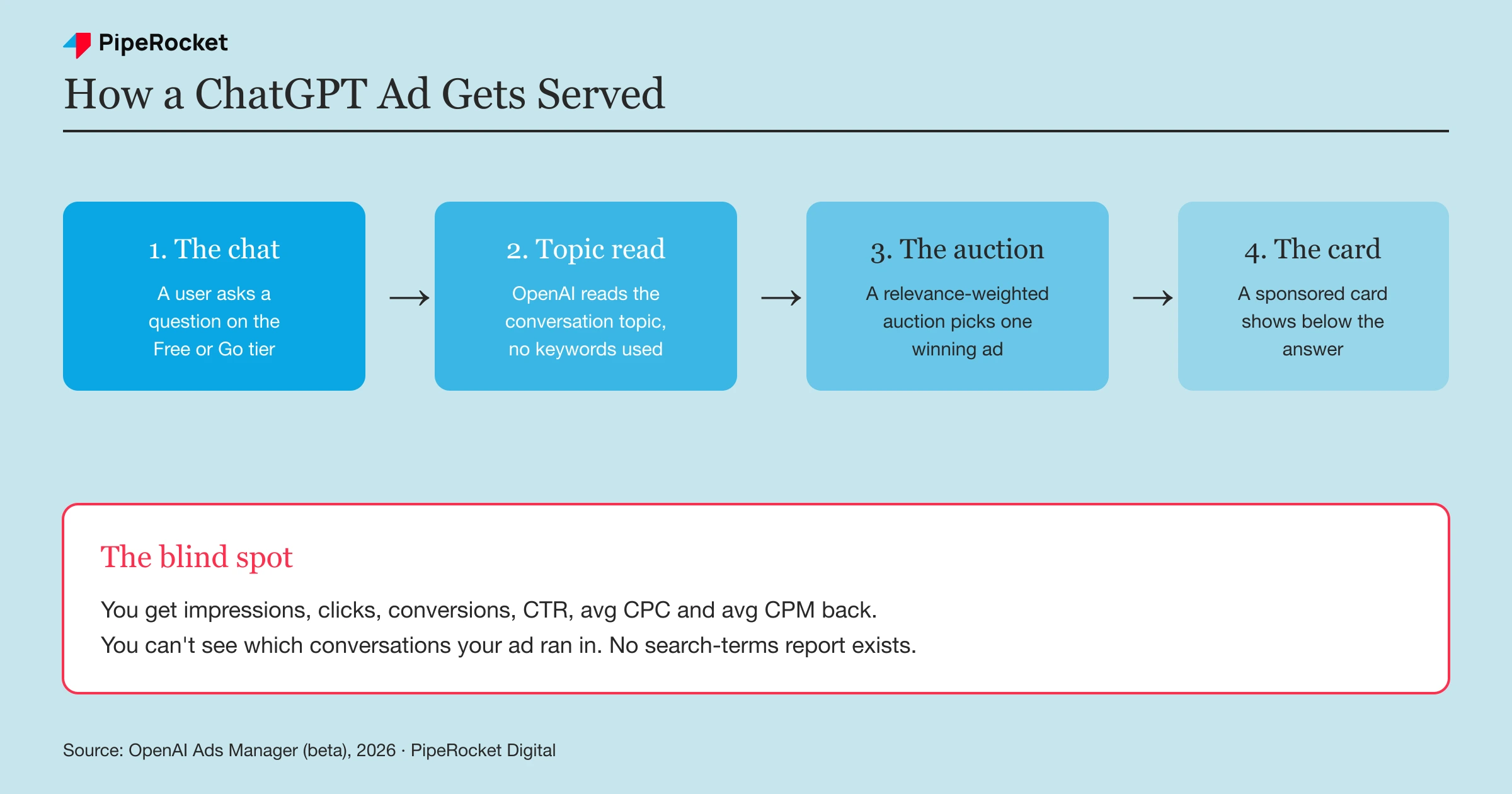
This is the biggest mental shift. ChatGPT ads don’t use keywords, cookies, browsing history, or uploaded audience lists. OpenAI reads the topic of the live conversation and matches your ad to commercial intent it detects in that chat.
So instead of a keyword list, you’re describing who you’re for and what problem you solve, and the system decides when a conversation is relevant. A relevance-weighted auction then picks one ad for that moment. You’re steering by intent description rather than exact-match brackets.
Bidding and tracking look normal, mostly
You can bid CPC or CPM, and early reporting on the beta points to rough starting figures: a max bid around $3 to $5 per click for CPC, and a default near $60 for CPM. There’s no minimum spend to open an account, which is genuinely rare for a new channel.
For measurement, you get a pixel, a Conversions API, and UTM support, so you can pass purchases, sign-ups, and leads back in. It’s the same conversion plumbing you already run. The catch lives in the next section.
Why the Measurement Gap Should Worry a SaaS Marketer
You can’t see where your ad actually ran. From running ChatGPT ads, our team gets the metrics you’d expect: impressions, clicks, conversions, CTR , average CPC, and average CPM. What you don’t get is any view into which conversations or placements served the ad.
For a channel you’re supposed to optimise, that placement blind spot is the story. On Google you’d pull the search terms report and cut the junk. Here there’s no equivalent report, so you can’t see the “queries” behind your spend or blacklist the bad ones.
That changes how you run it. You’re optimising a black box on outcome metrics alone, which means:
- You lean harder on your own conversion tracking, because it’s the only honest signal you have
- You judge the channel on cost per qualified lead rather than any in-platform placement quality score
- You accept that you can’t do the search-terms-style pruning that makes Google Ads efficient over time
Treat it like a channel you can measure at the outcome but not diagnose at the source. That’s a fine trade for a test. It’s a harder trade if you’re trying to scale spend and defend every dollar to a board.
Does ChatGPT Advertising Even Fit B2B SaaS?
For most SaaS teams, this is a test-budget channel today, not a core one. The generic guides skip this question, so here’s the honest read. It works when your buyer’s problem shows up as a commercial topic in casual conversation, and it struggles when your buyer is a narrow role.
The reason is the targeting model. You can’t say “show this to VPs of Compliance at fintechs over 200 employees.” You can only ride the topic of the conversation. So the channel favours products with broad, describable intent over products that live in a tiny, specific job function.
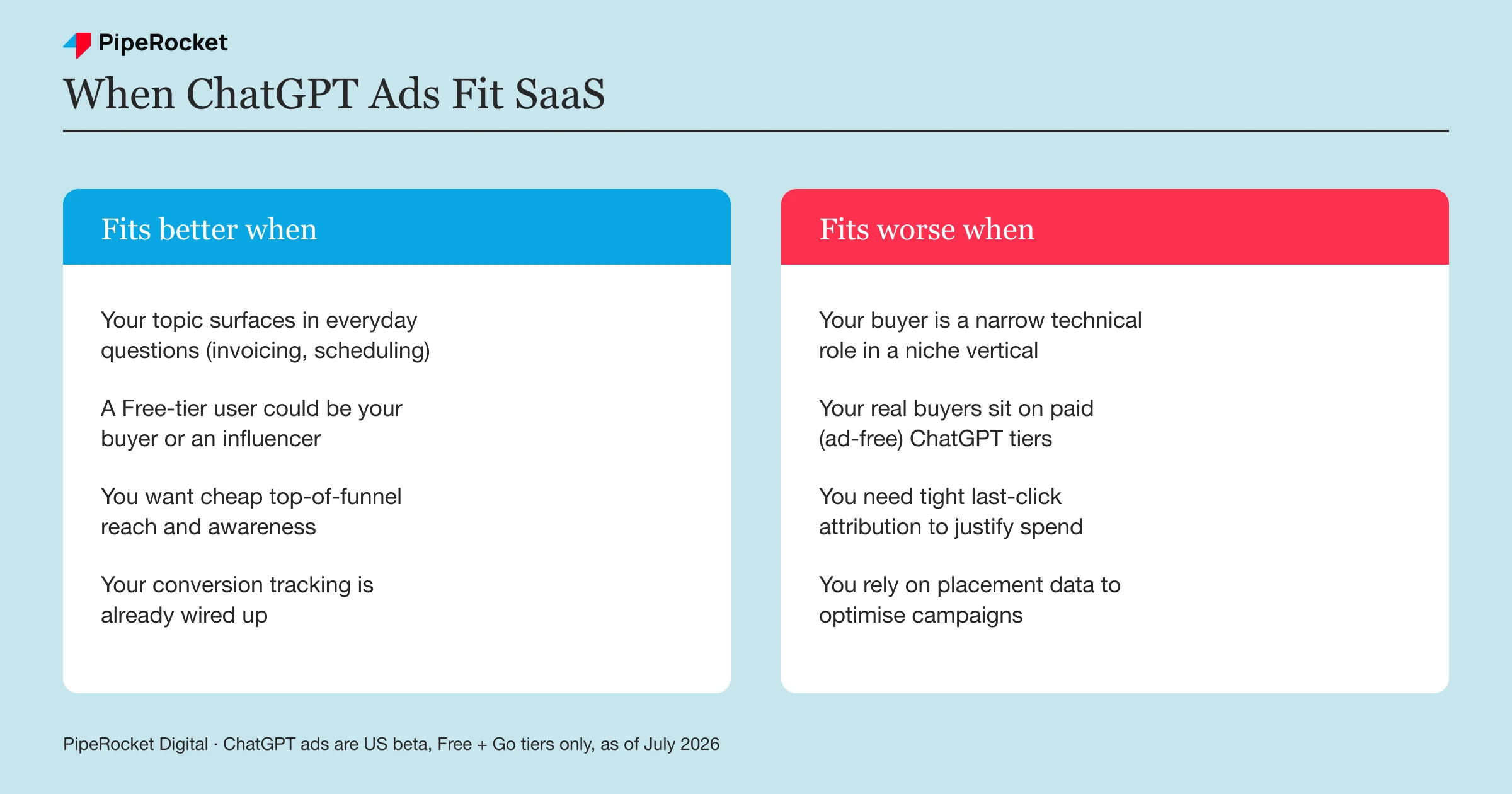
| ChatGPT ads fit better when | ChatGPT ads fit worse when |
|---|---|
| Your topic comes up in everyday questions (project management, invoicing, scheduling) | Your buyer is a narrow technical role in a niche vertical |
| A free-tier user could plausibly be your buyer or influencer | Your only real buyers sit on paid ChatGPT tiers |
| You want cheap awareness and top-of-funnel reach | You need tight last-click attribution to justify spend |
| You have conversion tracking already wired up | You rely on in-platform placement data to optimise |
A horizontal tool like an invoicing or scheduling SaaS has a real shot here, because those topics surface in ordinary chats. A compliance SaaS for fintech risk teams has a much harder time, because that buyer rarely announces themselves through a generic conversation, and they’re often on a paid tier anyway.
Now you might say, “so why touch it at all?” Because the cost of a controlled test is low, there’s no minimum spend, and being early on a channel while CPCs are soft is how you learn it before your competitors do. Just size the test like a test.
Common Mistakes to Avoid
Treating it like Google Search Ads
The interface feels familiar, so people import their paid-search instincts and stall. There are no keywords to bid on and no search terms report to prune, so a keyword-first workflow just doesn’t map. Brief the intent and the audience description instead, and let the conversation-matching do the targeting it was built to do.
Expecting to reach paid-tier buyers
Ads only serve to Free and Go tier users right now. If your ideal buyer is a senior decision-maker who’s expensed a Plus or Pro subscription, your ad will never reach them there. Check where your actual ICP lives before you fund this, or you’ll pay for reach that structurally excludes the people you sell to.
Judging it by last-click alone
The measurement is outcome-only with no placement visibility, so a strict last-click lens will make an early awareness channel look like a failure. Track assisted conversions and pipeline influence, not just the final-click demo. If you kill it on last-click math in week two, you never learn whether it was feeding demand upstream.
Scaling before you’ve read the data
It’s a beta, and pricing and auction behaviour are still moving. Pouring a real budget in before you have a few weeks of clean conversion data is how you burn spend on a channel you don’t understand yet. Start small, hold it long enough to read a trend, then decide.
How PipeRocket Helps SaaS Teams Test ChatGPT Ads
We treat ChatGPT ads as a measured experiment. We wire up your SaaS PPC tracking first so every click ties back to real pipeline, then we run a controlled test with a test-sized budget and honest outcome reporting, placement blind spot and all. We’ll also tell you plainly when your buyer isn’t reachable here yet and your money belongs in Search. If you want a paid team that reads the data before it scales, reach out to us .
Frequently Asked Questions
Are ChatGPT ads available to advertisers now?
Yes, for US advertisers. OpenAI opened a beta self-serve Ads Manager to all US businesses on May 5, 2026, with no minimum spend to start. Ads are shown to Free and Go tier users in the US, Canada, Australia, and New Zealand, while paid tiers like Plus and Pro stay ad-free. Access and availability are still expanding, so treat the current setup as a beta that can change.
How do you target ads on ChatGPT?
You don’t use keywords, cookies, or uploaded audience lists. OpenAI reads the topic of the live conversation and matches your ad to the commercial intent it detects, then a relevance-weighted auction picks one ad for that moment. As an advertiser, you describe your audience and intent rather than building keyword lists. OpenAI does not share the underlying conversations with advertisers.
How much do ChatGPT ads cost for a SaaS company?
There’s no minimum spend to open an account, which makes it cheap to test. early reporting on the beta points to a starting CPC max bid around $3 to $5 per click, and a default CPM near $60, though these are early figures and will move. For SaaS, judge cost the same way you judge any paid channel: what you pay for a qualified lead against that customer’s lifetime value , not the click price on its own.