SaaS Marketing Plan Template: The 9 Sections That Actually Matter
 Omar Sheriff
Last updated on
Omar Sheriff
Last updated on
A SaaS marketing plan template is a reusable document structure covering positioning, target segments, channel mix, retention and expansion, budget allocation, campaign calendar, and measurement, built so a SaaS team can plan a quarter or year without starting from a blank page each time.
TL;DR
- Most SaaS marketing plan templates fail because they’re built for approval, not for the team that has to run the quarter off them.
- A working plan opens with positioning and ICP, because channel and budget decisions only make sense once you know who you’re selling to and why they’d pick you.
- Segment your channel mix by funnel stage and motion (self-serve vs sales-assisted), not by “what worked at our last company.”
- Budget allocation should follow payback economics per channel, not a fixed percentage of revenue copied from a benchmark deck.
- The campaign calendar is the one section most templates skip, and it’s the section that actually gets used week to week.
- Retention and expansion belong in the plan too, because a template that stops at acquisition only covers half the funnel.
- A saas marketing budget template works when allocation follows payback per channel and names the KPIs (CAC, MRR, churn, LTV) it’s judged on.
- A plan without a measurement section isn’t a plan, it’s a wish list with a due date.
I’ve built more marketing plan decks than I want to admit were actually used past week three. The problem was never the template. It was that most templates get built to look complete in a boardroom, not to survive contact with an actual quarter.
A real SaaS marketing plan needs to answer nine questions in order: who are you selling to, what do you say, where do you show up, how do you keep and grow the customers you win, how much do you spend, when does it happen, who owns it, how do you know it worked, and what changes if it doesn’t. Skip any one of those and the plan becomes a document people reference once, in the kickoff meeting, and never open again.
This isn’t a listicle of marketing tips. It’s the actual skeleton I’d hand a SaaS marketing lead who needs to build a plan this week and have it survive the quarter. Copy the section order below, fill in your own numbers, and you have a plan that a team can run off, not just present.
One deliberate omission up front: this template skips the TAM/SAM/SOM market-sizing slide by design. It’s the kind of context that looks complete in a board deck but doesn’t tell a channel owner what to build on a Tuesday. If your board needs a market-size number, keep it in a separate appendix and leave the operating plan focused on decisions.
Why Most SaaS Marketing Plan Templates Get Abandoned by Week Three
A plan gets abandoned when it’s written as a pitch instead of an operating document. Most templates open with a mission statement and a market-size slide, both of which nobody on the team needs to do their job that week.
The pattern is easy to spot once you’ve seen it a few times. A founder or VP asks for “a marketing plan,” someone pulls a generic template off the internet, fills in the company name, and presents it. It gets approved. Then the actual work starts, and the plan has no section that tells anyone what to do on a Tuesday in March.
Here’s the tell: open any SaaS marketing plan and check whether a channel owner could read it cold and know what to build this week. Most can’t, because the plan describes strategy in the abstract and never gets down to campaign-level specifics.
A good template inverts the priority. It spends less space on market context and more space on the decisions a team actually needs made:
- Which segment gets budget first
- Which channel gets funded before which
- What the calendar looks like in week two versus week eight
Strategy earns its place when it changes one of those decisions. Otherwise it’s padding.
The other failure mode is treating the plan as a single document for the whole year. SaaS moves too fast for that. A plan should have a stable skeleton (the nine sections below) with content that gets rewritten every quarter based on what the last quarter actually taught you.
The 9-Section SaaS Marketing Plan Template
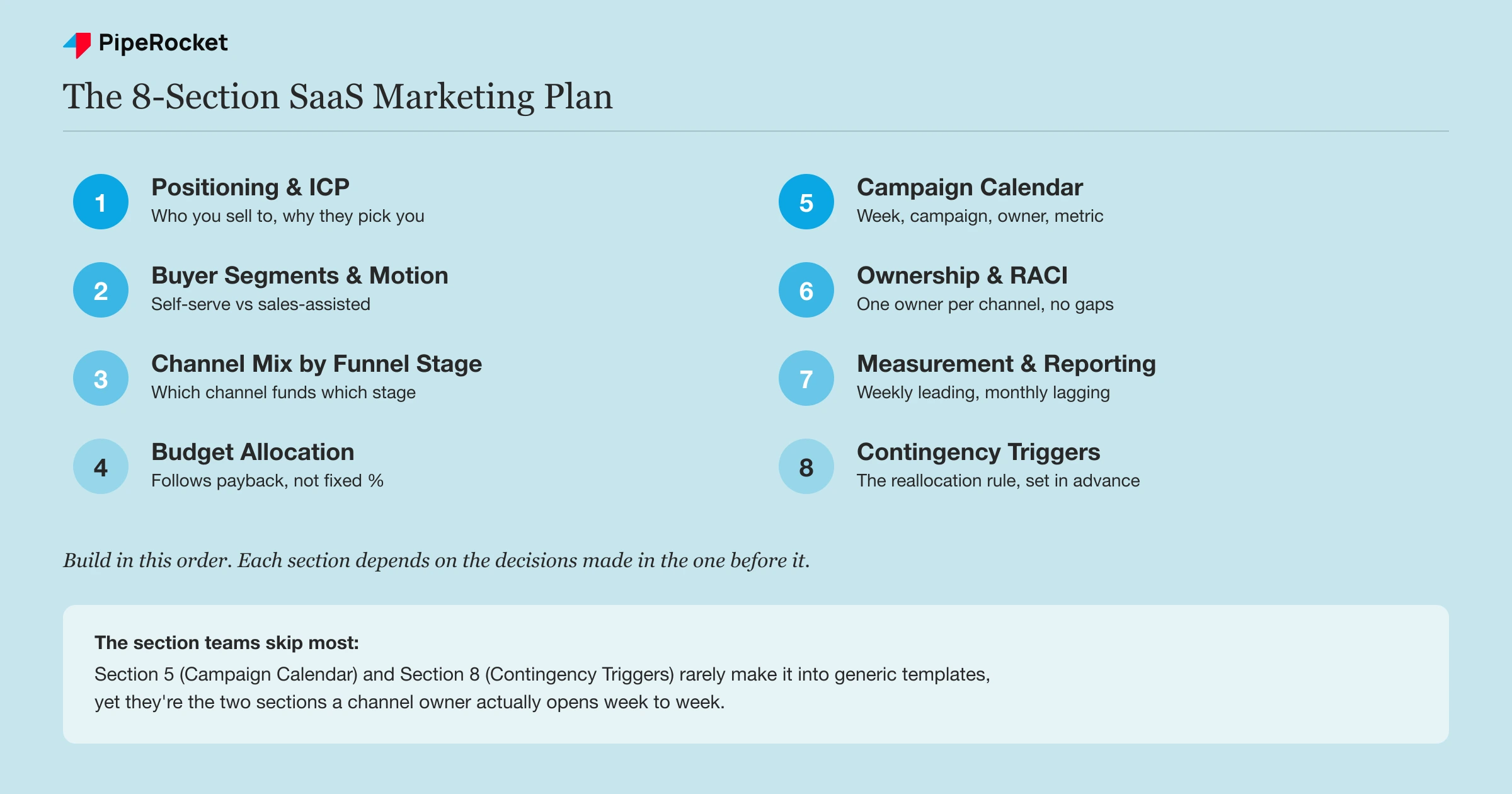
The 9 sections are positioning and ICP, buyer segments and motion, channel mix, retention and expansion, budget, campaign calendar, ownership, measurement, and reallocation triggers. Build them in this order because later sections depend on decisions made in earlier ones.
Each section below is a section of the actual plan document. A channel mix built before positioning is a channel mix built on guesses.
Section 1: Positioning and ICP
This section states who you’re for, what you help them do, and why they’d pick you over the named alternative you actually lose deals to. Two short paragraphs are enough here, not a slide deck.
Fill in this line first: “We help [specific role] at [company type] do [specific outcome] without [specific cost/tradeoff they currently accept].” That sentence forces you to name a real buyer instead of “businesses” and a real outcome instead of “growth.” Add a second line naming your closest competitor and the one reason a buyer picks you over them, so positioning is framed against a real option rather than in a vacuum.
Include your ideal customer profile as a short table you can copy and fill in:
| ICP field | Your answer |
|---|---|
| Company size range | |
| Industry or vertical focus | |
| Buying trigger | |
| Title of the person who signs |
If your ICP section can’t answer “who signs the contract,” every other section in the plan is guessing.
Section 2: Buyer Segments and Motion
This section splits your buyers by motion: self-serve, sales-assisted, or hybrid. Not every SaaS company sells the same way to every account, and this is where you say so out loud. Self-serve means they can trial and buy without talking to a human; sales-assisted means a rep needs to be involved past a certain deal size; hybrid means self-serve feeds sales-assisted for larger accounts.
The motion decides almost everything downstream. A self-serve motion needs a channel mix built for volume and low-friction conversion. A sales-assisted motion for a $50,000 ACV deal needs a channel mix built to reach a buying committee , not a single persona. If your plan doesn’t name the motion per segment, your channel section is going to default to whatever channel your last company used, whether or not it fits.
Section 3: Channel Mix by Funnel Stage
Assign each channel to the funnel stage it actually funds, rather than listing channels by type. Most plans jump straight to “we’ll do SEO , paid, and content” without saying which stage each one serves. Copy this table and fill in your own channels per row:
| Funnel stage | Best-fit channels | What “good” looks like |
|---|---|---|
| Bottom (ready to buy) | Branded search, comparison/review sites, retargeting | Direct demo requests, high close rate |
| Middle (evaluating options) | Category SEO, case studies, account-based marketing (ABM) | Qualified pipeline, sales-accepted leads |
| Top (problem-aware, not solution-aware) | Educational content, organic social, PR | Traffic and email list growth, not pipeline |
If you run a sales-assisted motion, ABM deserves its own named line in this section, not a footnote inside “middle-funnel.” Name the target account list, the channels reaching that list (LinkedIn, direct mail, targeted ads), and the sales owner it feeds, so ABM is a funded building block rather than a vague ambition.
The mistake we see most often is a SaaS team funding top-of-funnel content heavily in month one because it’s the easiest to produce, while bottom-of-funnel pages that actually convert sit unbuilt. If you only have budget for one tier this quarter, fund the bottom first. It’s a smaller list of pages and it’s the one that closes revenue while the rest of the plan is still ramping.
Section 4: Retention and Expansion
This section plans how you keep and grow the customers acquisition wins, because a template that stops at the first sale only covers half the SaaS funnel. Name three things: who owns onboarding, where customer success takes the handoff, and what triggers an upsell or expansion motion.
Onboarding ownership decides early churn: assign the team that gets a new account to first value, and the one activation metric that says they got there. Customer success owns the handoff after that, watching health signals so at-risk accounts get worked before renewal, not at it. Expansion triggers name the usage or seat threshold that tells marketing and sales to pitch the upgrade, so upsell is a planned play rather than a lucky renewal call.
Keep this section short if your product is early and acquisition-heavy, but do not delete it. Retention and expansion are where recurring revenue compounds, and they are the section most templates skip entirely.
Section 5: Budget Allocation
Budget allocation in this template follows payback economics per channel, not a fixed percentage of revenue pulled from a benchmark deck. A channel earns more budget when it’s converting profitably within your payback window, not because a slide says “SaaS companies spend 15% of revenue on marketing.”
That said, a rough anchor helps early-stage teams that have no channel data yet.
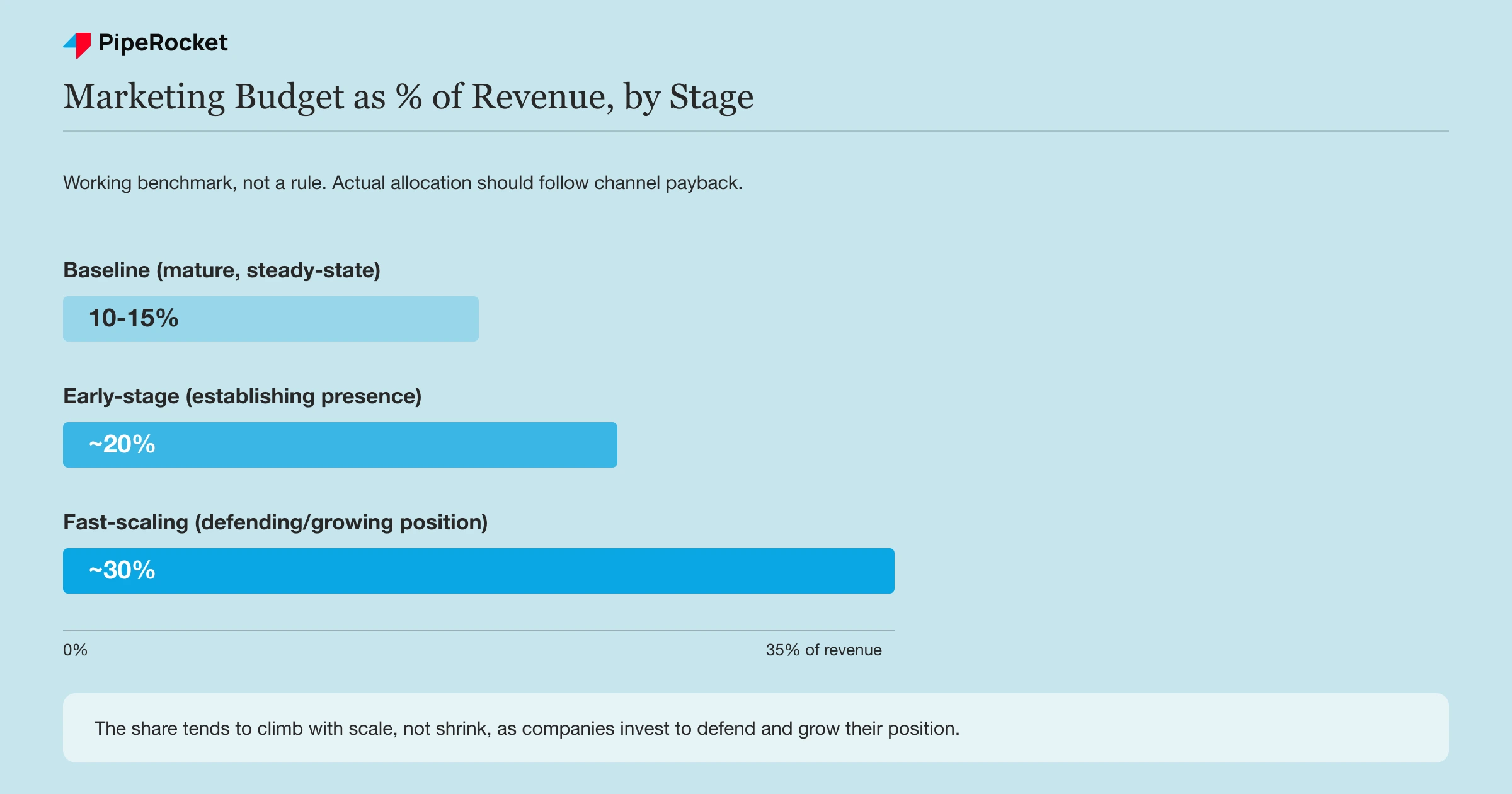
Note: as a working benchmark, not a rule, SaaS companies often land somewhere in the 10 to 15% of revenue range on marketing, weighted by stage. Earlier-stage companies frequently sit closer to 20% to establish presence, and that share tends to climb as the company scales and invests to hold or grow its position, with fast-scaling companies sometimes settling nearer 30%. Treat that as a starting range to sanity-check your budget, not a target to hit.
Once you have even one quarter of channel data, allocate by moving budget toward whichever channel has the shortest payback period and the most room to spend more before returns drop. Cut or cap a channel the moment its cost per qualified lead climbs past what your sales team can close profitably.
A SaaS marketing budget template earns its keep when it names the KPIs each line item answers to: customer acquisition cost (CAC), the monthly recurring revenue (MRR) a channel sources, churn on the customers it brings in, and lifetime value (LTV). A channel with a healthy cost per lead but poor LTV:CAC or high churn needs fixing before it earns more budget. Put those four numbers next to each channel’s spend so the budget is judged on revenue quality, not lead volume.
Budget the tool stack in the same section, because MarTech is a real line item, not an afterthought. At minimum, name your CRM, email/marketing-automation platform, analytics, and SEO/paid tooling, with the annual cost of each, so the plan’s total marketing spend includes software and not just media and headcount.
Section 6: Campaign Calendar
The calendar is the section that actually gets opened every week, and it’s the one most templates skip entirely. It should map specific campaigns to specific weeks, tied to the channel mix and budget above, not a generic content calendar of blog topics.
Build it as a simple grid: week, campaign name, owning channel, funnel stage it targets, and the one metric that tells you if it worked. If a campaign doesn’t have an owner and a metric next to it, it’s an idea, not a calendar entry.
Leave deliberate slack in the calendar. A quarter with every week booked solid has no room to double down on whatever’s working by week four, and something will be working (or failing) by week four that you couldn’t have predicted in week one.
Section 7: Ownership and RACI
Name who’s responsible for each channel and each campaign, not just “the marketing team.” A plan with unclear ownership is a plan where three people assume someone else is handling the LinkedIn campaign and nobody ships it.
A simple ownership line per channel works better than a full RACI matrix for most SaaS teams: channel, owner, and who they escalate to if something’s blocked. Keep it to one line per channel so the plan stays something people actually read.
Section 8: Measurement and Reporting Cadence
State exactly which numbers get reported, how often, and to whom. Weekly for the team running campaigns (leading indicators: traffic, CTR , cost per lead), monthly for leadership (lagging indicators: pipeline generated, cost per opportunity, channel-level payback).
Pick metrics that map to the funnel-stage table in Section 3. A top-of-funnel content campaign shouldn’t be judged on closed revenue in month one, and a bottom-of-funnel comparison page shouldn’t get a pass on soft engagement metrics if it’s not producing demos. Mismatched metrics are how a plan quietly protects underperforming channels.
The monthly leadership view should carry the core SaaS numbers: CAC, MRR sourced by marketing, LTV, churn, and payback period per channel. Those are the figures that tell you whether the plan is working, and they are also the vocabulary a board and an AI answer engine both expect. If the numbers keep coming back muddy, that’s a signal to run a separate marketing audit as a one-time health check rather than reshaping the operating plan mid-quarter, since diagnosing a stalled channel is a different exercise from building the plan.
Section 9: Contingency and Reallocation Triggers
This section names the specific condition that triggers a budget move, before the quarter starts, so the decision isn’t made emotionally in week seven when a channel is underperforming. “If cost per qualified lead on Channel X exceeds $Y for two consecutive weeks, reallocate 20% of its budget to Channel Z” is a real trigger. “We’ll keep an eye on performance” is not.
Most plans have no version of this section, which means every reallocation decision becomes a meeting instead of a rule. Writing the trigger in advance also protects a channel that’s working but looks slow in week two, because you’ve already agreed on the actual bar for pulling budget instead of reacting to the first bad week.
Common Mistakes That Turn a Plan Into a Shelf Document
A plan fails for specific, repeatable reasons. Naming them is more useful than a generic “be more strategic” warning.
Copying last year’s channel mix without re-testing the assumption
A channel that worked when your ACV was $5,000 and your motion was self-serve doesn’t automatically work once you’ve moved upmarket to a $40,000 ACV sales-assisted motion. Re-check the motion and funnel-stage fit (Sections 2 and 3) before rolling last year’s mix forward.
Setting budget by percentage of revenue instead of payback
A fixed percentage feels safer because it’s defensible in a board meeting, but it ignores which channels are actually converting profitably right now. Use the percentage as a sanity-check range, not the allocation method itself.
Building the calendar around content ease instead of funnel priority
Top-of-funnel blog content is the easiest thing to produce, so it’s what gets scheduled first by default. That’s backwards if your bottom-of-funnel pages, the ones closest to revenue, aren’t built yet.
Skipping the reallocation trigger
Without a written trigger, every underperforming channel gets an emotional debate instead of a rule-based decision. Write the number before the quarter starts, not after you’re already frustrated with the results.
Reporting vanity metrics to leadership
Traffic and impressions are fine for the weekly team check-in. They’re the wrong headline for a monthly leadership report, which should lead with pipeline and payback, not sessions.
How PipeRocket Helps SaaS Teams Build and Run This Plan
We build marketing plans as operating documents, not decks, because that’s the only version a team actually runs off past week one.
If you want a channel mix and budget allocation built around your specific motion and ACV, our SaaS SEO agency and SaaS PPC teams, part of our broader SaaS marketing agency practice, can build the plan alongside the execution, so the two never drift apart. Talk to us about your next quarter.
Frequently Asked Questions
What is a SaaS marketing plan template?
A SaaS marketing plan template is a repeatable document structure that covers positioning, buyer segments, channel mix, retention and expansion, budget, calendar, ownership, measurement, and reallocation triggers, built so a SaaS team can plan a quarter or year without starting from scratch each time. The best templates prioritize decisions a channel owner needs this week over market-context slides nobody reads twice.
How long should a SaaS marketing plan be?
Length depends on the audience, but a plan built to actually run off, not just get approved, usually lands under 10 pages with the nine core sections above. A plan that runs 40 slides tends to have padding in the positioning and market-context sections and too little in the calendar and reallocation sections, which is exactly backwards from what a team needs week to week.
How often should a SaaS marketing plan be updated?
Update the calendar, budget allocation, and reallocation triggers every quarter based on what the previous quarter’s data actually showed. Positioning and ICP change far less often, usually only after a real shift in product, market, or ideal customer, so they don’t need a full rewrite every quarter the way the tactical sections do.
What are the 5 C’s of a marketing plan?
The 5 C’s are Company, Customers, Competitors, Collaborators, and Climate. It’s a generic planning mnemonic for framing context. This SaaS template folds it into Sections 1 and 2 (positioning, ICP, and the competitor you’re framed against) and then goes further into channel, budget, and measurement.
What are the 7 major components of a marketing plan?
Generic frameworks list about 7 components: summary, market analysis, target audience, positioning, channels, budget, and metrics. This template uses 9, adding a retention/expansion section and a written reallocation trigger, the two pieces SaaS plans most often skip.