The SaaS Marketing Audit Framework We Actually Run for Clients
 Vignesh Sampath
Last updated on
Vignesh Sampath
Last updated on
A SaaS marketing audit is a structured review of positioning, channel spend, funnel conversion, and attribution, done to find where pipeline is leaking before you add more budget. It usually surfaces two or three fixable gaps that were quietly capping growth the whole time.
TL;DR
- Most audits start with channel performance, but the review should start with positioning because a weak message makes every channel look worse than it is.
- Confirm tracking works before auditing anything else: if signups, demos, and key events don’t fire correctly in your CRM and analytics, every downstream answer is wrong.
- Channel mix gets audited by asking whether each channel matches your buyer’s actual research behavior, not by ranking channels on ROAS alone.
- Website UX gets its own check, because unclear CTAs and missing social proof cap conversion even when positioning and channels are both working.
- Funnel conversion review means tracking the rate between every stage, not just top-of-funnel traffic and bottom-line revenue.
- Attribution gets fixed by picking one model everyone agrees to distrust equally, not by chasing a perfect model that doesn’t exist.
- SEO gets treated as one input inside the channel and funnel reviews, with a dedicated SEO audit only if it comes out as the biggest gap.
- The audit only pays off if it ends in three ranked fixes with owners and dates, not a 40-slide deck nobody actions.
When to Run a SaaS Marketing Audit
Run a SaaS marketing audit when growth stalls or a big change is coming, not on a fixed annual calendar. Four triggers matter most: a traffic or conversion plateau, an upcoming funding round or scale-up, a planned repositioning or new campaign, and the aftermath of an algorithm update or major product change.
- Traffic or conversion has stalled. Numbers that were climbing have flattened for two or more months and nobody can point to why.
- You’re about to raise or scale spend. Before a funding round or a budget increase, audit so you scale what works instead of amplifying a leak.
- You’re about to reposition or launch a new campaign. A repositioning built on stale assumptions carries them into every asset. Audit the current message first.
- An algorithm update or product change just landed. A core update, a pricing change, or a new module can shift which channels and pages actually convert.
Check Your Tracking Before You Trust Any Number
Confirm your tracking is clean before auditing anything else: signups, demo requests, and key funnel events all have to fire correctly into your CRM and analytics. An audit built on broken instrumentation produces wrong answers in every section downstream, because you’re reading numbers that never described reality.
Run three checks before you trust a single dashboard:
- Event coverage. Confirm every stage transition you plan to measure actually fires an event: signup, demo request, trial start, activation, paid conversion. A stage with no event is a stage you’re guessing at.
- CRM-to-analytics agreement. Pull the same metric from your CRM and your analytics tool for the same window. If demo requests read 120 in one and 90 in the other, resolve the gap before you audit the channel that feeds it.
- Duplicate and bot noise. Strip internal traffic, test submissions, and obvious bot signups. A trial-to-paid rate computed on inflated signups understates conversion and sends you chasing the wrong leak.
Tracking hygiene isn’t glamorous, but skipping it is how teams spend a quarter fixing a channel that was converting fine and only looked broken in a miscounted report.
Most SaaS Marketing Audits Start in the Wrong Place
Start a SaaS marketing audit with positioning, not channel reports. A weak core message makes every channel look broken, so fixing the message first often repairs channels that only looked like they were underperforming.
Most teams open a marketing audit by pulling channel reports: Google Ads spend , LinkedIn CPL, organic sessions, email open rates. That’s the wrong starting point, and it’s why so many audits end with “spend more on the channel that’s already working” instead of a real answer.
Channel data can’t tell you if the channel is broken or if the message running through it is broken. Say a SaaS company is running Google Ads at a $400 CPA with a 2% landing page conversion rate. That single number could mean any of three things:
- A targeting problem, showing the ad to the wrong audience
- A bidding problem, paying too much for the right clicks
- A positioning problem, where the ad promises something the page doesn’t deliver
The ads dashboard alone won’t tell you which. That’s why we start every audit with positioning. If the core message is off, every channel downstream inherits the problem, and fixing positioning first sometimes makes channels that looked “underperforming” fix themselves without a single bid change.
A generic B2B SaaS audit that skips straight to channel tactics is treating the symptom. The fix has to start at the message, because that’s the one variable every channel shares.
What a Positioning Check Actually Looks At
A positioning check comes down to three concrete comparisons, not a brand exercise.
- Website copy vs. sales call language. Pull the actual words your reps use on discovery calls and compare them to your homepage headline. If they don’t match, prospects who read the site before the call are getting a different pitch than the one that closes deals.
- Category claim vs. what buyers search for. If your homepage says “Revenue Intelligence Platform” but your buyers search “sales forecasting tool,” you’ve built a category nobody’s searching for.
- Differentiator vs. competitor claim. Pull your top three competitors’ homepages side by side. If your stated differentiator is also their stated differentiator, you don’t have one yet.
Say a compliance SaaS selling to fintech ops teams runs this check. Its homepage leads with “automated compliance workflows.” Its sales calls, the ones that actually close, lead with “we stop your SOC 2 audit from blowing up your Q4.” That’s the same product pitched as two different products, depending on which version the buyer heard first.
Auditing Whether You’re Targeting the Right ICP
Check that the audience your marketing targets matches the accounts that actually convert and retain, because a message aimed at the wrong ICP fails no matter how sharp the copy is. Positioning and ICP are two halves of the same check: the right message pointed at the wrong buyer still misses.
Pull your best-fit customers, the ones with the fastest sales cycles, lowest churn, and highest expansion, and describe what they share: company size, industry, buying trigger, and who signs off. Then compare that profile to who your ads target, who your content speaks to, and who your SDRs prospect.
When the converting ICP and the targeted ICP drift apart, you see it as rising CAC and falling retention at the same time. That’s the signal to re-aim before you re-spend.
Why Positioning Problems Hide Inside Channel Numbers
A positioning gap rarely shows up as a positioning metric because there isn’t a positioning metric on most dashboards. It shows up as a paid CPA that keeps climbing even after you fix targeting, or an SEO page that ranks fine but converts at half the rate of a weaker-ranking competitor page.
If you’ve already rebuilt a landing page twice and the conversion rate barely moved, the page usually isn’t the problem. The offer underneath it doesn’t match what the visitor expected when they clicked.
How to Audit Channel Mix Without Just Ranking by ROAS
Auditing channel mix means checking whether each channel matches how your specific buyer actually researches and buys, not ranking channels by last quarter’s ROAS . A channel with worse ROAS this month can still be the right channel if it’s the one building the pipeline your best-converting channel depends on later.
Ranking by ROAS alone punishes channels that do their job earlier in the funnel. LinkedIn thought-leadership content rarely closes a deal on its own. But if it’s why a prospect recognized your brand name when your Google Ad showed up three weeks later, cutting it for a weak attributed ROAS means cutting the thing that made the other channel work.
The right question for each channel is whether it matches where your buyer actually is when they’re doing that activity, not whether it converted on its own.
| Channel | Matches buyer behavior when… | Breaks down when… |
|---|---|---|
| Google Search Ads | Buyer already knows the solution category and is comparing vendors | Category is new and nobody searches for it by name yet |
| SEO / organic content | Sales cycle is long enough to justify a 6-12 month build-out | You need pipeline in the next 60 days |
| LinkedIn Ads / organic | Buyer is a specific named persona active on the platform | ICP is broad or skews outside LinkedIn-heavy roles |
| Outbound / SDR | Deal size justifies a human touch and target accounts are identifiable | Product is self-serve or PLG-first with a low ACV |
| Email / lifecycle | You already have a list and the gap is nurture, not acquisition | The problem is top-of-funnel volume, not conversion of existing leads |
Checking Whether Spend Matches Where Your Buyer Actually Researches
Pull your last 20 closed-won deals. Ask each rep, or check call notes, how the buyer said they first heard of you and what they looked at before booking a call.
Compare that list to your spend breakdown by channel. If 60% of buyers mention finding you through a peer recommendation or a comparison page , and 5% of your budget goes toward the content that supports comparison research, that’s the gap. It’s rarely subtle once you run the comparison.
Checking Whether You’re Underinvesting in the Channel That Feeds the Others
Look for a channel with a poor standalone ROAS but a high assist rate in multi-touch paths. If your data shows most closed deals touched organic content early and paid search late, organic is doing acquisition work your ROAS report is crediting entirely to paid.
Cutting that organic budget because its direct-attributed number looks weak breaks the channel that was actually filling the funnel.
Funnel Conversion Review: Track Every Stage, Not Just the Ends
A funnel conversion review means measuring the conversion rate between every stage of your funnel, not just top-of-funnel traffic and closed revenue. Teams that only track sessions and closed deals are missing the stage where most of the leak actually happens.
Most SaaS teams can tell you their traffic number and their revenue number cold. Ask them for the conversion rate from MQL to SQL, or from trial signup to activation, and you’ll often get a shrug or a stale number from a dashboard nobody’s opened in months.
That gap matters because the fix for a top-of-funnel problem and the fix for a mid-funnel problem are completely different, and you can’t tell which one you have without stage-by-stage data.
Mapping Your Actual Stages, Not the Textbook Ones
Every SaaS company’s funnel looks different depending on whether it’s PLG, sales-led, or a hybrid. A PLG company’s real stages might be visit, signup, activation, paid conversion. A sales-led company’s stages are closer to visit, MQL, SQL, opportunity, closed-won.
Map your own stages before you audit them. Borrowing a generic five-stage funnel from a blog post and forcing your data into it hides the exact leak you’re trying to find.
Calculating the Conversion Rate at Each Handoff
Once your stages are mapped, calculate the percentage that moves from each stage to the next one, and hold each rate up against what’s realistic for your motion.
- Visit to signup or MQL
- Signup or MQL to SQL or activation
- SQL or activation to opportunity or paid conversion
- Opportunity to closed-won
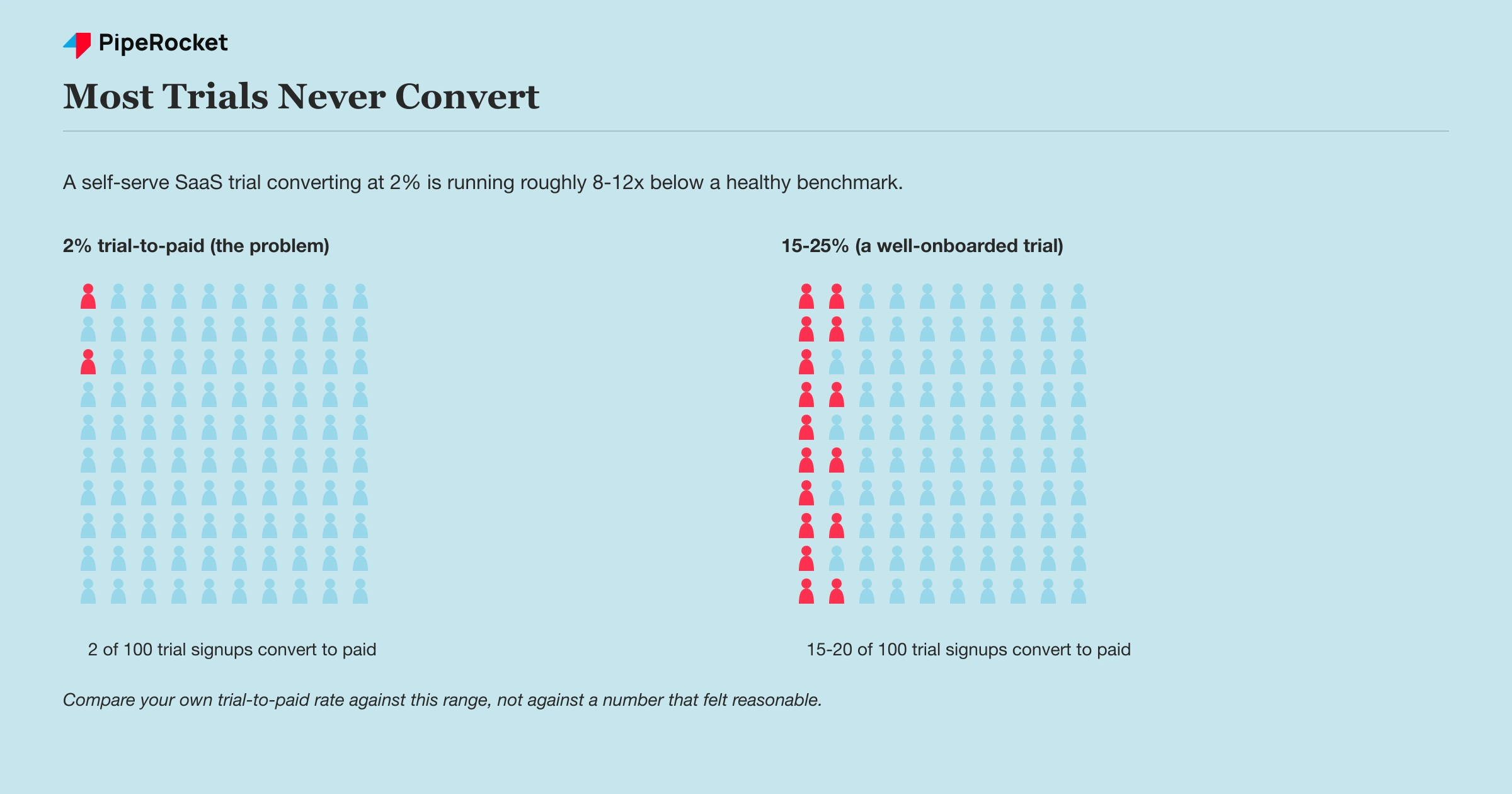
A trial-to-paid conversion rate of 2% for a self-serve SaaS product isn’t automatically bad. It’s bad relative to what similar products in your category typically see, which is usually somewhere in the 15-25% range for a well-onboarded free trial. Compare your number against that range, not against a number you picked because it felt reasonable.
Finding Where the Biggest Drop Actually Sits
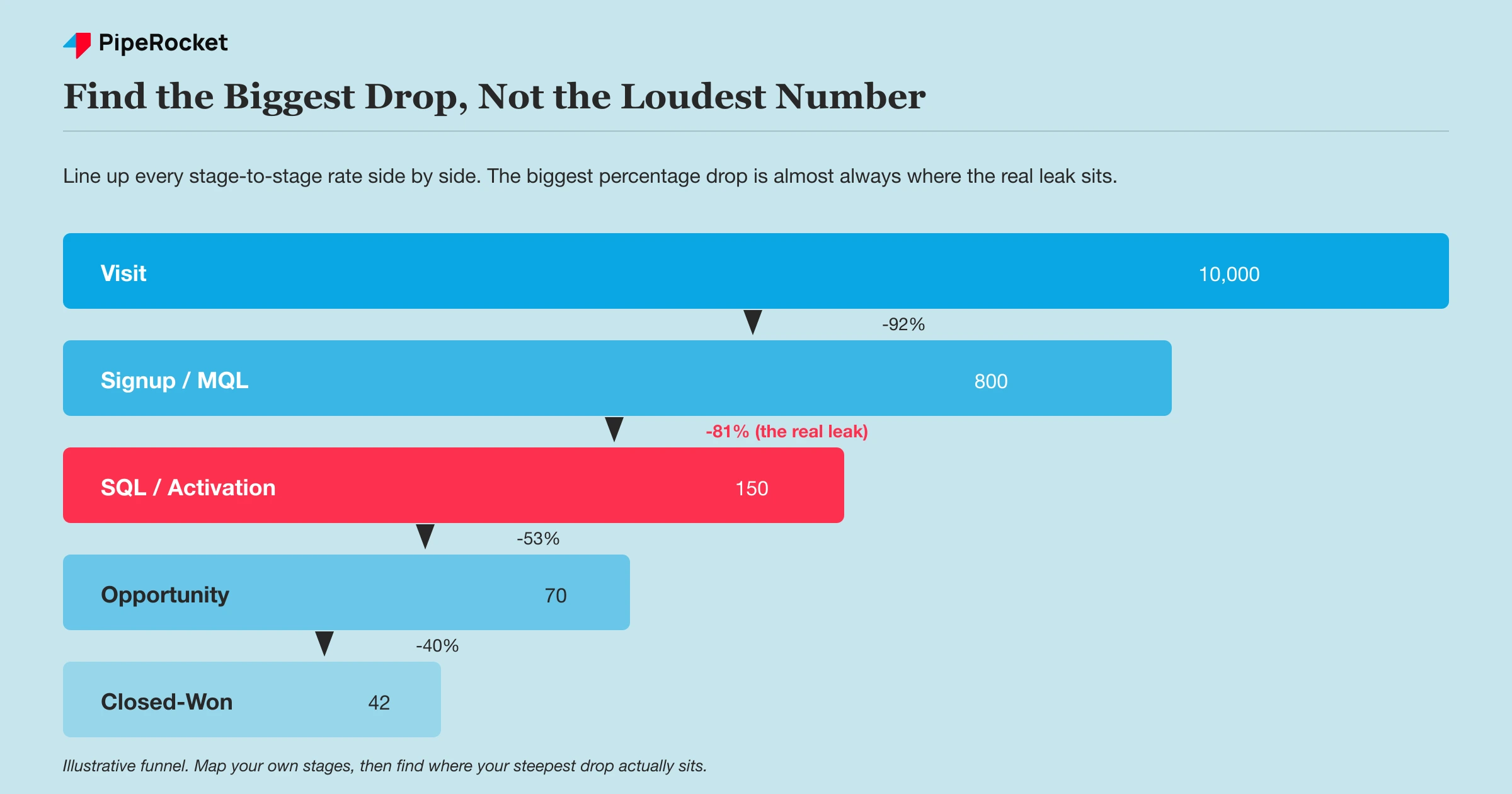
Line up all your stage-to-stage rates side by side and look for the single biggest percentage drop. That’s almost always where the real leak is, and it’s rarely where the team assumed it was.
We’ve seen teams convinced their problem was top-of-funnel volume when the real leak sat somewhere else entirely: a 48-hour gap between demo request and the sales team actually reaching out. Nobody was measuring that stage because it never showed up on the traffic-to-revenue dashboard.
Why Attribution Breaks Down and What to Do Instead of Chasing a Perfect Model
Attribution breaks down because no single model can honestly credit every touchpoint in a B2B SaaS buying journey that often runs 5 to 15 touches across months. The fix is picking one model everyone agrees to distrust equally, and pairing it with a few directional signals a single model can’t capture, rather than chasing a better model that doesn’t exist.
| Model | What it does | Why it breaks down |
|---|---|---|
| Last-click | Gives 100% of the credit to whatever channel was clicked right before signup | That’s almost always branded search or a direct visit, so it credits the finish line and ignores what built the intent |
| First-touch | Gives all credit to the first channel a prospect stumbled into | Over-credits the top of the journey even when that channel did nothing after the first visit |
| Multi-touch | Splits credit across every touchpoint in the journey | Needs clean cross-device, cross-channel data most SaaS marketing stacks don’t have, so it becomes a more complicated way of being wrong |
A model built on incomplete data is just a more complicated way of being wrong, and the complexity makes the wrongness harder to spot. That’s why the goal is consistency, not a perfect model.
Picking One Model on Purpose, Not by Default
Pick a primary model your whole team agrees to use for one purpose only: comparing this month to last month, and this quarter to last quarter. Don’t ask it for the absolute truth about which channel deserves credit.
Ask it to be consistent enough that a change in the trend line actually means something changed, not that the tracking shifted.
Adding Signals a Single Model Can’t Capture
Layer in signals that sit outside any attribution model entirely.
- Ask new customers directly, during onboarding or in a signup survey, how they first heard of you. Self-reported attribution is messy but it catches word-of-mouth and dark social that no pixel will ever see.
- Track branded search volume over time as a proxy for awareness. A rising trend usually means upper-funnel activity is working even when it can’t be directly attributed to a specific channel.
- Watch assist patterns in whatever multi-touch data you do have clean, even if you don’t trust the full model, just to see which channels tend to show up early in winning paths versus losing ones.
None of these replace a model. Together, they catch what a single number always misses.
How SEO Fits Into a Full Marketing Audit
SEO is one input into a full marketing audit, sitting inside the channel mix review and the funnel conversion review rather than standing as its own audit. It shows up in two places: as a channel to evaluate against buyer behavior, and as a contributor to the funnel stages your organic traffic actually moves through.
If SEO traffic is climbing but MQLs from organic aren’t, that’s a funnel conversion issue sitting on top of a channel that’s technically doing its job.
The one SEO check that belongs in every marketing audit is which terms actually drive pipeline, not which terms drive traffic. Map your top organic landing pages to closed-won deals, or at least to demo requests and trials. A page pulling thousands of visits that never touches a won deal is an informational term doing brand work, while a low-volume comparison or “vs” term that sits in winning paths is the SEO worth protecting budget for.
A dedicated technical crawl, keyword gap analysis, and on-page review go deeper than a full marketing audit needs to. A full SaaS content audit , scoring every page for pipeline contribution, cannibalization , and refresh priority, is a separate and deeper exercise on its own. If SEO comes out of this review as the area needing the most work, that’s the point to run a focused audit for it, rather than cramming a full technical review into a broader positioning and funnel exercise.
Review Paid Channels for Budget Leaks and Message Mismatch
Audit paid channels for two specific leaks: budget spent on low-intent keywords that never convert, and ad-to-landing-page message mismatches that waste the clicks you do pay for. These are separate from the broader channel-mix question and usually recover spend faster than any bid change.
Cutting Budget on Low-Intent Keywords
Pull your search terms report and sort spend by converting versus non-converting queries. Broad, informational, or loosely matched terms often quietly absorb a chunk of budget while producing no pipeline.
Pause or tighten the terms with real spend and zero downstream conversions, then redirect that budget to the intent-heavy terms already producing deals. This is often the single fastest recovery in the whole audit.
Checking Ad-to-Page Message Match
Read each active ad next to the page it points to. If the ad promises “SOC 2 in 30 days” and the landing page headline talks about “compliance workflows,” the visitor who clicked on the promise lands on a different pitch and bounces.
Every high-spend ad should carry its exact promise through to the page headline. A mismatch here shows up as a high click-through rate paired with a low landing page conversion rate, and it’s fixable in an afternoon.
Evaluate Website and UX for Conversion Friction
Evaluate your website for the friction that caps conversion even when positioning and channels both work: unclear or competing CTAs, missing social proof , and pages that make the next step hard to find. UX gaps quietly waste traffic every other part of the audit worked to earn.
Positioning tells you whether the offer is right. This check tells you whether the page lets a convinced visitor act on it. A landing page with a strong offer can still leak conversion rate if the path to the next step is cluttered.
Walk your highest-traffic pages and check three things:
- One clear primary CTA per page. A page offering a demo, a trial, a newsletter, and a webinar all at once splits the visitor’s attention and lowers the odds of any single action.
- Social proof near the decision point. Logos, review scores, and named results should sit close to the CTA where they reinforce the action, instead of on a separate page a visitor never reaches.
- Obvious next step above the fold . A visitor should never have to scroll or hunt to find what you want them to do next.
Common Mistakes That Turn an Audit Into a Wasted Quarter
Most audits fail in four predictable ways: auditing every channel with the same depth, treating the audit as a one-time event, presenting findings without ranking them, and skipping owner and date assignment. Each one turns a real diagnosis into a deck nobody actions.
Auditing Every Channel With the Same Depth
Not every channel deserves equal audit time. Weight your audit depth to match spend and pipeline contribution, not curiosity:
- A channel at 2% of budget gets a quick check, not a three-day deep dive
- Your largest spend category gets the most audit hours, every time
- A channel with low spend but a suspicious conversion drop still earns a closer look
Skip this weighting and you’ll burn the time you set aside for the whole audit on a channel that barely affects the outcome.
Treating the Audit as a One-Time Event
A marketing audit run once a year and filed away stops being useful the moment your channel mix or funnel shifts. For most SaaS companies, that happens within a quarter or two.
Build the core metrics from this audit into a recurring monthly or quarterly check, even a lightweight one, instead of waiting for the next full audit to notice a new leak.
Presenting Findings Without Ranking Them
A findings deck that lists 15 issues with equal visual weight leaves the reader to guess which three actually matter. If everything is flagged as important, nothing gets fixed, because the team defaults to whichever fix is easiest instead of whichever fix has the most impact.
Skipping Owner and Date Assignment
An audit that ends with “we should look into fixing the trial onboarding flow” and no named owner or deadline dies in the same meeting it was presented in. Every finding needs a name and a date attached before the meeting ends, or it joins the pile of insights everyone agreed with and nobody acted on.
How PipeRocket Runs a SaaS Marketing Audit
We run this exact framework for SaaS clients: positioning check against sales call language, channel mix scored against buyer research behavior, funnel conversion mapped stage by stage, and one attribution model the whole team agrees to trust consistently.
If SEO comes out as the biggest gap, we follow up through our SaaS SEO agency service. If paid channels need the deeper cut, our SaaS PPC team picks it up from there, all inside the same SaaS marketing agency practice. Want us to run this on your account? Reach out here .
Frequently Asked Questions
What is a SaaS marketing audit?
A SaaS marketing audit is a structured review of a company’s positioning, channel spend, funnel conversion rates, and attribution setup, run to find specific gaps that are capping pipeline growth. It’s different from a single-channel audit because it looks at how these pieces interact instead of scoring one channel in isolation. The output should be a short, ranked list of fixes, not a broad health report. If your buying motion runs through a multi-person committee rather than a single buyer, our B2B marketing audit covers the sales-and-marketing alignment checks this SaaS-specific version doesn’t.
What is the purpose of a marketing audit?
The purpose of a marketing audit is to find where pipeline is leaking before you add more budget. It surfaces the two or three fixable gaps quietly capping growth, so you scale what works instead of amplifying what doesn’t.
How often should a SaaS company run a marketing audit?
A full audit once or twice a year is usually enough for most SaaS companies, paired with a lighter monthly or quarterly check on the core metrics it surfaced. Running a full audit more often than that usually means the last one didn’t produce real fixes, so the team is auditing again instead of acting. If your channel mix or ICP changed significantly, that’s a good trigger to run one sooner than the calendar suggests.
What’s the difference between a marketing audit and an SEO audit?
A marketing audit covers positioning, channel mix across paid, organic, and outbound, funnel conversion, and attribution, treating SEO as one channel among several. An SEO audit goes deep on a single channel, covering technical crawlability, keyword gaps, content quality, and backlinks in far more detail than a full marketing audit has room for. Most teams run the broader marketing audit first to find out if SEO is actually the priority area, then follow up with a dedicated SEO audit if it is.