The B2B Marketing Audit Framework for Sales Alignment, ABM, and Attribution
 Sabari Rohith
Last updated on
Sabari Rohith
Last updated on

A B2B marketing audit is a structured review of how marketing and sales work together, how account-based programs are performing, and whether attribution reflects a real buying committee instead of one buyer. It’s meant to surface specific, fixable gaps, not produce a general health score.
TL;DR
- Sales-and-marketing alignment gets audited by comparing lead definitions and handoff speed, not by asking each team if they feel aligned.
- ABM program health depends on whether the right accounts are actually being reached across every role on the buying committee, not just whether a list exists.
- Attribution in a long B2B cycle has to credit multiple people across months, so the audit checks whether your model can even see the committee, not just whether it’s accurate.
- Channel and content fit gets reviewed against how each stakeholder on the committee actually researches, since a VP and a hands-on user don’t read the same page.
- ICP and messaging fit gets checked against who is actually buying today, not the persona doc written two years ago.
- Tech stack and CRM data flow get audited for whether tracking can even attribute activity to the right account, before the attribution model itself is questioned.
- The audit only pays off if it ends in three ranked fixes with named owners, not a shared deck that quietly disappears.
Why Most B2B Marketing Audits Miss the Real Leak
Most B2B marketing audits check traffic, content output, and campaign performance by channel, then miss the two layers where pipeline actually leaks: the marketing-to-sales handoff and whether marketing reaches every role on the buying committee. Both live in the CRM, not the channel report.
Those numbers can look fine on their own while still missing where the deal actually stalled:
- Traffic
- Content output
- Campaign performance by channel
A services firm can have rising traffic, a full content calendar, and solid ad CTRs, and still watch deals die in the same place every quarter: the gap between “marketing qualified” and “sales actually called.” That gap doesn’t show up in a channel report because no channel owns it.
B2B deals, especially anything with a real sales cycle, involve a handoff between teams and a group of people on the buyer’s side making the decision together. An audit that treats this as a content-and-channel problem is auditing the wrong layer. It also has to look at the handoff itself, the account list, and whether attribution can even see more than one buyer.
That’s the gap this audit closes. If you want the SaaS-specific version of a full-funnel audit, positioning through attribution for a single-product SaaS company, our SaaS marketing audit framework covers that ground in more depth.
This piece is built for the layer above it: any B2B model, service or SaaS, where the buying decision runs through more than one person.
The Five Areas a B2B Marketing Audit Covers
A full B2B marketing audit covers five areas: ICP and messaging fit, content and SEO visibility, demand generation, sales-and-marketing alignment, and the tech stack that tracks it all. Each area gets one direct check and one red flag to watch for.
| Audit area | What to check | Red flag |
|---|---|---|
| ICP and messaging | Whether today’s best-fit accounts match the persona doc and the value prop on the page | Marketing is still writing to a buyer that stopped closing two quarters ago |
| Content and SEO | Whether each committee role can find a relevant page in search and AI answers | One persona owns all the content; other roles have nothing to read |
| Demand generation | Whether spend maps to accounts that actually became revenue, not just volume | Channels are judged on lead count, never on closed-won by source |
| Sales-and-marketing alignment | Whether both teams score “qualified” the same way and hand off fast | “MQL” means two different things depending on who reads the report |
| Tech stack and CRM | Whether tracking can attribute activity to the right account and multiple contacts | The CRM logs one contact per deal against a six-to-ten-person group |
The next sections walk each area in order, then fold in the two checks that separate a real B2B audit from a generic one: ABM role coverage and buying-committee attribution.
ICP and Messaging: Audit Who You’re Actually Selling To
ICP and messaging get audited by comparing the accounts closing today against the persona doc and the value prop on your key pages. If your best recent wins don’t match the profile marketing is still writing to, the audit’s first fix is the target, before any channel or content work.
Pull your last 20 closed-won accounts and list their industry, size, and the trigger that started the deal. Set that beside the ICP definition marketing is running campaigns against right now.
When the two lists diverge, marketing is spending to attract a buyer that stopped converting. We’ve seen a client’s strongest quarter come entirely from a segment their persona doc never mentioned, which meant every ad headline was aimed one segment to the left of the money.
Then read your homepage and top landing pages as each committee role would. A hands-on user, a budget holder, and a security reviewer each need the value prop framed for their own risk. If every page speaks only to the champion, the messaging audit has found its gap.
Content and SEO: Audit Whether Each Role Can Find You
Content and SEO get audited by checking whether every buying-committee role has a relevant page that ranks in search and gets cited in AI answers, not just whether the blog is publishing. A full calendar aimed at one persona still leaves most of the committee with nothing to read.
Map your existing content against the committee roles and the buying stage each one researches in. Look for roles with zero coverage, usually the budget holder and the technical reviewer, since most calendars over-index on the early-stage champion.
Then check visibility, not just output: which pages actually rank, which branded and non-branded terms you hold, and whether AI answer engines surface you for the questions buyers ask. Rising publish counts with flat rankings mean the content is being made but not found.
This is a scoped check, not a full teardown. For the page-by-page depth of a SaaS content audit , that sits in its own dedicated framework; here you only need to confirm every role has something to find and that it’s actually surfacing.
Demand Generation: Audit Revenue Fit, Not Volume
Demand generation gets audited by tracing spend back to accounts that became revenue, not by comparing lead volume across channels. This is the layer everyone already checks, so the audit’s job is to re-score it on closed-won by source, then move fast to the coverage question underneath it.
Pull spend and lead counts by channel, then join them to closed-won deals in the CRM. A channel that produces the most leads and the fewest deals is a volume machine, not a demand engine, and it usually survives on lead-count reporting alone.
The deeper demand-gen question in B2B is not how many leads, but whether the right accounts are being reached across every role, which is where account-based marketing gets audited.
Audit Your ABM Program’s Actual Health
An ABM program’s health depends on whether marketing is actually reaching every relevant role inside each target account, not on whether an account list exists in a spreadsheet somewhere. A list without full-role coverage is a target, not a program.
Start by pulling your current target account list and checking it against the CRM. For each account in an active deal cycle, count how many named contacts marketing has actually engaged, not just added to a list.
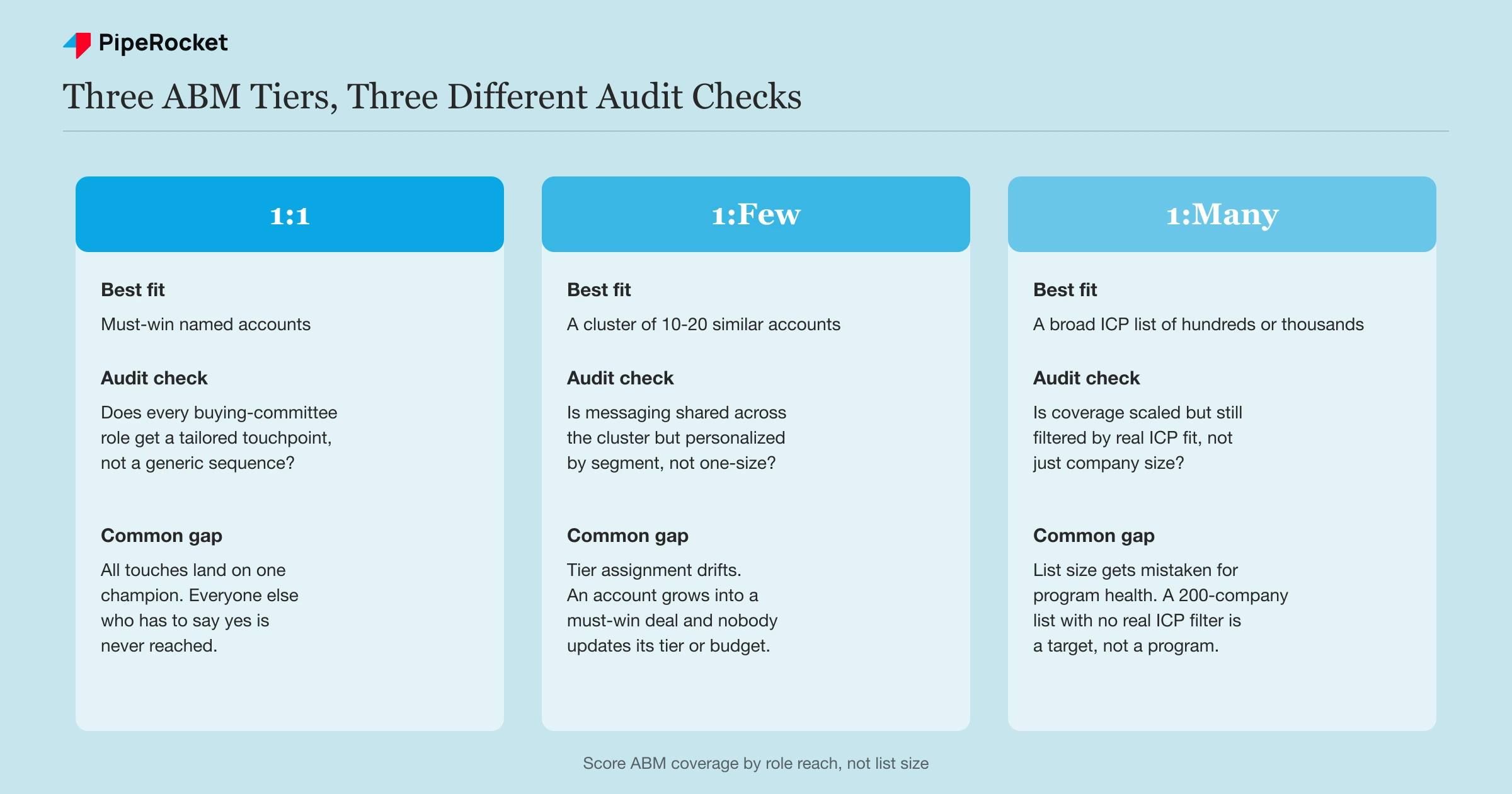
| ABM tier | Best fit | What to check in the audit |
|---|---|---|
| 1:1 | Must-win named accounts | Every buying-committee role has a tailored touchpoint, not a generic sequence |
| 1:Few | A cluster of 10-20 similar accounts | Messaging is shared across the cluster but personalized by segment, not one-size-fits-all |
| 1:Many | A broad ICP list of hundreds or thousands | Coverage is scaled but still filtered by real ICP fit, not just company size |
Checking Whether Every Committee Role Gets a Touchpoint
Most ABM programs concentrate almost all their touches on one champion inside the account, usually whoever first engaged. Pull the org chart for your five largest active-deal accounts and mark which roles marketing has actually reached with a relevant touchpoint.
If the answer is “just the champion” on most of them, the program is running 1:1 in name and 1:none in practice for everyone else in the room who has to say yes.
Checking Whether Tier Assignment Still Matches Deal Value
An account can drift from 1:Few into a must-win 1:1 deal without anyone updating its tier, especially once a champion starts moving fast internally. Recheck tier assignments against current pipeline value at least quarterly, because a stalled tier assignment usually means a stalled level of investment too.
Sales-and-Marketing Alignment: Audit This First
Sales-and-marketing alignment gets audited by comparing what each team actually calls a qualified lead and how fast a lead moves from marketing to a sales conversation. Asking either team how aligned they feel isn’t reliable. The lead definition and the clock are.
Check Whether “Qualified” Means the Same Thing to Both Teams
Pull marketing’s lead scoring criteria and sit down with a sales rep to walk through the last 20 leads marked “qualified.” Ask the rep, for each one, whether they’d have called it qualified too.
If the answer is no more than a third of the time, marketing and sales are scoring against two different definitions, and every report built on “MQLs” is measuring two different things depending on who’s reading it.
Measure the Real Handoff Speed, Not the SLA on Paper
Check your CRM for the real time gap between a lead hitting marketing-qualified status and the first sales touch, not the SLA that’s written in a playbook somewhere. Playbooks say 24 hours. Real handoffs often run days.
We’ve told a client not to scale ad spend at all until this gap closed, because every new lead was landing in the same slow queue as the ones already going cold. Scaling spend into a broken handoff just buys more leads that sit unanswered.
Look at What Sales Actually Hears on Calls
Sit in on five recent discovery calls, or pull the recordings if calls aren’t live. Compare the objections and questions buyers raise against what your content and ad copy currently promise.
If sales keeps fielding a question your top-of-funnel content never addresses, that’s a signal marketing is optimizing for a message the market isn’t asking about yet.
Tech Stack and CRM Data Flow: Audit What Your Tools Can Actually See
The tech stack gets audited by checking whether tracking, forms, and CRM fields can attribute activity to the right account and to multiple contacts, before you question the attribution model itself. A stack that logs one contact per deal will make even a perfect model report a committee decision as a single-buyer one.
Walk the path a real buyer takes: form fill, tracking tag, lead record, account record, then hand-off field. Check that each step writes to the account, not just an orphaned contact, and that a second or third contact from the same company lands on the same account rather than a duplicate.
Common failures live here, not in the model: forms that don’t capture company, tracking that breaks across devices, and CRM records where the account link is optional. Fix the plumbing first, then the attribution question below becomes answerable.
Audit Whether Attribution Can Even See the Buying Committee
Attribution in a B2B cycle has to account for a group of people engaging with your marketing across months, so the audit checks whether your model can even register that many people, before it checks whether the model is accurate. Most attribution setups quietly assume one visitor equals one buyer, and a committee-based deal breaks that assumption immediately.
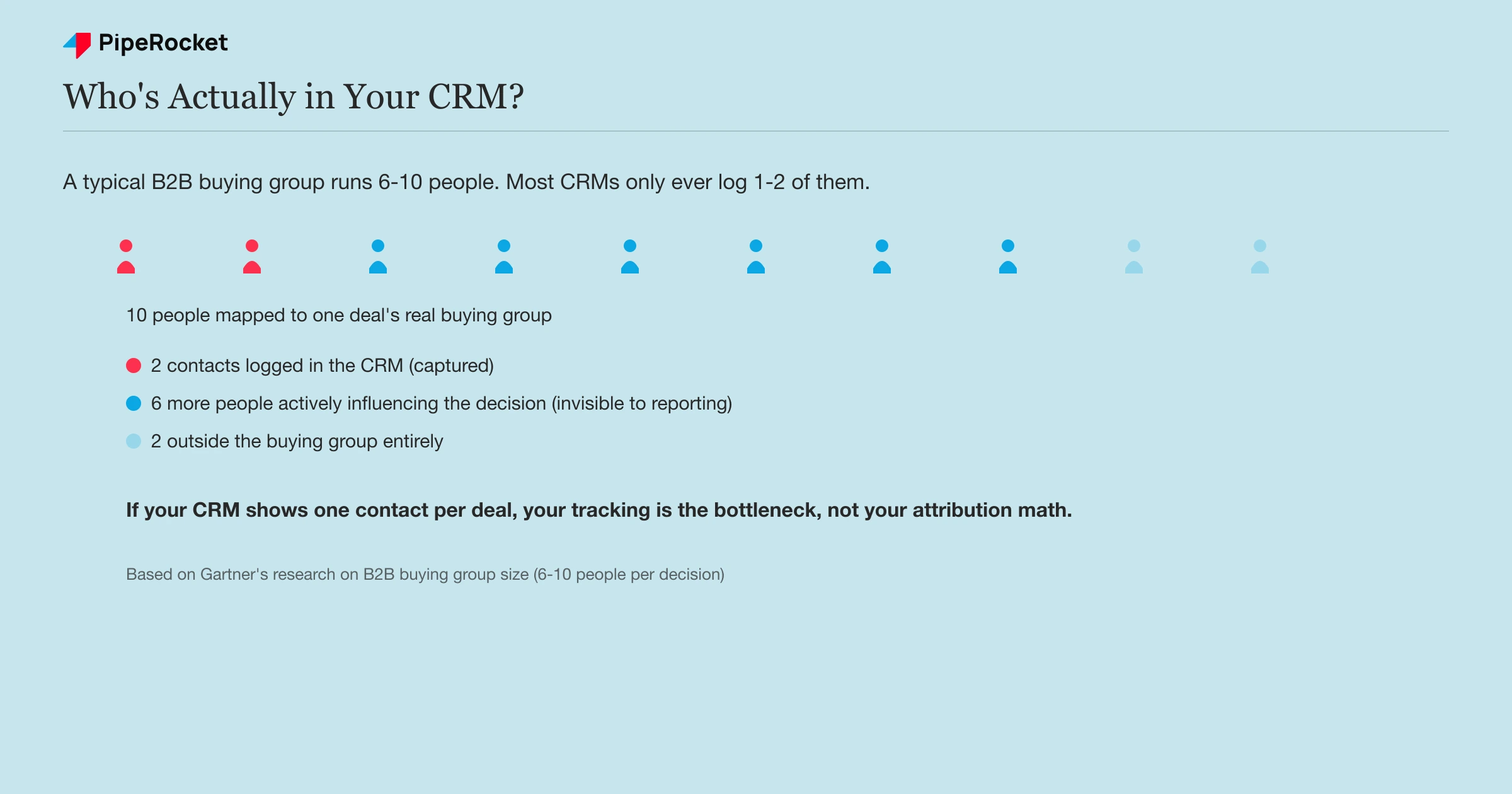
A typical B2B buying group involves somewhere between six and ten people, according to Gartner’s research on B2B buying groups, each researching independently before the group ever compares notes.
If your CRM is only capturing the one contact who filled out a form, the other five to nine people influencing the decision are invisible to your reporting, even though they’re actively shaping the outcome.
No attribution model has this fully solved. Multi-touch models need clean tracking across every device and channel those committee members touch, and most B2B stacks don’t have that. The honest fix is picking one model everyone distrusts equally and adding signals a single model can’t capture.
Checking Whether You’re Even Capturing Multiple Contacts Per Account
Pull your 10 most recent closed-won deals and count how many distinct contacts from the buyer’s side show up anywhere in your CRM, not just the one who signed.
If most deals show only one or two logged contacts against a group that Gartner-style research puts at six to ten, your tracking is the bottleneck, not your attribution math.
Adding Committee-Level Signals a Single Model Misses
Layer in checks that don’t depend on perfect tracking.
- Ask new customers during onboarding which roles were involved in the decision and what each one cared about
- Track how many distinct contacts per account engaged with gated content or attended a webinar, as a rough proxy for committee reach
- Watch whether deals with three or more engaged contacts close faster or at a higher rate than single-contact deals in your own data
None of these replace a model, and we’ll be honest about the current state of the field: no company has attribution across a full buying committee completely figured out. These signals just catch what a single number always misses.
Common Mistakes That Turn a B2B Marketing Audit Into a Wasted Quarter
An audit that doesn’t change anything afterward failed for a specific, predictable reason.
Auditing Content and Channels Without Ever Touching the CRM
A findings deck built entirely from Google Analytics and ad platform dashboards can’t see the handoff gap or the committee-coverage problem, because both live in the CRM, not the marketing stack. Pull CRM data as a mandatory input, not an optional cross-check.
Scoring ABM Coverage by List Size Instead of Role Coverage
A target account list with 200 companies looks like a healthy program until you check how many roles inside each account are actually being reached. List size measures ambition. Role coverage measures execution. A shorter list where marketing has reached the champion, the budget holder, and the security reviewer beats a longer one where every touch went to a single name.
Treating One Attribution Model as the Final Answer
Picking a primary attribution model is necessary for consistency, but treating its output as gospel means ignoring every committee member the model structurally can’t see. Pair the model with the committee-level signals from the tech-stack area, every time.
Skipping Owner and Date Assignment
A finding that ends with “sales and marketing should sync on lead definitions” and no named owner or deadline dies in the meeting where it was presented. Every fix from this audit needs a name and a date attached before anyone leaves the room.
How PipeRocket Runs a B2B Marketing Audit
As a SaaS marketing agency , we run this exact framework for B2B SaaS clients across all five areas:
- Lead-definition and handoff-speed checks between marketing and sales
- ABM coverage scored by role reach instead of list size
- One attribution model paired with committee-level signals it can’t capture on its own
- ICP, messaging, and content-and-SEO checks that confirm every committee role can find a relevant page, folding into a deeper SaaS content audit where the content area is the biggest gap
If sales alignment or lead quality comes out as the biggest gap, that work usually feeds straight into a B2B marketing agency engagement built around fixing pipeline handoff, not just adding traffic. Want us to run this on your account? Reach out here . Prefer to run it yourself first? Our interactive B2B marketing checklist covers the same ground.
Frequently Asked Questions
What should you include in a full B2B marketing audit?
Include five areas: ICP and messaging fit, content and SEO visibility, demand generation by revenue source, sales-and-marketing alignment, and the tech stack that tracks it all. For B2B, add ABM role coverage and buying-committee attribution.
What are the 7 steps in the audit process?
There’s no universal 7-step standard for a B2B marketing audit. Structure it by the five areas above instead: check each area, note the red flag, and end with three ranked fixes that each have a named owner and a date.
What is a B2B marketing audit?
A B2B marketing audit is a structured review of how well marketing and sales work together, how account-based programs are performing, and whether attribution can see a full buying committee rather than a single contact. It’s different from a channel audit because it looks at the handoffs and coverage gaps between teams and roles, not just campaign numbers in isolation. The output should be a short list of ranked, owned fixes.
How is a B2B marketing audit different from a SaaS marketing audit?
A B2B marketing audit is framed for any business model where a group of people makes the buying decision together, whether that’s a services firm, an agency, or a SaaS company selling to enterprise accounts. A SaaS marketing audit narrows in on positioning, channel mix, and funnel conversion for a single-product SaaS company, often assuming a shorter, more self-serve buying path. Use the SaaS version when your buyer is closer to one decision-maker; use this framework when a committee is involved.
How often should a B2B company run a marketing audit?
Once or twice a year is enough for most B2B companies, paired with a lighter quarterly check on lead-definition alignment and ABM tier assignments specifically, since those two drift the fastest. If your sales cycle length or committee size shifts significantly, for example after moving upmarket into larger accounts, that’s a reason to run one sooner than the calendar suggests.