SaaS Go-to-Market Strategy: The Launch Playbook From ICP to Day 90
 Praveen Ravi
Last updated on
Praveen Ravi
Last updated on

CB Insights found that 43% of failed, VC-backed startups point to poor product-market fit as the reason they shut down, the single biggest cause in their dataset. Budget wasn’t the problem. Nobody wanted the thing badly enough to pay for it, and the team found out after launch instead of before.
TL;DR
- A launch needs its own motion: Inside a SaaS go-to-market strategy, launching a new product or feature is a sequencing problem, separate from steady-state acquisition or brand positioning.
- Validate the ICP with real behavior: A written ideal customer profile means nothing until real prospects show genuine intent to pay for what you’re building.
- Sequence the launch in stages: Private beta, early access, then general availability each de-risk the next stage instead of gambling on one big-bang date.
- Pick channels built for a spike: Launch channels favor concentrated reach among a warm audience, a different logic than the diversified portfolio steady-state acquisition runs.
- Price for the launch you’re running today: Launch pricing only needs to clear the friction bar for an early sale, and the packaging can get perfected later with real usage data.
- Brief sales and support before launch day: A demo nobody can support or sell converts a launch into a support fire drill.
- Run the first 90 days on a plan: Day 0 to 90 has its own milestones, and the metric that matters changes at each stage.
- Build on four core elements: Every SaaS GTM strategy runs on an ICP, a value proposition, pricing and packaging, and distribution channels before any launch-specific sequencing starts.
- Pick a GTM motion first: Product-led fits low-complexity broad markets, sales-led fits complex enterprise deals, and partner-led extends reach through someone else’s channel.
The Core Elements of a SaaS Go-to-Market Strategy
A SaaS go-to-market strategy is built on four core elements: an ideal customer profile, a value proposition, pricing and packaging, and distribution channels. Settle these four before you sequence any launch, because every launch decision inherits its logic from them.
Think of these four as the foundation the launch sits on. The rest of this guide goes deep on the launch-specific version of each element, but the framework below is what a GTM strategy covers before a single launch date gets picked.
Our SEO lead plans the content side of GTM on a similar long horizon: a three-year plan built on top of a mind map that defines the full topic universe before a single piece gets published, rather than deciding what to write quarter by quarter. The same logic applies to a GTM launch: map the full landscape of what has to be true (ICP, message, pricing, channel) before picking a date, instead of filling in the gaps as the launch approaches.
| Core element | What it covers |
|---|---|
| Ideal customer profile | The firmographics, company size, and pain points of the buyer most motivated to pay right now |
| Value proposition | The business outcome and ROI the product delivers, phrased in the buyer’s terms |
| Pricing and packaging | How value is captured: tiered, usage-based, or flat, and which tier the first cohort buys |
| Distribution channels | How the product reaches buyers, from self-serve checkout to partner-led enterprise sales |
Value Proposition: The Outcome You Sell, Not the Feature List
A value proposition states the concrete business outcome a buyer gets and the ROI that justifies the spend, in the buyer’s own words. It answers “why switch” before it ever mentions a feature.
This is separate from positioning. Positioning decides the category you compete in and the message that beats the alternative a buyer already knows. The value proposition is the payoff line inside that positioning: the specific result a buyer can point to when they defend the purchase internally.
A value proposition that lists capabilities (“real-time dashboards, SSO, audit logs”) describes the product. One that names an outcome (“cut audit prep from three weeks to two days”) sells it. The second version survives a budget review. The first one gets cut.
Choosing Your GTM Motion: PLG, Sales-Led, or Partner-Ecosystem
Choose a GTM motion before you build the launch: product-led growth for low-complexity, broad-market products; sales-led growth for complex, high-value enterprise deals; and partner-ecosystem to extend reach through marketplaces and agencies. Product complexity and deal size decide which one fits your SaaS go-to-market strategy.
The motion you pick shapes every downstream choice, from pricing to which channels carry the launch. Most SaaS teams run one primary motion and borrow tactics from the others rather than splitting effort evenly.
| GTM motion | Best fit | Example channel |
|---|---|---|
| Product-led growth (PLG) | Low-complexity products a buyer can adopt without a rep | Free tier or trial, self-serve checkout, in-product upgrade prompts |
| Sales-led growth (SLG) | High-complexity, high-value deals with multiple approvers | Outbound reps, demos, paid pilots, procurement-led enterprise sales |
| Partner-ecosystem | Products that ride an existing platform or buyer relationship | Cloud marketplaces (AWS, Azure), agency partners, integration listings |
For a full teardown of the self-serve motion, from activation loops to expansion revenue, a product-led growth strategy deserves its own deep dive, and our sibling guide on the product-led growth strategy covers it. The launch playbook below applies whichever motion you run.
Why a Product Launch Needs Its Own Go-to-Market Motion
A SaaS go-to-market strategy for a launch is the plan for how a new product, feature, or market entry meets its first real customers. It is not the same document as your ongoing acquisition plan or your positioning work, even though all three feed each other.
Most teams treat “go-to-market” as a catch-all term for the marketing plan. That’s incomplete. A launch has a start date, a fixed set of unknowns, and a narrow window to learn from real buyers before the budget and the internal patience run out.
Two other disciplines sit next to this one, and it helps to draw the line clearly.
- Positioning decides the category you compete in and the message that makes a buyer choose you over the alternative they already know. That work has to happen before launch, but it’s a separate craft with its own frameworks.
- Customer acquisition is the ongoing channel portfolio and CAC math you run once the product is live and selling. That’s steady-state work, built to compound over quarters.
This guide covers what happens between those two: the sequencing decisions that get a new product or feature safely in front of its first buyers.
Think of it as the bridge. Positioning tells you what to say, and acquisition tells you how to keep growing once the engine is running. Go-to-market for a launch is how you turn the key the first time without stalling the engine.
Most Launch Failures Are Sequencing Failures
The common story is that a launch fails because marketing didn’t spend enough or sales didn’t close hard enough. Look closer at real post-mortems and the pattern is usually earlier in the chain: the team skipped validation, picked the wrong channel for a cold audience, or shipped a price nobody had tested.
A launch that goes wrong in week one rarely gets a second look from the same budget or the same internal champions. That cost outlasts a single bad quarter. It’s a shot you rarely get to take the same way twice.
Validate Your ICP Before You Build Anything to Launch
A launch-ready ideal customer profile, the first building block of any SaaS go-to-market strategy, has already shown it will pay for what you’re building. Company size, industry, and tech stack describe who might fit the profile, but that’s a different question from who’s motivated enough to buy right now.
Most teams inherit an ICP definition from the positioning work and treat it as settled. That’s a mistake at launch specifically, because positioning validates fit and framing. It doesn’t validate willingness to pay for something that doesn’t fully exist yet, which is exactly the gap a launch has to close.
Confirm the Firmographic Profile Actually Buys
Run the ICP definition against a small batch of real prospects before committing a launch date to it. Pull 15 to 20 contacts who match the profile on paper and get them on a call instead of sending a survey.
A survey tells you what people think they’d do. A conversation, especially one that asks for a real next step, tells you what they’ll actually do.
Ask about the budget line this would come out of, who else needs to approve it, and what they’re using today instead. If half the calls surface a different persona as the real buyer, the ICP needs a rewrite before the launch plan gets built on top of it.
Picture a compliance SaaS built for fintech risk teams. The founders assumed the compliance officer was the buyer, since that’s who the product serves day to day.
A dozen validation calls later, the real budget holder turned out to be the VP of Engineering, because the tool touched the audit trail on production data. That single correction changed who the entire launch sequence, from beta invites to sales talk tracks, was built around.
Look for a Signal Stronger Than Interest
Interest is cheap. Someone saying “looks cool, keep me posted” costs you nothing to hear and tells you almost nothing. The signal that actually de-risks a launch is one that costs the prospect something: a deposit, a signed letter of intent, a calendar hold for onboarding, or a commitment to migrate data.
Waitlists are a weak proxy unless you attach a real ask to joining one. A waitlist with a $500 refundable deposit filters out the tire-kickers in a way a plain email-capture form never will. If you can’t get a single prospect to commit anything before launch, that’s information telling you to wait.
Sequence the Launch Instead of Doing It All at Once
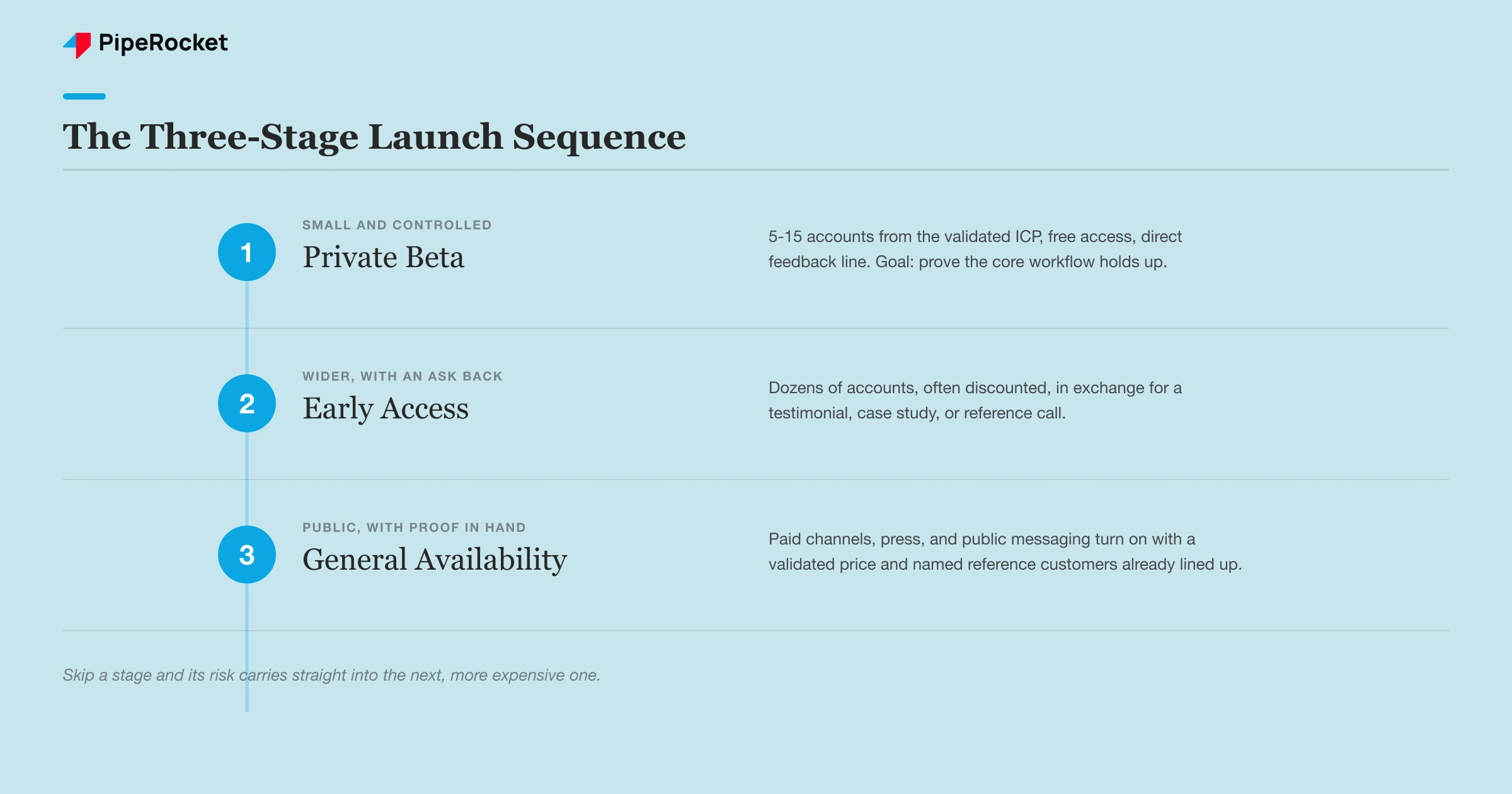
A staged launch sequence beats a single big-bang date because each stage retires a specific risk before you spend money proving the next one. Skip a stage in your SaaS go-to-market strategy and you carry its risk straight into a bigger, more expensive, more public one.
Private Beta: Prove the Product Works Before You Promote It
Private beta exists to answer one question: does the core workflow hold up with real data and real usage, outside your own test accounts. Invite a small group, usually 5 to 15 accounts from your validated ICP, and give them the product for free in exchange for direct feedback access.
Don’t promote a private beta publicly. The whole point is a controlled group small enough that you can talk to every single user and fix what breaks before anyone outside that group sees it.
Early Access: Earn Proof Points and Fix What Breaks
Early access widens the group, usually into the dozens, and starts asking for something back: a testimonial, a case study, a reference call, or in some cases a paid pilot. This is the stage where you collect the proof points a general launch needs to convert cold traffic.
Price is often discounted here on purpose, in exchange for public permission to use their name or their numbers. If you can’t get a single early-access account willing to be quoted, that’s worth pausing on before you widen the launch further.
General Availability: Open the Doors With Evidence in Hand
General availability is the public launch, and it should walk in with proof already in hand: a working product, a validated price, and at least a handful of reference customers willing to be named. GA is expensive to get wrong because it’s the stage where paid channels, press, and public messaging all turn on at once.
Teams that skip straight to GA without a beta or early-access stage run three experiments in public, on the same budget, at the same time:
- Product validation: does the core workflow hold up under real, unsupervised usage?
- Pricing validation: will buyers pay the price you set, without a discount to soften it?
- Channel validation: do the paid and press channels actually reach your ICP?
That’s three experiments where one bad result can sink the other two.
Choose Launch Channels for a Spike, Not a Steady Funnel
Launch channel selection favors concentrated reach in a warm, known audience over the diversified portfolio a steady-state acquisition plan runs. In a SaaS go-to-market strategy, a launch is a spike you need to land inside a short window. Steady-state acquisition is a compounding system you build over quarters, and the two need different channel logic entirely.
Our guide to SaaS customer acquisition strategy covers how to build and fund that ongoing channel portfolio once the product is live. At launch, the question is narrower: who already trusts you enough to act in the first two weeks, and how do you reach all of them at once.
| Launch channel logic | Steady-state acquisition logic | |
|---|---|---|
| Goal | Concentrated spike in a short window | Compounding pipeline over quarters |
| Audience | Warm, already-connected contacts | Cold and warm demand, blended |
| Channel count | Few, deliberately narrow | Portfolio, sized to deal complexity |
| Success signal | Fast activation and first proof points | CAC payback and pipeline contribution |
| Budget behavior | Front-loaded, one-time push | Ongoing, reallocated by channel performance |
Own Channels You Already Control
Start with the channels where you don’t have to earn attention, because you already have it. Your existing customer base, your email list, your team’s personal networks, and any community you’ve built are the fastest and cheapest way to reach people who already trust you.
An existing customer telling their peer about a new feature converts at a rate no cold channel will match on day one. Sequence your owned-channel outreach first, and let it generate the early proof points that make every other channel work harder later.
A dev-tools SaaS launching an API monitoring add-on skipped paid ads entirely for the first two weeks. It emailed its existing 4,000-account base, posted in its own community Slack, and asked ten friendly customers to try it first.
Those ten accounts alone surfaced three onboarding bugs and gave the team its first two public case studies before a single paid click ran.
Borrowed Reach for Day One
Borrowed reach means channels where someone else’s audience temporarily becomes your launch audience. Partner co-announcements, integration marketplace listings, analyst briefings, and platforms built specifically for new-product visibility all fall here.
Pick one or two borrowed channels that overlap tightly with your validated ICP rather than spreading a press push everywhere. A generic tech-press mention drives vanity traffic. A partner’s newsletter to their existing SaaS-buyer list drives people who already fit your profile.
Price and Package for the Launch Motion, Not the Steady-State Roadmap
Launch pricing only has to clear the friction bar for an early sale. It doesn’t need to be the final monetization model, and treating it that way is what stalls launches for weeks that should have taken days.
Most teams over-engineer packaging before they have proof anyone will pay at all. Three tiers, add-ons, and usage-based metering are all reasonable decisions eventually. At launch, they’re mostly guesses dressed up as strategy, built on usage patterns you haven’t observed yet.
Set a simple, defensible price for the first cohort and be upfront that it’s an early-access rate. Grandfather early customers into that price as a reward for taking the risk on an unproven product.
Reserve the right to test tiers and packaging once real usage data exists. Let that usage data decide the final packaging instead of another round of internal debate.
Get Sales and Support Ready Before the Launch Date, Not After
Internal launch readiness means sales and support can handle real customer conversations on day one, rather than a slide deck sitting somewhere in a shared drive. Marketing readiness gets most of the attention when teams plan a SaaS go-to-market strategy. Internal readiness usually gets a fraction of the time and it shows immediately once the first tickets and calls come in.
SiriusDecisions, now part of Forrester, has found that roughly 65% of the sales content marketing produces goes unused, mostly because it’s outdated or too hard to customize for a live conversation. A stack of one-pagers built in the final week before launch, without input from the reps who’ll actually use them, tends to join that pile.
Build launch readiness around what a rep or a support agent needs mid-conversation instead of what looks complete in a review meeting.
- A one-page objection-handling sheet covering the five questions prospects actually ask
- A support macro or two for the most likely first-week tickets, written before those tickets exist
- A short internal demo walkthrough recorded once, so every rep sees the same version of the pitch
- A clear escalation path for bugs the beta didn’t catch, with an owner named, not “engineering”
Run a dry-run call with your own sales team a week before launch, where they pitch the new product to each other. It surfaces the gaps in the material faster than any written review does.
Common Mistakes to Avoid
Confusing Interest for Demand
Teams count waitlist signups, LinkedIn comments, and “looks great” replies as validation and greenlight a launch date on the strength of them, resting the whole SaaS go-to-market strategy on an unproven signal. None of that costs the prospect anything to say. Demand only shows up when someone commits money, time, or their own reputation to the outcome, and a launch plan built on free interest usually meets a market that goes quiet the moment a price appears.
Launching on Every Channel at Once
A team that’s spent months preparing wants to make noise everywhere on day one, firing paid ads, press, partner emails, and a social push the same morning. The result is a spike of unqualified traffic that overwhelms an understaffed support team, with no clear read on which channel worked. Stagger channels by a few days each and keep a clean enough signal to know what to double down on.
Locking Pricing Before You Have Proof
Some teams spend the pre-launch runway debating tier structure and per-seat versus usage-based billing before a single customer has paid anything. That debate is worth having, just not before real usage data exists to settle it.
An early, simple, clearly-temporary price gets you to real data faster than any amount of internal modeling does.
Leaving Sales Unbriefed Until Launch Day
Marketing finishes the launch assets, hits send, and hands sales a one-line Slack message the morning of. Reps field their first real questions with no talk track and no pricing guidance, and prospects notice the improvisation immediately.
Brief sales at least a week ahead, with the same material support and product have already reviewed.
Run the First 90 Days on a Plan
The first 90 days after launch are where a SaaS go-to-market strategy meets real usage. Each month carries a different goal, and treating all three the same is how a team misses the moment to fix something before it compounds. Day 0 to 30 is about activation. Day 31 to 60 is about retention signal. Day 61 to 90 is about whether the motion is ready to scale.
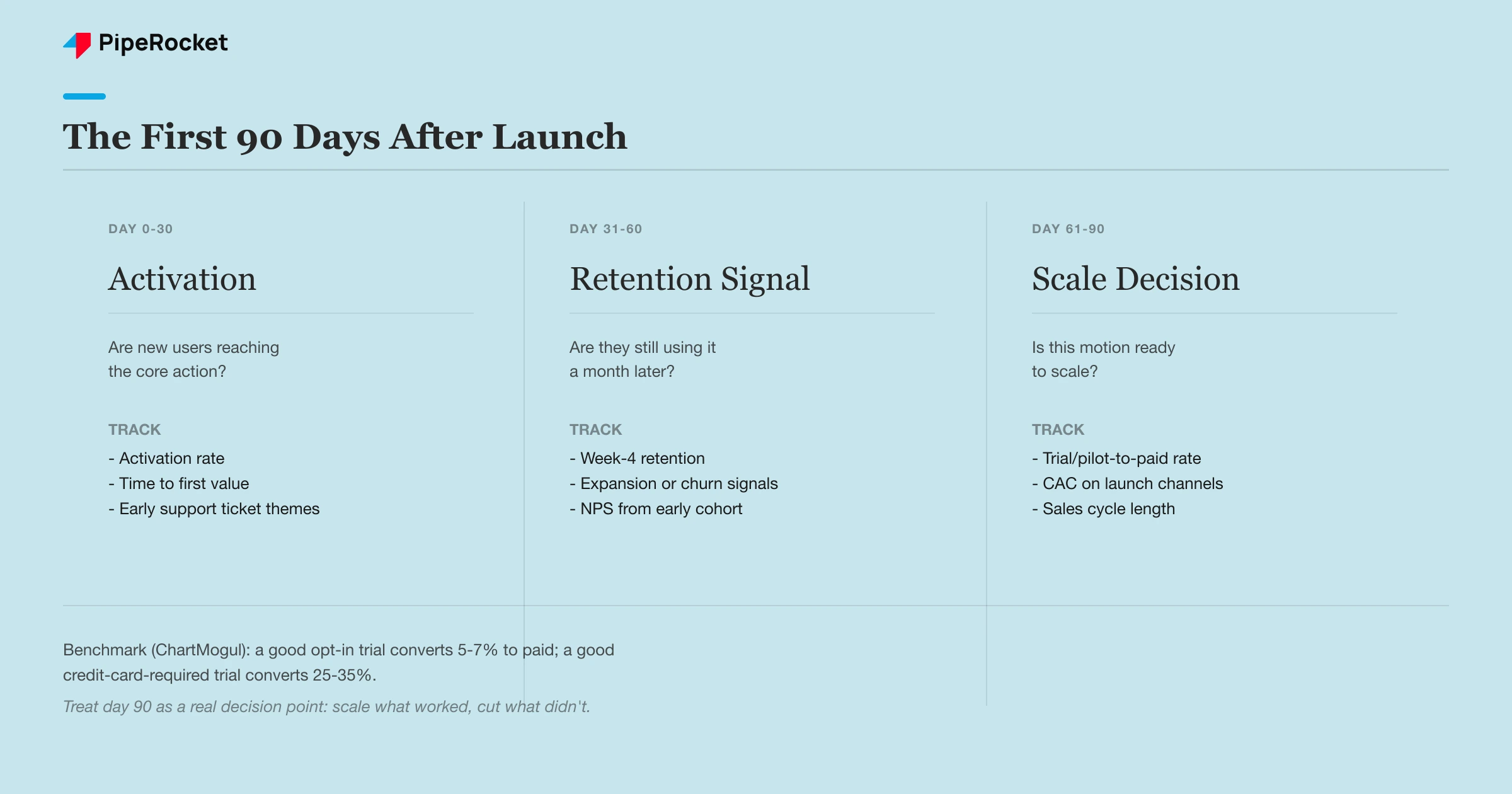
| Window | Primary question | What to track |
|---|---|---|
| Day 0-30 | Are new users reaching the core action? | Activation rate, time to first value, early support ticket themes |
| Day 31-60 | Are they still using it a month later? | Week-4 retention, expansion or churn signals, NPS from early cohort |
| Day 61-90 | Is this motion ready to scale? | Trial-to-paid or pilot-to-contract rate, CAC on launch channels, sales cycle length |
Benchmark trial conversion against real numbers instead of guessing at what “good” looks like.
Did You Know: ChartMogul’s SaaS conversion benchmarks put a good opt-in free trial at 5-7% converting to paid, with 12-16% considered great. Trials that require a credit card upfront convert far higher, 25-35% is good and 50-60% is great, because the sign-up itself already screens for intent.
A launch cohort converting well below the range that matches your trial type by day 90 is telling you something specific. Either the ICP validation missed, or the price and package don’t match what that cohort is willing to pay.
Treat day 90 as a real decision point instead of a formality. Scale the channels and the price that worked, cut the ones that didn’t, and feed everything you learned about messaging back into the positioning work and everything you learned about channels into the ongoing acquisition plan.
How PipeRocket Digital Helps SaaS Teams Launch
As a SaaS marketing agency , we help SaaS teams turn a launch into a repeatable motion instead of a one-time scramble, building the paid and organic channel plan that carries a launch cohort into steady-state growth. Our SaaS PPC team builds the paid side, and you can see how we’ve done it for other teams on our list of the best SaaS marketing agencies .
Get in touch if you want a second set of eyes on your launch plan before the date is locked.
Frequently Asked Questions
What is SaaS and GTM?
SaaS is software delivered over the web on a subscription. A SaaS go-to-market strategy (GTM) is the plan for how a SaaS product reaches buyers, covering ICP, value proposition, pricing, and distribution.
What is a go-to-market strategy?
A go-to-market strategy is the plan for how a product reaches its target buyers and turns them into customers. For SaaS it runs on four elements: ICP, value proposition, pricing and packaging, and distribution channels.
What is SaaS marketing strategy?
A SaaS marketing strategy is the ongoing plan to generate demand and build brand across everything you sell. It is broader than GTM, which handles a single launch. See our SaaS marketing pillar for the full picture.
What’s the difference between go-to-market strategy and marketing strategy?
A go-to-market strategy is the plan for how a specific product, feature, or market entry reaches its first customers, including ICP validation, sequencing, pricing, and internal readiness. A marketing strategy is broader and ongoing, covering how you generate demand and build brand across everything you sell, not just a single launch. Every launch needs a go-to-market plan. Not every marketing initiative needs one.
How long should a SaaS product launch take?
Most SaaS launches run 8 to 12 weeks from private beta through general availability, though the exact length depends on how much the product changes based on beta feedback. Rushing the sequence to hit an arbitrary date usually costs more time later, when an unvalidated ICP or an untested price forces a restart after GA. Build the timeline around the proof points each stage needs to produce rather than an arbitrary date picked in a planning meeting.
Do you need a different GTM strategy for each new feature?
Not every feature needs the full sequence. A minor feature that extends existing use cases can usually go straight to existing customers with a simple announcement. A feature that opens a new use case, a new buyer persona , or a new pricing tier needs its own scaled-down version of the launch motion, including a validation step with a handful of accounts before a wider rollout.