SaaS Buyer Persona: What It Is and How to Build One That Works
 Ranjeeth Kumar
Last updated on
Ranjeeth Kumar
Last updated on
A SaaS buyer persona is a research-backed profile of the specific person who evaluates, champions, or uses your software, built from their goals, daily frustrations, and how they actually search and buy, not a guess dressed up in a name and a stock photo.
TL;DR
- A SaaS buyer persona documents how a real segment of your market thinks, searches, and decides, built from research rather than assumption.
- Most B2B SaaS products sell to a committee, so you need separate personas for the economic buyer, the champion, and the end user, not one blended profile.
- A buyer persona is not the same as an ICP: the ICP defines which companies to target, the persona defines the individual people inside them.
- PLG and sales-led motions need different personas because the moment someone becomes “the buyer” happens at a completely different point in the journey.
- Building a persona takes structured research, customer interviews, sales call transcripts, support tickets, and search behavior, not a template you fill in from your own assumptions.
- The most common mistake is writing one persona for an entire buying committee, which quietly breaks your messaging, your content, and your keyword targeting all at once.
- A persona is only working if it’s changing what you write, who you target, and how sales opens a call. If nothing changed, you built a poster, not a persona.
What Is a SaaS Buyer Persona?
A SaaS buyer persona is a documented profile of one specific type of person in your market, built from real research into their role, goals, daily frustrations, and buying behavior. It’s not your whole audience. It’s one slice of it, described in enough detail that a writer, a seller, or an ad manager could make a decision without asking you first.
In B2B SaaS, that matters more than it does almost anywhere else. You’re rarely selling to one person. A single deal usually runs through an economic buyer who owns the budget, a champion who’s pushing the tool internally, and an end user who has to live with it every day. Blend all three into a single “SaaS Buyer” persona and you write content that half-answers everyone’s questions and fully answers no one’s.
A persona is also not the same thing as an ICP. The ideal customer profile describes the company you want to sell to (industry, size, revenue), while the persona describes the individual person inside that company who evaluates or buys. You need both: the ICP tells you which accounts to target, the persona tells you how to talk to the people inside them.
We’ve watched teams build a persona once, put it in a slide deck, and never touch it again. Eighteen months later the product has moved upmarket, the ICP has shifted, and the persona still describes a customer that left the funnel a year ago.
The Core SaaS Buyer Persona Types
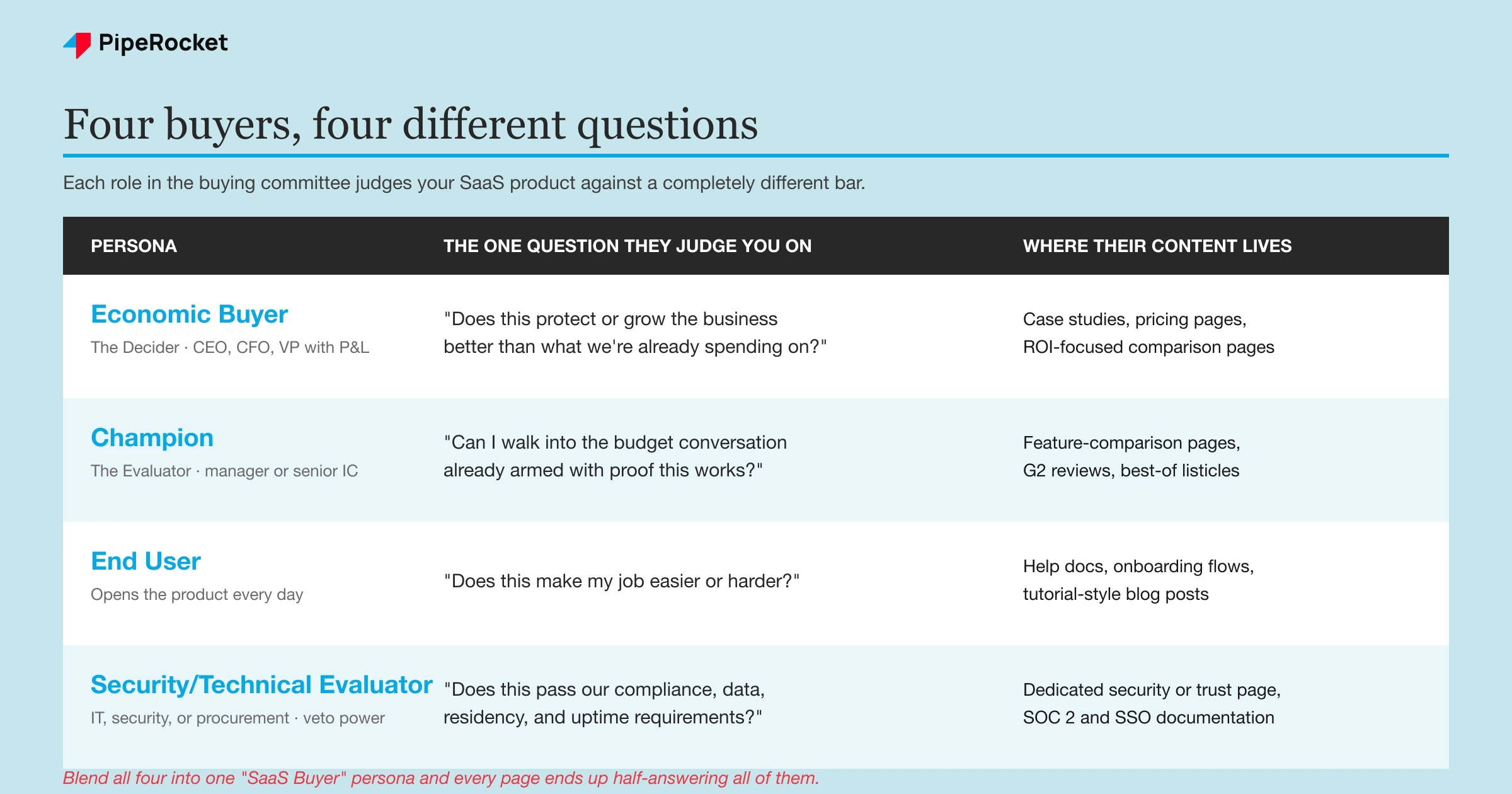
Most B2B SaaS purchases run through three to four distinct roles, and each one needs its own persona because each one is judging the product against a completely different question.
The Economic Buyer (The Decider)
The economic buyer controls the budget and asks one question above all others: does this protect or grow the business better than what we’re already spending money on. This is usually a CEO, CFO, or VP with P&L responsibility.
They rarely read your blog. They read the one-page ROI summary your champion forwards them, so your content for this persona lives in case studies, pricing pages, and comparison pages built around cost, risk, and payback period, not feature depth.
The Champion (The Evaluator)
The champion is the person inside the company who found your product, believes it solves a real problem, and is now spending their own political capital pushing it through approval. They’re usually a manager or senior individual contributor, not the person signing the check.
Their search behavior looks completely different from the economic buyer’s. They’re comparing tools feature by feature, reading G2 reviews, and searching things like “best [category] software for [team size]” because they need to walk into the budget conversation already armed with an answer.
The End User
The end user is whoever opens the product every day after the deal closes, and they judge it on one thing: does this make my job easier or harder. They rarely have purchasing power, but ignore them and you’ll win the deal and lose the renewal.
Their searches are tactical: “how to automate [specific task],” “[tool] vs [tool] for [specific workflow].” Content built for this persona belongs in your help docs, onboarding flows, and tutorial-style blog posts, not your pricing page.
The Technical or Security Evaluator
In mid-market and enterprise SaaS, a fourth role shows up before the deal closes: someone from IT, security, or procurement who has veto power but zero interest in the product’s features. They’re checking SOC 2 status, data residency, SSO support, and uptime history.
Skip this persona and a deal that felt closed can stall for weeks while your champion scrambles to answer questions nobody prepared them for. A dedicated security or trust page, built for exactly this reader, removes that entire bottleneck.
PLG and Sales-Led SaaS Need Different Personas
PLG and sales-led motions need separate personas because the moment someone becomes “the buyer” happens at a completely different point in the funnel, which changes what the persona has to capture. In a product-led growth (PLG) motion, an end user often self-serves into a paid plan with no economic buyer or champion involved at all, at least at first.
Sales-led SaaS flips that order. The economic buyer and champion get involved before anyone has touched the product, so their personas need to carry more about internal politics, procurement steps, and how the deal actually gets approved.
| Motion | Who becomes “the buyer” first | What the persona needs to capture |
|---|---|---|
| Product-led (PLG) | The end user, often self-serve | In-product behavior, activation triggers, upgrade prompts, what makes a free user hit a paywall |
| Sales-led | The economic buyer or champion | Procurement process, internal approval chain, competing priorities, what makes a demo worth booking |
| Hybrid | Starts as PLG, escalates to sales-led at a usage or seat threshold | Both of the above, plus the specific trigger that moves an account from self-serve to a sales conversation |
If your product runs a hybrid motion and your persona only describes one side of that table, your marketing will keep optimizing for the wrong half of the funnel.
How to Build a SaaS Buyer Persona
Building a real persona means gathering evidence from five sources (customer interviews, sales call transcripts, support tickets, search behavior, and closed-won CRM data) and refusing to fill gaps with assumptions, even when the gaps are inconvenient.
- Closed-won and CRM deal data. Start from the deals you actually won. Your CRM already shows which company types, roles, and use cases convert, so the persona is anchored in real buying behavior before you talk to a single customer.
- Customer interviews. Talk to 8 to 10 customers who match the segment you’re profiling and ask open questions: what triggered the search, what alternatives they considered, what almost stopped them from buying. Don’t lead the witness with your own theory of why they bought.
- Sales call recordings and transcripts. Sales hears the messy, layman language buyers actually use, not the polished terms your team assumes they search for. That language is exactly what should end up in your keyword targeting and page copy.
- Support tickets and churn feedback. The complaints that show up after the sale reveal the gap between what a persona expected and what they got, which tells you exactly what your pre-sale content is failing to set up correctly.
- Search and on-site behavior. Look at the queries bringing people to your site and the pages they land on before converting. A persona that ignores real search data is a persona built on a guess about what people search, not what they actually type into Google.
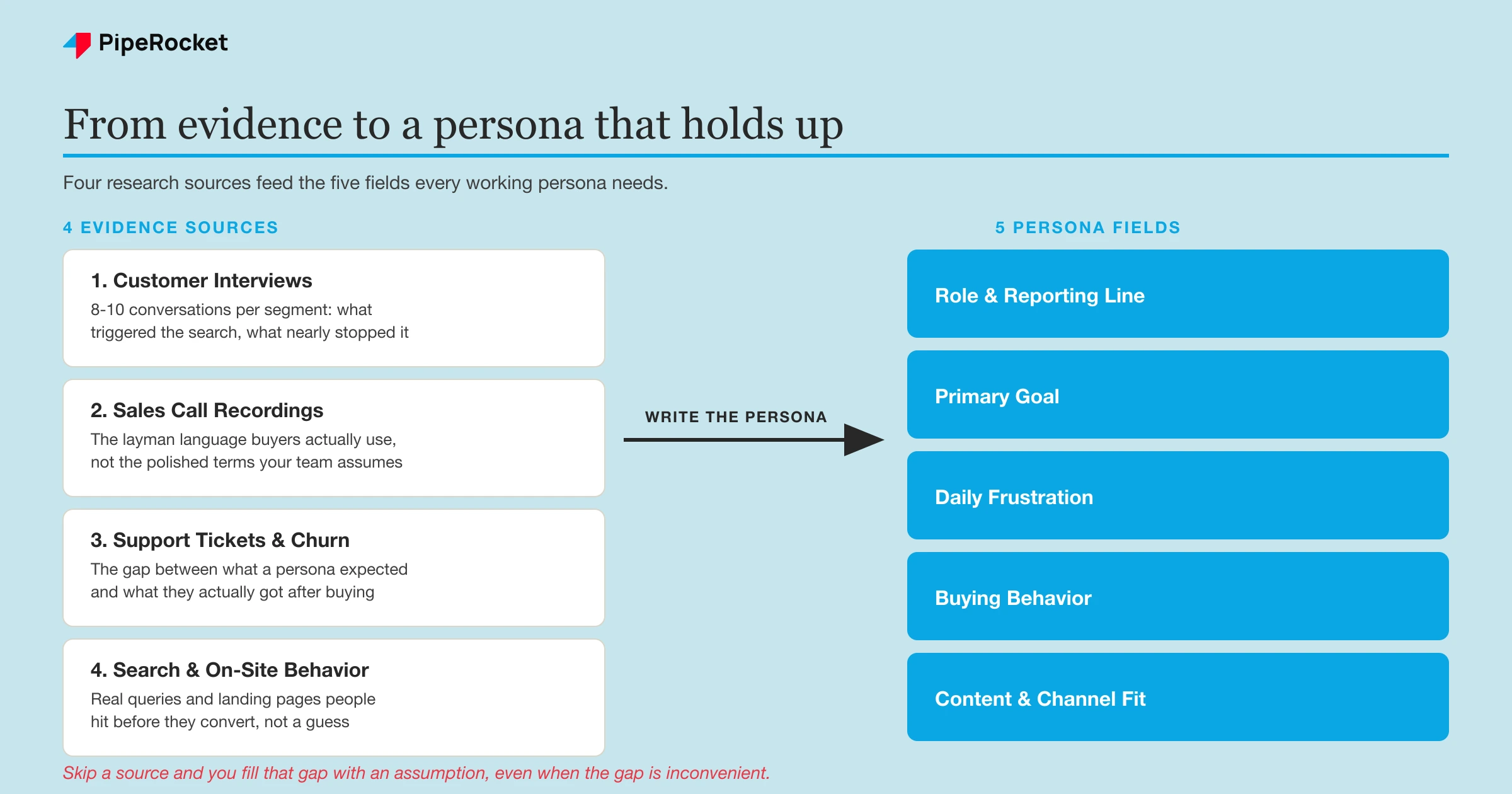
Once you’ve gathered the evidence, write the persona around these fields:
- Role and reporting line: their title, who they report to, and who reports to them
- Primary goal: the outcome they’re personally judged on at work
- Daily frustration: the specific, recurring annoyance that makes them start looking for a solution
- Current tech stack: the tools they already run, since a new purchase has to fit or replace something they use every day, and integration gaps are often the real reason a deal stalls
- Buying behavior and triggers: how they research, who they loop in, and the event that starts the search
- Buying objections: the specific reasons this persona hesitates or says no, such as switching cost, security review, or a competing internal priority, so your content can answer each objection before it kills the deal
- Content and channel fit: where they actually spend time, so you know where to put the content built for them, and which keywords to prioritize when you score SaaS keywords by ICP intent
Keep the set small. Limit yourself to two or three core personas per campaign, because trying to speak to more than that in a single motion spreads your messaging too thin to convert any of them. Personas also drift as your market moves, so review them quarterly against fresh CRM and interview data and update the fields that no longer match reality.
Common Mistakes to Avoid
Most SaaS buyer personas fail quietly. Nobody notices until content stops converting and no one can say why.
Writing one persona for the whole buying committee
Blending the economic buyer, champion, and end user into a single “SaaS Buyer” persona is the single most common mistake we see. It’s also the one that does the most damage, because the damage is invisible until you audit your content library. Only then do you realize every page has been trying to answer three different people’s questions at once.
Guessing instead of interviewing
A persona built entirely from internal assumptions, with no customer interviews or sales call review behind it, describes who your team thinks buys the product, not who actually does. The two drift apart faster than most teams expect, especially after a pricing change or a shift upmarket.
Treating the persona as a demographic sheet
Age, job title, and company size tell you almost nothing about why someone buys. A persona built around goals, frustrations, and buying triggers changes what you write. A persona built around demographics just changes what stock photo you pick for the slide.
Letting personas go stale
A persona is a snapshot of a moving target. If your ICP has shifted upmarket, your pricing has changed, or your product has added a feature that opens a new use case, the persona built two years ago is now actively misleading your content and ad targeting, not just outdated.
Building personas nobody on the team actually uses
A persona that lives in a slide deck and never reaches the writer, the ad manager, or the sales team isn’t a working tool, it’s documentation of a research project. The test isn’t whether the persona exists. It’s whether anyone can point to a piece of content or a targeting decision that changed because of it.
How to Know If Your Personas Are Actually Working
A working persona changes real decisions, not just internal vocabulary. Check for three things before you trust yours.
- Content splits cleanly by persona. If you can look at your blog, your comparison pages, and your product pages and clearly say which persona each one was built for, the persona is doing its job. If everything reads like it’s talking to everyone, it isn’t.
- Sales repeats your persona’s language back to you. When reps say a prospect used almost the exact frustration or goal language from your persona doc unprompted, that’s real confirmation the research was accurate.
- Targeting gets more specific over time. A real persona should let you cut wasted spend by excluding people who don’t match it, on LinkedIn, in your ad platforms, and in your keyword targeting. If your targeting hasn’t gotten more specific since you built the persona, it’s sitting on a shelf instead of running your marketing.
Keeping personas connected to live search behaviour is ongoing work, and the SaaS SEO agency shortlist covers teams that maintain that link.
How PipeRocket Digital Builds SaaS Buyer Personas That Drive Pipeline
We build personas from actual sales call transcripts, support tickets, and search data, not a template filled in from guesswork, then map every keyword and page to the specific persona it’s meant to convert. That’s the foundation behind our SaaS SEO agency work and our SaaS PPC campaigns, both built persona-first so content and ad targeting never fight each other.
If your current personas were built once and forgotten, talk to us about rebuilding them around who’s actually buying today.
Frequently Asked Questions
What is a SaaS buyer persona?
A SaaS buyer persona is a research-based description of one specific type of buyer, built from their role, goals, frustrations, and how they search and decide, used to guide what content gets written and who marketing targets. It’s built from real customer interviews, sales calls, and search behavior, not internal assumptions about who buys the product.
What are the four types of buyer personas?
Most B2B SaaS purchases involve up to four roles: the economic buyer who controls budget, the champion who advocates internally, the end user who uses the product daily, and, in mid-market and enterprise deals, a technical or security evaluator who checks compliance and data requirements before approving the purchase. Not every deal involves all four, but larger deals almost always do.
How is a buyer persona different from an ICP?
An ideal customer profile (ICP) describes the company you want to sell to, things like industry, company size, and revenue. A buyer persona describes the individual person inside that company who evaluates or buys the product, including their role, goals, and behavior. You need both: the ICP tells you which companies to target, and the persona tells you how to talk to the people inside them.
What are the three types of buyers?
In buyer psychology, the three types are the tightwad (spend-averse) buyer, the average or unconflicted buyer, and the spendthrift (free-spending) buyer. This buying-style framework is separate from the role-based SaaS personas (economic buyer, champion, end user) covered above.
What are some real SaaS buyer persona examples?
A common example is a mid-market SaaS company selling to a “VP of Operations” economic buyer who cares about cost and risk, an “Ops Manager” champion who found the tool and is pushing it through approval, and an “Analyst” end user who runs it daily. Each gets separate content: an ROI-focused comparison page for the VP, a feature-comparison guide for the manager, and a tutorial-style help doc for the analyst.