Google Ranking Factors 2026: The Complete List (Free PDF Download)
 Sabari Rohith
Last updated on
Sabari Rohith
Last updated on
Google ranking factors are the signals its algorithm uses to decide the order of search results for a query, covering your content, links, technical health, and brand. Google has never published an official count, and the famous “200 ranking factors” figure is old SEO folklore, not a Google number. Google actually confirms only a handful of signals directly. This is the complete list for 2026, with every factor tagged by how much evidence stands behind it: confirmed by Google, revealed by the 2024 leak, correlated but unconfirmed, or myth. That honesty layer is the whole point, because most ranking-factor lists present a rumor and a confirmed signal as if they carry equal weight, and they do not. You can grab the entire list as a free, brand-themed PDF below, no email required.
Google Ranking Factors 2026 (Free PDF) The complete list, grouped by category and tagged by evidence level, plus a priority sequence. A 4-page branded reference you can keep. 4 pages · PDF · No email required Download PDFTL;DR
- The count is folklore. Google has never confirmed “200 factors.” Its own documentation describes ranking systems (RankBrain, BERT, PageRank, and so on), not a countable list of discrete factors.
- Only a handful are officially confirmed: high-quality content, links, HTTPS, mobile-friendliness, page experience and Core Web Vitals, freshness, and intrusive-interstitial penalties.
- The 2024 Google leak added real evidence for site-wide authority, click signals (NavBoost), a new-site “sandbox,” author entities, and link-quality tiers, but “documented internally” is not the same as “confirmed live-weighted.”
- E-E-A-T is not a direct ranking factor. It is the framework Google’s human raters use to train and validate the algorithm, a distinction almost every list gets wrong.
- The AI-search era reweights, it doesn’t replace. The same signals that rank you also get you cited in AI Overviews, but “ranking” now shares the page with a synthesized answer.
- Sequence beats checklist. Fix indexation and intent first, build authority and brand next, and leave the rounding-error signals for last.
How Many Google Ranking Factors Are There?
There is no official number. “200 ranking factors” is an unofficial figure from the early 2010s that took on a life of its own and now gets repeated as if Google published it. Google never did.
More importantly, the framing is slightly wrong. Google’s own Guide to Google Search ranking systems describes systems, not a discrete list of weighted factors. RankBrain, BERT, neural matching, PageRank-based link analysis, the reviews system, and the freshness systems are named machines that each read many signals. Counting “factors” treats a handful of inputs and a whole ranking system as the same unit, which is why every list lands on a different total, from 7 to over 270.
So the useful question is not “how many are there” but “which ones does Google actually confirm, which ones do we have strong evidence for, and which ones are noise.” That is exactly how the list below is organized.
The Complete List of Google Ranking Factors, Tagged by Evidence
Here is the full map, grouped by category. Each factor carries a tag so you can see at a glance how much weight the evidence really supports:
- ✅ Confirmed: Google has stated it publicly or documented it officially.
- 🟡 Leak/Evidenced: surfaced in the March 2024 Content Warehouse leak or in strong correlation studies, but not officially confirmed as live-weighted.
- ⚪ Myth/Negligible: debunked, retired, or a rounding-error signal not worth chasing.
Content and relevance
| Factor | Evidence |
|---|---|
| Content that satisfies the query intent (helpful, people-first content) | ✅ Confirmed |
| Topical relevance and depth (semantic coverage, entities) | ✅ Confirmed |
| Content quality and originality | ✅ Confirmed |
| Freshness / query-deserves-freshness | ✅ Confirmed |
Title relevance to the query (titlematchScore) |
🟡 Leak/Evidenced |
| “Effort” / page-quality scoring on articles | 🟡 Leak/Evidenced |
| Content length / word count as a direct target | ⚪ Myth/Negligible |
| Keyword density | ⚪ Myth/Negligible |
Links and off-page
| Factor | Evidence |
|---|---|
| Backlinks from trusted, relevant sites | ✅ Confirmed |
| Number of referring domains (breadth beats raw count) | 🟡 Leak/Evidenced |
| Link source-page quality tiers (high/medium/low) | 🟡 Leak/Evidenced |
| Homepage PageRank distributed sitewide; homepage trust buckets | 🟡 Leak/Evidenced |
| Anchor-text relevance (and anchor-mismatch demotion) | 🟡 Leak/Evidenced |
| Link volume bought at scale | ⚪ Myth/Negligible |
Technical and indexability
| Factor | Evidence |
|---|---|
| Crawlability and indexability | ✅ Confirmed |
| HTTPS / site security | ✅ Confirmed |
| Mobile-friendliness (mobile-first indexing) | ✅ Confirmed |
| Site structure and internal linking | ✅ Confirmed |
| Structured data (eligibility for rich results, not a rank boost) | ✅ Confirmed |
| Exact-match domain over-optimization | ⚪ Myth/Negligible |
Page experience
| Factor | Evidence |
|---|---|
| Core Web Vitals (LCP, INP, CLS) | ✅ Confirmed |
| Intrusive interstitials (penalty) | ✅ Confirmed |
| A perfect PageSpeed score | ⚪ Myth/Negligible |
User interaction and behavioral
| Factor | Evidence |
|---|---|
| Click signals / NavBoost (goodClicks, badClicks, longest clicks) | 🟡 Leak/Evidenced |
| SERP -dissatisfaction / pogo-sticking demotion | 🟡 Leak/Evidenced |
| Chrome usage data at the site level | 🟡 Leak/Evidenced |
| Social-media shares as a direct signal | ⚪ Myth/Negligible |
Site-level, brand, and entity
| Factor | Evidence |
|---|---|
Site-wide authority (siteAuthority in the Q* system) |
🟡 Leak/Evidenced |
New-site suppression / hostAge “sandbox” |
🟡 Leak/Evidenced |
| Brand and entity consistency (recognizable entity) | 🟡 Leak/Evidenced |
| Author entities and author-page associations | 🟡 Leak/Evidenced |
| E-E-A-T as a direct ranking factor | ⚪ Myth/Negligible |
The rest of this guide explains what each of these means and why it does or doesn’t deserve your time, tier by tier.
Tier 1: Ranking Factors Google Has Officially Confirmed
These are the signals Google has stated publicly or documented in its own material. If you only work on this tier, you will out-rank most sites, because most sites still don’t get these right.
High-quality, people-first content
This is the signal Google talks about most. Its March 2024 core update folded the old Helpful Content System directly into core ranking and reframed the whole thing around one question: was the page made to help people, or to game search? Content that matches the searcher’s intent and answers the question completely is the single biggest lever, and it is independent of word count or how many times the keyword appears.
Links from trusted, relevant sites
Backlinks remain one of Google’s strongest confirmed signals. Google’s Andrey Lipattsev named links as one of the top signals back in 2016 , and nothing since has demoted them. What matters is quality and relevance: a few backlinks from credible sites in your category beat a hundred low-value ones. Correlation studies consistently find that the number of referring domains, not raw link count, tracks rankings most closely.
HTTPS and site security
Google confirmed HTTPS as a lightweight ranking signal in 2014 . It is a tie-breaker, not a lever, but it is table stakes, and a mixed-content or insecure site gives Google a reason to trust you less.
Mobile-friendliness
Mobile-friendliness has been a ranking factor on mobile since 2015 and, with the move to mobile-first indexing, Google now crawls and ranks the mobile version of your site by default. If your mobile experience is broken, that is the version being judged.
Page experience and Core Web Vitals
Page experience is confirmed, measured through Core Web Vitals: Largest Contentful Paint, Interaction to Next Paint, and Cumulative Layout Shift. The nuance that matters: this is a tie-breaker among otherwise comparable pages, not a way to leapfrog stronger content. Pass the thresholds and move on.
Freshness
Freshness is a named system in Google’s own documentation, applied when a query “deserves” recency (news, “best” lists, anything time-sensitive). For those queries, a stale page loses to a current one regardless of how good it is. The leak later showed Google tracks freshness through three separate dates, which we cover in the next tier.
No intrusive interstitials
Google penalizes intrusive interstitials (pop-ups that block content on load, especially on mobile). This is a confirmed negative signal, not a positive one.
Tier 2: What the 2024 Google Leak Actually Revealed
In March 2024, internal Google Content Warehouse API documentation was accidentally pushed to a public GitHub repository. It comprised 2,596 modules and 14,014 attributes , and after Rand Fishkin and Mike King published their analyses, Google confirmed the documents were authentic while cautioning against “inaccurate assumptions” from “out-of-context, outdated, or incomplete information.”
That caveat is the right frame for this whole tier. The leak proves these attributes exist inside Google’s systems. It does not prove how heavily each is weighted today, or that every one is still active. Every factor below should be read as “documented internally,” not “confirmed live-weighted.”
Site-wide authority (siteAuthority)
The leak revealed a siteAuthority score inside the “Compressed Quality Signals” used by Google’s Q* ranking system. For years Google publicly said no single site-wide authority score existed. The documents show one does. It contradicts the party line and validates why domain authority
, the third-party approximation SEOs have used for years, tracked reality reasonably well.
Click signals (NavBoost)
NavBoost appeared 84 times across five modules. It is a click-based re-ranking layer that tracks “goodClicks,” “badClicks,” and “lastLongestClicks,” sliced by country and device. In plain terms, Google watches whether searchers click your result, stay, or bounce back to the SERP, and adjusts accordingly. This is why click-through rate and genuine satisfaction, not just the ranking mechanics, feed back into position.
The “sandbox” (hostAge)
A hostAge attribute is used to sandbox “fresh spam” at serving time. Google’s John Mueller had publicly said “there is no sandbox.” The leak shows a mechanism that suppresses new sites until they earn trust, which is exactly what SaaS founders describe when a new domain can’t rank for months no matter how good the content is.
Chrome usage data
Site-level Chrome metrics appear in quality-scoring modules, contradicting earlier statements that Chrome data doesn’t feed organic rankings. Treat this as a reason to care about real user behavior across your whole site, not a single-page tweak.
Author entities
Authors are stored as explicit document attributes, with author-to-entity relationships tracked. This is the machinery behind the “who wrote this” side of quality: a named, credentialed author connected to a real entity is something Google’s systems can actually represent.
Link-quality tiers and anchor text
Links pass value based on the source page’s quality tier (high, medium, low), homepage PageRank is distributed across the site, and homepage trust is bucketed as not-trusted, partially-trusted, or fully-trusted. The leak also confirmed demotions for anchor-text mismatch, exact-match domains, and location mismatches. All of it points the same way: link quality and relevance beats link quantity.
Tier 3: Strongly Correlated but Not Confirmed
These factors have real evidence behind them (correlation studies, the leak, or logical inference) but are not officially confirmed as direct signals. Treat them as informed bets, not facts.
E-E-A-T (Experience, Expertise, Authoritativeness, Trust)
This is the most misrepresented item in the entire space, so read it carefully: E-E-A-T is not a direct ranking factor. It is the framework Google’s human quality raters
use to score results, and those scores train and validate the algorithm rather than change any single page’s rank directly. Google added the second “E,” Experience, in late 2022. E-E-A-T absolutely shapes what ranks over time, especially for YMYL
topics, but there is no eeatScore you can optimize. You build it through the confirmed signals: real authors, real authority, real trust markers.
Referring-domain growth
Correlation studies across billions of pages find that pages with almost no referring domains get almost no organic traffic, and that steady referring-domain growth tracks with ranking gains. It is a correlation, not a proven direct lever, but it is one of the strongest correlations in SEO .
Vendor “weighting” percentages
You will see charts claiming “content is 23% of the algorithm” or “Core Web Vitals are 28% of ranking weight.” These are proprietary vendor models, not Google numbers. They can be a useful mental model for prioritization, but presenting them as Google fact is where a lot of lists lose credibility. There is no published weighting.
Content depth and title optimization
Page-one results average roughly 1,447 words
, and the leak’s titlematchScore suggests title-to-query relevance is measured. Both are worth acting on, but the word-count figure is a correlation (thorough content tends to be longer), not a target to pad toward.
Tier 4: Myths and Rounding-Error Factors
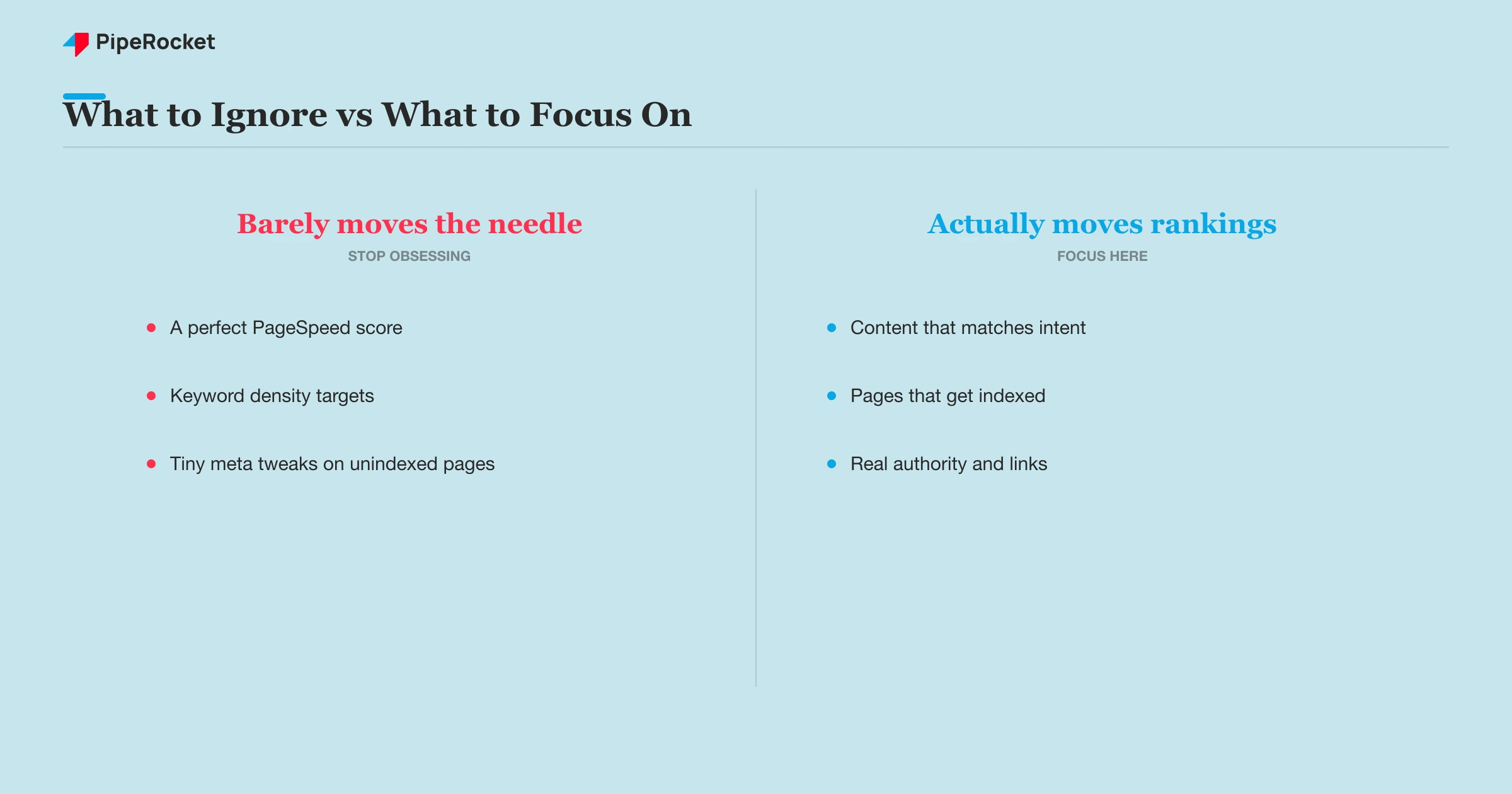
This is where most wasted SEO effort goes. Polishing these while your real pages aren’t indexed or don’t match intent is, as the saying goes, rearranging furniture in a house with no front door.
A perfect PageSpeed score
Page experience is real; a perfect score is over-hyped. Top-ranking pages for competitive queries routinely score in the 80s. Pass Core Web Vitals and stop grinding from 88 to 98.
Keyword density
Stuffing a keyword to hit a density percentage is a solved problem from a decade ago. Google reads meaning now. Use the term naturally and write for the searcher.
Social signals as a direct factor
Shares and likes are not a confirmed direct ranking factor. Social drives distribution and can earn links, which do count, but the share count itself is not a lever.
Exact-match domains and word-count targets
Exact-match domains no longer confer an advantage and can trigger a demotion when over-optimized. And the old “2,000-word sweet spot” study has been debunked for years. Length follows thoroughness; it is not a goal.
How AI Overviews and AI Mode Change the Ranking Conversation
The AI-search era doesn’t replace ranking factors, it reweights them and adds a new surface on top. AI Overviews now appear on a large and growing share of US queries, though estimates vary widely by methodology, from around 21% in conservative trackers to 60%+ in others, so treat any single figure with skepticism.
Three practical shifts matter for a 2026 ranking-factor list:
- The same signals feed both surfaces. Clear structure, answer-first content, genuine authority, and consistent entity signals are what rank you and what get you cited in AI Overviews . There is no separate “AI ranking factor” list to chase.
- “Ranking” now shares the page with a synthesized answer. A number-one blue link sits below an AI Overview that may answer the query outright. Winning position one matters less than being the source the answer is built from.
- Google is now training raters on AI answers. The September 2025 Quality Rater Guidelines added an entire chapter on evaluating AI Overviews, a signal of how seriously Google is treating answer quality, not just page quality.
The takeaway: the fundamentals didn’t change, but experience, entity consistency, and answer-first structure carry more weight than raw keyword coverage did three years ago.
How These Factors Shift for SaaS
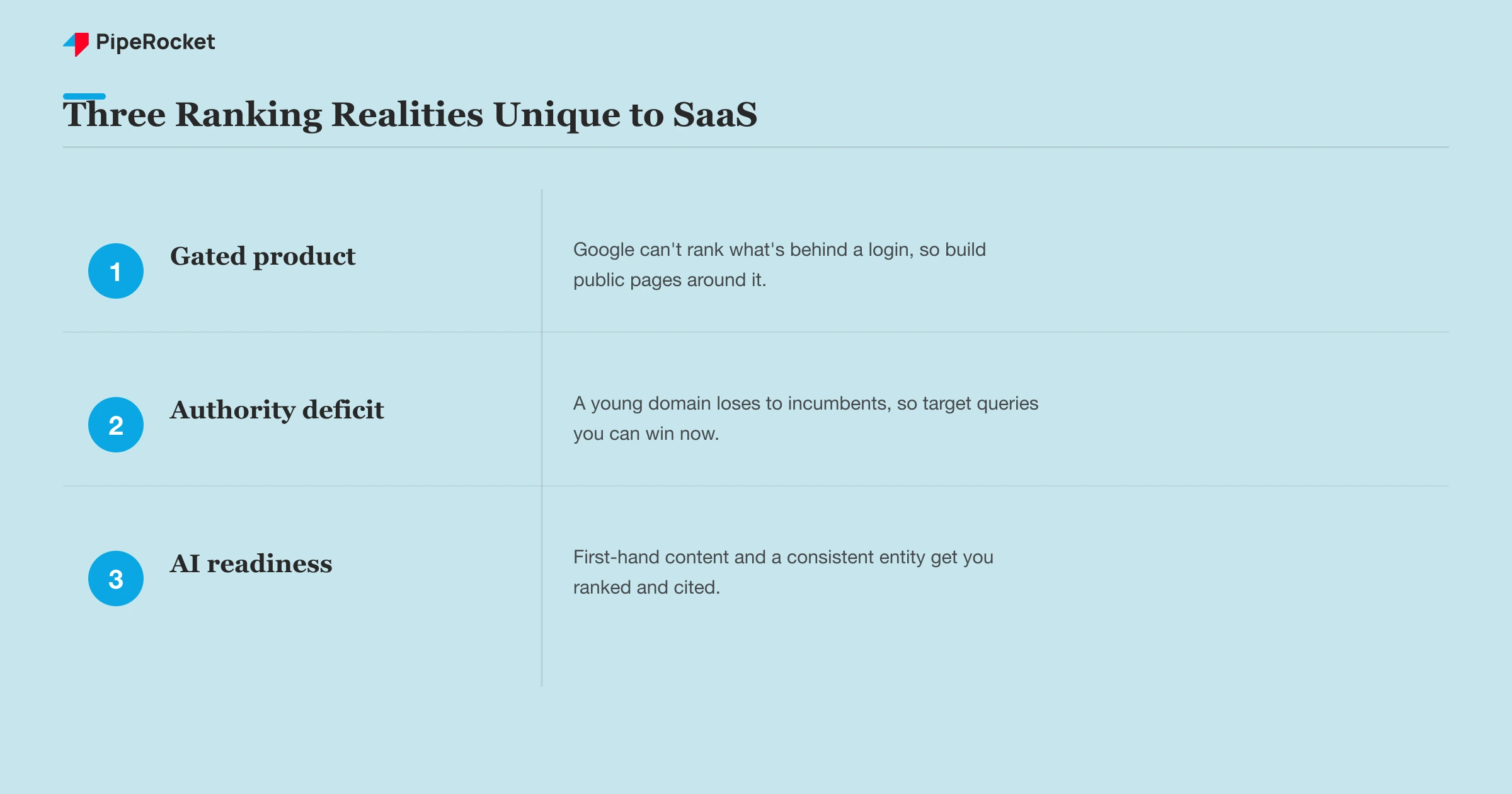
The generic factor lists assume a content site with an aging domain and fully indexable pages. B2B SaaS breaks all three assumptions, which is why the standard advice quietly underperforms for SaaS teams.
Most of your product can’t be indexed
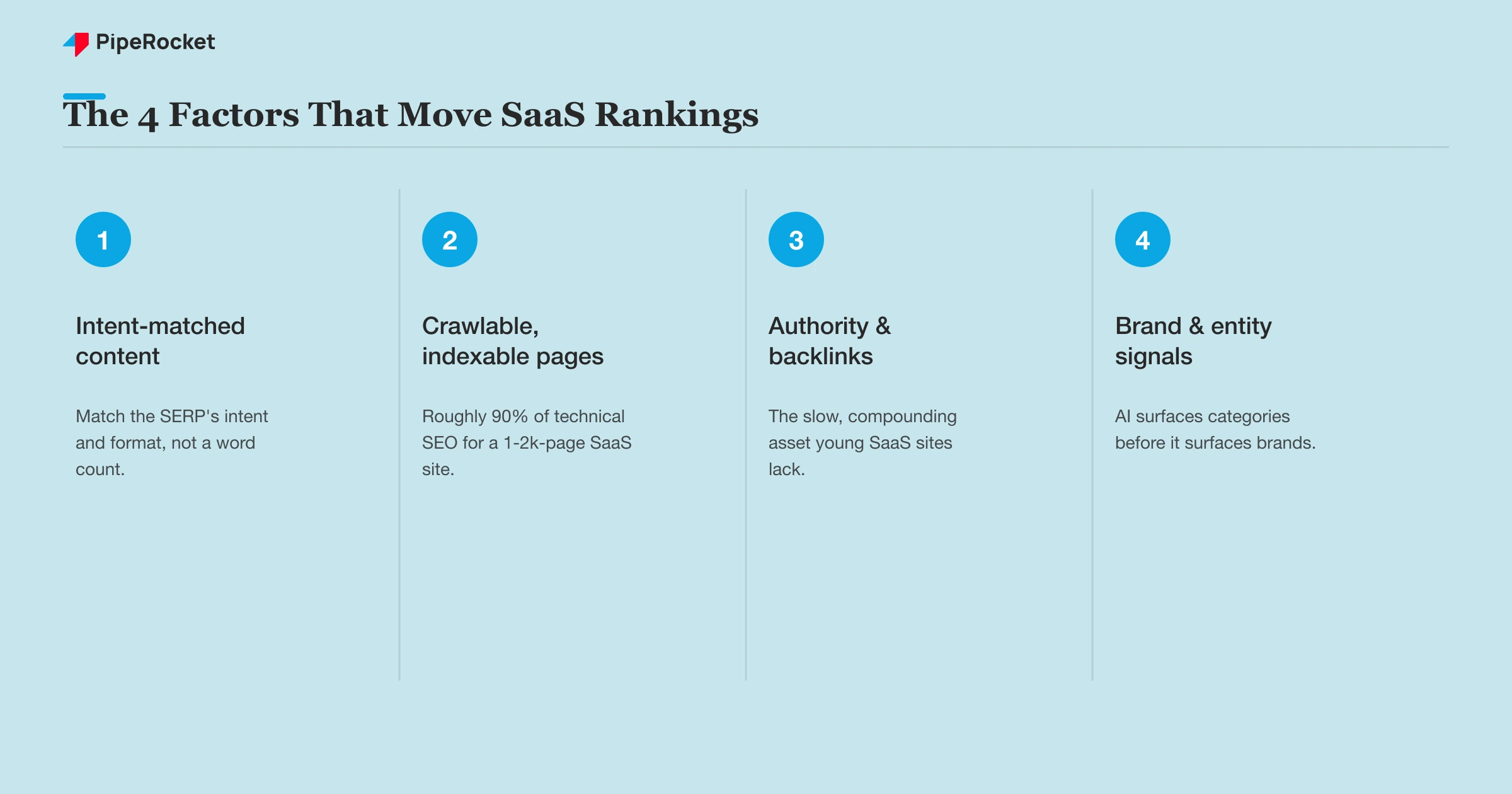
Google can’t rank what it can’t crawl, and most of a SaaS product lives behind a login. The fix is a public, indexable layer around the product: use-case pages, integration pages, and detailed feature pages that describe what the product does, so there is something for Google to rank in the first place. Confirm those pages are indexed before optimizing anything else on them.
You’re building authority from a standing start
A young SaaS domain competes against incumbents with years of banked links and trust, and the leak’s hostAge sandbox makes that disadvantage concrete. You close the gap with consistent link building
and realistic targeting: win the queries you can win now while the domain matures, instead of throwing content at head terms above your weight class. This is where the authority tier and the “sandbox” reality collide for SaaS specifically.
First-hand experience and entity consistency compound
The web is saturated with restated consensus, and both Google and the AI engines increasingly reward conviction. Founder-led and practitioner-led content with real examples, tied to a clean, consistent entity (same name, category, and facts everywhere), is what makes a SaaS site both rankable and citable. Treat it as one effort, not a separate AI project. Building topical authority around your category is the compounding version of this.
A page-two ranking we fixed with intent, not links
How to Prioritize: Sequence Beats Checklist
Knowing the factors isn’t the hard part. Working them in the right order is. The reason sites stall is almost always sequence, not knowledge.
| Order | Fix this | Why it comes first |
|---|---|---|
| 1 | Indexation | A page that isn’t indexed can’t rank, full stop |
| 2 | Search intent | The right page type for the query beats a better wrong one |
| 3 | Content quality and depth | Satisfy the query completely, don’t pad it |
| 4 | Authority and links | The slow compounding asset, so start early |
| 5 | Brand and entity | Feeds both Google and AI search over time |
| 6 | Page experience and minor technical | Tie-breakers, only worth it once 1 to 5 are solid |
Work top to bottom. A perfect Core Web Vitals score on an unindexed page that answers the wrong intent is worth exactly nothing.
How PipeRocket Digital Approaches Ranking Factors
We don’t chase the 200-factor list. We fix indexation first, match intent before publishing, build genuine authority and a consistent entity over time, and treat page-experience polish as the tie-breaker it is. If your content is good but rankings aren’t moving, the problem is almost always one of the confirmed factors, not a missing minor one. See how we run SaaS SEO , or talk to our team and we’ll tell you which factor is holding you back.
Frequently Asked Questions
How many Google ranking factors are there?
Google has never published an official count. The commonly cited “200 ranking factors” is old, unofficial SEO folklore. Google’s own documentation describes ranking systems like RankBrain, BERT, and PageRank rather than a countable list of factors, and it confirms only a handful of specific signals directly. Treat the big round numbers as folklore and focus on the few confirmed factors that do most of the work.
What is the most important Google ranking factor?
There isn’t a single one, but for most queries it comes down to content that matches search intent combined with links and authority. Google’s own guidance puts helpful, people-first content and links at the top of the confirmed list, and no other signal outweighs getting those two right on a page Google can actually crawl and index.
What did the 2024 Google leak reveal about ranking factors?
The March 2024 Content Warehouse leak documented attributes for a site-wide authority score (siteAuthority), a click-based re-ranking layer (NavBoost), a new-site sandbox (hostAge), Chrome usage data, and author entities, several of which contradicted Google’s past public statements. Crucially, the leak proves these attributes exist inside Google’s systems, not how heavily each is weighted in live ranking today.
Is E-E-A-T a Google ranking factor?
Not directly. E-E-A-T (Experience, Expertise, Authoritativeness, Trust) is the framework Google’s human quality raters use to score results, and those scores train and validate the algorithm rather than change any single page’s rank. It shapes what ranks over time, especially for health, finance, and legal topics, but there is no E-E-A-T score you can optimize directly.
Do page speed and Core Web Vitals affect rankings?
Yes, but as a minor, tie-breaker-level signal under page experience, not a primary lever. You want to pass the Core Web Vitals thresholds and keep the experience smooth, but chasing a perfect score is wasted effort, since top-ranking pages routinely sit below a perfect rating. Content relevance and authority outweigh page speed by a wide margin.