SaaS Content Strategy: How to Decide What to Create and Why
 Kamaraj Mathiarasan (Kim)
Last updated on
Kamaraj Mathiarasan (Kim)
Last updated on

Most SaaS teams don’t have a content strategy. They have a content calendar, which is not the same thing. A calendar tells you what publishes on Tuesday. A strategy tells you why that piece exists, which pillar it feeds, and what happens if you never write it.
I’ve watched teams write 40 blogs in a quarter with zero of them tied to a decision. This guide is about the layer that comes before the writing: how a SaaS content lead decides what gets built, in what order, and how that plan feeds into distribution and authority once the content exists.
TL;DR
- Pillar architecture comes first: define the 4-8 topic pillars your company is allowed to own before a single title gets written, or every quarter starts from a blank page.
- Funnel allocation is a budget decision: TOFU, MOFU, and BOFU need explicit page-count targets tied to your actual sales motion, never an even split.
- Prioritization needs a scoring method: rank topics by pipeline proximity and competitive gap, and treat whoever’s loudest in the planning meeting as noise.
- The calendar is a resourcing tool: it should show writer capacity, review time, and what’s slipping, on top of dates.
- Content-to-pipeline mapping closes the loop: every published piece needs a tag back to the pillar and funnel stage it was meant to serve, so you can actually tell what’s working.
- SME interviews double as a content input: product, engineering, and CS interviews give you proprietary detail competitors can’t copy, so schedule them as a named step in the brief.
- Strategy feeds distribution and authority: the plan decides what to build, then separate systems decide how it gets seen and who says it.
A Content Calendar Is a Schedule, a Content Strategy Is a Decision
A content calendar answers “what publishes when.” A content strategy answers “why does this exist, and what does it replace if we cut it.” Most teams only ever build the first one, then wonder why content output doesn’t move pipeline.
I get it. It feels like progress when 12 blog titles are sitting in a spreadsheet with due dates next to them. But titles without an owning pillar are just a to-do list, and to-do lists don’t compound.
A strategy forces you to answer questions a calendar never asks. Does this topic belong to a pillar we’ve committed to owning? Does the funnel stage match a real step in how our buyers actually search?
The planning layer sits above execution
This is a distinction I have to keep repeating internally, honestly. Once your strategy says “we’re building 30 BOFU pages this year comparing us to five named competitors,” the execution questions are the writer’s job: tone, structure, which SEO angle each page takes.
Confusing the two is why teams end up with 40 blogs and no read on what any of them are for. If you already have a marketing team that treats every request as its own island, SaaS content marketing as a practice needs the planning layer sitting above it, deciding what gets requested in the first place.
Most teams start with tactics and back into strategy later
Most teams start writing because someone asked for a blog, not because a plan called for one. That’s backwards, and it’s why six months in, nobody can say which chunk of the content actually needs to exist.
The fix isn’t complicated. Before the next title gets assigned, write down the pillars, the funnel split, and the priority order. Everything downstream gets easier once that exists, including the conversations about headcount and budget that content leads usually lose because they can’t point to a plan.
Build a Pillar Architecture Before You Write a Single Title
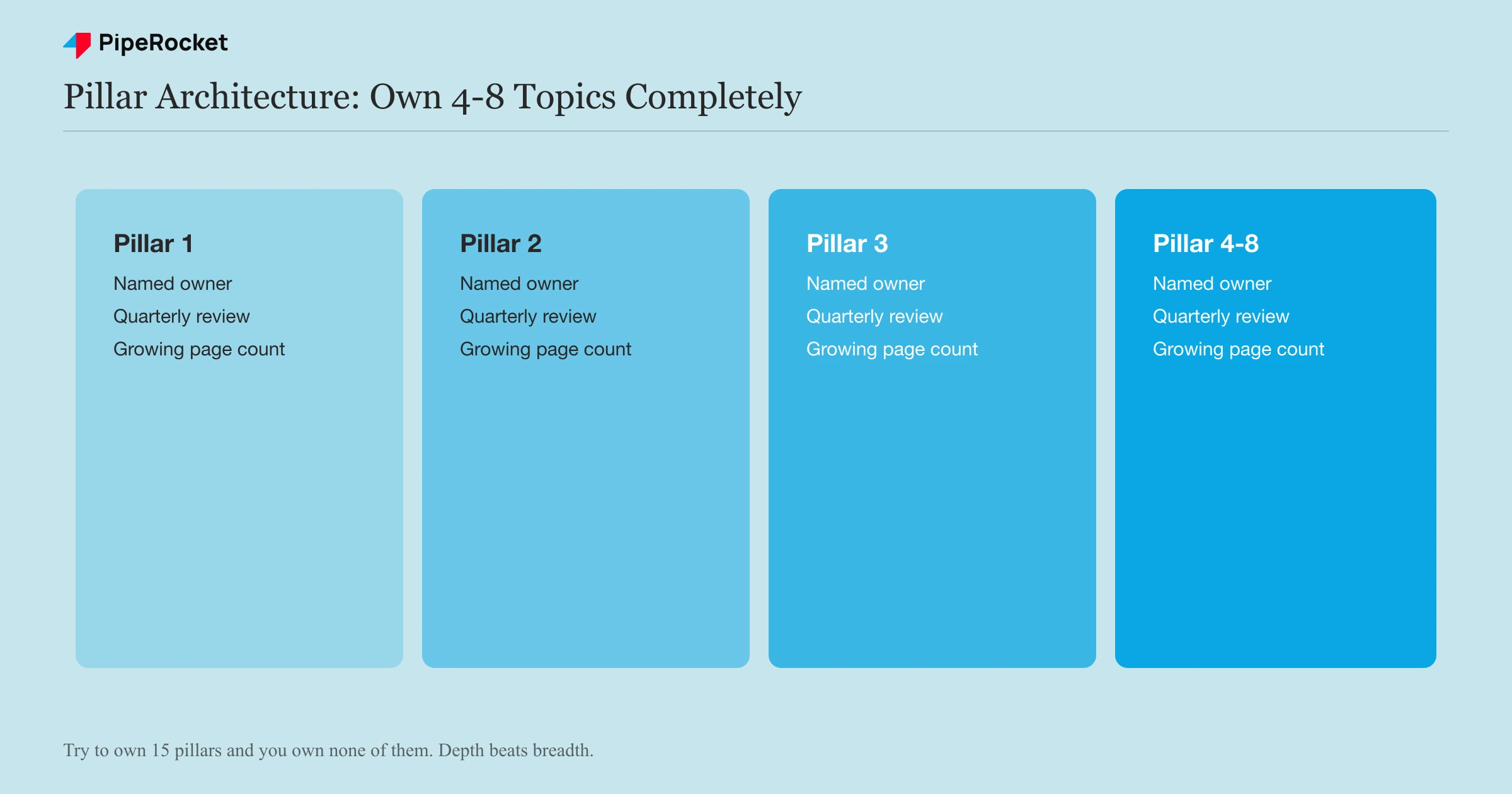
A pillar is a topic your company has decided to own completely, not a category you occasionally post about. Most B2B SaaS companies can genuinely own 4 to 8 pillars. Trying to own 15 means you own none of them, because depth is what makes a pillar defensible and depth takes real, sustained page-count investment.
I treat content as a product, not a publishing treadmill. A pillar only earns the name if it’s a connected system that keeps returning pipeline over time, the way our own SaaS SEO Compounding Revenue Machine approach treats a topic cluster, not a stack of one-off posts that decay the week after they publish.
Group topics into pillars instead of running a keyword list
A spreadsheet of 2,000 keywords is noise. A list of 250 topics is a strategy you can defend in a budget meeting. Related keywords don’t each need their own thin article:
- “what is GRC”
- “GRC components”
- “GRC examples”
Those three map to one pillar page with supporting sections. Treating them as one topic instead of three keywords is what turns a scattered list into a plan a CFO will actually fund.
Once topics are grouped this way, the math gets concrete fast. Instead of an open-ended ask like “write 30 articles this quarter,” you get a defensible business case: “the addressable topic map is 250 topics, split roughly 60 BOFU, 70 MOFU, and 200 TOFU.” That’s a budget line, not a wish list.
Pillars need an owner and a review cadence
Every pillar needs a named owner inside marketing, someone whose job includes noticing when a pillar’s coverage goes stale or when a competitor starts outranking it. Without an owner, pillars quietly rot. Nobody notices until a quarterly traffic review turns up a drop nobody can explain.
Set a review cadence per pillar (I run mine quarterly) where the owner checks three things:
- Is the pillar’s page count still growing, or has it stalled for two quarters running?
- Has a competitor published a stronger version of the pillar’s flagship page?
- Are the pillar’s BOFU pages still ranking, or has AI Overview coverage started eating the SERP real estate they used to own?
Map Every Topic to a Funnel Stage Before It Gets Written
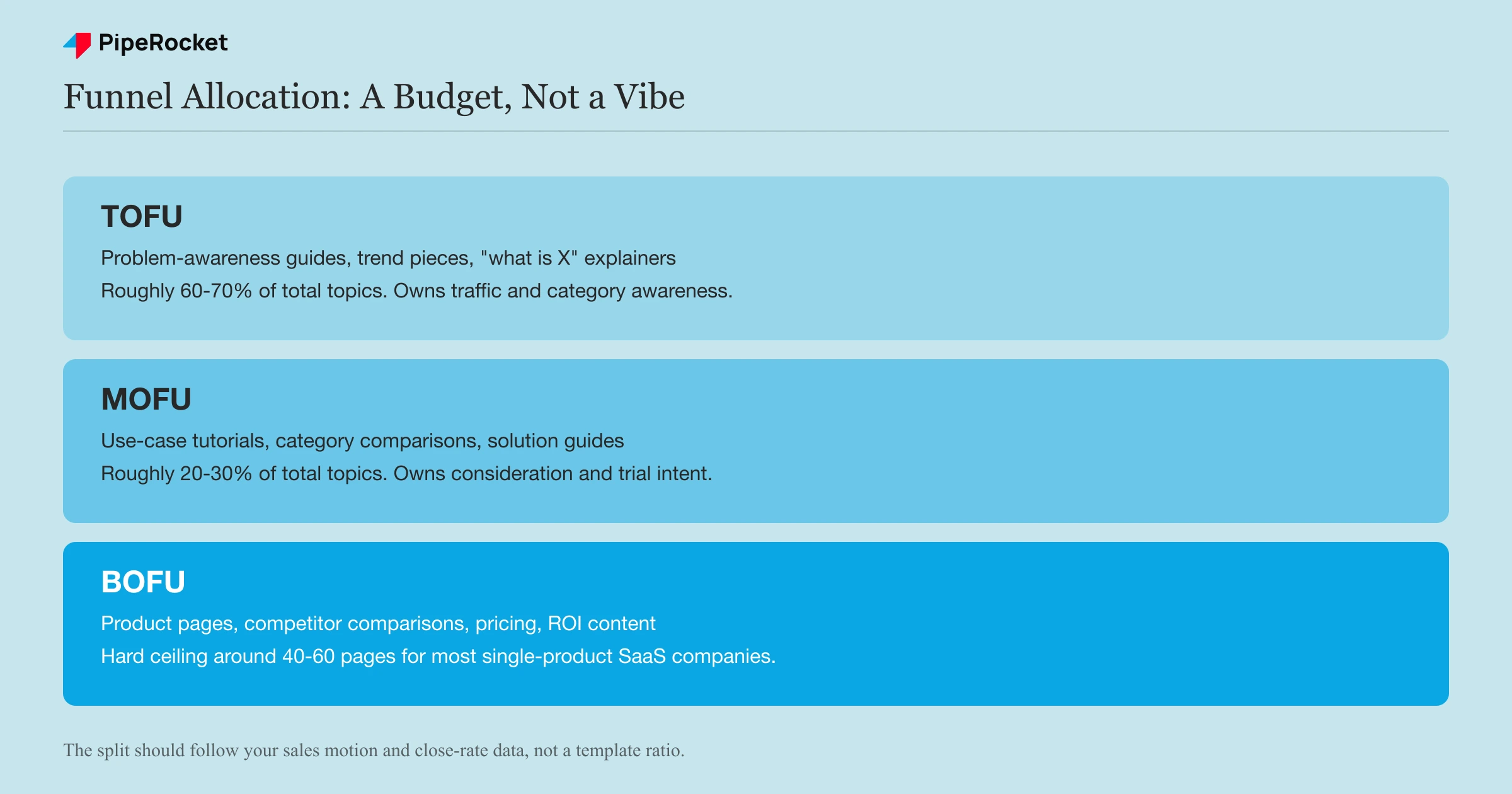
Funnel allocation is the step most teams skip entirely, and it’s the reason their content mix skews toward whatever’s easiest to write. TOFU content is cheap to produce and gets the most traffic, so teams default to it and call the resulting traffic growth a strategy.
That’s backwards for a subscription business. A single-product SaaS company can rarely defend more than 40 to 60 BOFU pages, things like software pages, alternatives, comparisons, and pricing breakdowns. Push past that ceiling and you’re stretching the same handful of buying-intent queries across too many thin pages, and stretching content this thin cannibalizes ranking share instead of adding it.
| Funnel stage | What it covers | Typical page-count ceiling | Owns |
|---|---|---|---|
| TOFU | Problem-awareness guides, “what is X” explainers, original research, ungated frameworks, founder-led video | Largest bucket, roughly 60-70% of total topics | Traffic, category awareness |
| MOFU | Use-case tutorials, category comparisons, solution guides | Mid-sized bucket, roughly 20-30% | Consideration, trial intent |
| BOFU | Product pages, competitor comparisons, pricing, ROI content | Hard ceiling around 40-60 pages for most single-product companies | Demos, trials, closed pipeline |
Not all TOFU is a generic explainer, and the plan should say which format each TOFU topic gets. The pieces that actually build category authority are original research, ungated frameworks a buyer can copy, and founder-led video that carries a point of view. Those are harder to produce than a “what is X” post, so decide upfront which TOFU topics deserve that heavier investment rather than defaulting every one to the cheapest format.
Match your funnel split to your actual sales motion
A self-serve, low-ACV product can run a heavier TOFU allocation because volume itself drives trial signups. A high-ACV, sales-assisted product needs the opposite: more MOFU and BOFU relative to TOFU, because a handful of the right comparison and ROI pages will move more pipeline than a hundred generic explainers ever will.
I’ve sat across the table from teams copying a funnel split off a blog post that had nothing to do with their actual sales motion. Look at your own close-rate data by content type before you commit to a ratio.
If BOFU pages are converting at a far higher rate per visitor than TOFU pages, that tells you something a generic 70/20/10 template never will.
Funnel stage decides the format the topic gets written in
The same subject can live at different funnel stages depending on how it’s framed, and the format should shift with it. “Workflow automation” as a TOFU piece is an educational explainer. As a MOFU piece it’s a use-case comparison. As a BOFU piece it’s a named-competitor page with pricing and a demo CTA.
Deciding the funnel stage upfront prevents the most common planning failure I see: a writer gets assigned “workflow automation” with no stage attached, defaults to the safest format (an educational listicle), and the company ends up with three TOFU pieces on the same topic and zero BOFU coverage.
The plan should also specify skimmability as a requirement, not leave it to the writer’s discretion. Every brief should call for clean formatting, data graphics, and real product screenshots, because a piece a reader (or an AI answer engine) can lift a clear claim from earns citations a wall of text never will.
Prioritize the Topic List Once Pillars and Stages Are Set
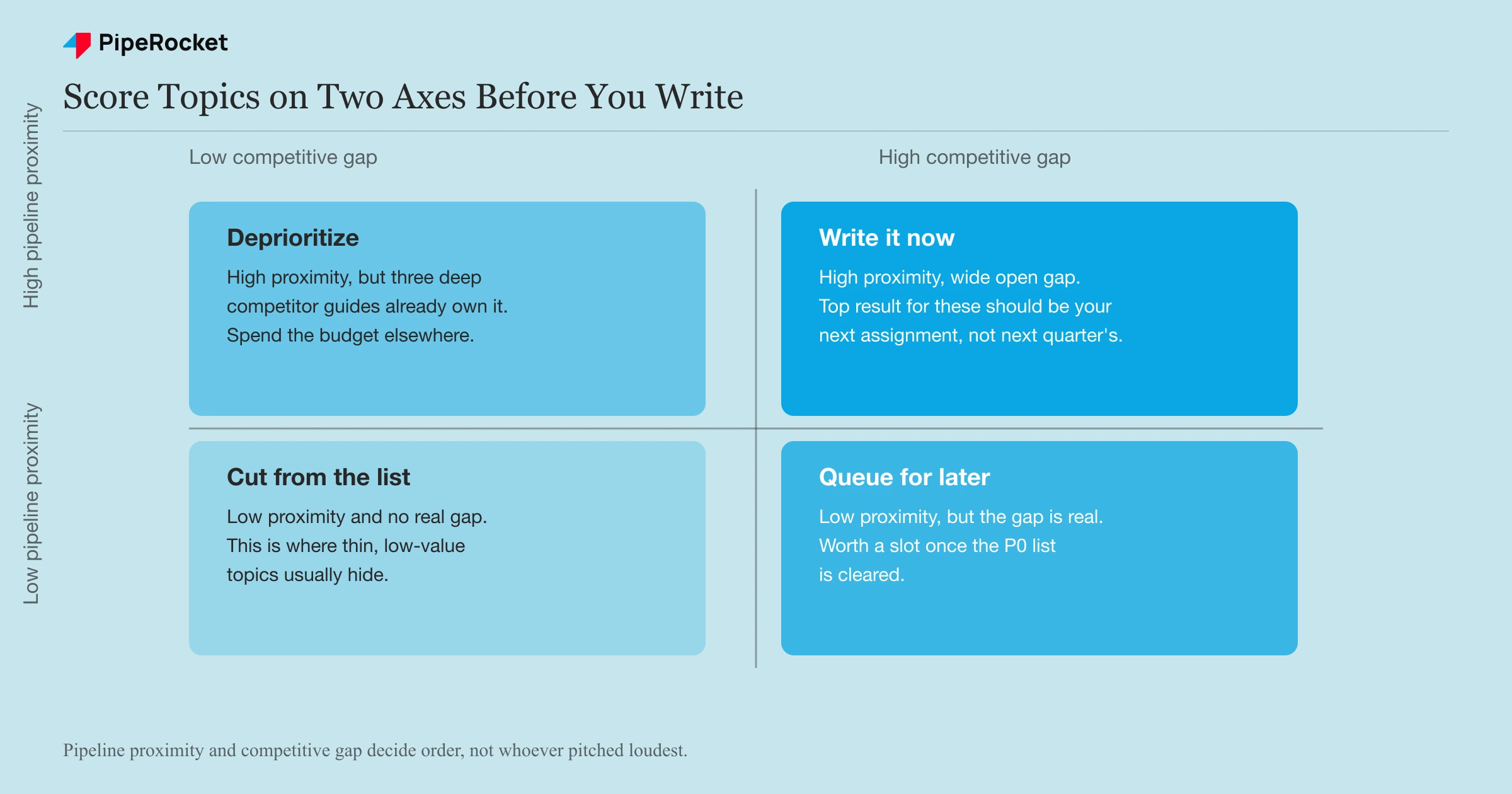
Prioritization is the step that decides order, and it needs a scoring method, not a gut call from whoever’s loudest in the planning meeting. Even once you have pillars and funnel targets set, you still have more topics than resources, so the order you build them in is its own decision.
I score every candidate topic on two axes: pipeline proximity and competitive gap. Pipeline proximity asks how close this topic sits to a buying decision. Competitive gap asks whether a competitor already owns the topic so thoroughly that writing it ourselves would be a waste of the quarter.
Score by pipeline proximity first
BOFU and MOFU topics score higher on pipeline proximity almost by definition, because they map directly to a stage in your buyer’s evaluation. But proximity alone isn’t the full picture.
A TOFU topic tied to a fast-growing pain point can beat a stale BOFU comparison nobody’s searching for anymore. Watch for the pain point Sales is suddenly hearing on far more discovery calls than it was a couple of quarters ago.
This is where talking to Sales, CS, and Product before finalizing the list pays off. Real buyers don’t search in the tidy, SEO -shaped phrases a keyword tool suggests. They use the messy, layman language Sales hears on discovery calls, and that language is often the fastest signal that a topic’s priority just changed.
Treat SME interviews as a content input of their own
Those same internal experts are also your best source of content nobody else can publish. Voice-of-customer research tells you which topics matter; SME interviews with product, engineering, and CS leads give you the proprietary detail that makes a piece defensible once it’s written. A competitor can copy your topic list in an afternoon. They can’t copy the specific failure mode your CS lead sees ten times a week, or the reason your engineers built a feature the way they did.
So the plan should schedule these interviews as a named step in the brief, with a specific SME attached to each topic that needs one. That turns a generic explainer into pillar content, and it’s the difference between a piece that reads like every other search result and one an AI answer engine has a reason to cite. Budget the interview time into the calendar the same way you budget writing and review.
Score by competitive gap second
A topic where three well-funded competitors already have a deep, well-linked pillar page is a worse bet than a topic where nobody’s written anything decent. This is obvious in theory and constantly ignored in practice, because the well-covered topic usually has the highest search volume and volume feels safer to chase than a gap.
Run the topic through Ahrefs or Semrush and check what’s actually ranking. If the top three results are thin, outdated, or clearly written for the wrong persona, that’s your gap. If they’re three deep, well-resourced guides from category leaders, deprioritize it and put the resourcing elsewhere.
Priority isn’t permanent
A P2 topic today can become a P0 next quarter if a competitor launches a feature that shifts the conversation, or if Sales starts flagging a new objection on every call. Revisit the priority list at the same cadence as your pillar review, not once a year.
Build a Calendar That Shows Resourcing Alongside Dates
A calendar that only shows publish dates hides the actual constraint, which is almost always writer and reviewer capacity, not ideas. I’ve never once run out of topics. I’ve run out of hours to get them reviewed and shipped on time, plenty of times.
Build the calendar around capacity first, topics second. If your writing team can realistically produce and fully review 8 pieces a month, plan 8, not 14 with the expectation that “we’ll catch up.” The overflow never gets caught up. It gets published rushed, or it doesn’t get published at all and quietly disappears from the plan.
Log every slip as data
Every topic that misses its planned month should get logged with why: reviewer bottleneck, research took longer than scoped, SME interview fell through. After two quarters of this, you’ll see the same one or two bottlenecks causing most of the slippage, and that’s the actual thing to fix, not “we need to write faster.”
If keyword mapping and calendar-building both live inside your own process rather than a template, our guide on building a SaaS keyword map and content calendar walks through the mechanics of turning the topic list into scheduled, resourced work.
Give review its own slot on the calendar
Teams calendar the writing and forget to calendar the review. A piece can sit in a Google Doc for three weeks waiting on a subject-matter-expert pass, and a calendar that only tracks “published” dates will never show that it’s stuck there.
Add a review checkpoint with its own owner and its own date, so a stalled draft shows up as late instead of invisible.
Tie Every Published Piece Back to Pipeline
Every piece of content should carry two tags from the moment it’s planned: which pillar it belongs to, and which funnel stage it’s meant to serve. Without those tags, a quarterly performance review turns into guesswork about which content is actually contributing.
This is the step most content teams skip, and it’s the one that turns a content operation from a cost center into something a CFO stops questioning. The tooling to make it work is simple:
- Link Google Analytics 4 and Google Search Console for behavioral and search data.
- Connect the CRM, HubSpot or Salesforce, so leads and revenue trace back to the pillar and funnel stage that produced them.
That second step is the one most teams skip, leaving everything credited to “organic search” as one undifferentiated bucket.
Watch first-touch and multi-touch attribution separately
A TOFU piece rarely shows up as the last touch before a deal closes, but it might be the first touch on a big share of your closed-won deals. If you only measure last-touch, TOFU content will always look like it’s failing, and you’ll defund the exact pillar that’s filling the top of your pipeline.
Multi-touch attribution matters more every year buyers spend longer researching before they ever talk to Sales. If first-touch attribution is shifting earlier in your own CRM data, that’s a signal your TOFU investment is working even when it never shows up as the last click before close.
A pillar with no pipeline attached gets cut
If a pillar has been live for two quarters and the CRM shows zero pipeline influence from any page inside it, one of three things is true:
- The funnel-stage mapping was wrong.
- The topic never had buying intent to begin with.
- A competitor is winning every relevant SERP .
Any of those is a reason to cut the pillar or rebuild it instead of publishing into it out of habit.
Common Mistakes to Avoid
Treating the calendar as the strategy
A due-date spreadsheet with no pillar ownership and no funnel targets is a to-do list wearing a strategy’s clothes. Fix it by building the pillar map and funnel allocation first, then let the calendar schedule the resourcing around that plan.
Splitting the funnel evenly out of habit
A default 33/33/33 TOFU/MOFU/BOFU split ignores your actual sales motion and your own conversion data by content type. Pull your CRM numbers before you commit to a ratio, and expect the right split to look lopsided.
Letting the loudest idea win the priority slot
Scoring topics by pipeline proximity and competitive gap takes longer than a quick show of hands in the planning meeting. Worth the extra hour, though. The loudest idea and the highest-priority idea are rarely the same thing.
Forgetting to tag content back to its pillar
- Publish a piece without a pillar tag and a funnel-stage tag, and you can’t measure it later.
- Add both to the brief template itself, before the writer starts, so it’s never left as an afterthought.
Building a calendar with no slack for review time
Scheduling every writer hour for drafting and none for review guarantees the review step gets skipped under deadline pressure. Budget review time into the calendar with the same weight as writing time.
How to Know the Strategy Is Working
The strategy is working when you can answer three questions without pulling a special report:
- Which pillars are compounding?
- Which funnel stage is under-resourced relative to its pipeline contribution?
- Which topics on the priority list got bumped, and why?
If you can’t answer those three from your existing tags and CRM connections, the measurement layer is the gap, not the content itself. Fix the tagging and attribution before writing a single new piece, because more content on top of a broken measurement layer just produces more content you can’t evaluate.
One thing the planning layer should name before that handoff: not every topic is meant to win on search. Some pillars earn their pipeline through organic distribution in niche communities, the Slack groups, Discord servers, and LinkedIn feeds where your buyers actually gather, and the plan should flag which topics are built for search versus which are built to travel in a community. The full playbook for that belongs to distribution, but the strategy layer decides the intent.
Once the plan is set and pipeline attribution is flowing, the next two questions are execution, not planning: how does each piece actually get in front of buyers, and how does the company build the authority that makes buyers trust what it publishes. Those live in their own systems on purpose, because bolting distribution or executive-voice decisions onto the planning layer is exactly how a clean pillar map turns back into a messy to-do list.
How PipeRocket Helps SaaS Teams Build This Layer
We build the pillar map, funnel allocation, and prioritization scoring before a single brief goes out, so the calendar has a plan behind it instead of a due-date list. Stuck writing 30 blogs a quarter with no read on which ones move pipeline? That’s usually a planning gap.
Once the plan exists, we hand off to our content distribution strategy work and our thought leadership strategy process. Want a SaaS SEO agency to own the whole loop? Get in touch .
Frequently Asked Questions
What is a SaaS content strategy?
A SaaS content strategy is the planning layer that decides which topic pillars a company owns, how content is split across TOFU, MOFU, and BOFU, and in what order topics get written. It sits above execution, deciding what gets built and why, while separate systems handle distribution and voice once a piece exists.
Without this layer, teams end up with a publishing calendar and no way to explain which content is actually contributing to pipeline.
How is a content strategy different from a content calendar?
A content calendar schedules publish dates. A content strategy decides which pillars exist, how the funnel is allocated, and which topics are prioritized before anything gets scheduled. Most teams only build the calendar, which is why they can list what published last month but can’t say which pillar it fed or whether it was worth the resourcing.
How many content pillars should a SaaS company have?
Most B2B SaaS companies can genuinely own 4 to 8 pillars in depth. Trying to cover 15 pillars usually means shallow coverage across all of them, since defensible pillar coverage requires sustained page-count investment a team can rarely spread across that many topics. It’s better to own fewer pillars completely than to spread the same budget thin across a longer list.
What is the 70/20/10 rule in content marketing?
The 70/20/10 rule splits a content budget into 70% proven, safe formats, 20% adjacent or experimental bets, and 10% high-risk innovation. It’s a risk-allocation rule, not a funnel-allocation rule, so don’t confuse it with a TOFU/MOFU/BOFU split.
For funnel allocation, skip preset ratios entirely. Pull your own conversion data by content type and match the split to your sales motion, which usually looks lopsided rather than even.
What are the 7 steps in creating a content strategy?
Creating a SaaS content strategy runs in sequence: (1) build the pillar architecture, (2) map each topic to a funnel stage, (3) prioritize by pipeline proximity and competitive gap, (4) pull input from SME interviews and voice-of-customer research, (5) build a calendar around resourcing, (6) tag every piece back to its pillar and funnel stage, and (7) measure pipeline attribution to decide what to cut or scale.