SaaS Content Distribution Strategy: Get Your Best Work Seen
 Kamaraj Mathiarasan (Kim)
Last updated on
Kamaraj Mathiarasan (Kim)
Last updated on
A content distribution strategy is the system you use to get published content in front of the right buyers, across owned, earned, and paid channels. Most SaaS teams don’t have one. They spend three weeks on a guide, hit publish, drop one LinkedIn post, and wonder why nobody read it.
The work was fine. The distribution was an afterthought. This guide is about fixing that half of the equation, so the content you already know how to make actually gets seen.
TL;DR
- Distribution is the missing half: Great content with no distribution plan loses to average content that gets pushed through every channel deliberately.
- Owned, earned, paid are three lanes: Each does a different job, and a real strategy runs all three instead of leaning on one.
- One pillar feeds everything: A single strong asset should spin out into a dozen or more derivative pieces sized for each channel.
- Syndication borrows audiences: Republishing on bigger platforms works when you protect your SEO with canonical tags first.
- Communities reach buyers directly: Genuine answers in the Slack groups and forums where your ICP already talks carry trust an ad can’t buy.
- Cadence beats intensity: A repeatable weekly rhythm moves more pipeline than one heroic launch day.
- Measure buyer signals over raw traffic: Judge distribution on whether the right buyers engaged and pipeline moved.
Why Publishing More Won’t Fix Your Distribution Problem
In most SaaS content programs, the bottleneck sits after publish, not in creation. Nobody owns what happens once a piece goes live. Teams keep adding to the calendar, assuming more posts equal more pipeline, when the real gap is that each post gets one shot at an audience and then dies.
Here’s the belief I want to challenge. Most SaaS teams treat distribution as a launch-day task: publish, share once, done. That’s why their best guide gets 40 views and their competitor’s average one gets 4,000. The competitor built a system to push it everywhere, repeatedly, for weeks.
Spend Less Time Creating, More Time Getting It Seen
The rough split we aim for is 40% of effort on creating a piece and 60% on distributing it. That feels backwards to most teams, who spend 90% creating and 10% sharing. If you’ve got a limited team, this reallocation matters more than any new tool.
Creation is the upstream input here. If you want the strategy behind what to write, when, and for which persona, that’s a separate discipline covered in our content marketing work. This guide starts the moment a piece is ready to ship.
Distribution Is a System, Not a One-Time Push
A launch-day blast treats every asset as disposable. A distribution system treats each asset as something you’ll reuse for months. The difference shows up in compounding: a system means today’s guide still earns attention in week six through email, a repurposed video, and a community answer you seeded.
So the question shifts from “what do we publish next” to “how many ways can we get this one piece in front of buyers.” That reframe is where most of the gains live.
Owned, Earned, and Paid: Your Three Distribution Lanes
Every distribution channel falls into one of three lanes, and each does a distinct job. Owned channels you control. Earned channels you influence through other people. Paid channels you rent for speed. A working strategy runs all three, because no single lane reaches a B2B buyer who bounces between search, LinkedIn, review sites, and their inbox.
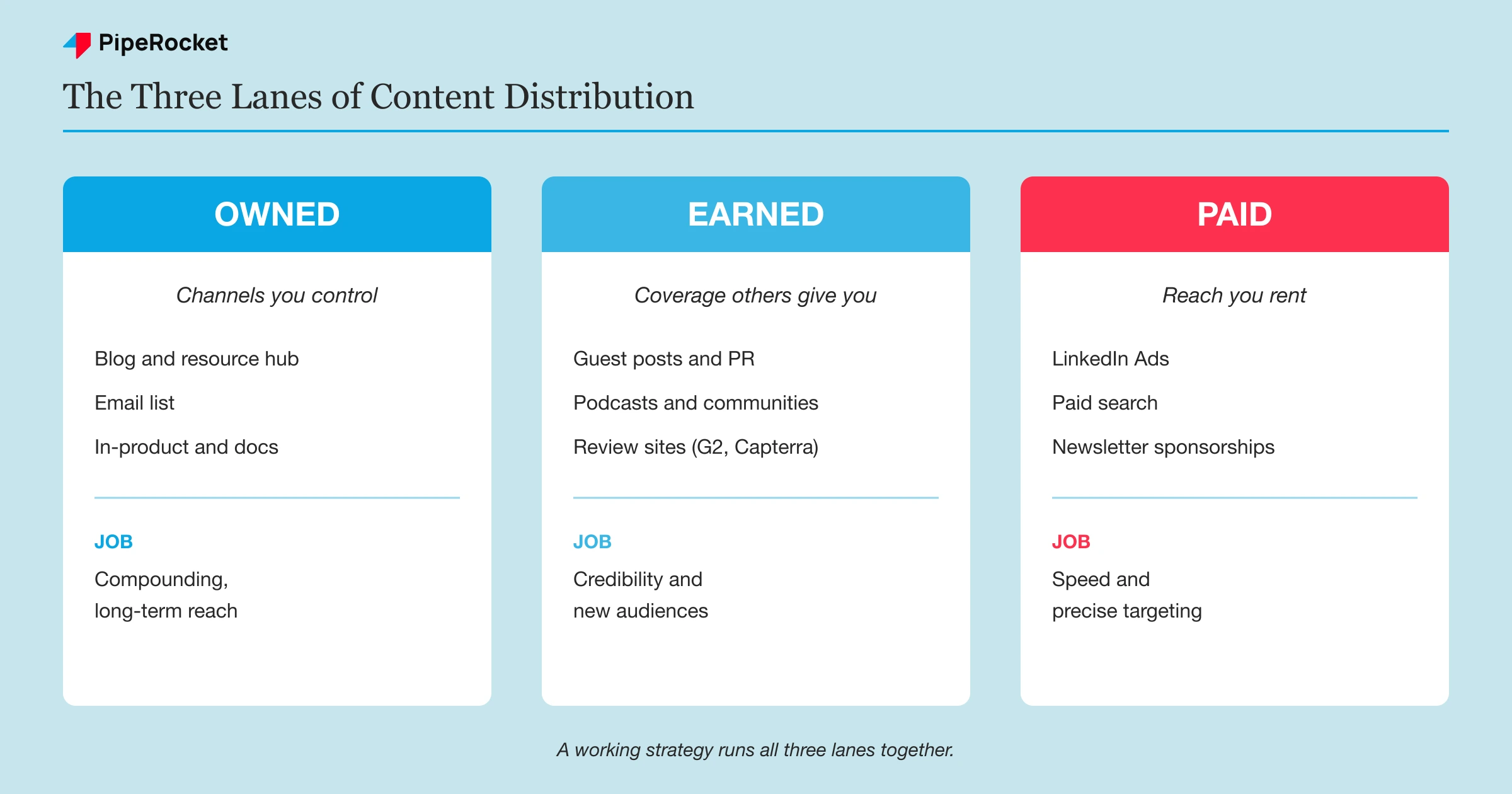
Here’s how the three lanes break down for a SaaS brand:
| Lane | What it is | Core SaaS channels | Best job |
|---|---|---|---|
| Owned | Channels you fully control | Blog, resource hub, email list, in-product, docs | Compounding, long-term reach |
| Earned | Coverage others give you | Guest posts, podcasts, communities, PR, review sites | Credibility and new audiences |
| Paid | Reach you pay for | LinkedIn Ads, paid search, sponsorships, newsletters | Speed and precise targeting |
Owned Channels Are the Foundation You Build On
Owned channels are where you set the rules and keep the audience data, so they anchor everything else. Your blog, resource hub, and especially your email list are assets that pay you back for years. When you publish, the first move is always to feed your owned channels: update the relevant hub page, add it to the next newsletter, link it from in-product help where it fits.
The email list is the most underrated owned asset in SaaS. Search and social can change their rules overnight. A list of buyers who opted in can’t be taken away, which makes it the safest place to distribute your best work.
Earned Channels Buy You Credibility You Can’t Self-Publish
Earned distribution is content about you, placed by someone else, and it carries trust you can’t manufacture on your own site. Guest posts on industry publications, podcast guest spots, and answers in the communities your buyers already trust all put you in front of warm audiences. The catch is that earned reach is slow and you don’t control the timing.
Review platforms like G2 and Capterra count here too. They generate referral traffic and authority signals, and buyers actively use them during evaluation, so keeping your profiles current is a real distribution move.
Paid Channels Give New Content Early Momentum
Paid distribution is the turbo boost: you pay to put a specific asset in front of a specific audience, fast. For SaaS, that usually means promoting a high-value guide or report to a tight ICP list on LinkedIn, or sponsoring a niche newsletter your buyers read. Paid works best when you point it at your proven winners.
The trade-off is real. Paid gives you immediate reach but stops the second you stop paying. Owned and earned compound; paid rents. Use paid to accelerate a piece that’s already earning organic traction, so the spend buys momentum instead of masking a weak asset.
How to Turn One Pillar Into Fifteen Assets
Repurposing is the highest-return move in distribution, because it lets you feed every channel from one piece of work instead of starting from scratch each time. The teams that win are squeezing more out of each asset instead of producing more of them. A single 2,000-word guide can become a LinkedIn carousel, three short social posts, a newsletter section, a 60-second video, and an infographic.
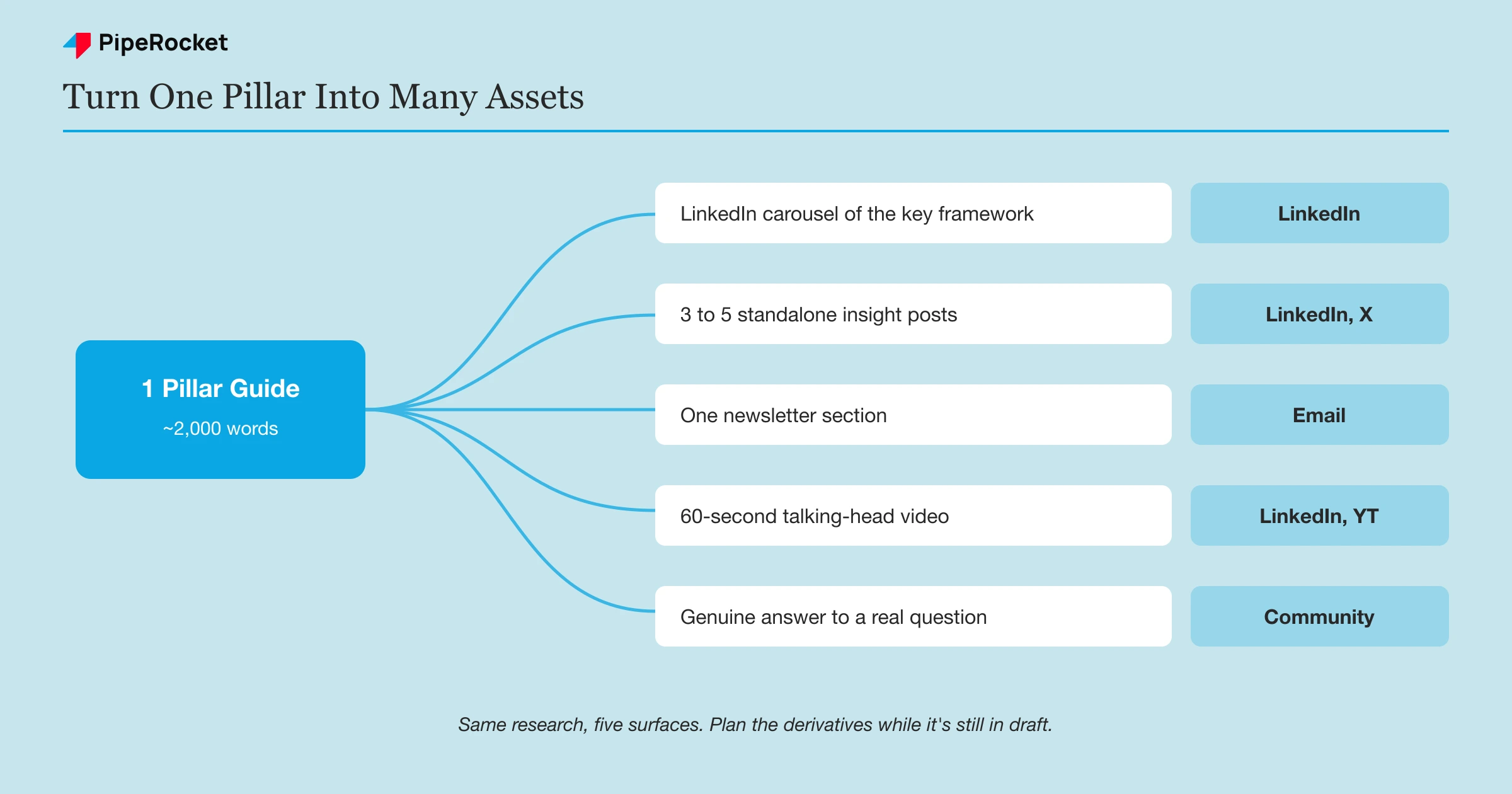
This is where the depth is, so here’s a concrete map from one source asset to its derivatives and the channel each one serves:
| Source asset | Derivative | Channel |
|---|---|---|
| Pillar guide | Carousel of the key framework | |
| Pillar guide | 3 to 5 standalone insight posts | LinkedIn, X |
| Pillar guide | One newsletter section | |
| Pillar guide | 60-second talking-head video | LinkedIn, YouTube |
| Pillar guide | One infographic | Social, the post itself |
| Pillar guide | Answer to a real question | Community, Reddit, Slack groups |
Atomize the Asset Before You Publish, Not After
Plan the derivatives while the piece is still in draft, so distribution isn’t a scramble later. When a guide is being written, mark the three or four sections that stand on their own. Those become your carousel, your video script, and your social posts. Doing this upfront means the day you publish, you already have two weeks of channel content ready to schedule.
A compliance SaaS for fintech teams might publish a guide on SOC 2 readiness. The audit-prep checklist inside it becomes a carousel. The one myth they debunk becomes a punchy LinkedIn post. The founder explaining why most teams start too late becomes the video. Same research, five surfaces.
Match the Format to Where Your Buyer Actually Is
Each channel rewards a different format, so a repurposed piece has to be rebuilt for its destination before it goes out. LinkedIn favors carousels and native video. Email favors a short lead-in that delivers value in the inbox instead of forcing a click. A community favors a genuine answer that happens to reference your work.
The mistake is dumping the same link everywhere. When we’ve seen repurposing fall flat, it’s almost always because the team shared the blog URL five times instead of reshaping the idea for each channel. Reshape, don’t rebroadcast.
Syndication: Borrowing Someone Else’s Audience Without Tanking Your SEO
Content syndication is republishing your existing content on a larger third-party platform to reach its audience. Done right, it puts a proven piece in front of thousands of new readers. Done wrong, it hands your search rankings to the platform that republished you. The difference comes down to one technical detail most teams miss.
Protect Your Rankings With a Canonical Tag First
Before you syndicate anything, make sure the republishing site points a canonical tag back to your original URL. That tag tells Google which version is the source, so you keep the ranking credit instead of watching the bigger domain outrank your own page. If a platform won’t add a canonical or at least a clear “originally published on” link back to you, treat that as a red flag.
The safest sequence is to publish on your own site first, let Google index it, then syndicate a week or two later. That way your version is established as the original before any copy exists elsewhere.
Pick Platforms Where Your Buyers Already Read
Syndication only pays off when the platform’s audience overlaps your ICP, so relevance beats raw reach. For B2B SaaS, that might mean an industry publication, a partner’s blog, Medium publications in your category, or a vertical community that accepts republished pieces. A guest column on a niche fintech site beats a general marketing blog with ten times the traffic if that’s where your buyers spend time.
Know the Difference Between Syndication and Guest Posting
Syndication republishes a piece you already own, while a guest post is original content written for someone else’s site. They serve different distribution jobs and teams often confuse them. Syndication extends the reach of a proven asset with almost no extra creation cost. A guest post earns you a fresh audience and usually a backlink , but you’re writing something new every time.
Use syndication to squeeze more mileage from your best existing guides. Use guest posts when you want to build relationships with a publication and earn links that lift your whole domain. Most SaaS programs need both, running on separate tracks so one doesn’t cannibalize the other.
Where SaaS Buyers Actually Hang Out: Community Distribution
Community distribution means showing up in the forums, Slack groups, and subreddits where your buyers already talk, and adding genuine value there. It’s one of the most underused earned channels in SaaS, because it can’t be automated and it doesn’t scale like a scheduled post. That’s exactly why it works: a real answer in the right room carries trust an ad never will.
The move is to answer a real question first and reference your content only when it genuinely helps. Drop a link with no context and you’ll get flagged as a marketer. Spend a few weeks being useful in a community and your content earns a welcome. For many SaaS categories, a single well-placed answer in a niche Slack group reaches more in-market buyers than a week of broadcasting on LinkedIn.
Pick two or three communities where your ICP is active and go deep. A vertical subreddit, an industry Slack, and a peer group cover more ground than a scattershot presence across a dozen forums you never really participate in.
Build a Distribution Cadence You Can Actually Run
A distribution cadence is the repeatable rhythm that turns one publish into weeks of reach. The teams that struggle treat distribution as a burst on launch day. The teams that compound spread it across a schedule they can sustain without burning out. Consistency here beats intensity every time.
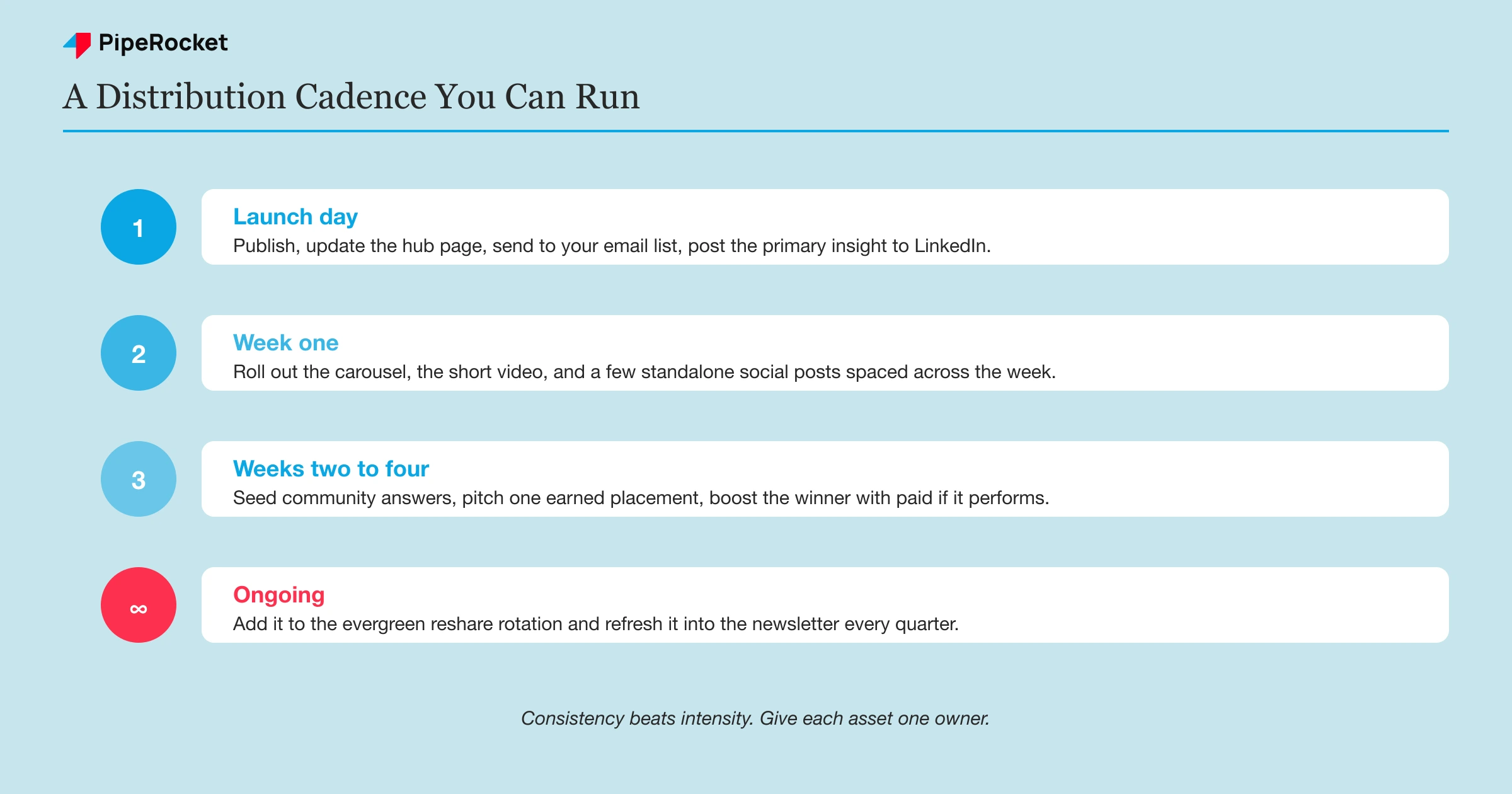
A workable cadence for a single pillar looks like this:
- Launch day: Publish, update the relevant hub page, send it to your email list, post the primary insight to LinkedIn.
- Week one: Roll out the carousel, the short video, and two or three standalone social posts spaced across the week.
- Weeks two to four: Seed genuine answers in communities, pitch it for one earned placement, boost the winner with paid if it’s performing.
- Ongoing: Add it to your evergreen reshare rotation and refresh it into the newsletter every quarter.
Start With Three or Four Channels, Not Every Platform
Pick the handful of channels where your ICP actually spends time and go deep, because a thin presence spread across seven platforms beats nothing but not much. For most B2B SaaS teams that stack is search, LinkedIn, email, and one earned motion like guest posts or podcasts. Master those before you add TikTok or a Discord server because a competitor did.
Give Distribution an Owner, or It Won’t Happen
Distribution dies when it’s everybody’s job and nobody’s responsibility. Assign one person to own the cadence for each asset, with the repurposing checklist and the schedule in front of them. When creation and distribution sit with the same overloaded writer, distribution is what gets dropped under deadline pressure.
Common Distribution Mistakes to Avoid
Distribution breaks in a few predictable ways. Each of these is fixable once you can name it, and most SaaS teams are making at least two of them right now.
Publishing and Praying
The most common failure is treating publish as the finish line. The piece goes live, gets one social share, and the team moves to the next item on the calendar. Publishing without a distribution plan mostly just means a bigger archive that nobody visits. The fix is to refuse to publish anything without its distribution schedule attached.
Sharing the Same Link Everywhere
Dropping the identical blog URL across five channels ignores that each channel rewards a different format. A raw link on LinkedIn gets throttled; a raw link in a community reads as spam. Reshape the idea for each surface instead of rebroadcasting one link, or the reach collapses.
Chasing Every New Channel
Every quarter a new platform gets hyped and teams spread themselves thinner chasing it. Being mediocre on seven channels loses to being strong on three. Add a channel only when you’ve maxed the ones you already run and you have evidence your buyers are on the new one.
Ignoring Your Owned Audience
Teams obsess over new reach while neglecting the email list and past readers who already trust them. Your existing audience is the warmest, cheapest distribution you have. Reshare evergreen winners to them and route every new piece through the newsletter before you spend a dollar chasing strangers.
How Do You Know Distribution Is Working?
Judge distribution on whether the right buyers engaged and pipeline moved. A post that gets 10,000 views from the wrong audience is worse than 200 views from in-market buyers. This is where I keep telling teams the same thing: stop chasing traffic, start chasing signals.
The signals that matter for distribution are the ones tied to your buyer. Track these instead of pageviews alone:
- Which channels drive engaged sessions from your actual ICP
- Whether branded search and direct traffic rise after a distribution push
- How many community answers or earned placements convert to real conversations
- Whether the same asset keeps producing leads months after publish
Distribution is an influence channel, so attribution will undercount it. A guide someone read on LinkedIn, then searched your brand a week later, and finally converted through direct traffic looks like a “direct” win in most tools. Watch the lift across channels together, and give credit to the reach that started the conversation even when the last click hides it.
The read is simple enough. If your best content is reaching more of the right people and your pipeline is filling with buyers who already know your brand, distribution is doing its job. If traffic is up but the conversations aren’t, you’re distributing to the wrong rooms.
How PipeRocket Helps SaaS Teams Distribute Content
We build distribution systems your team can keep running. At PipeRocket, we take the assets you already have and put them to work across owned, earned, and paid channels with a cadence your team can actually run. Our roots are in SaaS SEO , so search anchors the plan, then repurposing and syndication extend each piece for months. If you’d rather hand the execution to a team that owns the outcome, compare the best SaaS marketing agencies or just reach out to us for a call.
Frequently Asked Questions
What is a content distribution strategy?
A content distribution strategy is the plan for how you promote and publish content across channels to reach the right audience. It coordinates owned channels like your blog and email list, earned channels like guest posts and communities, and paid channels like ads. The goal is to make sure the content you create actually gets seen by buyers, rather than sitting unnoticed after you hit publish. A real strategy spreads one asset across multiple channels over weeks of deliberate reach.
How many distribution channels should you use?
Most teams do better focusing on three or four channels than spreading thin across seven. A workable starter stack for B2B SaaS is one search motion, LinkedIn, email, and one earned channel like guest posts or podcasts. The point is depth: a strong, consistent presence where your buyers already spend time beats a shallow presence everywhere. Add a new channel only once you’ve maxed the ones you run and have evidence your ICP is on the new one.
How often should you repurpose content?
Repurpose your best-performing content as long as it keeps earning engagement, and stop reworking a piece only when the returns clearly fade. Rather than a fixed frequency, watch the results: if a guide keeps producing leads and shares each time you reshape it, keep pulling derivatives from it. A single strong pillar can feed carousels, social posts, a newsletter section, and a video, then re-enter your evergreen rotation every quarter. Consistency and reuse beat constantly producing new pieces from scratch.