Finding a SaaS GEO agency that actually knows what they are doing is harder than it should be. Most agencies have added “AI search optimization” to their SEO service page without changing anything about how they build content, acquire authority, or measure results. The label is new but the work is the same.
I have spent over 10 years running marketing for SaaS companies. I went through more than 30 SaaS GEO agencies to put this list together, and I filtered hard on one thing: do they have a documented GEO methodology, or are they just repackaging SEO?
Below are the 8 SaaS GEO agencies that passed that test.
TL;DR
- Who are the best? The best SaaS GEO agencies include PipeRocket Digital, Siege Media, The SEO Works, FirstPageSage, Omniscient Digital, Minuttia, Searchbloom, and Single Grain based on our research and ranking criteria.
- What is a SaaS GEO agency? A SaaS GEO agency helps software companies get their brand, content, and product mentioned by AI search engines like ChatGPT, Perplexity, and Gemini when buyers are actively researching solutions.
- Why does GEO matter for SaaS? SaaS buyers increasingly use AI tools at the start of their evaluation cycle. If your content does not have the depth, structure, and authority to be cited by AI engines, a competitor that does will take that mindshare.
- What do they do? SaaS GEO services typically include AI-optimized content creation, entity building, structured data, digital PR and link acquisition, and ongoing monitoring of brand mentions across AI platforms.
How We Ranked These 8 SaaS GEO Agencies
I went through more than 30 agencies and filtered them against criteria that matter specifically for GEO, not just general SEO performance.
Here is what I weighted:
1. Do they have a documented GEO methodology, not just an SEO service relabeled for AI? (50% weightage)
2. Do their case studies show measurable AI search visibility improvements, not just traditional ranking gains? (30% weightage)
3. What is their review score on Clutch, G2, or FeaturedCustomers? (10% weightage)
4. Do they understand the SaaS buyer journey and how AI search fits into it? (5% weightage)
Our Pick for the Top 8 SaaS GEO Agencies
Here is a quick summary of all 8 SaaS GEO agencies listed in this blog:
| No. | Agency Name | Best For SaaS Companies Operating in | Notable Clients | Review Score |
| 1 | PipeRocket Digital | B2B SaaS, B2B Service | Storylane, DevRev, Goldcast, Leadsquared, Astra | 4.8 on Clutch |
| 2 | Siege Media | SaaS, B2B, Fintech, eCommerce | HubSpot, Airbnb, Y Combinator | 4.9 on Clutch |
| 3 | The SEO Works | B2B SaaS, FinTech, HealthTech, E-commerce | DHL, Weldrick’s Pharmacy, Intuit, Decathlon | 4.8 on Clutch |
| 4 | FirstPageSage | B2B SaaS, Professional Services, Technology | Salesforce, Nerdwallet, Verisign, Cadence | 4.6 on Clutch |
| 5 | Omniscient Digital | B2B SaaS, Marketing Technology | SAP, Loom, Jasper, Hotjar, Asana, Adobe | 4.8 |
| 6 | Minuttia | B2B SaaS | [VERIFY: notable clients before publishing] | 4.9 on Clutch |
| 7 | Searchbloom | SaaS, eCommerce, Technology | Bill.com, Nuvi, Idera | 4.9 on Clutch |
| 8 | Single Grain | SaaS, Fintech, Healthcare | SentinelOne, Uber, Nextiva | 4.8 on Clutch |
1. PipeRocket Digital – Best For: B2B SaaS AI Visibility and Pipeline
We started PipeRocket as a SaaS marketing agency before the rise of AI engines. Most SaaS GEO agencies now are just relabeling existing SEO as “AI optimized”. We did not want to do that.
What we do?
We understood that AI engines cite sources based on depth, structure, topical authority, and linking quality. So, we built our GEO programs around those factors from the start, not as an add-on to a content calendar.
Everything we do traces back to whether your buyers are finding you when they are actively evaluating a solution like yours.
The industries we serve: B2B SaaS, Fintech, PtaaS.
Our expertise:
- GEO for AI visibility
- SaaS SEO
- Content marketing
- Link building
- Authority building
- Conversion rate optimization
Notable Clients: Storylane, DevRev, Goldcast, Leadsquared, Astra.
Our Team Size: 30+. Each client is handled by a group of specialists so execution never stops.
Founders Experience: 25+ years
Pricing: Starts from $5000
Review Score: 4.8 on Clutch
Our Case Studies: PipeRocket Client Case Studies
2. Siege Media – Best For: Content-Led GEO Authority Building
Siege Media’s GEO approach rests on three pillars: data journalism, digital PR, and proprietary technology. LLMs reference original research heavily, so content built around unique data is far more likely to be cited than generic articles.
Their BlueprintIQ tool audits content against live ChatGPT, Gemini, and Perplexity results and flags topical and entity gaps that LLMs prioritize. Their DataFlywheel system keeps content current, which matters because AI engines consistently favor up-to-date sources.
One documented result: content they built for Mentimeter appeared in over 124,000 ChatGPT sessions and produced more than 3,000 conversions. That is what GEO tied to pipeline actually looks like.
The industries they serve: SaaS, B2B, Fintech, eCommerce, and more.
Their expertise:
- GEO for AI visibility
- SaaS SEO
- Content strategy and creation
- Digital PR
- Link building
- Content marketing
Notable Clients: HubSpot, Airbnb, Y Combinator.
Review Score: 4.9 on Clutch
Their Case Studies: Siege Media Case Studies
3. The SEO Works – Best For: GEO Universal Information Infrastructure
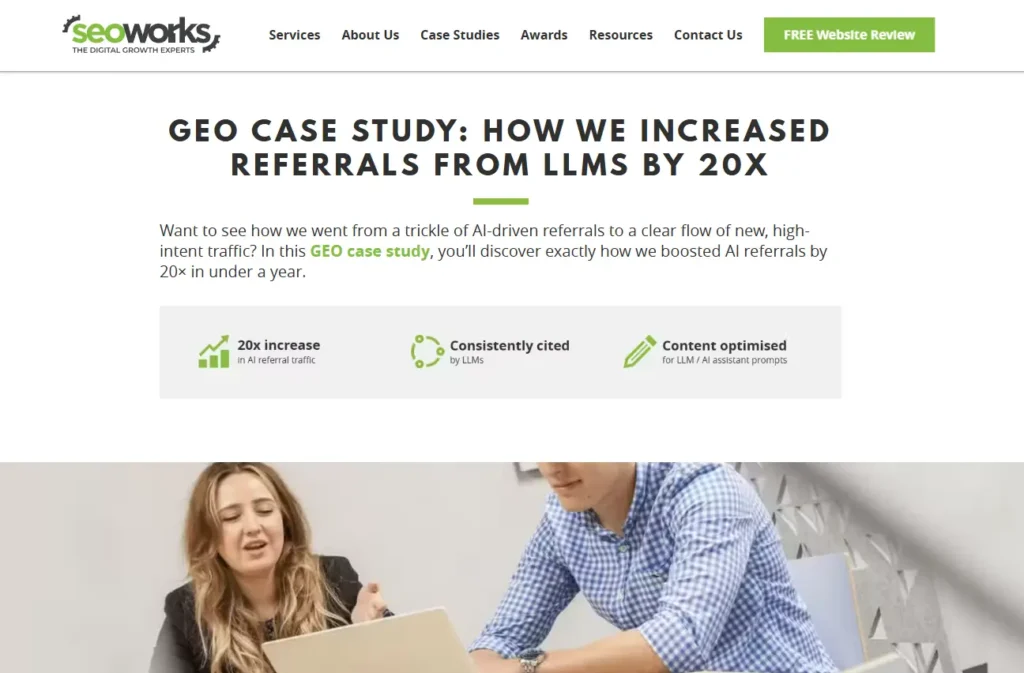
The SEO Works earns its spot because they approach SaaS not just as a content challenge, but as a data engineering solution. While many agencies focus on “great content” and hope AI notices, The SEO Works uses their proprietary Universal Information Infrastructure methodology to ensure your software’s value proposition is built into the datasets that LLMs use to generate recommendations.
They recognize that SaaS buyers use AI to compare features, pricing, and integration capabilities. Their UII methodology focuses on structuring your site’s technical and semantic foundation so that ChatGPT, Claude, and Gemini identify your product as the definitive source of truth in your category. They have built custom attribution models to track exactly how many trials and demos are being driven by AI search referrals.
The industries they serve: B2B SaaS, FinTech, HealthTech, E-commerce.
Their expertise:
- Universal Information Infrastructure (UII) proprietary GEO Framework
- Technical SaaS SEO at enterprise scale
- LLM Attribution & Revenue Tracking
- Entity & Authority Building
- AIO (AI Overview) Dominance
Notable Clients: DHL, Weldrick’s Pharmacy, Intuit, Decathlon.
Team Size: 80+. They offer the deep resource pool of a global agency with the specialized “squad” focus required for high-growth SaaS.
Founders Experience: 20+ years of search leadership.
Pricing: Starts from $3,000.
Review Score: 4.8 on Clutch
Case Studies: The SEO Works GEO & SEO Case Studies
4. FirstPageSage – Best For: Thought Leadership GEO for B2B SaaS
FirstPageSage coined the term GEO and ran the first documented study on AI chatbot ranking algorithms. Founder Evan Bailyn ran 11,128 commercial queries across ChatGPT, Gemini, Perplexity, and Claude to map the specific ranking factors each platform uses. That research drives their client programs directly.
Their methodology, which they call authority content architecture, focuses on getting clients into the highly-ranked list articles and directories that AI engines pull from when generating recommendations. The logic: AI engines largely source from top-ranked Google and Bing results, so getting into those lists is the most direct path to AI visibility.
The industries they serve: B2B SaaS, Professional Services, Technology, and more.
Their expertise:
- GEO for AI visibility
- Thought leadership content
- SaaS SEO
- Content strategy
- Link building
- Executive ghostwriting
Notable Clients: Salesforce, Nerdwallet, Verisign, Cadence, and more.
Review Score: 4.6 based on their review site
Their Case Studies: FirstPageSage Case Studies
5. Omniscient Digital – Best For: SaaS-Focused SEO and GEO as One System
Founded by former HubSpot marketing practitioners, Omniscient Digital’s core GEO concept is Surround Sound SEO: building brand presence across third-party lists, reviews, directories, and SERP content so LLMs consistently surface your brand in category answers.
Their GEO work is grounded in how RAG actually works. LLMs surface content that is crawlable, topically relevant, clearly structured, and backed by strong authority signals. Omniscient builds programs around those specific signals rather than repurposing keyword-based SEO work.
They require content with a strong point of view and unique insight, because generic information does not get cited regardless of how well it is technically structured.
The industries they serve: B2B SaaS, Marketing Technology, and more.
Their expertise:
- GEO for AI visibility
- SaaS SEO
- Content strategy
- Content marketing
- Link building
- Content operations
Notable Clients: SAP, Loom, Jasper, Hotjar, Asana, Adobe.
Review Score: 4.8
Their Case Studies: Omniscient Digital Case Studies
6. Minuttia – Best For: Strategic GEO for B2B SaaS Niche Authority
Minuttia is B2B SaaS-only. Their GEO playbook blends entity SEO, topical authority, and content distribution to capture qualified demand in generative engines including AI Overviews and chat search. Managing Director George Chasiotis has published research on entity SEO and topical authority as foundational signals for AI visibility.
Rather than running keyword-driven content calendars, they build strategy around how a specific SaaS company grows and map content to that motion. For GEO, that means producing content with strong points of view and subject matter depth, because surface-level content does not get cited regardless of technical structure. Starting price is $4,000+ per month.
The industries they serve: B2B SaaS.
Their expertise:
- GEO for AI visibility
- SaaS SEO
- Content strategy
- Entity and topical authority building
- Content marketing
Notable Clients: Docebo, Toggl, Sitecore
Review Score: 4.9 on Clutch
Their Case Studies: Minuttia Case Studies
7. Searchbloom – Best For: SEO and GEO With Strong Technical Foundations
Searchbloom has two documented methodologies directly relevant to GEO. ART covers traditional SEO (Authority, Relevance, Technology) and MERIT is built specifically for AI search: Mentions, Evidence, Relevance, Inclusion, and Transform, mapped to how LLMs evaluate and cite content.
What separates them is that they implement rather than just recommend. Six in-house specialist teams cover SEO, paid media, content, development, CRO, and outreach, so technical fixes, schema markup, and content optimization happen without a separate implementation layer. All GEO work is connected to SaaS-specific metrics including trials, demos, and ARR, rather than reporting on visibility in isolation.
The industries they serve: SaaS, eCommerce, Technology.
Their expertise:
- GEO for AI visibility (MERIT framework)
- Technical SEO (ART framework)
- On-page SEO
- Link building
- CRO
Notable Clients: Bill.com, Nuvi, Idera.
Review Score: 4.9 on Clutch
Their Case Studies: Searchbloom Case Studies
8. Single Grain – Best For: AI-Accelerated GEO and Content at Scale
Single Grain integrates GEO into a broader multi-channel program rather than running it as a standalone service. Their model connects SEO, GEO, and paid media into one strategy, so AI visibility improvements feed directly into paid targeting and CRO rather than sitting in a separate reporting silo.
Their investment in proprietary AI tooling accelerates testing of what AI engines respond to and tightens the feedback loop on content performance across ChatGPT, Perplexity, and Gemini. The multi-channel setup makes them most relevant for growth-stage SaaS companies that want GEO connected to a broader acquisition program rather than managed as an isolated content exercise.
The industries they serve: SaaS, Fintech, Healthcare.
Their expertise:
- GEO for AI visibility
- SaaS SEO
- Content marketing
- Conversion rate optimization
Notable Clients: SentinelOne, Uber, Nextiva.
Review Score: 4.8 on Clutch
Their Case Studies: Single Grain Case Studies
When Should You Hire a SaaS GEO Agency?
Before you start evaluating agencies, answer these questions honestly. The answers will tell you whether you are ready for a GEO engagement and what kind of agency you actually need.
1. Are your buyers starting their research on AI tools instead of Google?
This varies by category and buyer persona, but know where your specific buyer starts. If even a meaningful minority of your ICP is using AI tools at the top of their research cycle, GEO is no longer optional.
Signs your buyers are using AI search:
- You are seeing unexplained traffic drops from informational content despite maintaining rankings
- Prospects mention hearing about you from “AI” or “ChatGPT” in discovery calls
- Your competitors are showing up in AI-generated category answers and you are not
- Your content is getting fewer clicks despite holding rankings, which is a sign AI overviews are intercepting the intent
2. Do you have the content foundation that GEO requires?
GEO rewards companies that have already built depth and authority in their category. If your content program is thin, inconsistent, or lacks topical structure, GEO work will have limited impact until that foundation is in place.
Ask yourself honestly:
- Do you have comprehensive, well-structured content covering the core questions your buyers ask?
- Does your content get cited or linked to from credible sources in your industry?
- Is your brand mentioned consistently across industry publications, directories, and third-party review platforms?
- Do you have a structured data and schema implementation that makes your content machine-readable?
3. Are you losing deals to competitors who have better AI search presence?
If you are seeing longer evaluation cycles, more multi-vendor comparisons, or prospects arriving already anchored on a competitor’s framing, AI search is likely influencing the conversation before you ever get in the room.
Questions to ask your sales team:
- Are prospects mentioning specific competitor names more often in early conversations?
- Are buyers arriving with pre-formed opinions about your category that do not match your positioning?
- Has the number of vendors in a typical evaluation cycle increased in the last 12 months?
4. Is your SEO program producing diminishing returns?
If your organic program is running well but the pipeline contribution is flattening, GEO is a logical next investment.
Signs your SEO program is hitting a ceiling:
- Rankings are stable but organic traffic is declining
- Organic sessions are growing but demo requests from organic are flat
- Your top-traffic pages are informational and not converting to pipeline
- AI overviews are answering your target queries without linking to your content
5. Are you entering a new market where AI visibility could set the tone early?
New market entry is one of the highest-leverage moments for GEO investment. In an established category, you are fighting for position against brands that already have authority. In a new or emerging category, the content corpus is thinner and the opportunity to establish authority early is larger.
Getting GEO-optimized content in place before your competitors do in a new market means:
- AI engines learn to associate your brand with the category from early on
- You set the framing and vocabulary that buyers use to describe the problem
- Competitors who enter later have to fight for position you already hold
How to Choose the Right SaaS GEO Agency
GEO is still early enough that a lot of agencies are claiming expertise they do not have. Here is how to tell the difference.
1. Ask them to explain their GEO methodology, not just what GEO is
Every agency has a landing page about AI search now. What you want to know is how they actually build AI visibility. Ask them:
- How do you determine which AI engines are most relevant for our specific buyer?
- What signals do you optimize for to influence ChatGPT versus Perplexity versus Gemini?
- How do you measure AI visibility improvements and report on them?
- How is your GEO approach different from your SEO approach?
If the answers are vague or they mostly describe traditional content and SEO work with “AI” language added, that is your answer.
2. Ask for examples of brands they have gotten mentioned in AI-generated answers
This is the GEO equivalent of asking for case studies. Ask them to show you a category or question where a client’s brand appears in a ChatGPT, Perplexity, or Gemini answer that it did not appear in before their engagement.
This is hard to fake and hard to hand-wave. Either they can show you the before and after or they cannot.
3. Verify they understand your specific buyer’s AI search behavior
GEO for a PLG SaaS company selling to developers looks very different from GEO for an enterprise SaaS company selling to procurement teams. Ask them:
- What AI tools does your ICP use at the start of an evaluation cycle?
- What questions are they asking those tools that we should be showing up for?
- How do you research AI search intent before building a content strategy?
4. Check whether they treat GEO as a standalone service or part of a broader system
GEO that is disconnected from SEO, content, and link acquisition will produce limited results. AI engines do not just look at your content. They look at your overall authority and how many credible sources are citing you. An agency that can only do one piece of the system is not the right partner for a GEO program that compounds over time.
Ask them how GEO connects to the rest of your marketing program, and whether they can manage that integration or whether you will need multiple vendors.
5. Ask how they measure and report on GEO progress
GEO measurement is still maturing. There is no Google Search Console for ChatGPT mentions. Ask how they track AI visibility and what they report on:
- Do they use tools like Brandwatch, Mention, or dedicated GEO tracking platforms?
- How do they distinguish between AI-driven and organic traffic?
- What does a GEO progress report actually look like?
- How long before you should expect measurable AI visibility improvements?
6. Treat the sales process as a preview of the engagement
The way an agency behaves before you sign is your best data on how they will behave after.
- Are they asking hard questions about your product, ICP, and current content before presenting a proposal?
- Are they specific about what AI visibility looks like in your category, or are they speaking generally?
- Do they push back on goals that are unrealistic for GEO’s current maturity level?
An agency that is honest about what GEO can and cannot do right now is more trustworthy than one that promises top-of-ChatGPT visibility in 60 days.
Why Choose PipeRocket Digital as Your SaaS GEO Agency?
We built PipeRocket Digital because we kept watching SaaS companies burn growth budget on agencies that were optimizing for their own reporting metrics rather than their client’s pipeline.
GEO is the newest version of that problem. A lot of agencies are rushing to add “AI optimization” to their service list without changing anything about how they build content or measure impact. The result is the same: activity without accountability.
We work exclusively with SaaS and B2B SaaS companies. That constraint means our GEO programs are built around the actual questions your buyers are asking AI tools when they are evaluating a product like yours, not generic category content that looks good in a report but does not drive pipeline.
We connect GEO visibility to the rest of your marketing program. AI mentions that do not translate to more demos, more trial signups, or more qualified pipeline are interesting but not valuable. We build GEO programs that connect to the revenue outcomes you are actually trying to move.
Book a free consultation call with us and let us work through what a focused GEO program would look like for your specific product and market.
Frequently Asked Questions
1. What is GEO and how is it different from SEO?
SEO is the practice of optimizing your content to rank in traditional search engines like Google. GEO is the practice of optimizing your content and authority so that AI search engines like ChatGPT, Perplexity, and Gemini surface your brand when buyers ask questions your product answers.
The core principles overlap, but the specific signals each system rewards are different. GEO puts more weight on content depth, entity recognition, structured data, and the quality of citations pointing to your content.
2. Which AI platforms matter most for SaaS GEO?
It depends on your buyer. ChatGPT is the most widely used AI tool for general research. Perplexity is growing fastest among technical and research-oriented buyers. Gemini is integrated into Google’s search results, which means it matters for buyers who start on Google. A good GEO strategy tracks visibility across all three rather than optimizing for one.
3. How long before GEO work produces measurable results?
GEO is slower than paid search and faster than traditional SEO in some respects. If your content foundation is solid, early AI mentions can appear within two to three months of targeted GEO work. Consistent, compounding AI visibility across a category typically takes six to twelve months. Any agency promising AI search dominance in 30 days is selling you something that does not exist yet.
4. Does GEO replace SEO or complement it?
GEO complements SEO. The content depth, topical authority, and link acquisition that power a strong SEO program are the same factors that influence AI search visibility. Companies with strong organic foundations tend to have a significant head start on GEO. The agencies on this list understand that relationship and build programs where both compound together.
5. How do you measure GEO performance?
GEO measurement is still developing, but the core metrics include brand mention frequency in AI-generated answers, share of AI responses in your category that include your brand, referral traffic from AI platforms, and downstream impact on demo requests and trial signups. A serious GEO agency should be tracking all of these and connecting them to your pipeline, not just reporting on mentions in isolation.
6. Can a SaaS company do GEO without a strong content foundation?
Not effectively. GEO rewards brands that AI engines already recognize as credible, authoritative sources in their category. If your content program is thin, the fastest path to AI visibility is building that foundation first. A good GEO agency will tell you this upfront rather than promising results on a foundation that is not ready to support them.