Enterprise SEO: The Blueprint for Simple, Scalable SEO
 Kamaraj Mathiarasan (Kim)
Last updated on
Kamaraj Mathiarasan (Kim)
Last updated on
SEO strategies that work for small and medium businesses will not work for enterprises. An SMB manages roughly 1,000 pages and relies on manual, legacy systems. Enterprise SEO needs to scale to 10,000+ pages, span global audiences, and look well beyond keyword rankings. The right enterprise SEO strategy strikes a balance between scalable automation and precise manual oversight. Here is the framework that makes enterprise SEO optimization work at that scale.
TL;DR
- Enterprise SEO is a marketing approach built specifically for large organizations managing thousands to millions of pages
- The scope is far wider than SMB SEO. It demands content automation, governance frameworks, and technical infrastructure at scale
- A strong enterprise SEO strategy goes beyond rankings; it aligns SEO goals with revenue growth, market expansion, and customer retention
- Three pillars drive enterprise SEO: scalability through template engineering, governance and guardrails, and insights from centralized SEO data
- Four focus areas define the work: Technical Scale, Global Reach, Team Coordination, and Automation
What Is Enterprise SEO?
Enterprise SEO is the practice of planning, implementing, and managing search engine optimization for large-scale organizations. Unlike traditional SEO, it covers websites with thousands to millions of pages, involves multiple stakeholders and complex technical systems, and targets global or multi-location audiences.
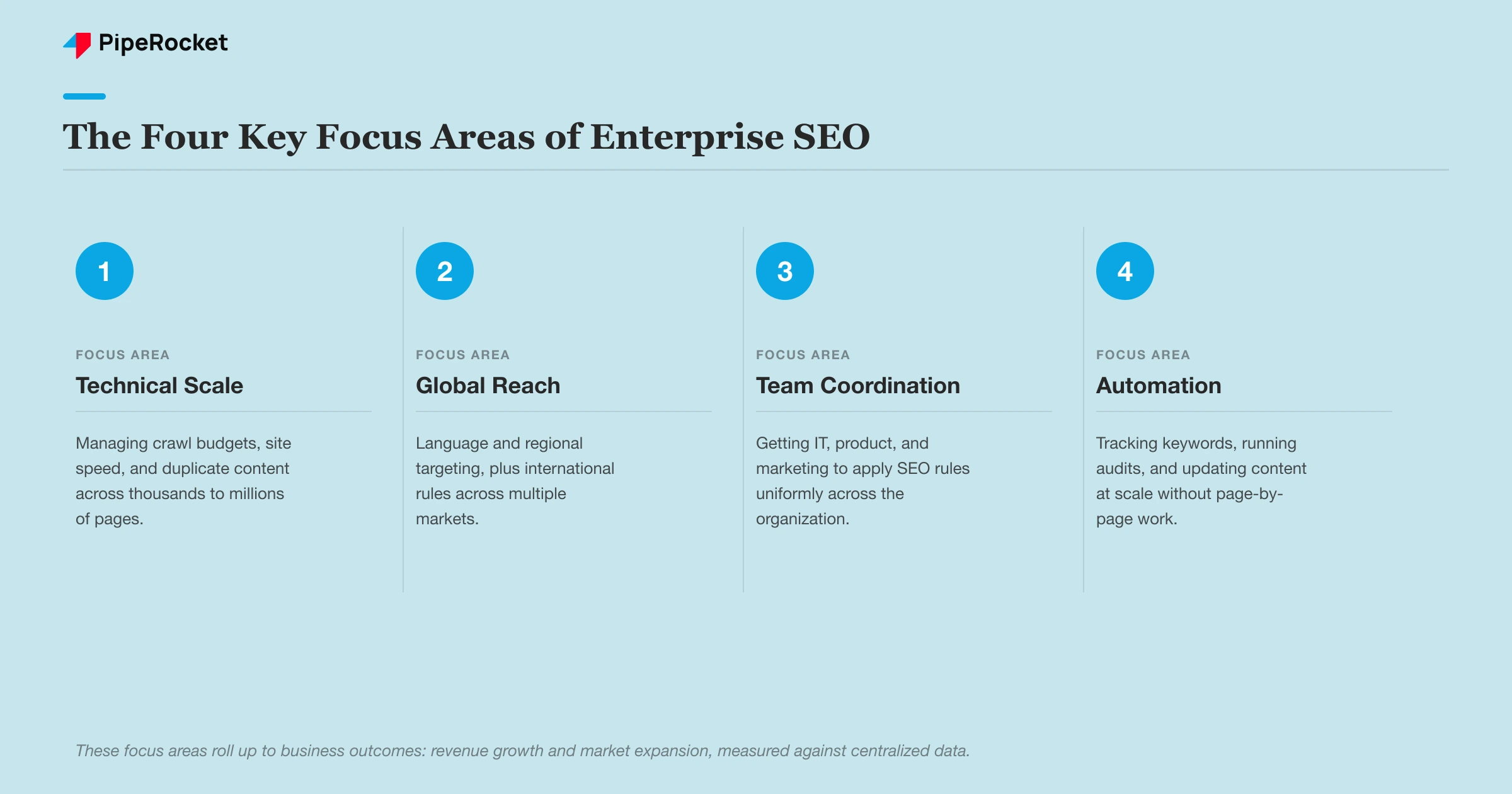
Enterprise SEO concentrates on four key focus areas that separate it from smaller-scale programs:
- Technical Scale: managing crawl budgets, site speed, and duplicate content across thousands to millions of pages
- Global Reach: language and regional targeting, plus international rules across multiple markets
- Team Coordination: getting IT, product, and marketing to apply SEO rules uniformly across the organization
- Automation: tracking keywords, running audits, and updating content at scale without manual page-by-page work
These focus areas roll up to business outcomes such as revenue growth and market expansion, measured against centralized data rather than rankings alone.
Enterprise SEO vs. SMB SEO: Key Differences
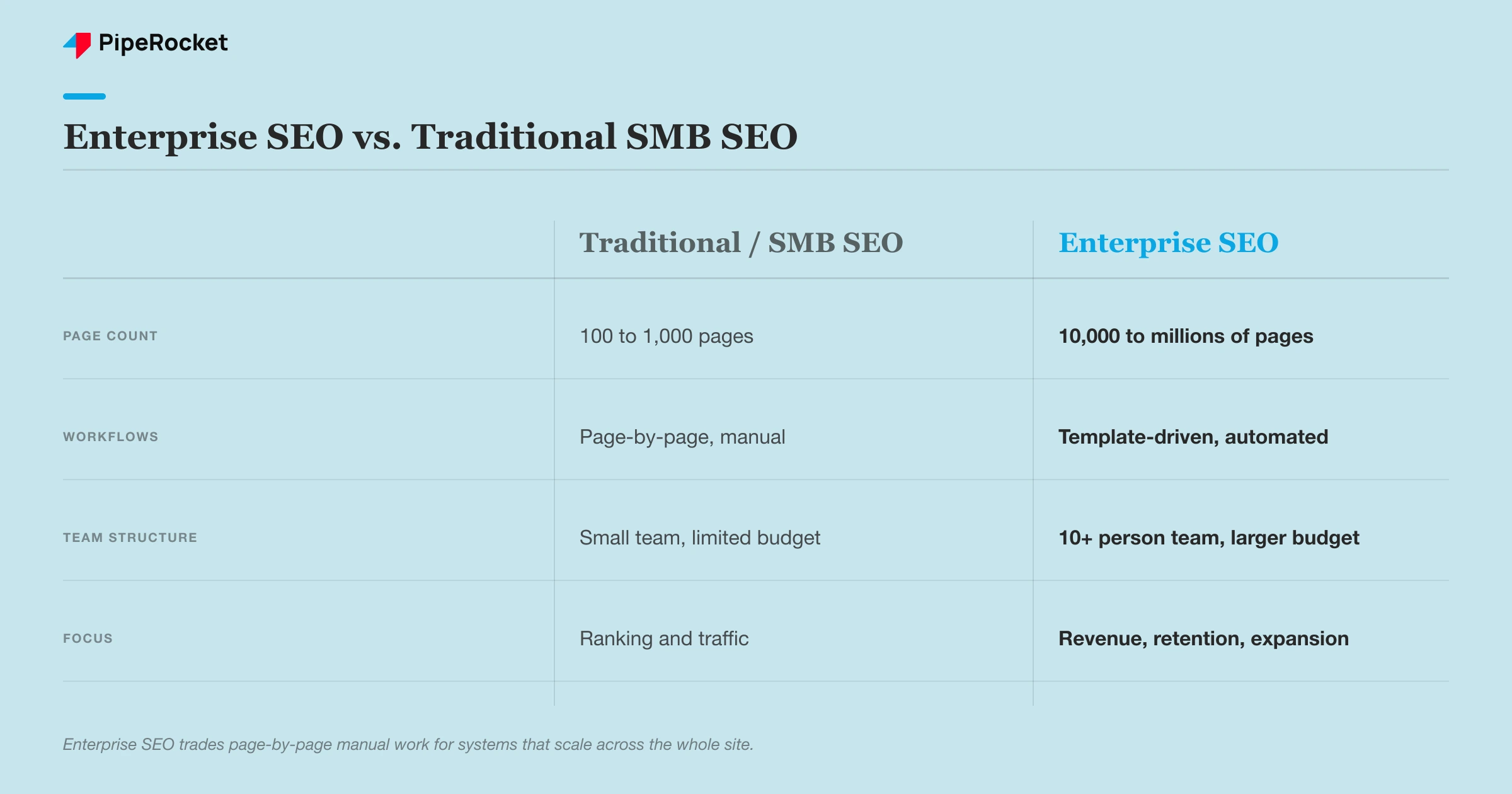
| Dimension | SMB SEO | Enterprise SEO |
|---|---|---|
| Page count | 100 to 1,000 pages | 10,000 to millions of pages |
| Keyword focus | Long-tail, low-competition | High-volume, competitive short-tail |
| Optimization approach | Page-by-page, manual | Template-driven, automated |
| QA process | Manual checks | Automated guardrails and pre-launch validations |
| Analytics tools | GSC + Google Analytics | Data warehouses (BigQuery, Redshift) + custom pipelines |
| Resource allocation | Small team, limited budget | 10+ person team, significant budget |
| Primary goal | Ranking and traffic | Revenue, retention, and market expansion |
What Are The Core Strategic Pillars of Enterprise SEO?
Enterprise SEO requires a strategy built on scalability, governance, and technical infrastructure, not standalone page-level efforts. Three foundational pillars drive a process-driven, cross-functional approach to enterprise level SEO.
Pillar 1: Scalability, Not Granularity
Enterprise SEO moves beyond individual page optimization. Instead of single-page edits, you optimize the systems that generate and manage thousands of pages at once. The shift is from granular refinements to template-driven SEO, where one code change impacts thousands of URLs at once.
Template engineering is among the highest-impact enterprise SEO best practices available. A single optimized template can unlock compounding traffic gains across entire product catalogs, location hubs, or resource libraries. This is the automation component that makes scale possible.
Pillar 2: Governance and Guardrails
Every piece of published content reflects directly on brand. At enterprise scale, manual QA breaks down, both in speed and reliability. SEO governance frameworks embedded into the content development lifecycle solve this.
Guardrails to implement:
- Automated QA checks that flag missing title tags, broken canonical tags , incorrect meta tags, and accidental noindex directives on core templates
- Pre-launch SEO validations built into every publishing and release process
- Staging environment testing before any SEO change goes live
Tip: Educate non-SEO team members (developers, product managers, writers) on crawlability, search intent frameworks, and internal linking impact. When developers understand content hierarchy, they build UX that also performs in search.
Governance gaps rarely show up as a technical failure first. On a recent enterprise account, a batch of competitor-term landing pages got flagged for approval the moment they were submitted in October, since those terms weren’t pre-cleared and had to be justified as business-critical before anyone would sign off. By the time that cleared, the content team had other work queued, so the pages waited. Then design and dev had their own backlog, so we built the pages ourselves rather than wait longer. They shipped in December. Two months passed between submission and launch, and the SEO work itself took a fraction of that time.
Pillar 3: Insights from SEO Data
Standard tools like Google Search Console and Google Analytics hit their limits quickly at enterprise scale. GSC caps reports at 1,000 rows. Sampling techniques designed for smaller sites don’t hold up for millions of URLs. Reporting delays and API limitations make real-time analysis impossible.
Measurement is also shifting. In June 2026, Google added generative-AI performance reporting to Search Console , surfacing impressions from AI Overviews, AI Mode, and Discover. It reports impressions but not click data yet, so enterprise teams should treat AI-surface visibility as a directional signal and keep revenue attribution anchored in their own pipelines.
What enterprise SEO data infrastructure requires:
- Data warehousing solutions such as BigQuery or Redshift to handle enormous data volumes
- Unified data pipelines that bring together search performance, analytics, conversion data, and content metadata
- Custom analysis capabilities for multi-dimensional reporting that standard dashboards cannot produce
How Does Enterprise Technical SEO Work?
In SEO for enterprise sites, millions of URLs need to be managed, monitored, and optimized continuously. Automation is what makes this feasible. Technical SEO at this level covers crawl budget management, Core Web Vitals optimization, sitemap automation, and maintaining a flat internal linking structure so deep pages get crawled and indexed.
Crawl Budget and Log File Analysis
Crawl budget is the number of URLs a search engine is willing and able to crawl within a given timeframe. For large websites, low-value or duplicate pages can silently consume this budget, leaving your high-value pages under-crawled.
To protect crawl budget:
- Prioritize high-value URLs so that key templates return clean, indexable HTML
- Maintain logical internal linking to guide Googlebots to important pages
- Audit and prune crawl waste; large sites accumulate significant crawl waste from duplicate and expired URLs
Log file analysis gives you direct visibility into how Googlebots actually crawl your site. For the full methodology, including template-weighted sampling when you can’t manually review every page, see our enterprise SEO audit walkthrough. Three things you can action from log data:
- Identify which sections are being prioritized or ignored by crawlers
- Spot orphan and dead pages that receive no crawl visits
- Track crawl budget being wasted on duplicate or parameter-based URLs
Managing Legacy Stacks
Legacy CMS platforms create long development queues even for minor SEO fixes. Monolithic architectures and rigid release cycles make core code changes risky, introducing problems like hardcoded titles, technical debt, and server-level conflicts.
Edge SEO implementations address this directly:
- Reduce dependency on slow development cycles for SEO fixes
- Enable site-wide changes to roll out without core code deploys
- Allow lower-risk testing of technical SEO changes before full deployment
Global Hreflang Architecture
When SEO spans multiple geographies, languages, and legal entities, the risks multiply: cross-market cannibalization , inaccurate regional targeting, and duplicate content issues. A properly implemented Hreflang architecture tells search engines exactly how to interpret your international site structure.
| Risk Without Hreflang | What Hreflang Solves |
|---|---|
| Wrong country version ranks in a market | Directs each region to its correct URL |
| Duplicate content across localized pages | Signals to Google which version is canonical per region |
| Cross-market keyword cannibalization | Separates ranking signals across country-specific domains |
Managing Multiple Domains and Subdomains
Enterprise sites rarely live on one domain: acquisitions, regional ccTLDs, product subdomains, and microsites all fragment authority and crawl signals. Keep a live inventory of every domain and subdomain, apply consistent canonical and hreflang rules across them, and standardize templates so one property does not undercut another in search.
Choosing an Enterprise SEO Platform
Choose an enterprise SEO platform on four criteria: data-warehouse-scale reporting (millions of URLs), multi-domain and international support, AI and AEO visibility reporting, and clean integration with your existing analytics and content pipelines. Match the platform to team size and program scope rather than feature count.
The right fit depends on how your organization is structured and where your crawl and content bottlenecks sit. For a category-by-category breakdown of the market, the tooling landscape is covered separately in our roundup of enterprise SEO software.
How to Scale Content for Enterprise SEO?
Scale enterprise content with standardized workflows, automation, modular content creation, and a centralized content management core with teams aligned across departments. When an SEO strategy spans regions and locations, content operations must follow these same systems.
For the SaaS-specific overlay, read our enterprise SaaS SEO guide .
Programmatic SEO and Taxonomy
Programmatic SEO (pSEO) uses templates, automation, and structured data to generate large volumes of high-quality, data-driven landing pages . Instead of one page for “best LMS,” pSEO builds thousands of pages for “best LMS for HR managers in Texas,” matching specific buyer intent at scale. Before building at that scale, run the qualification test in our programmatic SEO for SaaS guide, since most pSEO plays fail it.
Solid taxonomy and site structure make pSEO pages discoverable. Organizing pages into a logical hierarchy presents your site architecture clearly to search engines, enabling accurate indexing and avoiding the thin-page issues Google flags.
pSEO quality control checklist:
- Avoid doorway pages; each page must deliver genuine, unique value
- Avoid template feel; vary structure and content meaningfully across pages
- Use proprietary data to differentiate from generic programmatically-generated content
- Apply canonicalization to prevent duplicate content issues across similar pages
- Monitor Core Web Vitals across your page fleet
- Set low-value variants to noindex to protect crawl budget
This quality bar is not optional. Google’s June 2026 spam update reinforced its stance against manipulative and scaled AI-generated content. It was not a policy change, but a reminder that programmatic output which lacks unique value is exactly what these systems target.
Tackling Content Decay
Content decay, the gradual loss of search traffic, rankings, and relevance, is one of the most common large-scale SEO problems. At enterprise scale, it requires systematic detection and response, not manual spot-checks.
| Signal | What It Indicates | Recommended Action |
|---|---|---|
| Declining traffic over 90 days | Content losing search relevance | Refresh with updated information and structure |
| High exit rate on key pages | Content not meeting user intent | Rewrite to match current search intent |
| Orphan pages with no inbound links | Content isolated from site structure | Integrate into relevant clusters or prune |
| Negative ranking trendline | Competitors outpacing content quality | Audit and refresh based on competitor gaps |
| Obsolete or low-value content | Crawl budget waste and diluted authority | Prune via automated removal or redirect |
Set up automated triggers using Google Analytics and GSC APIs to surface pages that cross these thresholds, so no decaying page goes undetected across a site of thousands.
Future-Proofing: AEO and Entity Optimization
AI Overviews (AIO) and AI Mode are reshaping how search surfaces content. To stay visible, enterprise SEO strategies need to transition toward Answer Engine Optimization (AEO) and entity-based optimization.
Two steps to make this transition:
- Implement schema markup : the structured language AI engines use to understand and cite your content
- Build a knowledge graph that connects your brand entity to related topics and concepts, strengthening topical authority across AI-generated answers
How to Navigate the Enterprise Organization for Advocacy?
Navigate the enterprise organization with three levers: build a revenue-based business case with forecasting, choose the right SEO org model (Center of Excellence or embedded), and win dev and product buy-in. Enterprise SEO touches product, development, content, and leadership teams, so cross-functional alignment matters as much as any technical implementation.
We catalogue the common blockers in enterprise SEO challenges and how to fix them .
Building the Business Case with Forecasting
Leadership speaks the language of revenue. To secure buy-in, connect SEO investment directly to business outcomes, not rankings or traffic.
- Map the user journey through each funnel stage and apply conversion metrics to translate organic traffic into projected revenue
- Use data-driven forecasting models to show specific revenue outcomes tied to SEO investment levels
- Model the “cost of inaction,” demonstrating that doing nothing carries a higher cost than the SEO investment itself
- Anchor proposals to Total Addressable Market (TAM) to give leadership a market-scale frame of reference
Embedded vs. Center of Excellence: Choosing Your Model
How you organize your SEO team determines how fast you can move and how consistently you can deliver. The two main models serve different organizational needs:
| Center of Excellence (CoE) | Embedded Model | |
|---|---|---|
| Best for | Large orgs that need consistent, compliant, high-standard processes | Organizations that require high agility, specialization, and rapid iteration |
| Structure | Centralized SEO team sets standards for the entire organization | SEO specialists embedded within individual product or regional teams |
| Strength | Consistency, governance, and unified quality control | Speed, context, and cross-functional depth |
| Trade-off | Slower responsiveness to local or product-specific needs | Risk of inconsistent standards across teams |
Winning Dev and Product Team Buy-In
Technical SEO depends heavily on engineering cooperation. Getting it requires more than sending Jira tickets.
- Adopt an engineering partner mindset: engage with empathy for development constraints and priorities
- Speak the language of dev teams: work within Jira, Agile sprint cycles, and engineering-standard documentation
- Collaborate with product managers to define joint, outcome-based KPIs that align enterprise SEO metrics with product goals
Why PipeRocket Digital Is Your Enterprise SEO Partner
Building a corporate SEO framework is not just about expanding your purview; it requires a complete overhaul of strategy, governance, technical infrastructure, and organizational alignment. Whether you are building SEO for enterprise companies from scratch or revamping an existing program, our enterprise SEO services guide you through every component.
Our SaaS SEO service is built on the same pipeline-first principles that make enterprise programs actually generate revenue, not just rankings. With a 30+ person team that has worked across 70+ B2B SaaS companies and a 4.7 Clutch rating, we act as an extended revenue team, not a vendor.
To navigate enterprise SEO with a partner who has done it before, get in touch with us today .
Frequently Asked Questions for Enterprise SEO
1. What distinguishes enterprise SEO from small business SEO?
The difference is scale, complexity, and resource requirement. Enterprise SEO manages sites with 10,000 to millions of pages; small business SEO typically covers fewer than a few hundred. Enterprise SEO targets high-volume, competitive short-tail keywords with automation and governance frameworks. Small business SEO focuses on long-tail, lower-competition terms with manual, page-level optimization. Budget and team size are significantly larger on the enterprise side.
2. How do you handle crawl budget issues for large websites?
Effective crawl budget management focuses on reducing crawl waste and maximizing crawl efficiency. Key strategies include:
- Auditing and removing or consolidating low-value pages
- Fixing technical bottlenecks such as redirect chains and soft 404s
- Optimizing URL parameters to prevent duplicate page generation
- Using log file analysis to identify where crawl budget is being wasted
- Monitoring and adjusting using crawl analysis tools on an ongoing basis
3. What are the essential tools for an enterprise SEO stack?
A complete enterprise SEO stack in 2026 covers six categories:
- Enterprise SEO platforms : centralized tracking and reporting at scale
- Technical SEO and crawling tools: site audits, log file analysis, and crawl monitoring
- Backlink and competitor intelligence: link acquisition and gap analysis
- Content optimization and AI tools: on-page quality at scale
- Reporting and analytics tools: data warehouses like BigQuery or Redshift for custom analysis
- Workflow and project management tools: cross-team collaboration and sprint integration
4. How do you measure the ROI of enterprise SEO campaigns?
ROI is calculated by comparing the revenue generated from organic search against the total cost of the SEO program: ROI = (Organic Revenue − Cost of SEO) ÷ Cost of SEO Track organic revenue at the page and cluster level so you can attribute pipeline contribution accurately, not just at the domain level.
5. What is the best team structure for enterprise SEO?
The most effective structure for enterprise SEO management is a hybrid model: an in-house core team handles strategy and oversight, while a specialized agency partners on execution, technical SEO, and content creation. If you are evaluating external partners, our roundup of the best B2B SEO agencies is a useful starting point for shortlisting. A typical enterprise SEO team includes:
- SEO Director: owns strategy, stakeholder alignment, and roadmap
- Technical SEO Specialists: manage infrastructure, crawl health, and schema
- Content Strategists: lead keyword mapping, cluster planning, and editorial quality
- Link Building Specialists: drive authority acquisition and digital PR
- Data Analysts: own reporting, forecasting, and pipeline attribution
6. How much does enterprise SEO cost?
Enterprise SEO cost scales with team size, page volume, and program scope. Most enterprise programs run as monthly retainers in the thousands to tens of thousands of dollars, driven by tooling, in-house headcount, and agency support rather than a single fixed price. Larger, multi-market sites sit at the higher end.