What Is Enterprise SaaS SEO? Four Pillars Explained
 Kamaraj Mathiarasan (Kim)
Last updated on
Kamaraj Mathiarasan (Kim)
Last updated on
What Is Enterprise SaaS SEO?
Enterprise SaaS SEO is the practice of building and scaling organic search programs for large or high-growth SaaS businesses with complex site architectures, multiple products or personas, and a need to generate qualified pipeline across long B2B sales cycles.
It is SEO, but the scale changes everything: more pages to govern, more stakeholders to align, more ICPs to serve, and more technical surface area where things can silently break. A misconfigured template that would cost a startup one ranking can cost an enterprise company hundreds.
This is the SaaS-specific angle on enterprise SEO. Where a general enterprise SEO guide treats any large site, the SaaS version deals with buying committees, multiple product lines, and organic pipeline attributed back to ARR across long B2B sales cycles.
TL;DR
- Pipeline attribution and organic CAC are the metrics enterprise leadership actually funds, well beyond traffic or ranking counts
- At enterprise scale, the organizational and governance challenges are as difficult as the technical ones
- Technical SEO failures cascade across thousands of pages through shared templates. Fix governance before publishing new content
- Content architecture across multiple products and ICPs requires deliberate design, not organic growth
- AI search visibility is now a separate optimization layer that enterprise SaaS companies cannot afford to ignore
Standard SaaS SEO gets you to $10M ARR. The enterprise version gets you past it. The playbook changes because the problem changes: more product lines, more ICPs, more markets, and a technical infrastructure complex enough that a single template decision affects thousands of pages. Most organic programs stall at scale not because the strategy was wrong, but because it was built for a smaller version of the company it now needs to serve.
| Area | Standard SaaS SEO | Enterprise SaaS SEO |
|---|---|---|
| Site scale | 50 to 500 pages | 500 to 50,000+ pages |
| Products and ICPs | One product, one buyer | Multiple products, personas, and verticals |
| Technical risk | Isolated errors | Template errors cascade at scale |
| Stakeholders | 1 to 3 people | SEO, engineering, product, content, RevOps |
| Reporting | Traffic and rankings | Pipeline, SQL attribution, organic CAC |
| Link strategy | Opportunistic | Programmatic, asset-driven |
| AI search | Optional consideration | Required optimization layer |
Why Enterprise SaaS Companies Cannot Treat SEO as a Marketing Side Project
At enterprise scale, organic search is a strategic revenue channel or a liability, with no middle ground. Enterprise SaaS SEO compounds pipeline at near-zero marginal cost, while paid acquisition stops the moment budget pauses.
The economics make it unavoidable. Industry benchmarks put the average B2B SaaS SEO ROI at roughly 702%, with a payback period of under seven months, which works out to more than $22 back for every dollar invested in organic search over time. Treat those figures as directional rather than a guarantee, but the direction is clear. Paid acquisition can never replicate that compounding curve because the cost scales linearly with spend and stops the moment the budget pauses.
At enterprise scale, the compounding advantage is even more pronounced. A content library of 500 high-quality pages built over two years keeps generating pipeline at zero incremental cost per visit, while paid spend of the same budget period contributes nothing after the campaigns end.
What this looks like in practice: A $50M ARR enterprise collaboration SaaS discovers through a pipeline attribution audit that 60% of their closed-won enterprise accounts had at least one organic search touchpoint in the 90 days before entering the sales cycle. The SEO program had never been given credit for that contribution because the attribution model only tracked last-touch paid channels. After rebuilding the measurement framework, the company doubles the SEO budget at the next planning cycle.
First-hand takeOn a recent enterprise engagement, the SEO was never the hard part. We submitted a set of competitor-term landing pages for approval in October, and were told those terms weren’t allowed. We had to justify them as business-critical before we got the green light. Then the content team had higher-priority commitments, so it sat. Then design and dev were backed up, so we built the pages ourselves. The first set went live in December. Two months end to end, and almost none of it was about SEO tactics. It was governance.
The Four Pillars of Enterprise SaaS SEO
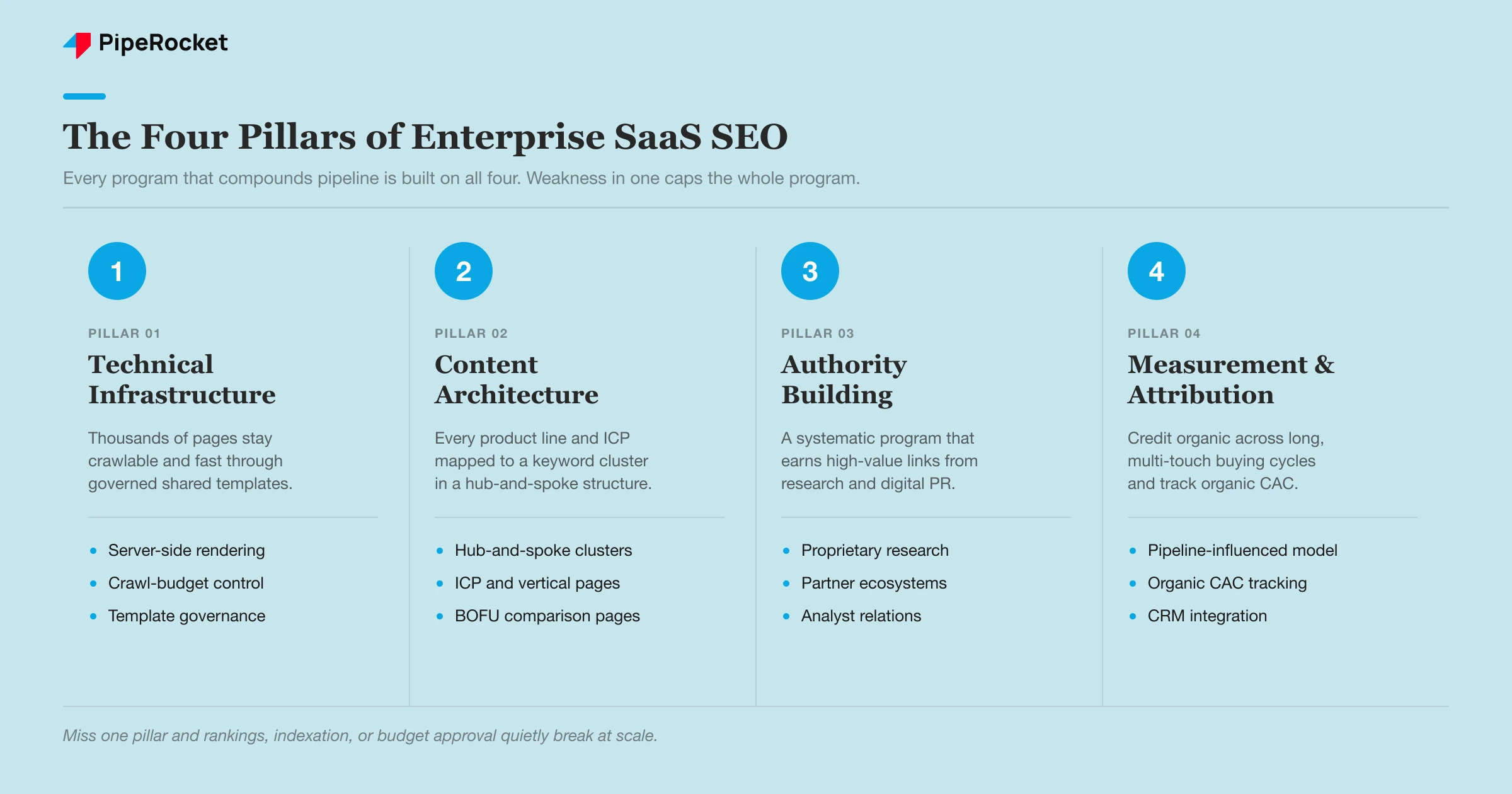
The four pillars of SaaS SEO at enterprise scale are technical infrastructure, content architecture, authority and links, and measurement and attribution. Every program that generates consistent pipeline is built on all four, and weakness in any one limits the entire program.
| Pillar | What it covers | What breaks without it |
|---|---|---|
| Technical infrastructure | Crawlability, rendering, Core Web Vitals, template governance | Content that cannot be indexed regardless of quality |
| Content architecture | ICP -mapped keyword clusters , hub-and-spoke structure, product line coverage | Content that never compounds into topical authority |
| Authority and links | Programmatic link acquisition, digital PR, partner ecosystems | Rankings that stall when competition for high-value terms is high |
| Measurement and attribution | CRM integration, pipeline reporting, organic CAC tracking | SEO budgets that cannot be justified in board meetings |
Pillar 1: Technical Infrastructure at Enterprise Scale
Technical infrastructure at enterprise scale means making thousands of pages crawlable, renderable, and fast through shared templates, so a systems-level fix beats page-by-page work. In enterprise SaaS SEO, multiple product areas, dynamic content, gated sections, and marketing sites on separate tech stacks all raise the technical SEO surface area.
The enterprise-specific technical issues that show up most consistently in audits:
- JavaScript rendering: enterprise SaaS marketing sites frequently use React, Next.js, or Angular frameworks. Without server-side rendering configured correctly for public-facing pages, Google sees empty HTML shells instead of content. This does not show up in your analytics because the pages look fine to humans
- Crawl budget inefficiency: enterprise sites generate thousands of low-value URLs through URL parameters from marketing tools, session IDs, and faceted navigation. Googlebot spending crawl budget on those URLs means your high-value content pages get crawled less frequently
- Template governance failures: a single SEO error in a global page template can replicate across hundreds or thousands of pages before anyone notices
- Subdomain fragmentation: enterprise SaaS companies often have product documentation, regional sites, help centers, and marketing properties on separate subdomains. Without a deliberate internal linking strategy, authority earned in one property does not flow to others
- API and developer documentation optimization: for developer-facing SaaS, API references, quickstarts, and SDK docs are a high-intent organic surface in their own right. Making them indexable, well-structured, and internally linked to product pages captures technical evaluators who search for integration and endpoint queries, an audience most marketing-site SEO never reaches
What this looks like in practice: An enterprise DevOps SaaS company conducts a full technical audit ahead of a site architecture project. They discover that their documentation subdomain, which earns 400 backlinks per year from developer blogs, shares zero internal link equity with their main marketing domain because there are no cross-subdomain links. Implementing a targeted internal linking program between the docs subdomain and product pages lifts the main domain’s ranking positions for ten competitive developer tool queries within three months.
Pillar 2: Content Architecture Across Products and ICPs
Content architecture in enterprise SaaS SEO is the deliberate hub-and-spoke structure that maps every product line and ICP to a keyword cluster, signaling topical authority and building a logical buying path for each buyer. At enterprise scale the challenge is organizing existing content, not producing more. A practical four-tier framework accounts for multiple product lines, ICPs, buying stages, and international markets:
- Tier 1: Core product and solution pages targeting the highest-intent, most competitive terms. These are the conversion destinations that all other content should link toward
- Tier 2: Vertical and use-case pages built around ICP-specific problems your product solves. One page per key industry or use case
- Tier 3: Pillar pages establishing topical authority in each major keyword cluster. One per theme, linking to every spoke
- Tier 4: Supporting content including comparison pages , alternatives pages , how-to guides, and FAQ content targeting long-tail intent
Treat competitor and alternative pages as a funnel-mapping tactic, not just a content tier. “[Competitor] alternative” and “[Competitor] vs [you]” queries are late-stage evaluation intent from buyers already in market, so a dedicated page per major competitor captures buying committees comparing shortlisted vendors and routes them to the highest-intent product pages.
Our SaaS SEO strategies guide covers the keyword mapping process for each of these tiers in detail.
What this looks like in practice: An enterprise project management SaaS has 200 published articles, all tagged under a single “Resources” category with no hierarchical structure. A content architecture rebuild organizes them into four product-line clusters, each with a pillar page, vertical pages for six key industries, and a BOFU layer of comparison and alternatives pages. Within eight months, two of the four clusters reach page-one rankings for their pillar terms. No new content was published during the rebuild.
Pillar 3: Authority Building at Enterprise Scale
Authority building for enterprise SaaS SEO is a systematic, ongoing program that earns high-value links from research, partner ecosystems, and digital PR, because high-value commercial terms in competitive SERPs demand domain authority that periodic outreach cannot produce. Four approaches that work at scale:
- Proprietary research and benchmark data: enterprise SaaS companies have access to anonymized usage data across hundreds or thousands of clients. Turning that data into annual industry reports builds a link magnet that earns citations from industry publications, analyst firms, and competitor content year over year
- Integration and partner ecosystems: every integration partner has documentation, a marketplace listing, and often a blog. Systematically ensuring those ecosystem touchpoints include contextual backlinks to your domain is a structural link acquisition strategy that scales with your partner network
- Analyst relations: citations and profiles from Gartner, Forrester, and their peer-review platforms carry authority that outranks most editorial links and feed directly into how enterprise buyers (and AI answer engines) evaluate vendors. A deliberate analyst-relations motion, briefing analysts and keeping profiles current, compounds both SERP authority and shortlist presence
- Thought leadership and digital PR: enterprise buyers read industry publications, analyst reports, and executive content. When your leadership team publishes original perspectives in those channels, the citations that follow carry significantly more authority than directory links or guest posts on low-DA blogs
Our in-depth SaaS link building guide covers each of these approaches with specific implementation steps.
What this looks like in practice: A SaaS security platform publishes a quarterly Threat Intelligence Report based on anonymized data from its enterprise client base. The report is picked up by three tier-one security publications, two analyst firms, and dozens of security blogs each quarter. After four quarters, the report landing page has 280 referring domains and lifts the authority of every page it links to internally.
Pillar 4: Measurement and Attribution for Enterprise Pipeline
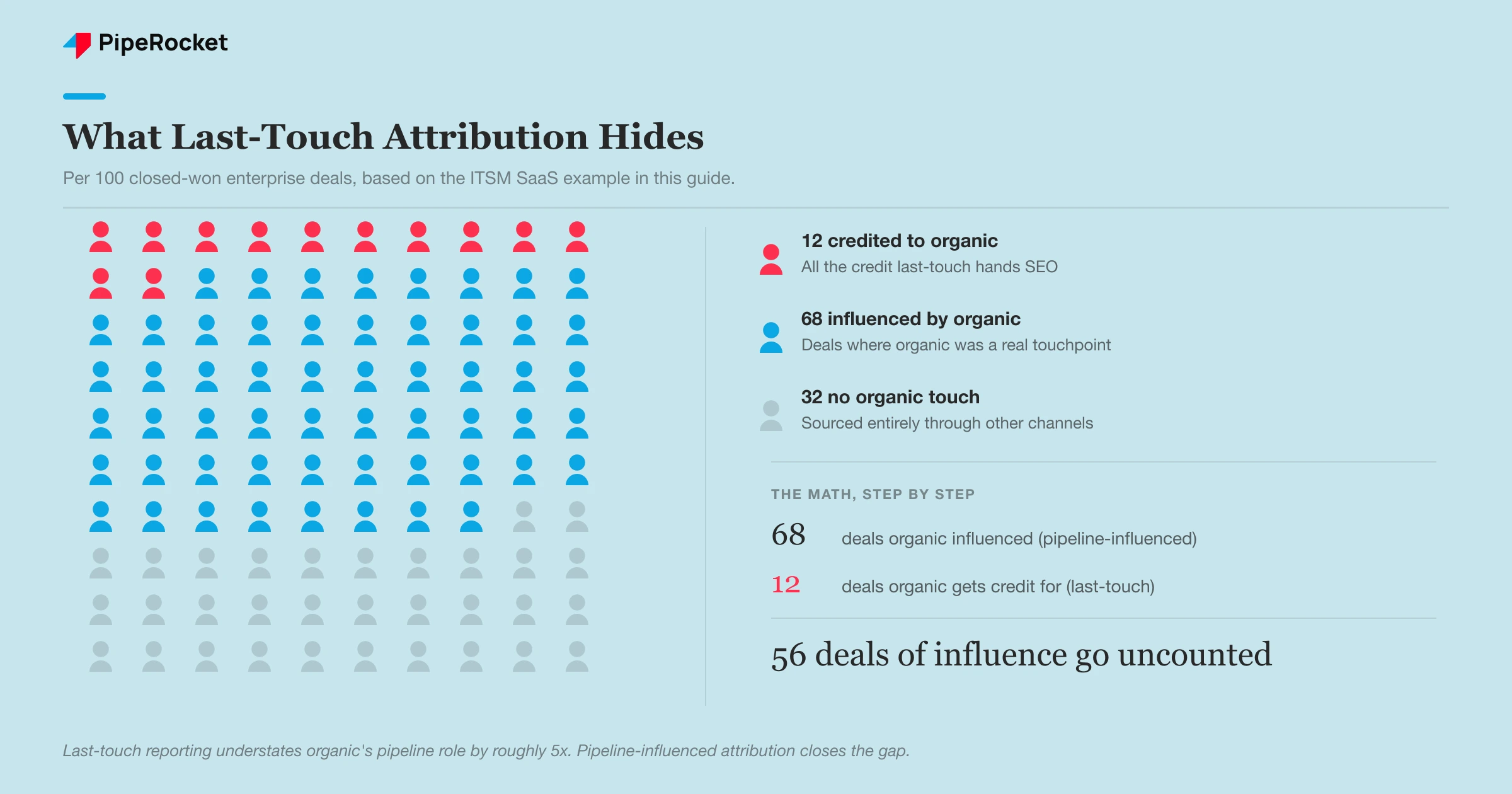
Measurement and attribution in an enterprise SaaS SEO program means crediting organic across long, multi-touch buying cycles and tracking organic CAC, because last-touch models hand all the credit to the final channel and leave SEO contributing pipeline it never gets credit for.
Content also compounds by shortening the sales cycle. When buying-committee members find answers to their evaluation questions in organic content before the first sales call, they enter the cycle pre-educated, which speeds deals through evaluation and raises sales-cycle velocity, a pipeline effect worth measuring alongside sourced and influenced revenue.
| Attribution model | What it captures | Limitation |
|---|---|---|
| Last-touch | Final touchpoint before conversion | Misses all organic influence in earlier buying stages |
| First-touch | First interaction with the brand | Misses the compounding influence of ongoing content engagement |
| Linear | Equal credit to all touchpoints | Does not weight the touchpoints that actually drove decisions |
| Pipeline-influenced | Any opportunity where organic was a touchpoint | Shows the full breadth of organic’s role across all deals |
| Organic CAC | Cost to acquire a customer through organic vs. paid | The most compelling metric for budget justification |
For enterprise SaaS, pipeline-influenced and organic CAC are the two metrics worth building toward. This requires B2B marketing operations infrastructure: CRM integration with proper lifecycle stage tracking, consistent UTM hygiene across all organic touchpoints, and a RevOps partner who understands multi-touch attribution methodology.
What this looks like in practice: An enterprise ITSM SaaS switches from last-touch to pipeline-influenced attribution after a RevOps audit reveals that organic content was present in 71% of deals closed in the previous quarter. Under last-touch, organic received credit for 12% of pipeline. Under pipeline-influenced, it receives credit for 68%. The CMO uses this data to make the case for tripling the content budget. The board approves it in the same meeting.
How Enterprise SaaS SEO Must Adapt for AI Search
Enterprise SaaS SEO adapts for AI search by structuring content as direct answers, keeping brand entity descriptions consistent across the web, and earning presence in the third-party sources AI engines trust. AI Overviews , ChatGPT, and Perplexity are not replacing traditional search, but they add a visibility layer that enterprise SaaS companies optimize for separately.
| Traditional SEO signal | AI search signal |
|---|---|
| Keyword density and placement | Direct, complete answers to specific questions |
| Backlink quantity | Authority of sources that cite your content |
| Meta title optimization | Brand entity consistency across the web |
| Content length | Content structure and modularity |
| Domain authority | Presence in trusted third-party sources (G2, analyst reports) |
Enterprise SaaS companies that are structuring their content for direct answers, maintaining consistent brand entity descriptions across all external properties, and building presence in the analyst and review ecosystems that AI engines draw from are showing up in AI-generated responses at significantly higher rates.
Structured data is the mechanical lever underneath this. Marking up organizations, products, FAQs, and how-to content with schema gives AI engines machine-readable, citable facts to lift, which improves the odds your pages are the source an AI Overview or ChatGPT answer pulls from rather than a competitor’s.
Measurement of this layer is improving. As of June 2026, Google Search Console reports impressions in AI Overviews, AI Mode, and Discover, giving enterprise teams a first-party signal for where their content appears in generative surfaces. Click data is not yet broken out, so treat these impressions as a visibility gauge rather than a traffic number. Google also added a control for opting content out of generative features. (Google Search Central )
What this looks like in practice: An enterprise data integration SaaS notices that a competitor is being referenced in ChatGPT responses for “best data integration platforms” despite ranking below them on Google. An audit reveals the competitor has a consistent, structured company description across 40 review sites and analyst profiles, while the SaaS company has four different descriptions across those same properties. Standardizing their brand entity across all external sources results in measurable improvement in AI citation frequency within two quarters.
Enterprise SaaS SEO Implementation Checklist
Use this checklist to pressure-test a program against all four pillars before scaling spend:
- Audit crawl budget, JavaScript rendering, and shared template governance before publishing any new content
- Map every product line and ICP to a keyword cluster in a hub-and-spoke architecture, including competitor and alternative pages
- Optimize API and developer documentation as its own indexable, internally linked surface
- Stand up programmatic link acquisition: original research, partner ecosystems, analyst relations, and digital PR
- Wire the CRM for pipeline-influenced attribution and organic CAC, not last-touch reporting
- Add schema markup and keep brand entity descriptions consistent across G2, analyst profiles, and review sites
- Track sales-cycle velocity alongside sourced and influenced pipeline
- Review AI Overview and AI Mode impressions in Search Console as a generative-visibility gauge
Why Enterprise SaaS Companies Trust PipeRocket to Scale Their Organic Program
Enterprise SEO at scale requires more than a content calendar and a keyword tool. Enterprise SaaS SEO requires a team that can navigate the organizational complexity, build the technical governance, and connect every organic touchpoint to a pipeline outcome that survives scrutiny from the CFO.
PipeRocket’s enterprise SEO services were built specifically for this. Before any keyword tool opens, the team goes inside your sales call recordings, maps each ICP across your product lines, and builds a demand model that starts with your revenue target and works backwards to the content, technical, and link investments required to hit it.
- SaaS SEO: pipeline-first enterprise SEO strategy across multiple products and ICPs, with technical governance built into delivery, BOFU content live in month one, and reporting tied to MQLs, SQLs, and organic CAC
- SaaS PPC: paid programs that share data with your organic program so both channels optimize for the same pipeline outcomes instead of running in separate silos
- Marketing Operations: the CRM integration, attribution framework, and reporting infrastructure that makes enterprise organic pipeline visible at the board level
With 70+ B2B SaaS companies served and a 4.7 rating on Clutch, PipeRocket functions as an extended revenue team. If your enterprise SEO program is not showing up in your pipeline report, that is the specific problem we were built to solve.
Conclusion
Enterprise SaaS SEO is not standard SEO at higher volume. It is a different discipline that requires technical governance at scale, content architecture across multiple products and ICPs, systematic authority building, and a measurement framework that connects organic search to board-level revenue metrics. The companies that build it correctly turn organic into their lowest-CAC acquisition channel. The ones that skip the infrastructure keep rebuilding from scratch every time the team or the strategy changes.
Frequently Asked Questions
1. What makes enterprise SaaS SEO different from regular SaaS SEO?
Scale, complexity, and organizational dynamics. At enterprise scale, technical errors cascade across thousands of pages. Content has to serve multiple products and ICPs simultaneously. Cross-functional alignment with engineering, product, and RevOps is as important as the SEO tactics themselves. And reporting has to connect to pipeline and revenue in a way that can survive a board-level conversation.
2. How do you handle SEO across multiple product lines without cannibalizing rankings?
Each product line needs its own keyword universe, content architecture, and conversion path. Keyword mapping at the product level, combined with clear internal linking rules that prevent pages in different product clusters from targeting the same terms, manages cannibalization . When two product pages legitimately compete for the same query, resolve it with a canonical tag and redirect the weaker page’s authority to the primary.
3. How much does enterprise SaaS SEO cost?
Early-growth enterprise programs (Series B to C) typically run at $8,000 to $20,000 per month covering strategy, content production, technical SEO, and link acquisition. The relevant benchmark is not the monthly spend but the organic CAC relative to paid CAC. When organic CAC falls below paid CAC, the program is generating positive ROI at scale.
4. How do you get internal buy-in for enterprise SEO investment?
Connect the program to revenue before it starts. Model the pipeline contribution using reasonable conversion assumptions, show the compounding CAC advantage versus paid, and set 90-day milestones that demonstrate momentum quickly. CFOs respond to organic CAC benchmarks. CMOs respond to pipeline attribution data. Board members respond to the compounding cost curve.
5. How does enterprise SaaS SEO support freemium or product-led growth?
For freemium and product-led SaaS, organic search feeds the top of the self-serve funnel: high-intent problem and use-case queries route visitors directly into a free trial or free tier instead of a demo form. The content that ranks should map to activation moments, targeting the jobs a user completes in the product, so organic sign-ups convert to paid at a rate the team can measure alongside sales-led pipeline.
6. How does enterprise SaaS SEO interact with paid acquisition?
Organic and paid are complementary, not competitive. Paid search data reveals which landing pages, keywords, and audiences convert at the highest SQL rates, and that data should directly inform which organic content gets built first. In enterprise SEO for SaaS, the teams that integrate both channels into a single demand generation framework consistently outperform those running them in isolation. Our B2B PPC campaigns guide covers the paid side of this integration in detail.