The 11 Most Common Enterprise SEO Challenges (And Fixes)
 Kamaraj Mathiarasan (Kim)
Last updated on
Kamaraj Mathiarasan (Kim)
Last updated on
Enterprise SEO is hard because of everything around the tactics: the organizational friction, the governance gaps, the attribution blindspots, the competing priorities that push SEO work to the back of every engineering queue. This guide covers the 11 enterprise SEO challenges that actually block pipeline, and what high-growth SaaS teams do to solve each one.
TL;DR
- Enterprise SEO challenges are the organizational, technical, and strategic obstacles that prevent large-scale B2B SaaS companies from converting organic search investment into measurable pipeline
- Most enterprise SEO failures are not technical. They are governance failures, alignment gaps, or measurement blindspots
- AI search has added a new visibility layer that requires separate optimization strategies from traditional search
- The enterprise SEO teams generating pipeline have solved for organizational alignment first and technical execution second
- The obstacles span four categories: cross-functional governance, technical and crawl infrastructure, content architecture, and pipeline attribution, plus a growing AI-search visibility layer traditional SEO does not cover
- Every challenge on this list is fixable. None of them require starting over from scratch
What Are Enterprise SEO Challenges?
Enterprise SEO challenges are the obstacles that prevent large B2B SaaS companies from turning organic search investment into consistent, measurable pipeline. They differ from the challenges facing smaller SaaS SEO programs in both scale and complexity.
A startup SEO mistake costs one ranking. An enterprise SEO mistake can cost thousands. A startup misalignment between SEO and engineering means a delayed fix. An enterprise misalignment means a six-month engineering queue and four stakeholder sign-offs before anything moves.
Here is a snapshot of the 11 challenges this guide covers:
| # | Challenge | Where it shows up |
|---|---|---|
| 1 | Cross-functional alignment | Engineering ships without SEO input, rankings drop |
| 2 | Technical governance at scale | Template errors cascade across thousands of pages |
| 3 | Content architecture across products and ICPs | Content that competes with itself and never compounds |
| 4 | Crawl budget inefficiency | High-value content under-indexed, low-value URLs over-crawled |
| 5 | AI search visibility | Rankings without AI citations means declining CTR |
| 6 | Attribution and pipeline reporting | SEO cannot prove its revenue contribution at board level |
| 7 | Content quality at scale | Publishing volume without perspective produces traffic, not pipeline |
| 8 | Link authority in competitive SERPs | High-value terms locked behind domain authority gaps |
| 9 | Legacy CMS and rigid tech stacks | SEO fixes stall behind platform limits and slow deploy queues |
| 10 | Site architecture bloat | Subdomains and microsites split link equity and dilute authority |
| 11 | International SEO complexity | Broken hreflang sends the wrong region’s page into search results |
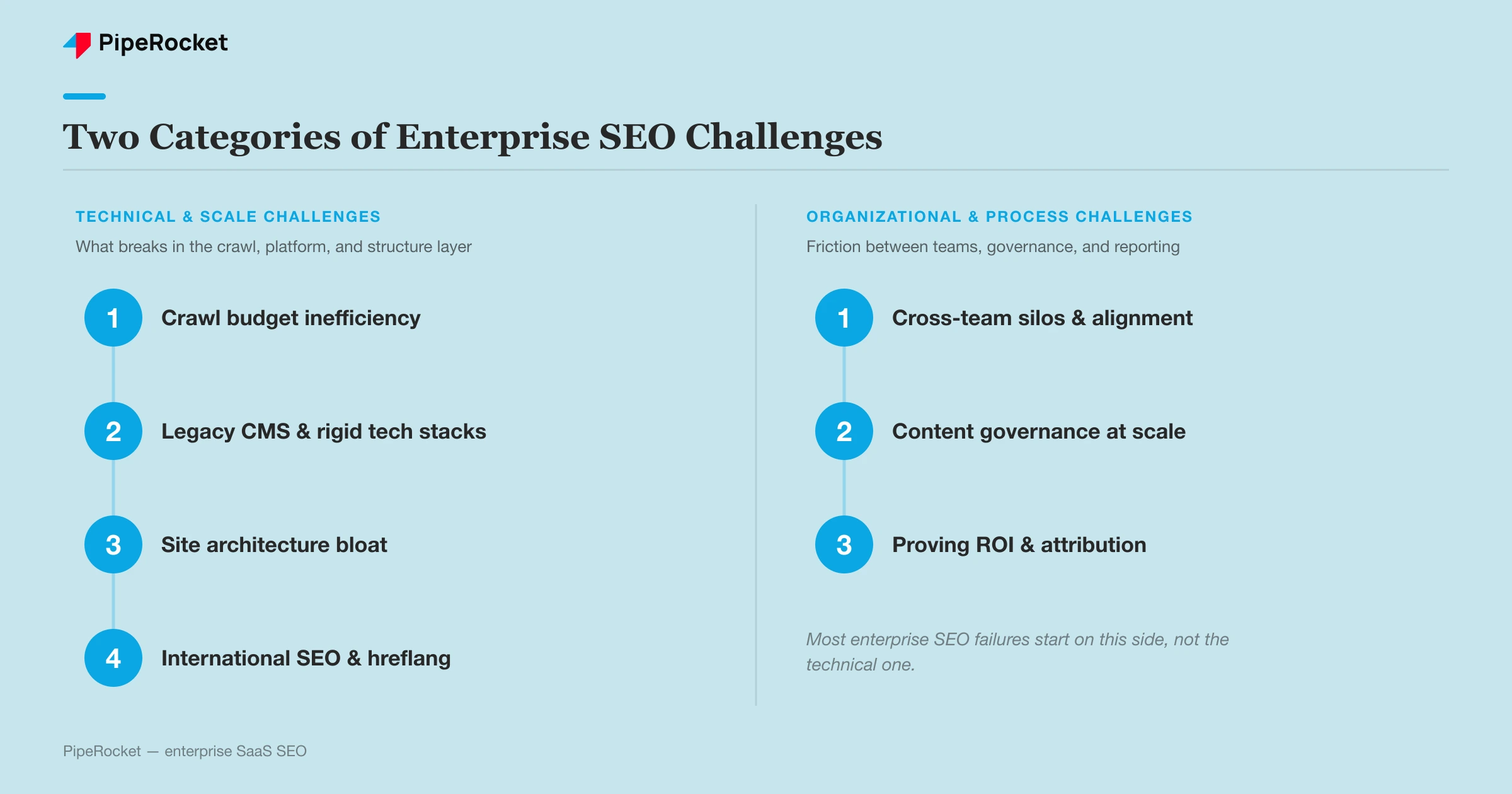
Challenge 1: Getting Cross-Functional Alignment on SEO
Cross-functional alignment is the enterprise SEO challenge of getting engineering, product, content, marketing, legal, and PR to factor SEO into daily decisions. The fix is embedding SEO review gates into each team’s workflow before code or content ships.
Enterprise SEO lives at the intersection of engineering, product, content, marketing, and often legal and PR. None of those teams report to the same person. None of them have SEO as their primary KPI. And all of them make decisions daily that affect organic search performance without realizing it.
Engineering ships a site migration without preserving URL redirects. Product launches a new feature section with duplicate title tags across every page. A regional marketing team creates a campaign microsite on a subdomain with no canonical configuration. Each of these is a decision made by someone who was not thinking about SEO because SEO was not in their workflow.
On a recent enterprise engagement, the SEO itself was never the hard part. We submitted a set of competitor-term landing pages for approval in October, and were told those terms weren’t allowed until we justified them as business-critical. Then the content team had higher-priority commitments, so the pages sat. Then design and dev were backed up, so we built the pages ourselves. The first set went live in December, two months end to end, and almost none of that timeline was about SEO tactics. It was governance.
What high-growth SaaS teams do instead:
- Build SEO review checkpoints into engineering sprint workflows, specifically a review gate before any code affecting public-facing pages is merged
- Include SEO briefs as standard inputs for new product page launches, the same way design specs and copywriting briefs are required
- Create a shared SEO impact scorecard that product, engineering, and marketing teams reference when planning work that touches the site
- Assign an internal SEO champion in each function whose role includes flagging SEO-impacting decisions before they ship
What this looks like in practice: A $75M ARR enterprise SaaS company implements a “one-pager SEO review” requirement for any engineering ticket affecting navigation, URL structure, metadata templates, or rendering configuration. The form takes five minutes to complete and routes to the SEO lead for a 24-hour review. In the first six months, the process catches three changes that would each have caused significant ranking drops.
Challenge 2: Technical Governance at Enterprise Scale
Technical governance is the challenge of controlling SEO-critical configuration across thousands of templated pages, where one bad directive cascades site-wide. The fix for this enterprise SEO challenge is written standards plus an enforcement gate that blocks unreviewed changes.
At enterprise scale, technical SEO works as a systems engineering problem rather than a page-by-page discipline. A noindex directive in the wrong template does not break one page. It breaks every page that uses that template.
The most common technical governance failures in enterprise SaaS:
| Issue | How it happens | Scale of impact |
|---|---|---|
| Template-level metadata errors | Developer updates global title tag format | Affects every page using that template |
| JavaScript rendering misconfiguration | SSR disabled on public content pages | Entire product sections invisible to Google |
| Staging environment leakage | Staging URLs indexed without noindex in production | Duplicate content competing with canonical pages |
| Redirect chain accumulation | Multiple site migrations without redirect cleanup | Authority diluted across redirect hops |
| Orphaned content | Pages published without internal links pointing to them | Content never crawled or indexed |
Governance requires two things: written standards that define the correct configuration for every SEO-critical element, and enforcement mechanisms that prevent those standards from being overridden without a review process. A standards document nobody checks stays inert as documentation and does nothing to prevent regressions.
What this looks like in practice: A cloud communications SaaS conducts a technical audit after a quarterly traffic decline and discovers that 1,200 pages have incorrect canonical tags pointing to a deprecated URL structure from a migration two years prior. A canonical tag cleanup combined with 301 redirects from the deprecated URLs results in a 31% increase in indexed high-value pages within 90 days.
Challenge 3: Content Architecture Across Multiple Products and ICPs
Content architecture becomes an enterprise SEO challenge once a library has to serve multiple products and ICPs without pages competing for the same query. The fix is ICP-to-keyword mapping plus hub-and-spoke clustering that assigns each query one owner page.
Enterprise SaaS companies rarely sell one product to one buyer. Building a content library that serves all dimensions without cannibalizing itself or confusing Google about topical authority is one of the hardest structural challenges in enterprise SEO .
The most common content architecture failures at enterprise scale:
- Keyword cannibalization: two pages on the same domain targeting the same query, often because regional or product teams independently publish duplicate or competing content. Google picks one, often not the one you want, and both pages underperform as a result
- Missing funnel coverage: deep awareness content with no BOFU layer, so enterprise buyers who are ready to evaluate vendors find a competitor’s comparison page instead of yours
- No vertical specificity: generic “enterprise software” positioning with no industry-specific pages, missing the high-converting intent of buyers searching for solutions in their specific context
- Unconnected content clusters: blog posts about related topics with no internal linking structure and no pillar page tying them together as a coherent authority signal
Our SaaS SEO strategies guide covers the ICP -to-keyword mapping process that underlies clean enterprise content architecture.
What this looks like in practice: An enterprise legal SaaS has 180 published articles about contract management, compliance, and legal operations, none of which link to each other in any structured way. A content architecture audit reveals 23 instances of keyword cannibalization and 60 articles with no internal links pointing toward conversion pages. A four-month rebuild with no new content adds hub-and-spoke structure, resolves cannibalization, and adds conversion-directed internal links throughout. Organic SQLs from that content library increase 40% over the following two quarters.
Challenge 4: Crawl Budget Inefficiency at Enterprise Scale
Crawl budget inefficiency is an enterprise SEO challenge smaller sites rarely hit: Googlebot spending its limited crawl on faceted-nav, parameter, and duplicate URLs instead of high-value pages. The fix is a crawl audit plus robots.txt, noindex, and canonical rules that redirect crawl to content that matters.
Enterprise SaaS sites generate URL complexity that smaller sites do not have to manage: URL parameters from marketing tools, faceted navigation creating hundreds of variations of the same page, session ID parameters, and help center articles with date-stamped URL variations. Each of these is a potential crawl budget drain.
Signs of crawl budget inefficiency:
- New content takes weeks or months to appear in Google’s index
- High-value pages are not refreshed in search results despite recent updates
- Google Search Console shows crawl errors on important pages while low-value pages are crawled regularly
- Large numbers of near-duplicate URLs appearing in the indexed page count
The fix requires a crawl budget audit that identifies which URL patterns are consuming disproportionate budget, and a configuration cleanup that uses robots.txt , noindex directives, and canonical tags to direct Googlebot toward the content that matters.
What this looks like in practice: An enterprise eCommerce SaaS discovers through a crawl analysis that 38% of Googlebot’s activity on their domain is directed at URL parameter variations generated by their A/B testing tool. Adding disallow rules for the parameter patterns in robots.txt results in a 22% increase in crawl activity on high-value product and content pages, with measurable ranking improvements for seven target keywords within 60 days.
Challenge 5: Visibility in AI Search and AI Overviews
AI search visibility is the newest of the enterprise SEO challenges: getting cited inside AI Overviews and answer engines, where a page-one ranking no longer guarantees inclusion. The fix is direct Q&A page structure plus a consistent brand entity across trusted third-party sources.
AI Overviews now reach over 2.5 billion monthly users, a figure Google confirmed at I/O 2026. ChatGPT, Perplexity, Gemini, and Google’s AI Mode are answering enterprise buyer queries with synthesized responses. For enterprise SaaS companies, ranking on page one of traditional search is no longer sufficient if AI-generated answers are being shown above organic results and your brand is not included in them.
| Traditional SEO signal | AI search signal |
|---|---|
| Keyword density and placement | Direct, complete answers to specific questions |
| Backlink quantity | Authority of sources that cite your content |
| Meta title optimization | Brand entity consistency across the web |
| Content length | Content structure and modularity |
| Domain authority | Presence in trusted third-party sources (G2, analyst reports) |
Measuring this layer got easier in June 2026, when Google Search Console began reporting impressions in AI Overviews, AI Mode, and Discover (click data is not yet included). That gives enterprise teams a first-party read on where their content surfaces inside AI search, rather than relying on manual prompt checks alone.
What this looks like in practice: An enterprise HR technology SaaS notices that a competitor is being referenced in ChatGPT responses for “best enterprise HR software” despite ranking below them on Google. An audit reveals the competitor has a consistent, structured company description across 35 third-party properties including G2, Capterra, LinkedIn, and Gartner Peer Insights. The enterprise HR SaaS has four different descriptions across those same platforms. Standardizing their brand entity and restructuring their top 20 pages with direct Q&A headings results in measurable AI citation improvement within two quarters.
Challenge 6: Attribution and Pipeline Reporting at Enterprise Scale
Attribution is where enterprise SEO challenges turn into budget problems: proving organic search’s revenue contribution across long, multi-touch enterprise buying cycles. The fix is multi-touch, pipeline-influenced reporting built on CRM integration and clean UTM data, owned by RevOps.
Enterprise SaaS buying cycles are long. A buyer might find a blog post through organic search in month one, attend a webinar in month two, read three comparison pages in month three, and book a demo in month four after receiving an SDR sequence. Under last-touch attribution, the SDR sequence gets all the credit. Neither first-touch nor last-touch captures the full role organic played.
This attribution gap is one of the primary reasons enterprise SEO programs get underfunded. The channel is contributing pipeline it is never receiving credit for.
| Step | What it requires |
|---|---|
| CRM integration | Every organic session tied to a contact record with source and medium fields populated |
| UTM hygiene | Consistent UTM parameters across all organic touchpoints so sessions are accurately categorized |
| Lifecycle stage tracking | Contact records updated at each stage so the path from organic first-touch to SQL is visible |
| Pipeline-influenced reporting | A report showing all opportunities where organic was any touchpoint, not just first or last |
| Organic CAC calculation | Total SEO spend divided by organic-sourced customers, benchmarked against paid CAC |
This is a B2B marketing operations problem as much as it is an SEO problem. The CRM configuration, the data governance, and the reporting infrastructure that make multi-touch attribution reliable require RevOps ownership, not just marketing intent.
What this looks like in practice: An enterprise cybersecurity SaaS builds a pipeline-influenced attribution report for the first time after a RevOps engagement. The data shows that 74% of opportunities closed in the last two quarters had at least one organic content touchpoint in the 60 days before entering the sales cycle. Under last-touch attribution, SEO had received credit for 9% of pipeline. The CMO presents the data to the board and receives approval for a 3x increase in content investment.
Challenge 7: Maintaining Content Quality at Enterprise Publishing Scale
Content quality at scale is the enterprise SEO challenge that grows with every writer you add: keeping distributed, high-volume publishing differentiated instead of generic. The fix is ICP interviews, mandatory point-of-view requirements, expert review, and first-party data baked into every brief.
Enterprise SaaS companies publishing at scale face a content quality problem that smaller teams do not encounter. When content production is distributed across agencies, contractors, and internal writers working from keyword briefs, the output tends toward the generic. Technically correct, topically thorough, and completely undifferentiated from the ten other articles covering the same topic. That sameness is one of the less visible difficulties with enterprise SEO at publishing scale.
The stakes here rose with Google’s June 2026 spam update (June 24 to 26), which sharpened enforcement against manipulative and scaled AI-generated spam. The underlying spam policies did not change, but at enterprise publishing volume, thin or templated output is exactly the profile that update targets.
What enterprise SaaS teams do to maintain content quality at scale:
- ICP interview integration: before briefing any content piece, interview one or two customers or prospects who represent the target ICP. Their language and specific pain points make the content impossible to replicate from a keyword brief alone
- Perspective requirements: every content brief specifies a point of view the piece must take, going beyond the topics it must cover
- Subject matter expert review: for technical topics, every published piece is reviewed by someone who has actually done the work rather than someone who can only describe it
- Data integration: wherever the company’s own product data, client results, or industry research can support a claim, it goes into the content. First-party data is the single strongest differentiator from AI-generated commodity content
Our SaaS marketing challenges guide covers the content operations dimension of this problem in more depth.
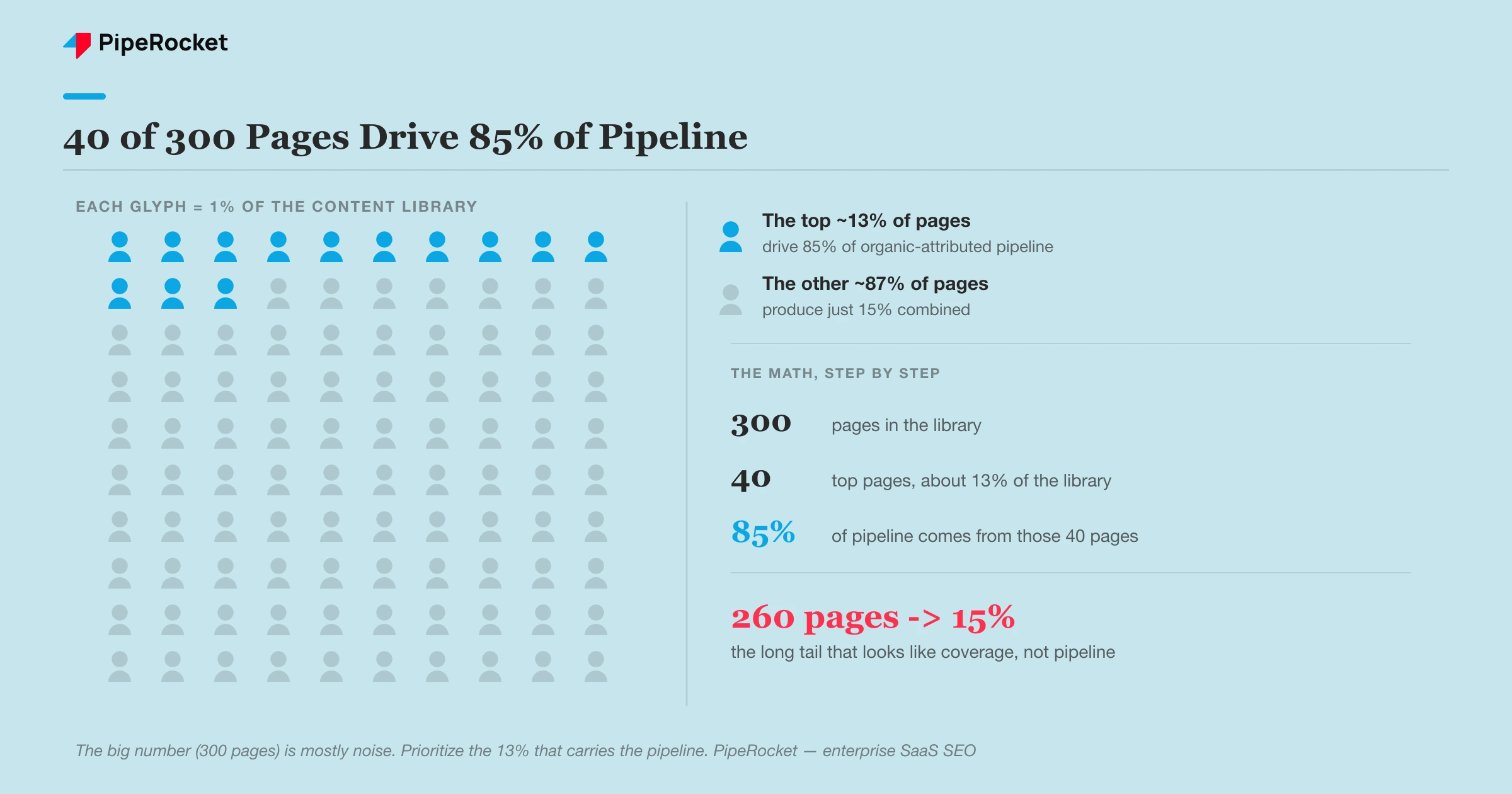
What this looks like in practice: An enterprise data management SaaS shifts from a volume-first to a quality-first content model after a content audit reveals that their 40 most-visited pages generate 85% of organic-attributed pipeline, while their other 260 pages generate the remaining 15% combined. They cut publishing volume by 60%, invest the saved budget in ICP interviews and proprietary data integration, and see organic SQLs increase 28% in the following quarter despite producing fewer articles.
Challenge 8: Building Link Authority in Competitive Enterprise SERPs
In competitive SERPs, link authority is the enterprise SEO challenge of closing a domain-authority gap against incumbents with years of accumulated link equity. The fix is durable link assets: proprietary annual research, an integration-partner link program, and executive digital PR, rather than outreach volume.
The SERPs for high-value enterprise software terms are dominated by established players with years of accumulated link equity. Competing against a DA 80 domain with a DA 45 domain requires a different approach than opportunistic guest posting or manual outreach campaigns.
Enterprise SaaS companies that have built durable link authority consistently use three structural approaches:
- Proprietary data as a recurring link asset: an annual industry report built on anonymized product data earns citations from analyst firms, industry publications, and competitor content year over year. After three or four years, the report becomes a primary reference for anyone writing about the topic
- Integration partner link ecosystem: every SaaS product integrates with others. A systematic program to ensure those touchpoints include contextual links to your domain generates high-DA, contextually relevant backlinks from within your exact product category
- Digital PR tied to executive perspectives: when your executive team publishes original research or commentary in tier-one publications, the resulting citations carry significantly more authority than any link-building campaign
A durable SaaS link building strategy is built on assets and systems that compound, so outreach volume stops being the constraint.
What this looks like in practice: An enterprise workflow automation SaaS competes against DA 75 to 85 domains for their target category terms at DA 52. Rather than running outreach campaigns, they launch three structural initiatives: an annual State of Workflow Automation report, a systematic integration directory program with their 80 technology partners, and a quarterly executive commentary series placed in HR and operations publications. After 18 months, their referring domain count grows from 340 to 890, their DA increases from 52 to 67, and they achieve first-page rankings for four of their ten target category terms.
Challenge 9: Legacy CMS and Rigid Tech Stacks Blocking Deploys
Legacy CMS constraints are the challenge of a rigid platform that cannot render, template, or deploy SEO fixes without engineering rework. The fix for this enterprise SEO challenge is a prioritized remediation backlog plus middleware or edge-layer changes that ship SEO fixes without a full replatform.
Many enterprise SaaS companies run on a CMS chosen years before SEO mattered to the business. The platform may not support server-side rendering on key page types, may hard-code metadata that SEO teams cannot edit, or may force every change through a slow release train. The result is a backlog of known fixes that sit unshipped for quarters because the platform makes them expensive.
What high-growth SaaS teams do instead:
- Separate fixes that need a true platform change from fixes that can ship through an edge layer, a tag manager, or a reverse proxy, and route the second group around the release train
- Build a prioritized SEO remediation backlog scored by pipeline impact, so engineering spends its limited platform capacity on the fixes that move revenue first
- Introduce a rendering or edge solution for critical page types when the core CMS cannot serve crawlable HTML, rather than waiting on a multi-year replatform
- Bring SEO into the platform-selection conversation early whenever a replatform or headless migration is already on the roadmap
What this looks like in practice: An enterprise fintech SaaS on an aging monolith CMS cannot edit title tags or add structured data on its highest-intent product pages without a developer release. The team moves metadata and schema management to an edge worker, which lets the SEO team ship title, meta, and structured-data changes on their own cadence while the slower CMS migration proceeds in the background.
Challenge 10: Site Architecture Bloat Across Subdomains and Microsites
Site architecture bloat is the enterprise SEO challenge of link equity and topical authority fragmenting across subdomains, campaign microsites, and acquired properties. The fix is a consolidation plan that migrates high-value content onto the primary domain with 301 redirects.
Enterprise SaaS companies accumulate properties over time: a campaign microsite on its own subdomain, a docs site, a help center, a blog acquired with a company, a regional marketing team’s standalone build. Each one splits authority away from the primary domain and often duplicates topics the main site already covers, so no single property builds the topical authority the business could earn if the content lived together.
What high-growth SaaS teams do instead:
- Inventory every subdomain, microsite, and acquired property, then classify each as consolidate, keep, or retire based on its traffic, links, and strategic role
- Migrate high-value content off subdomains onto subfolders of the primary domain with 301 redirects, so accumulated link equity flows to one domain
- Set a governance rule that new campaigns launch on the primary domain by default, with a subdomain requiring explicit SEO sign-off
- Consolidate overlapping topic coverage so one authoritative page replaces several thin ones scattered across properties
What this looks like in practice: An enterprise martech SaaS runs its blog on a subdomain and three campaign microsites on separate subdomains, each with its own backlinks and its own versions of the same category content. A consolidation project migrates the blog and the best microsite content into subfolders on the primary domain with redirects, which routes the previously scattered link equity to one domain and removes the duplicate category pages competing with each other.
Challenge 11: International SEO Complexity and Hreflang Errors
International SEO complexity is the challenge of serving the right regional or language version to the right searcher across dozens of markets. Fixing this enterprise SEO challenge takes a validated hreflang implementation with correct return tags, matched canonicals, and a consistent URL structure per market.
Enterprise SaaS companies selling into multiple regions run localized sites, translated content, and region-specific pricing. When hreflang annotations are missing, incomplete, or contradict the canonical tags, Google serves the wrong region’s page in search results, splits ranking signals across duplicate localized pages, or ignores the localization entirely. At the scale of dozens of markets, a small templating error multiplies into thousands of broken annotations.
What high-growth SaaS teams do instead:
- Validate hreflang with a crawler that flags missing return tags, mismatched canonicals, and pages pointing at non-indexable or redirecting URLs
- Standardize one URL structure per market (subfolder, subdomain, or ccTLD) and apply it consistently rather than mixing approaches across regions
- Keep canonical and hreflang directives in agreement, so localized pages are not canonicalizing away the exact versions hreflang is trying to surface
- Assign clear ownership for international SEO, since it sits between localization, engineering, and regional marketing teams that rarely coordinate on it
What this looks like in practice: An enterprise HR SaaS operating in nine markets finds that Google is serving its US English page to searchers in the UK, Germany, and France because hreflang return tags are missing on half the localized pages and several canonicals point back to the US URL. A hreflang audit and templating fix aligns the annotations and canonicals across all nine markets, so each region’s searchers reach the page built for them.
Why High-Growth B2B SaaS Companies Trust PipeRocket to Solve Their Enterprise SEO Challenges
Every enterprise SEO challenge in this guide requires more than a tactical fix. It requires organizational change, infrastructure investment, and a reporting model that connects organic search to the revenue metrics that drive enterprise budget decisions.
PipeRocket was built to solve exactly this. Before any content brief is written, the team maps the organizational dynamics, the technical state, and the pipeline targets that define what success looks like. Every recommendation is made in the context of what will move the revenue number, not just the rankings dashboard.
- SaaS SEO: enterprise SEO strategy and execution built for multi-product, multi-ICP complexity, with BOFU content live in month one, technical governance embedded in delivery, and every page tied to pipeline outcomes
- SaaS PPC: paid programs connected to your CRM and integrated with your organic strategy so both channels share data and report against the same pipeline targets
- Marketing Operations: the attribution infrastructure, CRM configuration, and multi-touch reporting framework that makes enterprise SEO pipeline contribution visible at the board level
With 70+ B2B SaaS companies served and a 4.7 rating on Clutch, PipeRocket operates as an extended enterprise revenue team. If your organic program is generating traffic that does not show up in your pipeline report, that is the specific problem we were built to solve.
Conclusion
None of these challenges are unsolvable. They are the predictable friction points that every large B2B SaaS company encounters as organic search scales beyond what a single team or a simple strategy can manage. Solve for cross-functional alignment and governance first. Fix what is actively breaking. Build the attribution infrastructure to make pipeline contribution visible. Then invest in the content architecture, authority building, and AI search optimization that turns organic into a compounding revenue channel for the long term.
Frequently Asked Questions
1. What is the biggest enterprise SEO challenge most teams underestimate?
Cross-functional alignment. Most enterprise SEO teams focus their energy on keyword strategy and content production and assume engineering and product teams will accommodate SEO requirements when needed. They rarely do, not because of bad intent, but because those teams have their own priorities and deadlines. Building SEO review into development workflows before it is needed prevents the governance failures that cause the most damage at enterprise scale.
2. How do you prioritize enterprise SEO challenges when you cannot fix them all at once?
Fix what is actively breaking first. Technical governance failures that are silently removing pages from Google’s index or cannibalizing rankings cause ongoing, compounding damage that gets worse every week you do not address them. Once those are resolved, prioritize by pipeline impact: the enterprise SEO issues preventing your highest-intent pages from ranking or converting deserve more attention than those affecting low-traffic content.
3. How long does it take to recover from a major enterprise SEO setback?
A technical issue like a crawl block or mass noindex can recover within 30 to 90 days once fixed. A content quality or architecture problem where you have built a large library of low-value content takes six to twelve months. Algorithm-driven traffic drops can take three to six months if the underlying issue is identified and addressed quickly.
4. Should enterprise SEO be managed in-house or through an agency?
Most enterprise SaaS companies at Series B and beyond benefit from a hybrid model. An in-house SEO director or VP owns strategy, cross-functional alignment, and board-level reporting. A specialist agency brings execution capacity, deep technical expertise, and the external perspective that in-house teams often lack after 12 to 18 months of building their own playbook.
5. How does fixing enterprise SEO challenges affect organic CAC over time?
Addressing these challenges compounds positively. Each technical fix removes a drag on the program. Each governance improvement prevents future damage. Each content architecture improvement increases the compounding velocity of the content library. The result is a declining organic CAC curve that paid acquisition can never replicate: as the content library grows, the cost per organic SQL falls.
6. What is enterprise SEO?
Enterprise SEO is the practice of managing organic search performance for large B2B SaaS companies with high page counts, multiple stakeholder teams, and complex technical infrastructure. It differs from smaller-scale SEO in both scale and organizational complexity.
7. What are some common challenges in SEO?
At enterprise scale, the common ones span four areas: cross-functional governance, technical and crawl infrastructure at scale, content architecture across products and ICPs, and pipeline attribution, plus a newer AI-search visibility layer. This guide covers all 11.
8. What is the 80/20 rule in SEO?
The 80/20 rule means a small share of pages drives most of your results. One case in this guide shows 40 of 300 pages, about 13%, generating 85% of organic-attributed pipeline, a similar imbalance to the classic 80/20 pattern.
9. What are common enterprise SEO challenges?
The most common ones are cross-functional alignment, technical governance, content architecture, crawl budget inefficiency, AI search visibility, attribution, content quality at scale, link authority, legacy CMS constraints, site architecture bloat, and international SEO complexity. Most of them trace back to governance, alignment, or measurement gaps, so the fixes usually start with process.