SaaS International SEO Strategy: A Practical Guide for 2026
 Kamaraj Mathiarasan (Kim)
Last updated on
Kamaraj Mathiarasan (Kim)
Last updated on

Most SaaS teams treat international SEO as a translation project. You pick a few languages, run the site through a translation plugin, and wait for traffic from new countries. It rarely works, because you’ve skipped the two decisions that actually matter: whether a market is worth entering, and how the site is structured to serve it.
International SEO is a business call before it’s a technical one. This guide walks through when to expand, how to prioritise markets, which URL structure to pick, how to get hreflang right, and how to know if any of it is working.
TL;DR
- When to expand: Enter a market only when its search demand and your go-to-market can both support it. A competitor’s
/de/folder is no reason. - Prioritise markets by evidence: Use existing search demand, GSC data from your current site, and sales signals to rank markets before you build anything.
- Pick the URL structure early: ccTLD, subdirectory, and subdomain each carry different trade-offs; subdirectories usually consolidate authority best for SaaS.
- Get hreflang exactly right: Self-referencing tags, return tags, an x-default, and correct language-region codes are where most international SEO quietly breaks.
- Localise properly: Real keyword research per market beats word-for-word translation, because buyers in each country search differently.
- Measure by market: Segment organic by country in GSC and GA4, and check rankings from the buyer’s location rather than your office.
Why International SEO Is a Business Decision Before a Technical One
The first mistake happens before anyone touches hreflang. Teams decide to go international because a competitor did, or because a board deck said “global expansion,” and only then ask which languages to add. That order is backwards.
A new market is a new go-to-market motion. If you can’t support demos, billing, contracts, or customer success in that country, ranking there just fills your funnel with leads you can’t close. Traffic you can’t convert becomes a cost.
The signals that you’re actually ready
You’re ready to enter a market when a few things line up at once. Not one of them alone justifies the build.
- Real, measurable search demand exists for your category in that language or country.
- You already see organic traffic or signups from there on your current site.
- Sales or customer success can operate in that market (language, timezone, pricing).
- Your product handles local requirements like currency, tax, or data residency.
When most of these are true, expansion compounds. When only the board’s ambition is true, you’ll build pages that rank for terms no one on your team can follow up on.
The signals that you should wait
Hold off when the demand is thin or the operation isn’t there yet. A market with strong search volume but no local sales support is a trap, because the SEO works and the revenue doesn’t.
Early-stage SaaS is the clearest case. If you haven’t nailed product-market fit and a clear ICP in your home market, international SEO just scales your confusion faster. We turn companies away from SEO more often than you’d think for exactly this reason. Fix the home market first, then export a system that already works.
How to Prioritise Markets and Keywords by Region
Rank your markets on evidence before you build a single localised page. The goal is to pick one or two markets and win them properly instead of spreading thin across ten.
Start with data you already own. Your Google Search Console and GA4 show which countries already send organic traffic and, more importantly, which convert. A country quietly generating trials in broken English is a stronger signal than a big-population market with zero engagement.
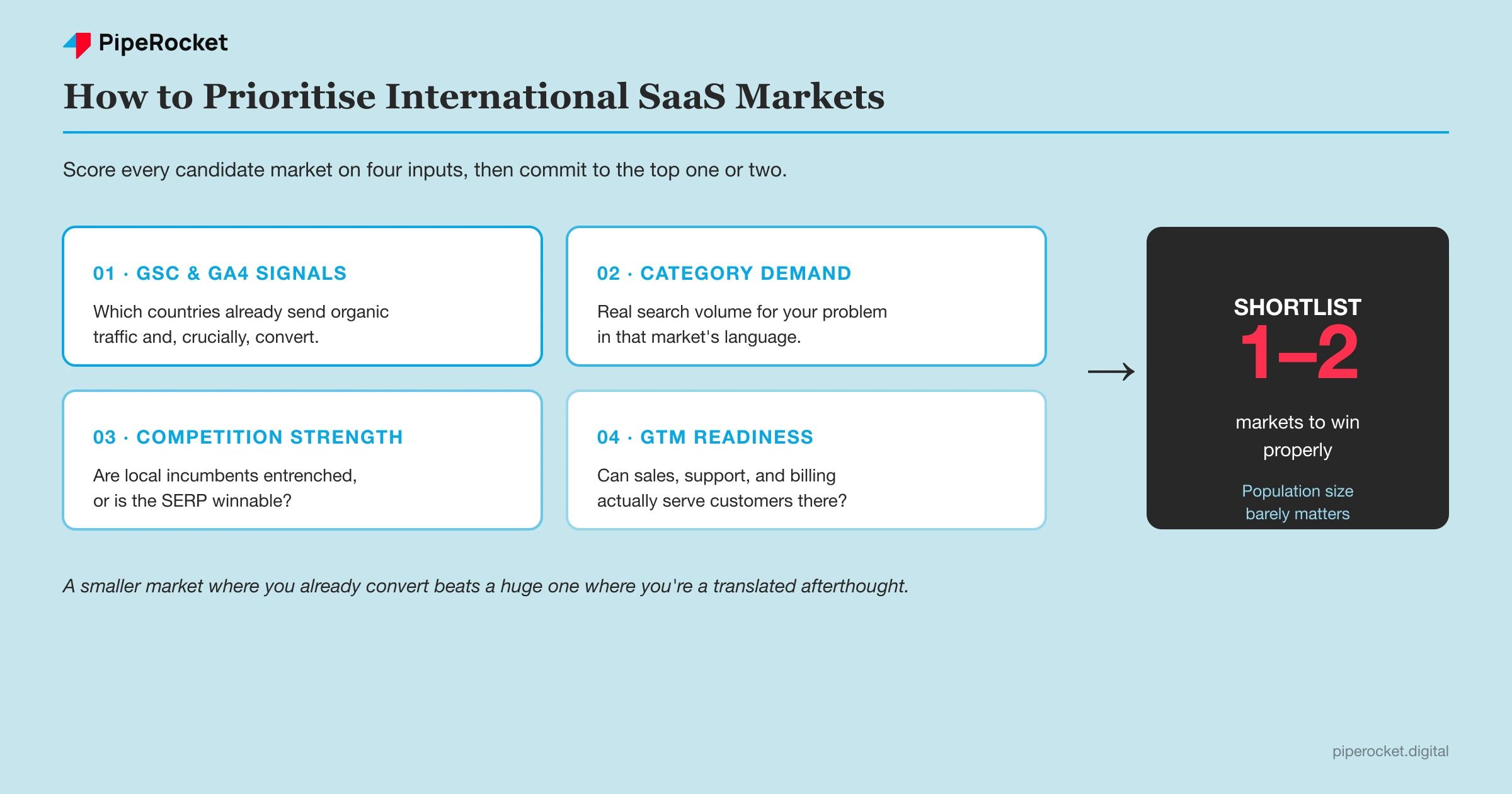
Then layer in demand and competition per candidate market:
- Category demand: Is there real search volume for your problem in that language?
- Competition strength: Are local incumbents entrenched, or is the SERP winnable?
- Conversion evidence: Do you already see signups or pipeline from that region?
- GTM readiness: Can the business actually serve customers there?
Score each candidate market against those four inputs, then commit to the top one or two. A market that ranks high on demand but low on GTM readiness goes on a waitlist rather than the build queue. This keeps the decision honest when a big-population market looks tempting on volume alone.
The counterintuitive part is that population size barely matters. A smaller market where you already convert, face weak competition, and can sell locally will out-earn a huge market where you’re a translated afterthought fighting entrenched incumbents. Rank on fit, then let the biggest well-fitting market go first.
Do Fresh Keyword Research in Each Market
Translating your English keyword list is the fastest way to target terms no one searches. Buyers in each country describe the same problem in different words, and sometimes the buying stage differs too.
Take a compliance SaaS expanding from the US into Germany. The US buyer searches “SOC 2 compliance software.” The German buyer is more likely searching around ISO 27001, because that’s the framework their auditors care about. Same product, different intent, and a translated keyword list would miss it entirely.
Run fresh keyword research in each target market’s language, using that market’s search data. Map the results to the same funnel stages you use at home, so a German BOFU page answers a German buyer’s decision-stage question rather than a translated US one.
Choosing Your URL Structure: ccTLD vs Subdirectory vs Subdomain
Pick your URL structure before you translate anything, because it’s the most expensive thing to change later. Google supports three options for multi-regional and multilingual sites, and each carries a real trade-off.
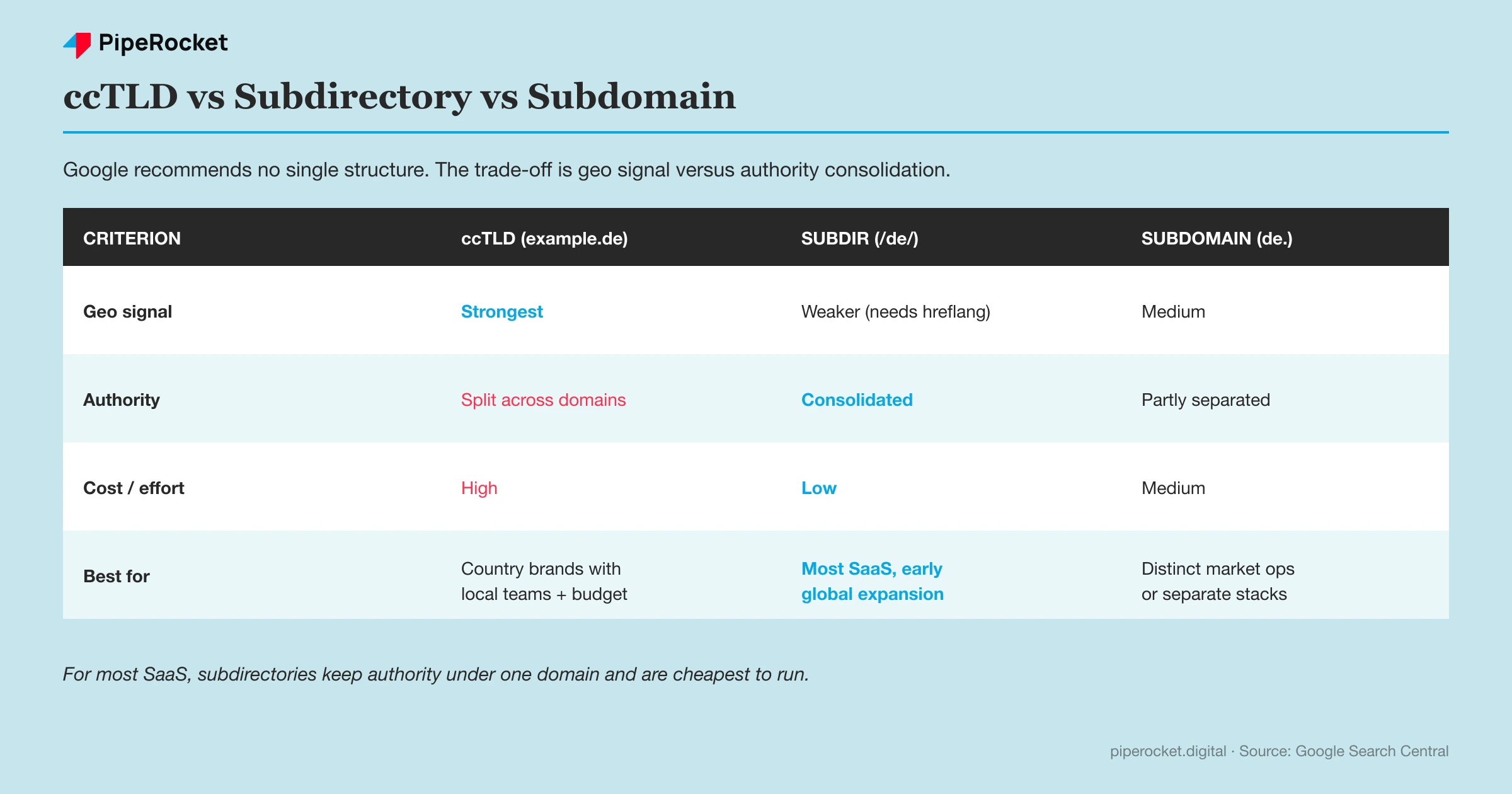
Google’s own documentation is clear that it doesn’t recommend one structure over the others. The right choice depends on your resources and how distinct each market really is. Here’s how the three compare.
| Structure | Example | Geo signal | Authority | Cost / effort | Best for |
|---|---|---|---|---|---|
| ccTLD | example.de | Strongest | Split across domains | High (separate domains, infra) | Country-specific brands with local teams and budget |
| Subdirectory | example.com/de/ | Weaker (needs hreflang) | Consolidated on one domain | Low | Most SaaS, especially early global expansion |
| Subdomain | de.example.com | Medium | Partly separated | Medium | Distinct market operations or separate tech stacks |
Why subdirectories usually win for SaaS
For most SaaS companies, subdirectories are the practical default. They keep every market under one domain, so the backlinks and authority you’ve built for your main site help your new pages rank instead of starting each country from zero.
They’re also cheap to set up and manage on a single host. A ccTLD sends the strongest country signal, but you’re effectively launching a brand-new domain per country and rebuilding authority each time. That’s a heavy price for a team entering its first or second market.
When a ccTLD earns its cost
A ccTLD works when a market is genuinely a separate operation, with its own local team, local pricing, and enough budget to build authority on that domain. It gives the clearest geotargeting and lets you host locally if latency matters.
It breaks when you use it too early. Splitting a modest authority profile across five country domains leaves you with five weak sites instead of one strong one. Reach for a ccTLD only when a market can stand on its own.
Where subdomains fit
A subdomain sits between the two. It gives you some separation, useful when a market runs on a different tech stack or a distinct team owns it, while keeping the brand recognisable. The catch is that Google treats a subdomain as somewhat separate from the root, so authority doesn’t flow as cleanly as it does within a subdirectory.
Pick a subdomain when there’s a real operational reason to isolate a market, such as a separate CMS, a local engineering team, or infrastructure that has to live in-region. If the only motivation is “it feels cleaner,” a subdirectory will almost always serve a SaaS site better. Don’t split what you don’t have to.
Getting Hreflang Right
Hreflang is where international SEO quietly falls apart. It’s an annotation that tells Google which language and region a page targets, so the right version shows to the right user. Get it wrong and Google ranks your English page in Germany, or treats your localised versions as duplicates.
Google supports three ways to declare it: HTML <link> tags in the head, an HTTP header for non-HTML files, and XML sitemap entries. Pick one method and apply it consistently. The rules below matter more than the method you choose.
For most SaaS sites the sitemap method scales best. HTML link tags bloat the head of every page once you pass a handful of markets, and each new market means editing every existing page’s tags. A sitemap keeps the annotations in one place and is easier to generate programmatically from your CMS. Whichever you choose, don’t mix methods on the same site, because conflicting signals are harder to debug than a single consistent setup.
The rules that decide whether it works
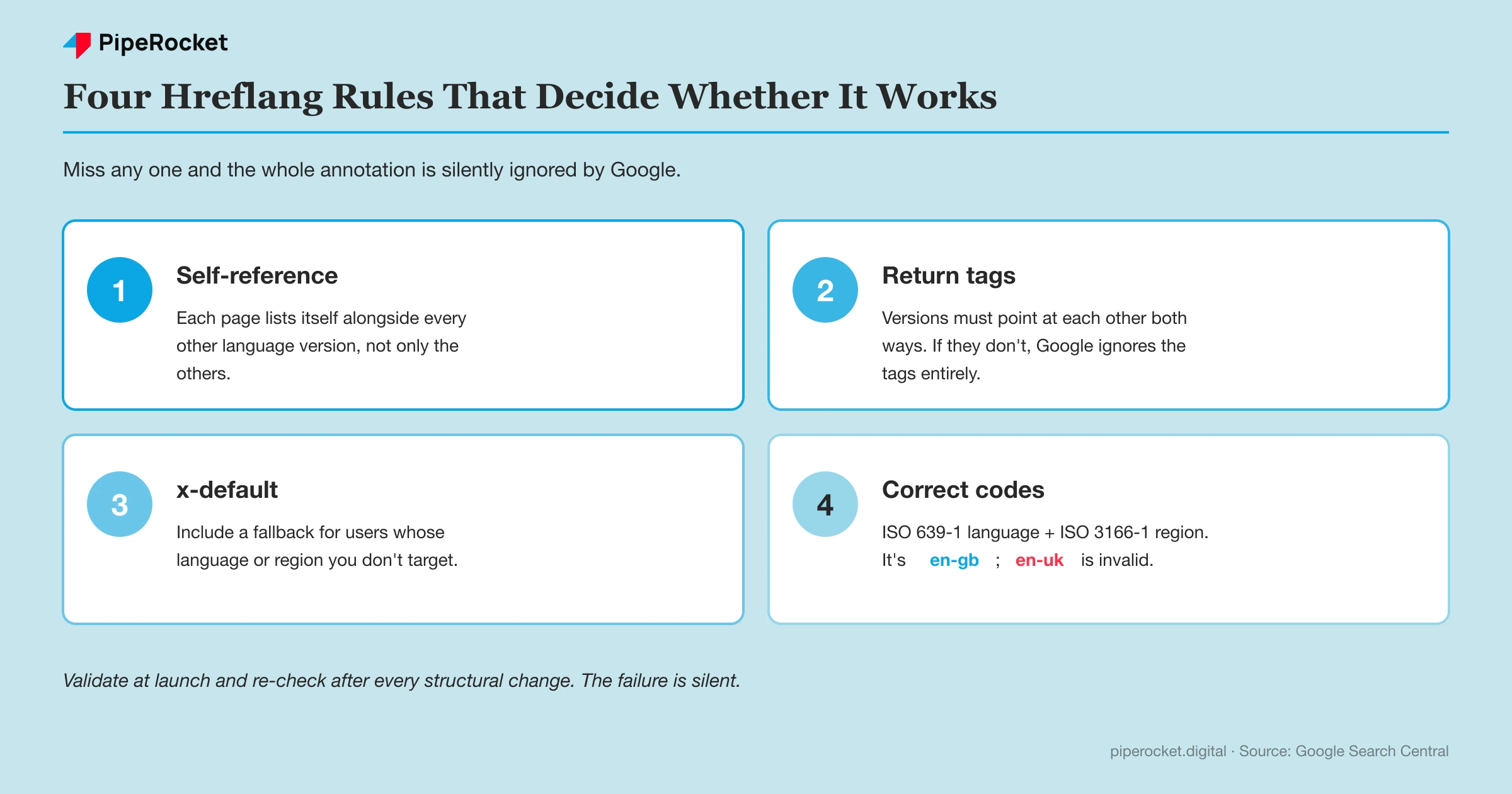
Four things have to be true, and missing any one of them silently voids the whole setup.
- Self-reference: Each page must list itself alongside every other language version, instead of only pointing outward to the others.
- Return tags: Versions must point at each other both ways. Google’s rule is blunt: if two pages don’t both point to each other, the tags are ignored.
- x-default: Include an
x-defaultversion for users whose language or region you don’t target, so there’s a sensible fallback. - Correct codes: Use ISO 639-1 for language and ISO 3166-1 Alpha 2 for region. It’s
en-gb, noten-uk, becauseUKisn’t a valid region code.
Validate before you trust it
Never assume hreflang is working because you added the tags. Missing return tags and broken URLs are the most common failures, and they don’t throw an error, they just get ignored.
Run every setup through a dedicated hreflang checker and watch the International Targeting data in Search Console for return-tag errors. Keep your hreflang and canonical tags consistent too, because a page that canonicalises to a different URL than it hreflang-references sends Google a contradiction. Validate at launch, then re-check whenever you add a market.
Localise Instead of Translating
A word-for-word translation targets terms locals never use. Localisation adapts the whole page to how a market actually searches and buys, and it’s the difference between international pages that rank and ones that sit invisible.
Translation converts the words on your existing page. Localisation rebuilds the page around the local buyer:
- The currency they pay in and units they measure in
- The examples and compliance frameworks that resonate locally
- The exact keywords they actually type
The first is a language task. The second is an SEO and marketing task.
Here’s the practical split for a SaaS team.
- Translate: UI strings, legal text, documentation where meaning must match exactly.
- Localise: Landing pages , category pages, comparison pages , and any content meant to rank or convert.
Use native speakers or professional localisation for anything that has to rank. Raw machine translation is fine for a first draft, but a native editor catches the phrasing and the local search terms that a model trained mostly on English will miss. The pages that carry your pipeline are exactly the ones that can’t afford to read like a translation.
Localise the On-Page Signals, Down to the Title Tags
Localisation runs deeper than the body text. The elements search engines and buyers read first often get left in the source language, which undercuts the whole effort.
Rewrite these for each market, using that market’s keywords:
- Title tags and meta descriptions
- Headings and image alt text
- URL slugs
A German page with perfectly localised body copy but an English title tag still tells Google and the buyer that it’s a translated US page. Structured data and local date formats belong on the list too, because they shape how your result renders in a local SERP.
Common Mistakes to Avoid
International SEO has a handful of failure modes that show up again and again. Each one is avoidable if you know to look for it.
Translating before choosing a URL structure
Teams rush to translate content, then realise the URL structure doesn’t support it and have to redo everything. Structure is the expensive decision. Settle ccTLD versus subdirectory versus subdomain first, then localise into it.
Auto-redirecting users by IP address
Detecting a user’s country by IP and force-redirecting them feels helpful, but Google warns against it directly. IP analysis is unreliable, and because Googlebot mostly crawls from the US, it may never see your other versions. Offer a language and region switcher and let users choose instead.
Broken or missing return tags
Hreflang without reciprocal return tags is the single most common failure. You point your German page at your English one, but the English page doesn’t point back, so Google ignores both. Validate reciprocity at launch and after every change.
Entering a market the business can’t serve
Ranking in a country where you can’t sell, support, or bill is a cost centre. The SEO works, the leads arrive, and no one can close them. Confirm go-to-market readiness before you confirm the keyword list.
Treating machine translation as finished work
Machine translation is a starting point. Shipping it unedited targets awkward phrasing and the wrong local terms, and it reads like a machine wrote it, which erodes trust in exactly the markets you’re trying to win.
How to Measure International Organic
Segment everything by country, because a global rollup hides which markets are working and which are dead weight. Your headline organic number can climb while a market you invested in flatlines, and you’d never see it in the aggregate.
In Search Console, filter performance by country to see clicks, impressions, and average position per market. In GA4, segment organic sessions and conversions by country so you can tie each market back to signups and pipeline rather than raw traffic. The market that generates trials matters more than the one that generates impressions.
Check rankings from the buyer’s location
Your office’s SERP isn’t your buyer’s SERP. Rank checking matters most when your buyers are outside your operating country, because SERPs are localised, and a keyword that ranks page one at home can sit on page six abroad. Even “best X for New York” ranks differently in New York than in California.
Use a rank checker with location set to each target market, so you see the SERP your buyer actually sees rather than the one your location returns. It’s the only honest read on whether a market is ranking.
Watch hreflang health as an ongoing metric
Treat hreflang errors as a live metric rather than a launch-day checkbox. Every time you publish a new page, add a market, or restructure URLs, you can quietly break a return tag and lose the annotation on pages that were working fine. The failure is silent, so nothing alerts you unless you look.
Check the International Targeting report in Search Console on a schedule, and re-run a dedicated hreflang validator after any structural change. Say a compliance SaaS adds a French market but forgets to update the return references on its existing German and English pages. Those German pages can quietly drop, because the reciprocity is now broken. Catching that in week one saves months of the wrong page ranking in the wrong country.
Give each market a realistic timeline
International SEO takes time, and it takes different amounts of time per market. Low-competition markets with strong localisation can show organic traction in three to six months. Markets with entrenched local incumbents can take six to twelve. Set that expectation before launch, so a slow-starting competitive market doesn’t get killed at month four right before it turns.
How PipeRocket Digital Helps SaaS Teams Go Global
We treat international SEO as a strategy decision first. Before a single page is translated, we lock the choices that are expensive to reverse: market demand, URL structure, and a validated hreflang setup. Then we localise the pages that carry pipeline and measure each market on its own.
If you’re weighing an international rollout, talk to us before you build. You can also see how we approach organic growth on our SaaS SEO agency page, or compare the best SaaS SEO agencies first.
Frequently Asked Questions
What is the difference between international SEO and multilingual SEO?
International SEO targets users in specific countries, so you might run a different strategy for Argentinian buyers than for Mexican ones even though both speak Spanish. Multilingual SEO targets a language regardless of country. International SEO is always multinational but not always multilingual. A UK company could target US buyers without translating anything, since both markets search in English but sit in different countries.
Should a SaaS company use ccTLDs, subdirectories, or subdomains?
For most SaaS companies, subdirectories like example.com/de/ are the practical choice, because they consolidate authority under one domain and are cheap to manage. ccTLDs like example.de send the strongest country signal but split your authority and cost far more to run. Subdomains sit in between. Base the decision on how distinct each market’s operation is and how much authority you can afford to spread.
How long does international SEO take to show results?
It depends on the market’s competition and the quality of your localisation. Markets with low competition and strong localisation can show organic traction in three to six months. More competitive markets with established local incumbents often take six to twelve months. Set the timeline per market before launch, so a slower competitive market isn’t abandoned right before it starts to rank.