
+49% Qualified Leads, Lower Cost per Lead: How PipeRocket Scaled Astra Security in North America
Company Overview
Astra Security sells penetration testing and VAPT into one of the most competitive, high-CPC corners of B2B cybersecurity, across four regions at once: North America, APAC, EU, and ANZ.
PipeRocket took over the paid program in June 2025 with a clear mandate: scale. Grow qualified-lead volume through paid search, not squeeze efficiency out of a fixed budget.
The Challenge
The account PipeRocket inherited had several structural problems working against it:
- No geographic granularity: NA, EU, and UK traffic was funnelled into broad campaigns with shared budgets and no geo-specific messaging, making real optimisation nearly impossible.
- Intent mismatch in the keywords: High-intent buyer terms sat in the same ad groups as low-intent research terms, diluting the signal and dragging up CPA.
- A competitor blind spot: Rival vendors were fielding comparison searches with no Astra presence, losing bottom-of-funnel demand every day.
- Landing-page friction: Forms buried below the fold, a chatbox overlapping CTAs, and one-size-fits-all messaging regardless of whether the visitor came from the US, EU, or APAC.
Our approach
PipeRocket ran the full Google Ads + Microsoft Ads program across all four regions, in six phases over the year.
Phase 1: Restructure & NA split
Replaced the broad US campaigns with tightly themed ones, one per core service line, and only paused the old campaigns once the new structure had proven traffic. The UK got dedicated keywords; the US competitor-alternative campaign moved to target-CPA bidding.
Phase 2: Geographic expansion & competitor launch
Stood up a dedicated ANZ campaign (excluded from APAC to avoid cannibalisation) and restructured EU/UK with geo-specific landing pages. Launched competitor-conquesting campaigns against the main rival vendors, plus a Bing competitor campaign, and moved several service-line campaigns onto portfolio bidding.
Phase 3: Budget scaling & peak
With the structure validated, scaled the weekly budget and pushed into peak performance. Refined ad copy, sitelinks, and negative keywords, and launched a high-intent quote-request keyword paired with a dedicated quote landing page.
Phase 4: Seasonal defence & CRO triage
As B2B demand softened after mid-December, proactively trimmed budgets by region in proportion to MQL volume, then used the slower period for a Microsoft Clarity audit, which surfaced the chatbox overlapping CTAs, form-rendering issues across screen sizes, and low-converting pages. Each was filed to the dev team as a specific ticket with session recordings.
Phase 5: Quality drive
Rebuilt budgets around the top performers, then pivoted the India campaigns to optimise for SQLs rather than MQLs, trading some raw lead volume for better-qualified pipeline. Reactivated EU/UK service-line campaigns on exact match, expanded the competitor campaigns to more rival vendors, and continued Clarity-guided landing-page A/B tests.
Phase 6: Aggressive scale
Set target-CPA at the ad-group level, concentrating the most aggressive targets on the proven high-intent ad groups. Moved the lead form into the first fold, launched Performance Max for incremental volume, and closed the attribution loop by uploading offline conversions from HubSpot back into Google Ads via GCLID, so Smart Bidding optimised toward real qualified leads, not just form fills.
The results
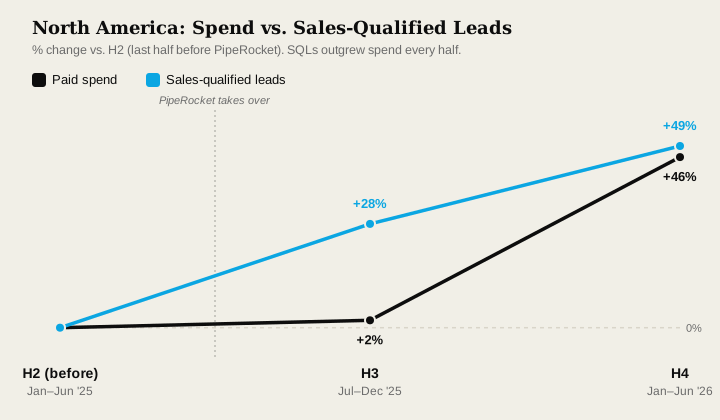
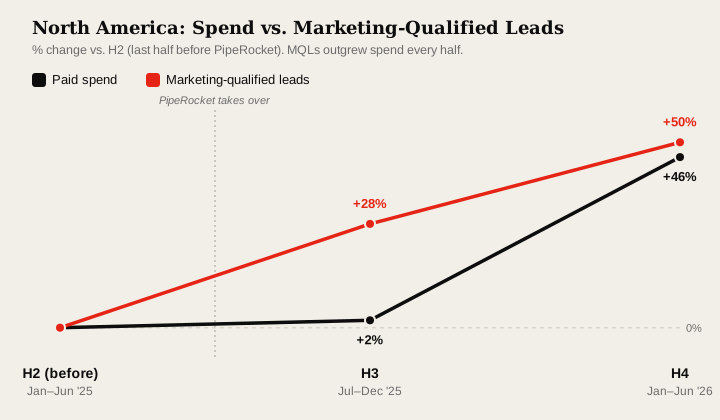
North America is Astra’s single largest paid market, representing roughly half of total program spend. That’s where the real test of “can you scale without losing efficiency” plays out, so that’s where we measured it: the half-year immediately before PipeRocket took over (H2, Jan–Jun 2025) against the two half-years since (H3, H4), using the same combined Google + Microsoft Ads and HubSpot-synced MQL/SQL definitions throughout.
| Period | Ad spend | SQLs | MQLs |
|---|---|---|---|
| PipeRocket takes over: June 2025 | |||
| H3 · Jul–Dec ‘25 | +2% | +28% | +28% |
| H4 · Jan–Jun ‘26 | +46% | +49% | +50% |
Sales-qualified leads in North America grew 49% by H4, outpacing the 46% increase in spend. That’s the headline: qualified-lead volume grew faster than investment, in a market where the norm is for cost-per-lead to climb as you scale.
- Marketing-qualified leads grew 50% over the same window.
- Cost per SQL actually declined: $7,415 in H2, dropping to $5,898 in H3, and landing at $7,262 in H4, about 2% below where it started despite spend growing 46%.
- The MQL → SQL rate held steady at roughly 66% throughout, so the extra volume didn’t dilute lead quality.
Why it worked
Seven compounding factors, not one silver bullet:
- Geo-theme campaign architecture. Splitting NA into tightly themed campaigns let the algorithm learn buyer intent precisely: each sent clean, homogeneous signals instead of muddied mixed-intent data.
- Ad-group-level target-CPA. Setting aggressive targets on the proven high-intent ad groups and lower ones on untested groups meant budget flowed toward proven converters instead of spreading evenly across unknowns.
- Competitor conquesting. The main rival vendors were all running unopposed, so targeted comparison campaigns captured bottom-of-funnel buyers already in vendor-selection mode.
- Form in the first fold + chatbox removal. Lifting the lead form above the fold and clearing the chatbox off PPC pages removed the scroll and overlap barriers on the highest-spend campaigns.
- The offline-conversion loop. Uploading HubSpot MQL/SQL data back to Google Ads via GCLID meant Smart Bidding learned from real qualified leads, not just form fills, sharpening every downstream bid, most of all in North America, the market with the deepest historical data to learn from.
- Region-specific landing pages. UK, EU, APAC, and ANZ visitors each saw pages built for their context. Relevance converts; generic pages don’t.
- Weekly tracking against goal. A regional MQL/SQL tracker updated weekly surfaced deficits early, giving the team room to correct course mid-month instead of discovering a shortfall at month-end.
More Success Stories
Achieving 3.5X MQL Growth: HyperVerge's Success Story with PipeRocket
Read full story

+67% Inbound Leads: How QX Scaled Pipeline Across Two Regions at Once
Read full story
From Zero to $285K in Pipeline: RunReveal's First 5 Months of Paid Ads
Read full story

Book a call today. Scale your pipeline tomorrow
Please note that we only partner with 1-2 new clients per month
Let's talk!