
How to Add Citation-Worthy Statistics to Your Content
 Sabari Rohith
Published on
Sabari Rohith
Published on
A citation-worthy statistic comes from a study or survey you actually ran, states one specific finding in a single sentence, and names its sample size and method so an AI engine or journalist can verify and attribute it back to you.
TL;DR
- Restating someone else’s stat never gets cited. AI engines trace numbers back to whoever ran the original study, ahead of every blog quoting it downstream.
- A citation-worthy stat starts with a narrow, answerable question your own data (not a survey vendor’s) can settle.
- Small first-party studies, even 30 to 60 customers, beat borrowed numbers because you control the methodology and can defend it.
- Write the finding as one extractable sentence with a number, a sample, and a timeframe, not a paragraph the reader has to mine for the number.
- Publishing the method next to the number is what makes AI engines and journalists trust it enough to cite it by name.
- A rounded-off sample size or an undated refresh is usually what gets a stat quietly dropped from future citations.
Why Restating Someone Else’s Stat Never Gets You Cited
Most B2B SaaS content teams have a “stats” section, and almost all of it is borrowed. A blog quotes a Gartner number, an AI-generated roundup quotes the blog, and six months later nobody can trace the number back to where it came from. AI engines can trace it, though, and they cite the study, not the fifth blog repeating it.
Our team ran an 8-month analysis of 53 B2B SaaS brands to see what AI engines actually pull into their answers. The pattern was blunt: pages that quoted other people’s numbers almost never got cited.
Pages carrying an original finding got pulled in repeatedly, sometimes months after publishing. The engines are doing source-tracing whether we like it or not.
This isn’t just an AI-search problem. Journalists have run into the same wall for years. A writer covering a trend needs a number to hang the story on, and “we asked 40 of our customers and here’s what we found” is something they can attribute and defend. “Industry reports suggest” is something their editor cuts.
The fix is producing the number yourself, even a small one, and becoming the site the roundups eventually quote.
Step 1: Pick a Question Only Your Own Data Can Answer
Start with a question you’re positioned to answer because of who your customers are, not a broad industry question a market-research firm already covers better than you can. “What’s the average SaaS churn rate” has a hundred better-funded answers already.
“What percentage of our onboarding calls mention pricing before feature questions” doesn’t, because nobody else has your onboarding call transcripts.
Look at What You Already Track
Before designing a new survey, check what your product, support, or sales team already logs. Support ticket categories, in-app event data, sales call notes, and churn-survey free text are all raw material for a stat nobody else can produce. A lot of “original research” projects fail before they start because the team assumes they need a big new survey, when the data’s often sitting in a CRM export.
Narrow Until It’s a Single Sentence
A good research question compresses to one line: “How many of our trial users activate a second feature within 7 days?” not “How do SaaS users behave during onboarding?” The narrower the question, the cleaner the eventual stat, and the easier it is for someone else to quote it without distorting it.
Step 2: Run a Small Study With a Real, Named Method
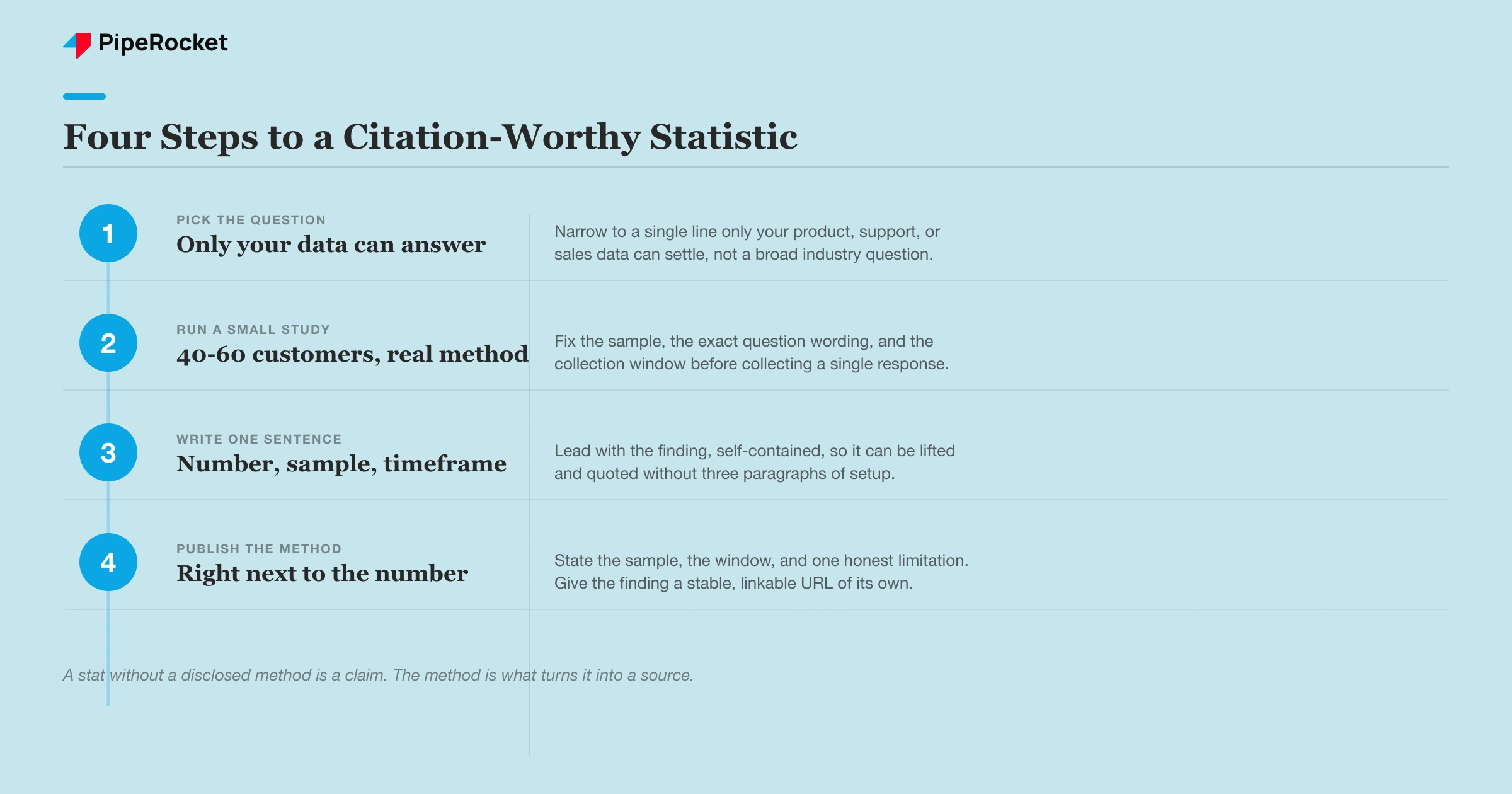
You don’t need a market-research budget to produce something citable. A survey of 40 to 60 of your own customers, run through a form and a few follow-up calls, is enough if the method is sound and disclosed. A fuzzy or hidden method is what kills citability, not the sample size.
Decide these three things before you collect a single response:
- Who’s in the sample (existing customers, trial users, a specific segment) and how many
- The exact question wording, since paraphrasing later breaks comparability
- The collection window (a specific month or quarter, not “recently”)
We evaluated 40-plus AI-monitoring tools for a separate project, spending real hours on each, and the honest conclusion was that most of them lean on synthetic prompts because there’s no “Search Console” for LLMs.
That gap cuts both ways. If nobody has ground-truth data on a question, a small, well-labeled study of your own users can become the closest thing to ground truth that exists, and AI engines notice when a number has nowhere else to have come from.
Keep the Sample Honest
Don’t survey your happiest customers and call it representative. If you’re only capturing renewal-ready accounts, say so in the writeup (“among customers renewing in Q2”) rather than implying it covers your full base. A stat that gets fact-checked and holds up gets cited again. One that gets debunked once follows you.
Step 3: Write the Finding as One Extractable Sentence
An AI engine, or a journalist skimming for a quote, needs to lift your number without reading three paragraphs of setup first. Write the headline finding as a single, self-contained sentence with the number, the sample, and the timeframe all in it.
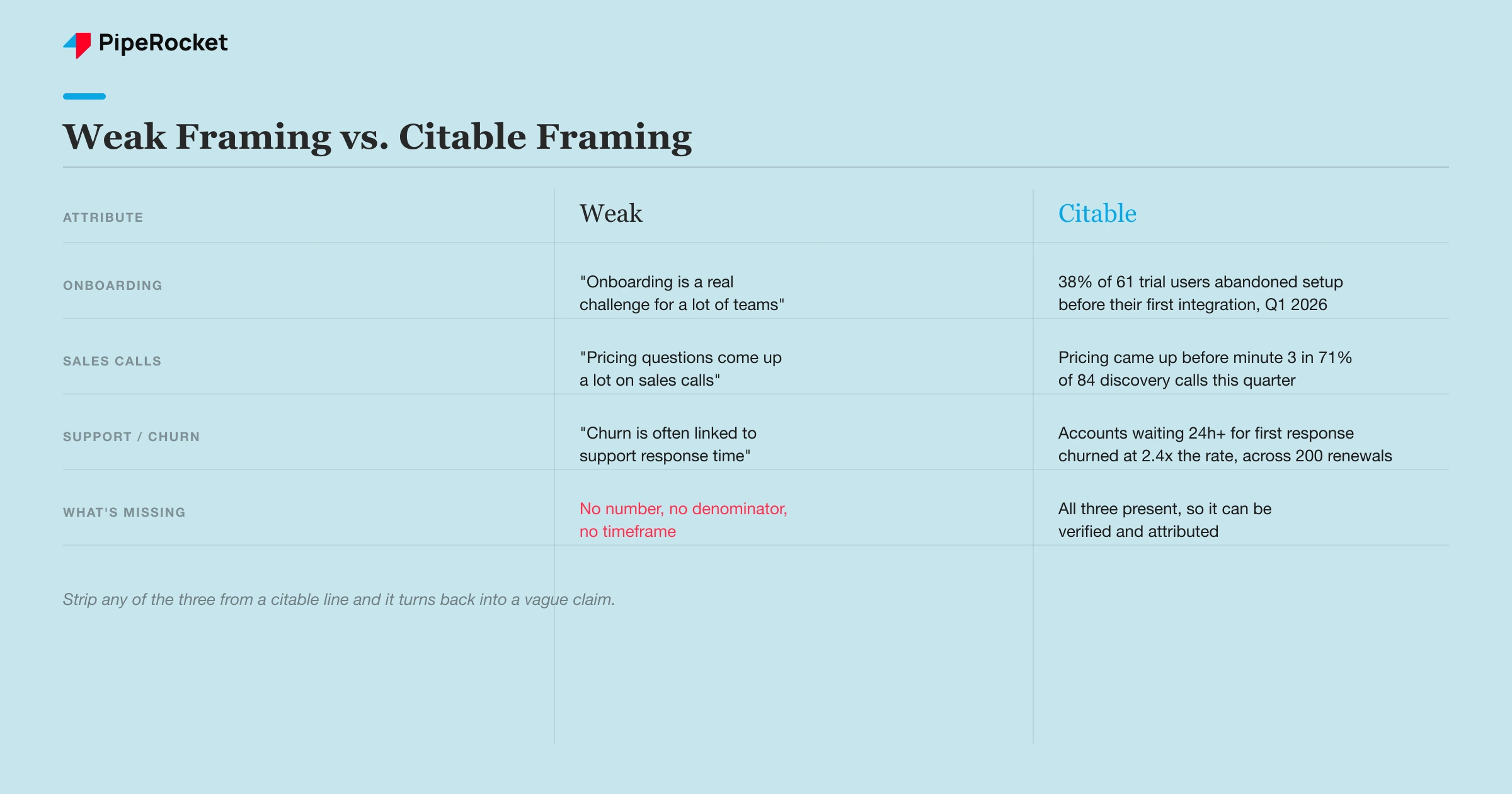
Compare the two versions below. The numbers are illustrative, standing in for whatever your own study turns up, not a PipeRocket finding.
| Weak framing | Citable framing |
|---|---|
| “Our data shows onboarding is a real challenge for a lot of SaaS teams” | “38% of the 61 trial users we surveyed in Q1 2026 abandoned setup before connecting their first integration” |
| “Pricing questions come up a lot on sales calls” | “Pricing came up before the third minute in 71% of the 84 discovery calls we reviewed this quarter” |
| “Churn is often linked to support response time” | “Accounts with a first support response over 24 hours churned at 2.4x the rate of accounts under 4 hours, across 200 renewals we tracked” |
Every citable version has three things the weak one is missing: a number, a denominator, and a time window. Strip any of the three and the sentence turns back into a vague claim nobody can quote with confidence.
Don’t Bury the Number in Narrative
Lead the paragraph with the finding sentence, then explain it. If the number shows up in the fourth sentence of a section, most extraction (human or model) will miss it or quote the wrong line instead. The sentence order should mirror how you’d want it to appear in someone else’s citation.
Step 4: Publish the Methodology Right Next to the Number
The number and the method belong in the same place, not the number on the page and the method buried in a linked PDF nobody opens. A short “how we ran this” block under the finding, even three sentences, is what turns a claim into a source. State the sample, the collection period, and one honest limitation.
That last part matters more than it sounds like it should. A study that says “this covers our existing customer base, not the broader market” reads as more trustworthy than one that implies universal reach.
Naming the limit signals someone actually thought about what the data can and can’t support. Overclaiming is the fastest way to get a stat quietly dropped from future citations once someone checks it.
Give It a Permanent, Linkable Home
A stat buried three paragraphs into a blog post gets forgotten. The same stat on its own findings page, with a clear title and a stable URL, is something people can bookmark, link to, and cite by name a year later. If you’re running these studies regularly, a dedicated research or stats hub is worth the setup cost, since it turns each new finding into another entry in something that already has a citation history.
Common Mistakes That Kill Citability
Rounding the Sample Size Out of the Sentence
Dropping “of 52 customers” because it feels small makes the stat sound bigger, but it also makes it unverifiable. A journalist or engine can’t cite what it can’t check, and a suspiciously round, sourceless number reads as marketing copy rather than data.
Refreshing the Number Without Re-Dating It
If last year’s survey gets rerun, the old date needs to go. We’ve seen teams update a stat’s headline but leave the original publish date, so anyone checking finds a number that’s actually two years stale sitting under a fresh-looking claim.
Publishing a Stat You Can’t Defend Under a Follow-Up Question
If a reporter or a competitor asks “how exactly did you calculate that,” you need a real answer ready. A stat with no defensible method behind it, even if the number’s directionally true, is a liability the moment someone pushes on it.
Treating One Data Point as a Trend
A single quarter of data is a finding, not a trend. Calling it a trend before you have at least two comparable periods is the kind of overreach that gets a stat picked apart in the comments, and once a number’s been publicly wrong, engines are slower to cite anything else from that source.
How PipeRocket Digital Helps SaaS Teams Build Citable Data
We run first-party research programs for SaaS clients as part of our SaaS SEO agency work, from scoping a narrow research question against your own product and support data to writing the finding as a single citable sentence with a disclosed method. If your content already ranks but nothing in it gets pulled into AI answers, that’s usually the gap. Get in touch and we’ll scope a first study against data you already have.
Frequently Asked Questions
What is a citation-worthy statistic?
A citation-worthy statistic is a number produced from your own first-party study or survey, stated as a single self-contained sentence with a sample size and collection window, and backed by a disclosed method that lets someone else verify and attribute it. It’s the opposite of a number borrowed from someone else’s report and restated in your own words.
How big does a survey need to be to get cited?
There’s no fixed minimum. A survey of 40 to 60 of your own customers can be cited just as readily as a 2,000-person industry report, as long as the sample and method are disclosed honestly and the question is narrow enough that the finding is defensible. What kills citability is a hidden or fuzzy method, not a small n.
Can I use third-party statistics alongside my own original data?
Yes, but keep the two clearly separated. Cite third-party numbers directly to their source with a link, and never let a borrowed stat get restated so many times it starts reading like your own finding. AI engines and readers both notice when attribution gets fuzzy, and it costs credibility on the original research sitting next to it.

