
In most B2B SaaS companies, the SEO team and the sales team have never had a real conversation. SEO picks keywords from a tool, sales works leads from a CRM, and the two only meet when sales complains the leads are junk. That gap is where pipeline quietly leaks, and closing it costs nothing but a few recurring meetings and a shared definition of what a good lead looks like.
This isn’t about attribution dashboards or who gets credit. It’s about two teams that touch the same buyer agreeing to act like it.
TL;DR
- The gap is human, not technical: SEO and sales work off separate inputs and never compare notes, so SEO optimizes for keywords sales would never qualify a lead from.
- Mine sales calls for keywords: The words your reps hear on discovery calls are the highest-intent keywords you have, and no tool will ever surface them.
- Agree on what a good lead is: Write down the ICP and the disqualifiers together, so SEO stops chasing traffic sales can’t use.
- Build a handoff both teams trust: A lightweight SLA on lead context and follow-up speed is what turns an organic lead into a worked one.
- Let sales feedback pick the next page: The objections reps answer all day are a content roadmap most teams ignore.
Why SEO and Sales Drift Apart in the First Place
The two teams are measured on different things, so they optimize for different things. SEO gets judged on rankings and traffic, sales gets judged on closed revenue, and nobody’s compensation depends on the handoff between them working. So it doesn’t.
Here’s what that looks like in practice. SEO ships a guide that ranks beautifully and pulls 5,000 visits a month. Sales gets a trickle of leads from it, most of them students, job seekers, or people three years from buying, and quietly stops trusting “organic” as a source.
Meanwhile the page sales would have loved, the one answering the exact objection they fight every week, never got written because it had no search volume worth a slot on the calendar.
Note: When traffic is climbing but pipeline is flat, you usually don’t have a traffic problem. You have an alignment problem, and the fix isn’t more content.
The deeper issue is that SEO treats keywords as the unit of work and sales treats conversations as the unit of work. A keyword is what someone types. A conversation is what they actually need. Those are not the same thing, and the whole point of aligning the two teams is to make the keyword list reflect the conversations.
Mine Your Sales Calls for the Keywords Sales Actually Cares About
Start with people, not tools. The one move that does the most for SEO -sales alignment is sitting in on sales calls and writing down the exact language buyers use, because real buyers don’t search the way SEO pros do.
Our team’s core keyword principle is that tools are for validation, not discovery. Lean only on Ahrefs or Semrush and you see what your competitors already found, in the polished category language they use. Sales hears something messier and far more useful: the layman words, the specific problem, the trigger that made someone pick up the phone today.
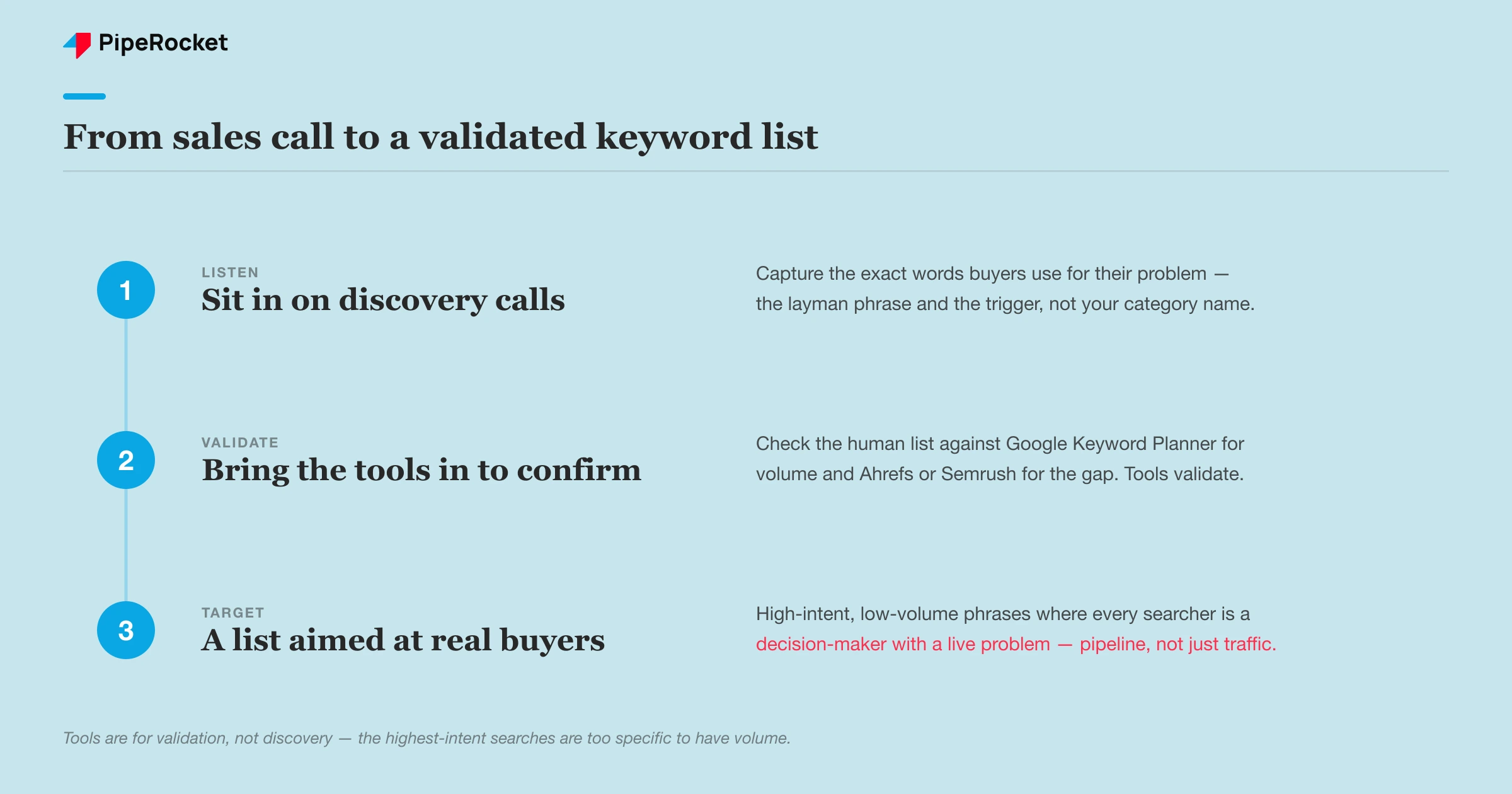
So before you open a keyword tool, do this:
- Sit in on five to ten discovery calls, or listen to the recordings.
- Write down the exact phrase the buyer uses for their problem, not your category name for it.
- Note the trigger that made them search, and the objection that almost killed the deal.
Then bring the tools in to validate. Take that human list and check it against Google Keyword Planner for volume and Ahrefs or Semrush for the gap. You’ll find two kinds of gold. Some phrases have real volume nobody on the SEO side knew to target. Others have almost no volume at all, but every searcher is a decision-maker with a live problem.
Take a compliance SaaS for fintech teams. Sales keeps hearing “how do I prove SOC 2 to an enterprise buyer mid-deal.” That phrase barely registers in a keyword tool. It’s also the exact moment a prospect needs them, so a page that answers it converts far above anything ranking for “what is SOC 2.”
That’s the trade-off to be honest about. Tool-led keyword research scales and looks rigorous, but it systematically misses the highest-intent searches because they’re too specific to have volume. Call-led research is slower and feels unscientific, and it’s where the qualified pipeline hides.
Agree on What a Good Lead Actually Is
SEO and sales have to write down the ICP and the disqualifiers together, in one document, before either team optimizes another thing. Most misalignment traces back to the two teams holding different, unspoken definitions of “a good lead,” then blaming each other when the numbers don’t match.
The exercise is simple and most teams skip it. Get SEO, sales, and whoever owns the funnel in a room and answer a short list out loud:
- Who is the buyer, by role and company size, and who is explicitly not?
- What signals mark a lead as sales-ready versus too early?
- What are the instant disqualifiers, the wrong-fit titles and company types sales refuses to work?
Write the answers down. That document becomes the filter SEO runs every keyword and every page through. A keyword that pulls the wrong company size isn’t a win just because it ranks, and once both teams have agreed to that in writing, the argument stops being personal.
This is also where you protect against a quieter failure. We’ve seen ABM and high-intent campaigns die on arrival because marketing ran them and sales ran the other way, with no shared definition of who the effort was even for. SEO has the same exposure. Rank for terms sales can’t use and you’ve built a beautiful machine pointed at the wrong people.
The honest version of this conversation includes funnel data. If sales won’t show SEO what happens after the click, all the way to qualified and closed, the SEO team is optimizing blind. That’s one of the clearest signs an alignment effort is going to stall, and it’s worth fixing before you touch a keyword.
Build a Handoff Both Teams Actually Trust
A lead generated by SEO isn’t worth much until sales works it, so the handoff needs a written agreement on two things: the context that travels with the lead, and how fast sales follows up. Without that, organic leads land in the same undifferentiated queue as a cold list and get treated accordingly.
The context half is about what sales sees when an organic lead arrives. At minimum, the lead record should carry the page that brought them in and the intent behind it, so a rep opening the lead knows whether they read a pricing page or a top-of-funnel definition post. Those are completely different conversations, and a rep who knows which one they’re walking into closes more of them.
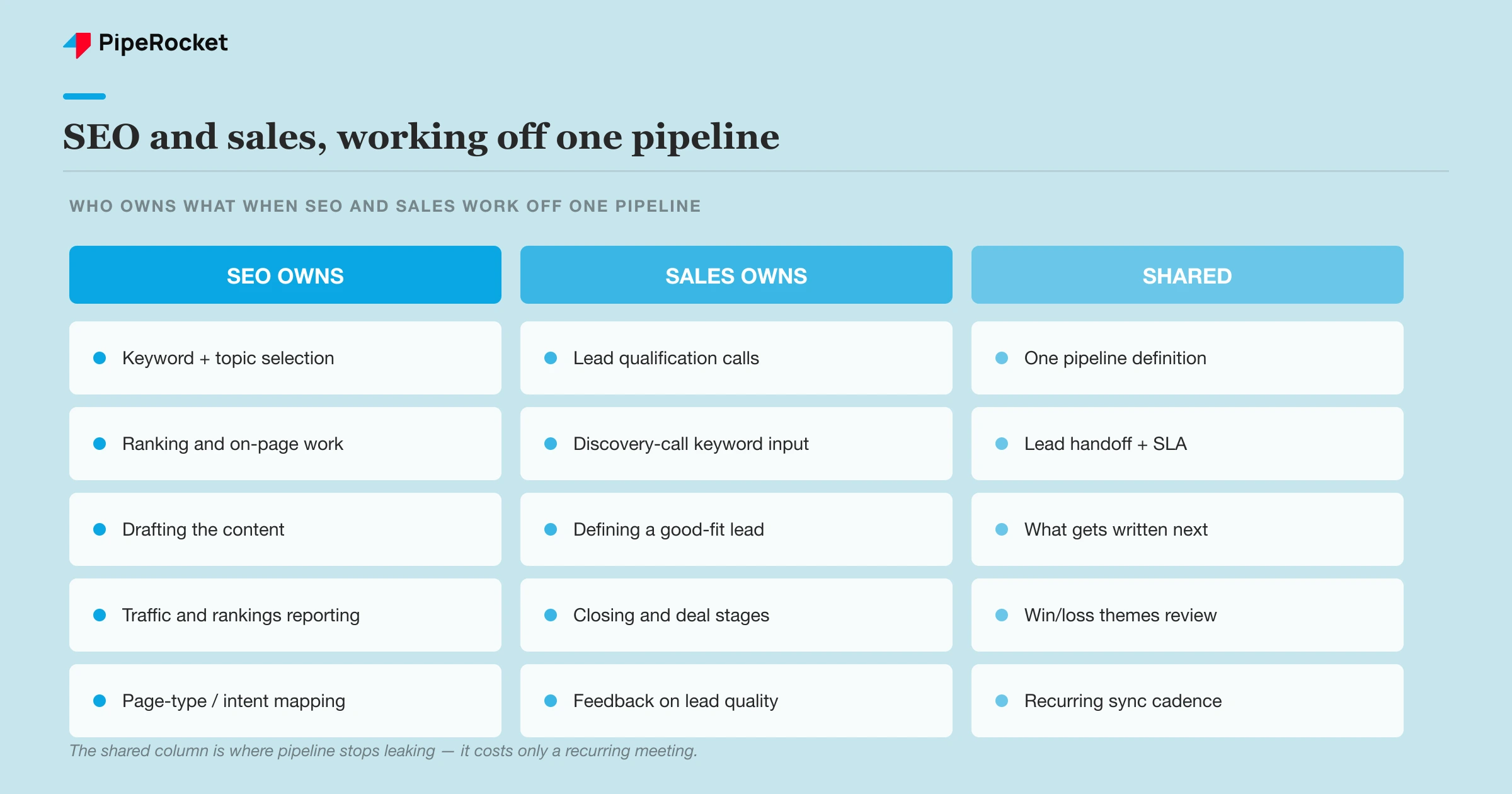
The speed half is a basic SLA, and it cuts both ways. Here’s a clean split of who owns what:
| Stage | SEO owns | Sales owns | Shared |
|---|---|---|---|
| Before the click | Targeting the right intent, page quality | ICP definition input | The agreed ICP and disqualifiers |
| The handoff | Passing page + intent context | Follow-up within the SLA window | The lead-quality definition |
| After the call | Adjusting content to call feedback | Logging why a lead was good or bad | The feedback loop cadence |
The SLA works less like bureaucracy and more like a forcing function. We once told a client not to scale spend at all, even though the ads were converting, because their sales team couldn’t follow up fast enough to work the leads they already had. Pouring more leads into a handoff that’s already dropping them just turns a marketing problem into a more expensive marketing problem.
The trade-off here is real. A heavy, formal SLA on a five-person team is overkill and will get ignored. A two-line agreement, follow up within a day and log why each lead was good or bad, is light enough that people actually keep it.
Let Sales Feedback Decide What You Write Next
The objections your reps answer every day are a finished content roadmap, and most SEO teams never ask for it. Sales spends all day learning exactly where deals stall, what competitors prospects are weighing, and what fear has to be answered before someone signs. That’s the brief for your next ten pages.
Set up a standing loop, monthly is plenty, where sales brings three things to SEO:
- The objections that keep coming up and killing or slowing deals.
- The competitors prospects mention by name, and why they’re tempted.
- The questions reps get asked so often they have a canned answer ready.
Each of those maps to a content type:
- A recurring objection becomes a page that handles it before the call.
- A competitor that keeps coming up justifies a comparison or alternative page.
- A repeated question becomes an article that answers it head-on.
The borrowed power here is that you’re taking the persuasive arguments sales already wins with and putting them where buyers search, so the page does some of the convincing before a human ever picks up the phone.
The feedback also runs the other way, and this is the part that builds trust. SEO should ask sales a single recurring question: what are you actually hearing from leads right now? When reps start saying “this one came in already knowing our product” or “they mentioned the comparison page on the call,” that’s your real signal that the alignment is working, long before any dashboard confirms it.
This is the difference between SEO that chases traffic and SEO that chases signals. The work is to answer the questions that move a deal rather than to maximize sessions, and sales is the only team in the building that hears those questions all day. Tie the content calendar to that, and you stop guessing.
One caution. Don’t let sales feedback become the only input either, because reps are biased toward the deals in front of them right now and can starve the top-of-funnel content that feeds next year’s pipeline. Weigh their input heavily for decision-stage pages, lightly for awareness ones.
How PipeRocket Aligns SEO With Sales
We build SaaS SEO around the conversations sales is actually having, not the keywords a tool happens to surface. That means sitting in on discovery calls to pull the real buyer language, agreeing on the ICP and the lead-quality bar with the sales team up front, and turning recurring objections into the pages that warm deals before a rep gets on the line.
If your organic traffic is climbing but sales still calls the leads junk, talk to our team or see how we run SaaS SEO . We work to one standard: own the outcome, not the output.
Frequently Asked Questions
Why don’t SEO and sales teams work together in most B2B SaaS companies?
They’re measured on different outcomes and rarely share data. SEO is judged on rankings and traffic while sales is judged on closed revenue, and no one’s goals depend on the handoff between them. So SEO optimizes for keywords that look good in a report and sales works leads in a CRM, and the two teams only meet when something breaks. Closing the gap takes a shared lead definition and a standing meeting, not new software.
What sales data should inform an SEO strategy?
The most useful inputs are the ones tools can’t give you: the exact language buyers use on discovery calls, the objections that stall deals, and the competitors prospects mention by name. CRM and funnel data matter too, because they show which leads actually qualified and closed, not just which pages got traffic. Pull the recurring questions reps answer all day and you have a content roadmap aimed straight at people who are ready to buy.
How do you keep SEO from generating leads sales won’t use?
Define the ICP and the disqualifiers with sales before you target anything, then run every keyword and page through that filter. A keyword that ranks but pulls the wrong company size or job title isn’t a win, even though the traffic chart says it is.
Pair that with a lightweight handoff agreement, where the page and intent context travel with each lead and sales commits to a follow-up window, so the leads SEO does generate actually get worked instead of sitting in a queue.