
A finance team doesn’t distrust SEO because SEO is failing. They distrust it because the KPIs on the slide measure how hard the channel is working, not what it returned. Rankings, sessions, a domain rating. Effort metrics, all of them.
So before you can win a budget conversation, you have to change the scorecard. Here’s the short list of SEO KPIs a CFO will actually back, how to define each one so it holds up under questioning, and which metrics to stop reporting on purpose.
TL;DR
- Wrong KPIs, not weak SEO, lose the budget room: Finance distrusts a scorecard built on effort metrics, so the fix is which KPIs you commit to, not how hard you spin the traffic chart.
- Commit to four CFO-grade KPIs: Organic-sourced pipeline, organic CAC, organic’s pipeline share, and influenced pipeline flagged as directional. That’s the whole set.
- A KPI a CFO trusts has a hard definition: Each metric needs one fixed formula, one source of truth, and the same rules every quarter, or finance treats the number as a moving target.
- Set targets off a baseline and a payback window, not a wish: Pull last year’s organic-sourced pipeline, account for the lag, and commit to a range you can defend.
- Drop the vanity metrics on purpose: Keyword count, domain rating, and raw sessions stay in your working dashboard and off the finance scorecard.
Why Your SEO KPIs Lose the Finance Room
Most SEO scorecards fail finance for one reason: they answer “did we do a lot of SEO?” when the CFO asked “what did the SEO return?” Those are different questions, and only the second one gets funded.
Our team sees this pattern constantly when interviewing SEO managers. A candidate shows real wins. Rankings up, traffic climbing, content shipping on cadence. Then the question lands: what business impact did that create? And the room goes quiet. The execution was strong. The translation into a number finance cares about never happened.
That gap is exactly what shows up on a budget slide. You’re proud of the work, the traffic chart looks great, and the CFO still files SEO under “cost we don’t fully understand.” A scorecard full of effort metrics confirms the suspicion instead of fixing it.
Note: Chase signals, not sessions. Rankings and sessions are the early signal that the work is happening, not the result, and a finance team can tell the difference in about four seconds.
So the move is a smaller, sharper set of KPIs rather than a better-looking dashboard, each one tied to money or to a decision finance can actually make. The rest of this is which KPIs make that cut and how to define them.
The CFO-Grade SEO KPI Set (and the Vanity Metrics They Replace)
Commit to four KPIs, not fourteen. A finance team trusts a short scorecard where every line maps to revenue far more than a long one where most lines map to activity. Here’s the set, what each one measures, why a CFO trusts it, and the vanity metric it retires.
| KPI | What it measures | Why a CFO trusts it | Vanity metric it replaces |
|---|---|---|---|
| Organic-sourced pipeline | Qualified pipeline value where organic was the sourcing channel | It’s denominated in currency, against plan, in finance’s own vocabulary | Total organic sessions |
| Organic CAC | Fully-loaded SEO cost divided by customers organic sourced | It’s a cost-efficiency number finance already uses for every channel | Cost per click / “cheap traffic” |
| Organic’s pipeline share | Organic-sourced pipeline as a percent of total new-business pipeline | It sizes the channel against the whole funnel, not in isolation | Keyword count / “ranking for 4,000 terms” |
| Influenced pipeline (flagged) | Branded and direct lift that tracks with content investment | Honest about what’s believed vs proven, which finance rewards | Domain rating / domain authority |
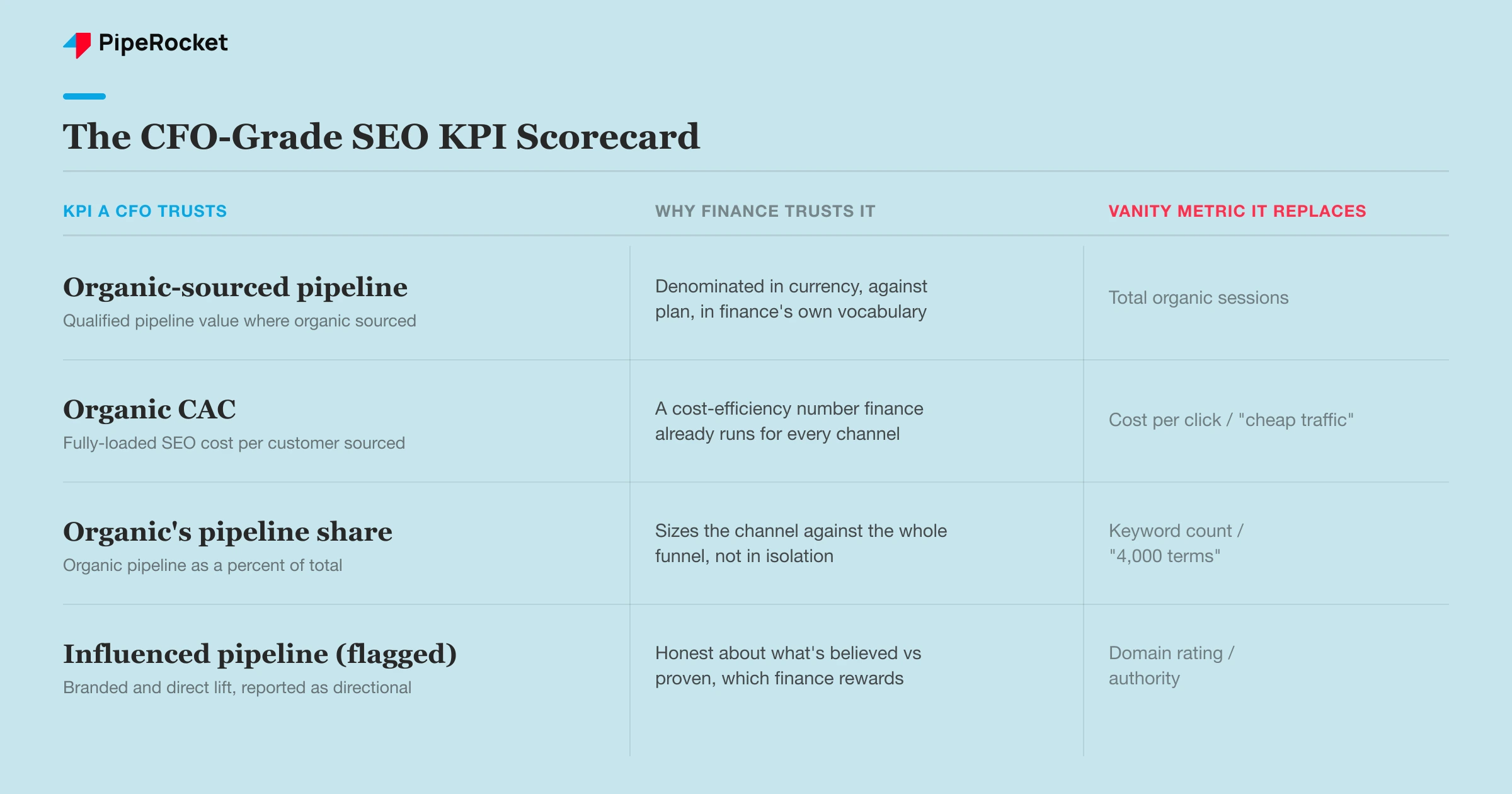
Read that table before you build a single slide. The left side is a revenue conversation. The right side is an SEO conversation, and finance didn’t come for an SEO conversation.
A few notes on why these four and not others. Organic-sourced pipeline is the headline because it’s the one number that answers “did it pay?” Organic CAC is the efficiency check finance reaches for next, because they run it on paid already and want the comparison.
Pipeline share keeps SEO honest about its real weight in the funnel. And influenced pipeline exists because some of organic’s impact never shows up as organic, so you report it as directional rather than pretend it isn’t there.
The catch with that fourth KPI is discipline. Influenced pipeline is real, but the moment you fold it into your headline number, one sharp question unravels the whole scorecard. Keep it labelled, keep it separate, and finance will trust the proven number more for it.
How to Define Each KPI So Finance Actually Trusts It
A KPI a CFO trusts comes down to a hard definition: one fixed formula, one source of truth, and the same rules every reporting period. The metric itself matters less than whether finance believes you’ll count it the same way next quarter.
This is the part SEO teams skip. They pick “pipeline” as the KPI, then define it loosely, and the number drifts every quarter because the definition was never locked. Finance notices, and a drifting number reads as a number you can move at will.
Lock these four things for every KPI before you report it once:
- The formula: the exact calculation, written down, that produces the number.
- The source of truth: the one system the number comes from, usually the CRM, not a blend of three tools.
- The qualifier: what counts as “qualified,” agreed with sales and finance, not defined by marketing alone.
- The window: the time period, fixed, because SEO lags and a shifting window hides the trend.
Define “Qualified” With Sales, Not Just Marketing
The single fastest way to lose finance is to define “qualified pipeline” yourself and have sales quietly disagree. When marketing counts an MQL and sales counts a real opportunity, your KPI and the revenue team’s KPI describe different things, and finance sides with revenue every time.
So agree the qualifier upfront. A lead that organic sourced only counts toward your KPI if it clears the same bar sales uses for any other channel. That usually means a sales-accepted lead or a created opportunity, not a form fill.
It makes your number smaller. It also makes it real, and a smaller real number beats a bigger one nobody downstream believes.
Pick One Source of Truth and Never Blend
Every KPI should come from one system, and for pipeline that system is the CRM. The temptation is to pull pipeline from analytics, CAC from a spreadsheet, and share from a third tool, then reconcile them on the slide. Finance spots the seams immediately.
When a number comes from one place, it survives the “where did this come from?” question with a one-word answer. When it’s stitched from three, every question forks into three more, and you spend the meeting defending plumbing instead of results.
If your stack can’t tie an organic-sourced deal back to the CRM cleanly today, that’s the real project, because a KPI you can’t trace isn’t a KPI a CFO will trust.
How to Set Targets Without Overpromising
Set every KPI target off a real baseline and a payback window, not off a number that sounds good in a planning meeting. The fastest way to lose finance’s trust isn’t a target you miss by a little. It’s a target you invented, then missed by a lot.
-
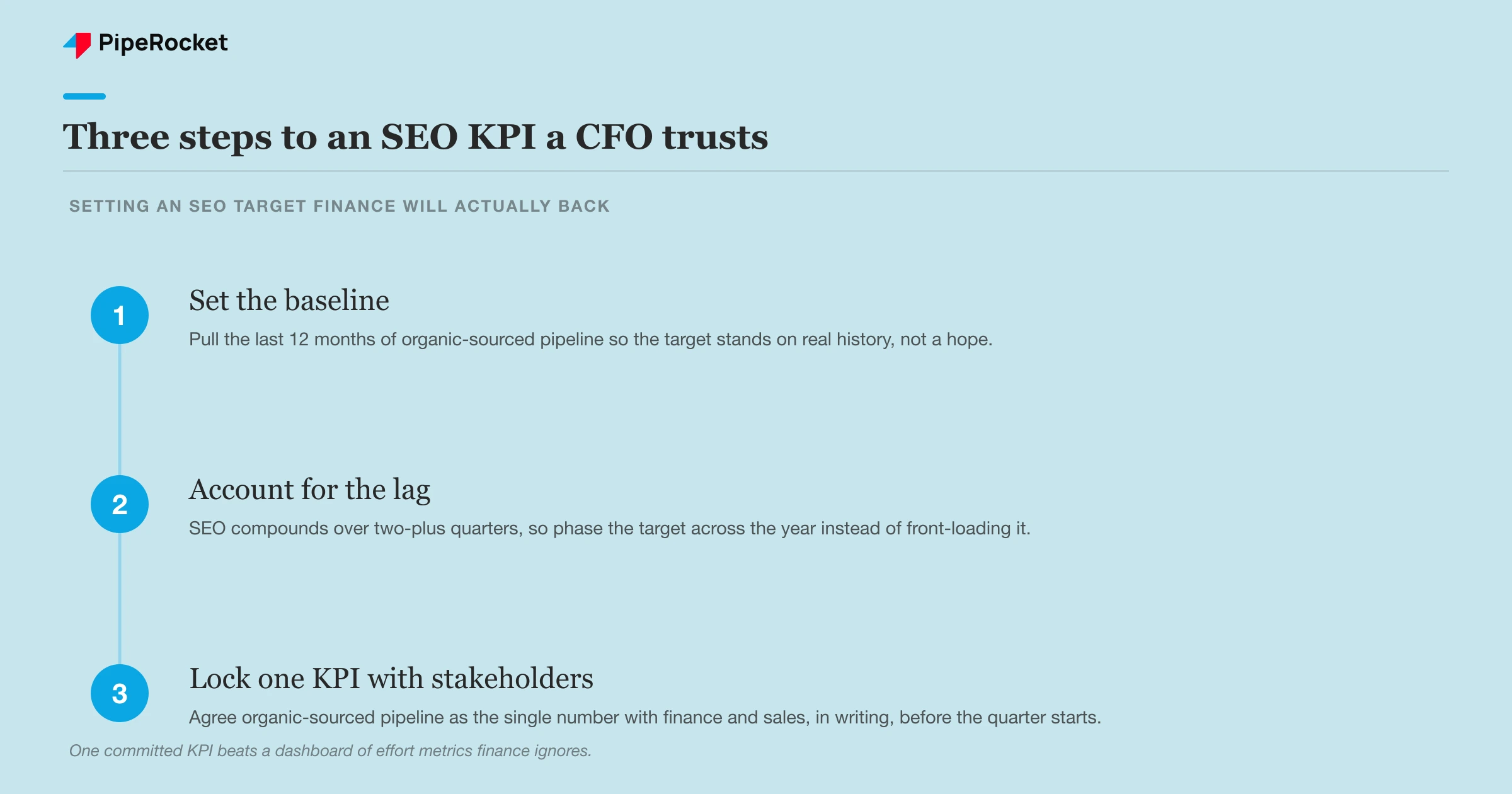
Start with the baseline. Pull last year’s organic-sourced pipeline using the definition you just locked, broken down by quarter. That history is the floor you build the target on. We’ve learned the hard way on the paid side that past data is the cheat code here.
Year-over-year and quarter-over-quarter movement across the full path, from click to demo to pipeline, tells you what’s realistic far better than instinct does.
-
Then account for the lag. SEO compounds and arrives late, so a target that assumes linear month-one growth is a target you’ll miss. Set the KPI against a trailing window, usually six to twelve months, so the lag and the compounding both show up honestly instead of making an early quarter look like a failure.
-
Align the stakeholders. There’s one more move that saves a lot of grief, and it has nothing to do with the math. Lock the headline KPI with every stakeholder before the quarter starts. When one exec tracks pipeline and another fixates on CAC, you spend every review defending which number matters instead of the number itself.
Our team learned this managing large paid budgets: align everyone on one main KPI early, ideally organic-sourced pipeline, and report the rest as support.
Note: Doubling the SEO investment won’t double the pipeline target, and finance will respect you for saying so. A channel has a realistic ceiling at a given level of authority and content velocity. Promise linear returns on a non-linear channel and you’ll set a target that breaks the trust you were trying to build.
The Vanity KPIs to Drop on Purpose
Some metrics aren’t just unhelpful in a finance conversation. They actively make SEO look junior, so cut them from the scorecard deliberately. The point isn’t that they’re useless. It’s that they answer questions finance never asked.
Here’s the honest split. The right column belongs in your working dashboard, where you and your team steer the work week to week. It just never makes the finance scorecard.
| Keep it on the finance scorecard | Drop it (keep in your working dashboard) |
|---|---|
| Organic-sourced pipeline | Total organic sessions |
| Organic CAC | Keyword count / “ranking for X terms” |
| Organic’s pipeline share | Domain rating / domain authority |
| Influenced pipeline (flagged directional) | Average position across all keywords |
| Backlink count, time on page, bounce rate |
The one that fools the most teams is raw sessions. A traffic spike from low-intent top-of-funnel terms makes a program look healthy while it’s quietly starving the pipeline, and reporting that spike as a KPI trains finance to watch the wrong line. More traffic can hide a failing program, which is exactly why it can’t be the metric finance grades you on.
AI visibility is the new entry on this list, and it’s worth a specific warning. Showing up in an AI answer is real and worth pursuing, but “AI sessions up 400%” is a vanity KPI in disguise. We’ve watched those numbers spike across twenty-plus pages overnight and vanish just as fast, which is not how real demand behaves.
If you want a finance-safe read on AI’s impact, watch whether bottom-funnel pages, branded search, and inbound quality move, not a session count from a tool.
How PipeRocket Sets SEO KPIs Finance Trusts
We don’t hand a client a rankings dashboard and call it a scorecard. As a SaaS SEO agency , we set the KPI set finance actually backs: organic-sourced pipeline, organic CAC, pipeline share, and influenced pipeline flagged as directional, each with a locked definition and a target built off a real baseline.
Most agencies report tasks completed. We own outcomes, so the KPIs we commit to are the ones a CFO can take into a budget review without flinching. If you want SEO measured as a revenue channel from the first quarter, reach out to us and we’ll build the scorecard with you.
Frequently Asked Questions
What SEO KPIs does a CFO actually care about?
A CFO cares about KPIs denominated in money or efficiency, not activity. The four that hold up are organic-sourced pipeline, organic CAC, organic’s share of new-business pipeline, and influenced pipeline reported as directional. Each one either maps to revenue or to a cost decision finance already makes for other channels. Rankings, sessions, and domain rating don’t make the list, because none of them answer whether the channel paid for itself.
How do you set realistic SEO KPI targets?
Start from a baseline, not a guess. Pull last year’s organic-sourced pipeline by quarter using a locked definition, then set the target against that history. Account for the lag by measuring on a trailing six-to-twelve-month window, because SEO compounds and a single early month understates it. Avoid promising linear growth, since a channel has a realistic ceiling at a given level of authority, and a target that assumes doubling spend doubles pipeline is one you’ll miss.
Why don’t finance teams trust traffic and rankings as KPIs?
Because traffic and rankings measure effort, not return, and they can rise while pipeline stays flat. A finance team has seen “traffic is up” presented as success before, then watched it fail to show up in revenue, so they’ve learned to discount it. The deeper problem is that a traffic spike from low-intent terms can hide a program that isn’t sourcing pipeline. Finance trusts a number tied to a closed deal, and traffic isn’t that number.